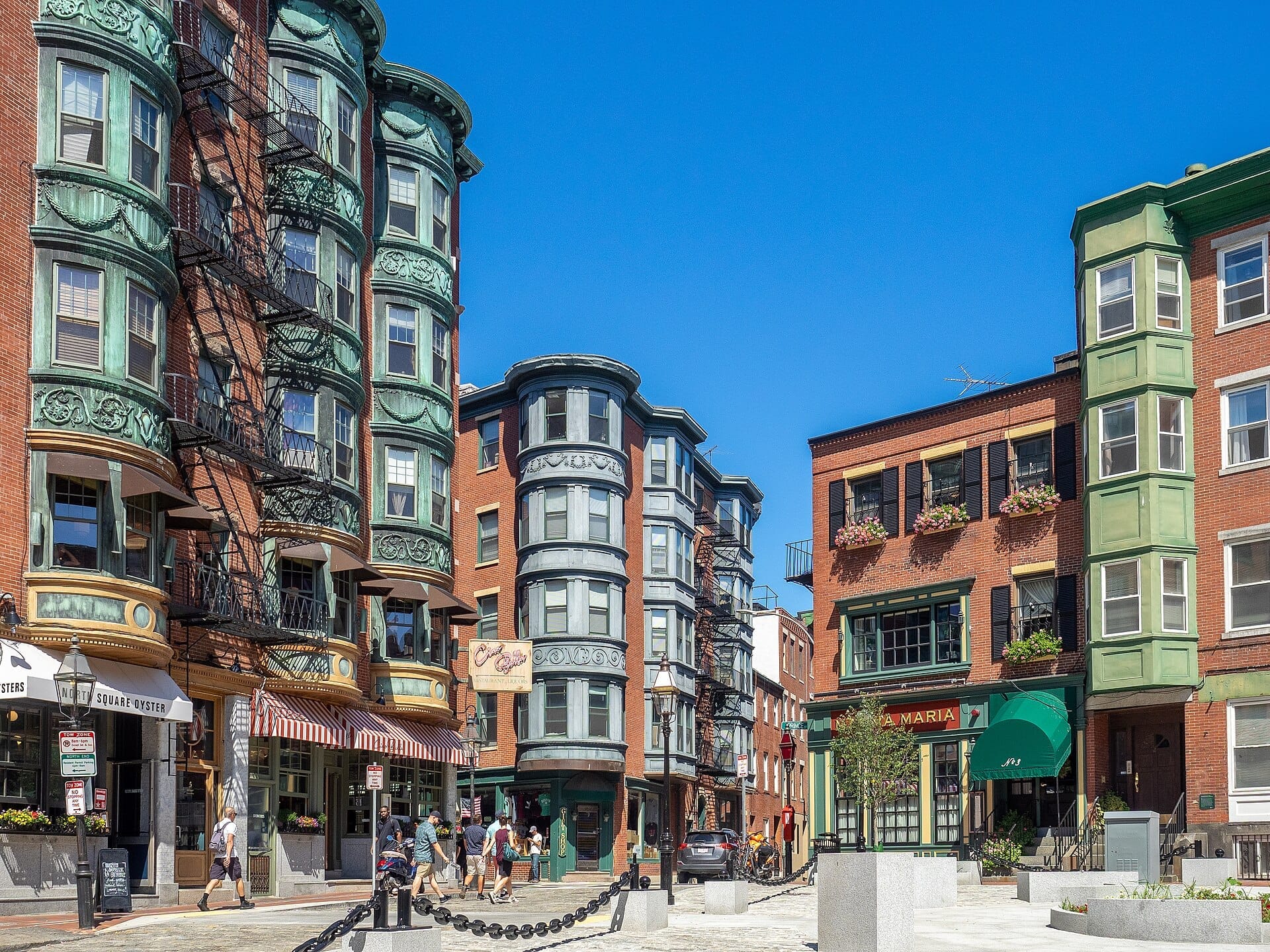
The North End is Boston's oldest residential neighborhood, a compact waterfront district where colonial history and Italian-American culture share the same narrow streets. From the Paul Revere House to the cannoli shops of Hanover Street, it rewards slow exploration on foot.
Boston's North End is the city's oldest residential neighborhood and its most densely layered: a place where 17th-century history, Italian-American tradition, and serious tourist traffic all compete for space on streets barely wide enough for two cars to pass. It is small, walkable, and unmistakable in character.
Orientation
The North End occupies the northeastern tip of the Shawmut Peninsula, covering roughly 0.36 square miles. Its boundaries are tight and logical: Commercial Street and Atlantic Avenue run along the eastern and southern edges facing Boston Harbor, North Washington Street forms the western boundary, and the elevated land near Copp's Hill marks the northern limit. To the south, the Rose Kennedy Greenway acts as a clear dividing line between the North End and the Financial District beyond it.
Understanding how the North End connects to surrounding areas helps with navigation. Cross the Greenway heading south and you're in the Financial DistrictDowntown Boston within five minutes on foot. Walk west along the waterfront and you'll reach the ferry terminals and HaymarketFaneuil Hall Marketplace in under ten minutes. Head north across North Washington Street and you're entering Charlestown, with the Bunker Hill Monument visible on the ridge above.
The internal street grid of the North End bears no resemblance to the orderly blocks of Back Bay or the South End. Streets here predate urban planning: Salem Street, Hanover Street, and Hull Street wind and bend in ways that can disorient first-time visitors within minutes. Salem and Hanover are the two main commercial arteries running roughly north-south through the neighborhood, and orienting yourself to one of those two streets will solve most navigation problems.
Character & Atmosphere
The North End operates on a rhythm that shifts noticeably across the day. On a weekday morning, the neighborhood belongs to residents: retirees collecting newspapers outside the bakeries on Hanover Street, delivery trucks inching down Salem Street with hazard lights blinking, the smell of fresh bread and espresso drifting from the cafes before the tourist crowds arrive. The streets are quiet enough that you can hear your own footsteps on the old brick sidewalks.
By midday, the calculus changes. Tour groups following the red-painted Freedom Trail line appear on Salem Street, pedestrian traffic thickens along Hanover, and the restaurant menus boards come out onto the sidewalks. This is when the neighborhood most clearly presents its dual identity: a living community with longtime residents and a major tourist destination that attracts millions of visitors annually. The two coexist without much friction, but the tourist layer is undeniably present from late morning through early evening, especially on weekends from spring through fall.
After dark, the North End shifts again. The tour groups thin out, the restaurants fill with dinner crowds, and the narrow streets feel more local. Tables outside the trattorias on Hanover Street fill up, wine glasses catch the light from window candles, and the whole neighborhood takes on a slightly warmer, slower quality. It is worth visiting both in the morning quiet and in the evening to understand what the place actually is beneath its tourist surface.
ℹ️ Good to know
Summer weekends in the North End are the busiest period of the year. The neighborhood's narrow streets and small footprint mean that peak hours between noon and 8 PM can feel quite crowded. Visiting on a weekday morning or in the shoulder seasons of spring and fall gives you a much clearer sense of the neighborhood's character.
What to See & Do
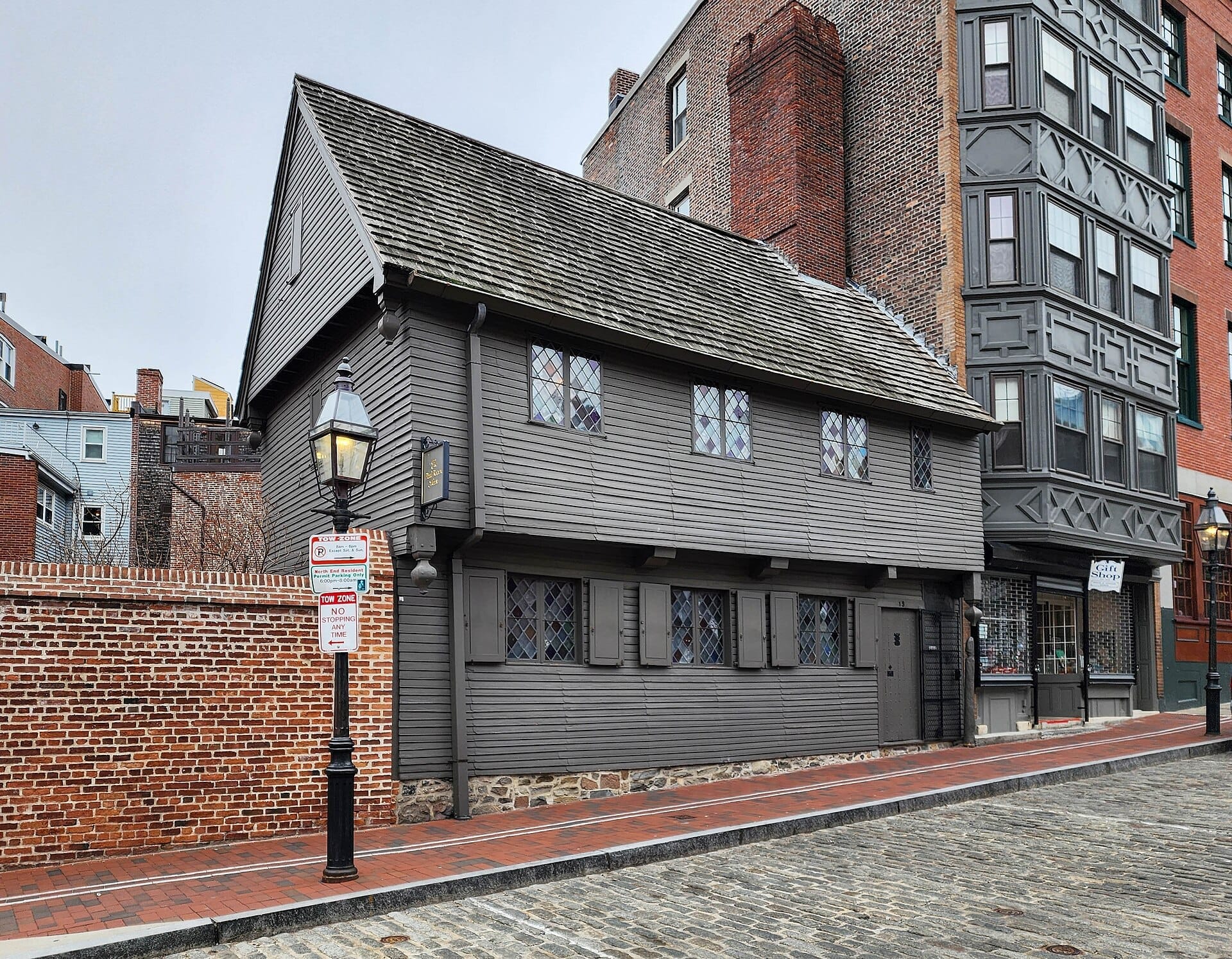
The North End holds more significant historic sites per square block than almost any neighborhood in America. The Paul Revere House at 19 North Square is the oldest remaining structure in downtown Boston, dating to around 1680. Revere lived here from 1770 to 1800, and the house is now a museum where you can walk through rooms furnished to approximate their 18th-century appearance. It is modest in size but evocative of colonial domestic life, and it anchors the North End's place on the Freedom Trail.
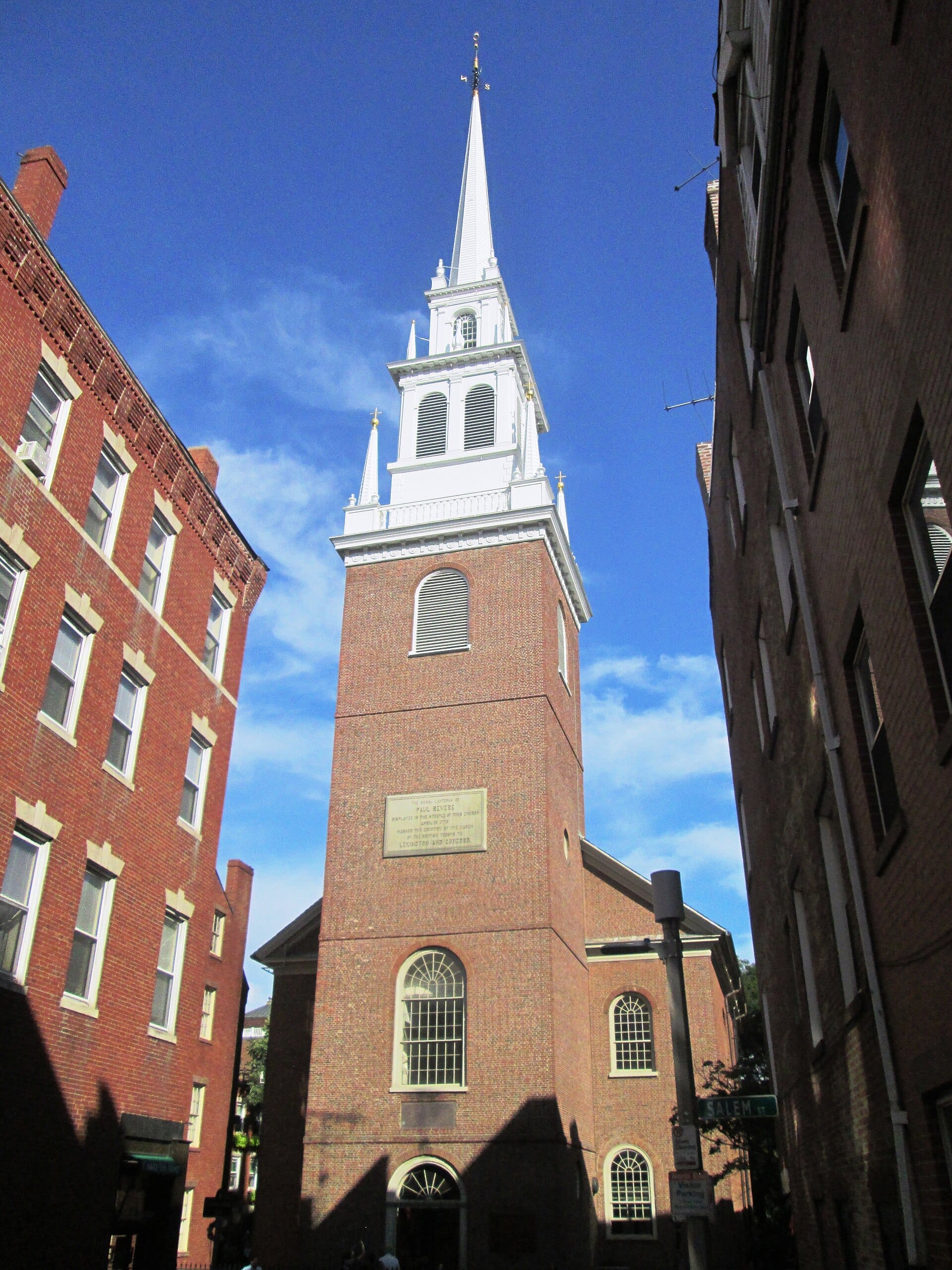
The Old North Church on Salem Street is the oldest surviving church building in Boston, constructed in 1723. This is the church where sexton Robert Newman hung two lanterns in the steeple on the night of April 18, 1775, signaling that British troops were moving by sea toward Lexington and Concord. The interior is spare and beautiful in the Georgian style, with box pews still intact. The church remains an active Episcopal parish, so hours for tourists can vary depending on services.
Copp's Hill Burying Ground on Hull Street sits at one of the highest points in the neighborhood and offers views across the harbor toward Charlestown. Established in 1659, it is the second oldest cemetery in Boston and contains the graves of many North End residents, including the Mather family of Puritan ministers. The slate headstones, many carved with winged death's-head motifs, are remarkable examples of colonial funerary art. The cemetery is free to enter and often far less crowded than the sites further down the Freedom Trail.
The waterfront edge of the North End offers a different kind of experience. Christopher Columbus Waterfront Park sits at the intersection of Commercial Street and Atlantic Avenue, a pleasant open space with a large trellis arbor looking out toward the harbor. It connects naturally to the Rose Kennedy Greenway, the linear park built over the Big Dig highway tunnel that now separates the North End from the Financial District. The Greenway hosts a seasonal outdoor market, food trucks, and occasional public art installations along its length.
Paul Revere House, 19 North Square: oldest remaining downtown Boston building, Freedom Trail anchor
Old North Church, 193 Salem Street: 1723 Georgian church, lantern signal site from April 1775
Copp's Hill Burying Ground, Hull Street: colonial cemetery with harbor views, established 1659
Christopher Columbus Waterfront Park: open waterfront space connecting to the Greenway
Langone Park: recreational park at the waterfront edge of the neighborhood near the bocce courts
Eating & Drinking
Food is the North End's dominant daily activity, and Hanover Street is the main stage. The street runs north from Cross Street up through the core of the neighborhood, lined on both sides with Italian restaurants, bakeries, and cafes for most of its length. The density of options is striking: within a few blocks you can count more than a dozen restaurants, several bakeries, and multiple espresso bars.
The bakeries are the neighborhood's most iconic food institutions. Mike's Pastry on Hanover Street and Modern Pastry a few blocks away have been the subject of a low-grade rivalry among regulars for decades. Both sell cannoli, sfogliatelle, lobster tails, and other Italian-American pastries, and both draw lines on weekend afternoons. The cannoli shells are filled to order at Mike's, while Modern has a loyal following for its slightly less theatrical atmosphere. Going to both and forming your own opinion is a reasonable approach.
Beyond the bakeries, the restaurant scene ranges from old-school red-sauce trattorias with checkered tablecloths to more contemporary Italian dining that focuses on regional cuisine and imported ingredients. Prices across the board tend to be mid-range to upper-mid-range: you can get a pasta dinner for around $20-$30 per person without wine, but many restaurants push well beyond that for full meals. Reservations for dinner are strongly recommended on weekends, as the most popular spots fill weeks in advance.
The coffee culture is worth slowing down for. Caffe Vittoria on Hanover Street is the oldest Italian cafe in Boston, serving espresso drinks in a room lined with vintage coffee machines and Italian memorabilia since 1929. Caffe dello Sport nearby is a smaller, more no-frills option with good espresso and a view of the neighborhood's foot traffic. Both serve as gathering places for longtime residents in the morning hours before the tourist crowd arrives.
💡 Local tip
If you want a cannoli without waiting in line, visit either Mike's Pastry or Modern Pastry on a weekday morning rather than a weekend afternoon. The quality is identical and the experience is considerably more pleasant.
Getting There & Around
The North End has no MBTA subway station within its boundaries, which surprises some visitors expecting a neighborhood this prominent to have direct T access. In practice, several stations are close enough that walking is straightforward. Haymarket station on the Green and Orange Lines puts you at the edge of the neighborhood in about a five-minute walk south along Hanover Street. Aquarium station on the Blue Line deposits you along the waterfront near the Christopher Columbus Park. North Station on the Green and Orange Lines is roughly a ten-minute walk, approaching the neighborhood from the northwest.
From Government Center, the walk down past Faneuil Hall and across the Greenway on Hanover Street takes about eight minutes. This is actually one of the best approaches, as it gives you a sense of how the North End sits in relation to the rest of the city. For a broader orientation to Boston's transit system, the getting around Boston guide covers MBTA options in detail.
Driving into the North End is inadvisable for visitors. The streets are narrow, parking is extremely limited and heavily resident-permitted, and the neighborhood's walkable scale makes a car more obstacle than convenience. Most visitors arrive on foot from adjacent neighborhoods or via the T. Several paid parking garages operate near Faneuil Hall and the Greenway, which function as reasonable drop-off points if you're coming by car.
Within the neighborhood, walking is the only practical option. The streets are too narrow and irregular for cycling to be comfortable, and the distances between points of interest are short enough that any other transportation is unnecessary. Plan for a lot of brick sidewalk, some uneven paving near the older sections of the neighborhood, and occasional narrow passages between buildings that barely qualify as streets.
⚠️ What to skip
The North End's brick sidewalks are charming but uneven in places, particularly near Copp's Hill and the older residential streets. Visitors with mobility challenges or those in heels should account for this when planning routes.
Where to Stay
The North End itself has relatively limited hotel options compared to neighborhoods like Back Bay or the Seaport District. This is primarily a residential and commercial neighborhood, not a hotel district, and most of the accommodation stock consists of vacation rentals and apartment-style stays rather than full-service hotels.
For travelers who want to be within easy walking distance of both the North End and the broader downtown area, the blocks just south of the Greenway near the Financial District and the Waterfront offer several hotel options. Staying here gives you the North End's restaurants and historic sites within a ten-minute walk while also keeping you close to South Station, the Seaport, and the Aquarium Blue Line stop.
The North End suits travelers who prioritize walkability, food culture, and historic atmosphere over large hotel amenities or nightlife proximity. It is an excellent base for first-time visitors to Boston who want to experience the Freedom Trail sites and Italian-American food scene in depth. For a broader look at accommodation across the city, the where to stay in Boston guide compares all major neighborhoods.
History & Context
The North End is Boston's oldest continuously occupied neighborhood, settled by English colonists in the 1630s. For roughly its first two centuries, it was home to some of the most prominent families in colonial and early American society: merchants, ministers, and patriots including Paul Revere. The neighborhood's proximity to the waterfront made it central to the maritime commerce that built early Boston.
The character of the neighborhood transformed dramatically in the 19th and early 20th centuries through successive waves of immigration. Irish families arrived in large numbers following the famine of the 1840s, followed by Jewish immigrants from Eastern Europe, and then by a major influx of Italian immigrants beginning in the 1880s. By the early 20th century, the North End had become one of the densest Italian-American communities in the United States. Many of the restaurants, bakeries, and social clubs that defined this era are still operating today, or have been replaced by similar establishments that maintain the neighborhood's culinary identity.
The neighborhood's physical isolation, created by the old elevated Central Artery highway that cut it off from the rest of downtown for decades, paradoxically helped preserve its character. When the Big Dig buried that highway underground and created the Rose Kennedy Greenway in its place, the North End was reconnected to downtown Boston while retaining the dense, human-scale street life that had developed in relative separation. The Freedom Trail, which passes through the neighborhood, further codified its role as Boston's most tangible link to colonial American history. For anyone interested in exploring that history more deeply, the Boston history guide provides essential context.
Practical Considerations
The North End is generally considered safe for visitors throughout the day and evening. As a heavily trafficked tourist and residential area, the streets near Hanover Street and the major historic sites maintain consistent foot traffic and activity. Standard urban precautions apply: be aware of your surroundings, keep valuables secured in crowded areas, and note that the narrow, winding streets can be disorienting after dark if you wander away from the main commercial strips.
Noise is worth factoring in if you're considering a vacation rental in the neighborhood. The streets nearest to Hanover Street and the restaurant corridor can be lively well into the evening on weekends, with dining crowds and the ambient noise of a dense urban neighborhood. Streets closer to Copp's Hill or the residential blocks near Hull Street tend to be quieter.
The neighborhood is compact enough that most people exhaust the major historic sites and a meal or two within a full day. For visitors building a broader Boston itinerary, the North End pairs naturally with a morning walk along the Freedom Trail, a stop at the Old North Church, and an afternoon in Charlestown to see the Bunker Hill Monument and the USS Constitution at the Charlestown Navy Yard. The two neighborhoods are connected by a waterfront walk along the Harborwalk that takes roughly 20 minutes.
TL;DR
Boston's oldest residential neighborhood, covering 0.36 square miles on the northeast tip of the Shawmut Peninsula, with no subway station of its own but easy walking access from Haymarket, Aquarium, and North Station stops.
Best for: history-focused travelers, food tourists interested in Italian-American cuisine, and anyone following the Freedom Trail who wants to spend time at the Paul Revere House and Old North Church.
The food scene is strong, with bakeries, trattorias, and espresso cafes concentrated along Hanover and Salem Streets. Cannoli lines at the famous bakeries are real on weekends; go on a weekday morning to avoid them.
Expect crowds from late spring through early fall, particularly on weekends between noon and 8 PM. The neighborhood's narrow streets amplify tourist density during peak hours.
Not ideal for travelers who want quiet evenings, easy car access, or a wide range of hotel options. Those priorities are better served by Back Bay or the Seaport District, both within 15-20 minutes on foot or transit.
Three days is enough time to cover Boston's historic core, world-class museums, and distinct neighborhoods without feeling rushed. This itinerary groups sights by geography, saves you backtracking, and flags what to skip based on the season.
Boston is one of the great museum cities in America, with world-class collections spread across every neighborhood. Whether you have one afternoon or a full week, this guide covers the best museums in Boston — from encyclopedic art institutions to immersive history experiences — with practical tips on saving money along the way.
Boston rewards visitors year-round, but the timing of your trip shapes everything from hotel rates to what you can actually do outside. This guide breaks down each season honestly, flags the crowd spikes most travelers miss, and helps you match your travel style to the right window.
Boston Logan International Airport is one of the most conveniently located major airports in the United States, sitting just 3 miles from downtown. This guide covers every terminal, every transport option, seasonal travel patterns, and the practical details that make the difference between a smooth arrival and a stressful one.
Boston sits on Massachusetts Bay, and the beaches that surround it range from easy MBTA rides to rewarding day trips up the North Shore. This guide covers every option worth knowing, from historic Revere Beach to the pristine dunes at Crane Beach.
Harvard and MIT sit just across the Charles River from Boston, connected by the MBTA Red Line and packed with free things to see. This guide covers how to get there, what to book in advance, the best spots on each campus, and what most visitors get wrong.
Boston throws one of the most celebrated Fourth of July events in the United States, anchored by the free Boston Pops Fireworks Spectacular on the Charles River Esplanade. This guide covers the fireworks schedule, best viewing spots, Harborfest events, weather expectations, and practical logistics to help you plan every detail.
Boston rewards those who look beyond the Freedom Trail. This guide uncovers the city's overlooked museums, quiet green spaces, architectural surprises, and neighborhood experiences that locals return to again and again.
Boston is where the American Revolution was born. This guide covers every major colonial and Revolutionary War site in the city, from the Freedom Trail's 16 landmarks to day trips to Lexington and Concord, with practical advice on pricing, crowds, and what's actually worth your time.
Fall is widely considered the best season to visit Boston. Temperatures drop to comfortable levels, the city's parks and tree-lined streets turn brilliant shades of red and gold, and a packed events calendar keeps things interesting well into November. This guide covers when to go, where to see color, what to do, and how to plan it all without overpaying.
Summer transforms Boston into one of the most active cities on the East Coast, with outdoor concerts, harbor cruises, Red Sox baseball, and a packed events calendar. This guide covers the best things to do in June, July, and August, plus practical advice on heat, crowds, and booking ahead.
Boston in winter is colder and snowier than most visitors expect, but that's exactly what makes it compelling. Shorter queues, lower hotel rates, festive neighborhoods, and some of the city's best indoor experiences await those willing to bundle up. This guide covers everything you need to know before you go.
Boston's luxury scene is more layered than most visitors expect. From the only Forbes Five-Star waterfront hotel in New England to Michelin-caliber dining in Back Bay, this guide covers where to stay, what to eat, and how to spend your time at the upper end of the city's offerings.
Boston's after-dark scene is denser and more diverse than its early-closing reputation suggests. This guide breaks down the best bars, live music venues, and clubs by neighborhood, with practical advice on cover charges, crowd patterns, and where to go based on what you actually want to do.
Boston has a reputation for being expensive, but the reality is more nuanced. The city's most iconic experiences, from the Freedom Trail to the Public Garden, cost nothing. This guide breaks down exactly where to spend, where to save, and how to see the best of Boston without the financial hangover.
Boston packs nearly 300 parks, 7 miles of linked greenway, a harbor with 34 islands, and a paddleable river into a city of under 50 square miles. This guide covers the best outdoor activities in Boston across every season, from free trail walks to whale-watching excursions and Harbor Islands camping.
Boston's shopping scene is more diverse and spread out than most visitors expect. This guide breaks down every major retail district, indoor mall, and open-air market, with straightforward notes on what's worth your time and money across every budget level.
Boston is one of the most solo-friendly cities in the United States: compact, walkable, transit-connected, and loaded with free and low-cost experiences. This guide covers everything from neighborhood safety and budget planning to the best solo activities and seasonal timing.
On the night of December 16, 1773, a group of colonists boarded three ships in Boston Harbor and dumped 342 chests of British tea into the water. It was one of the most consequential acts of political protest in American history. This guide covers what actually happened, what gets the story wrong, and the best ways to experience it when you visit Boston.
Two days in Boston is enough to walk the Freedom Trail, eat your way through the North End, stand in the shadow of Fenway Park, and still catch a harbor sunset. This guide breaks down exactly how to spend your time, what it will cost, and what the tourist traps are worth skipping.
Boston is one of the most rewarding cities in the U.S. for families. Compact enough to walk, rich in hands-on science and history, and generous with free outdoor spaces, it rewards kids of nearly every age. This guide cuts through the hype with real prices, seasonal advice, and straightforward notes on what's worth your time.
Boston sits at the center of one of New England's richest regions for day tripping. Within two hours, you can walk Revolutionary War battlefields, swim on pristine barrier beaches, explore world-class museums, or wander a storybook fishing village. This guide covers the best day trips from Boston, with practical advice on how to get there.
Boston rewards budget travelers more than almost any other major American city. From the 2.5-mile Freedom Trail to free museum days, public parks, and historic naval vessels, here are free experiences that capture the best of Boston.
Boston is compact enough to walk between many of its most famous neighborhoods, but knowing how to use the MBTA subway, buses, ferries, and ride-hailing services will save you time and money. This guide covers every way to move around the city, from Logan Airport transfers to day-to-day transit passes.
Boston rewards couples with a surprisingly diverse mix of romantic experiences: peaceful garden strolls, candlelit Italian dinners in the North End, sunset cruises on the harbor, and world-class art museums. This guide covers the best options by season, with real prices and practical advice to help you plan a memorable trip.
Salem is one of the most rewarding day trips from Boston, but it rewards those who go in prepared. This guide covers exactly how to get there, what to see beyond the witch trial sites, and how to avoid the October chaos that catches most visitors off guard.
Boston packs Revolutionary history, world-class museums, a legendary baseball stadium, and a working waterfront into one of America's most walkable cities. This guide covers the best things to do in Boston across every neighborhood, season, and budget — with practical details on pricing, timing, and how to get around.
Boston is one of America's great walking cities, compact enough to cover on foot yet dense with 400 years of history around every corner. This guide covers the best self-guided routes, iconic landmarks, and neighborhood walks across the city.
Boston's food identity runs deep: centuries of seafood tradition, immigrant-shaped neighborhoods, and a handful of dishes that define New England eating. This guide covers what to order, where to find it, what it should cost, and what to skip.
Choosing where to stay in Boston shapes your entire trip. This guide breaks down every major neighborhood by location, transit access, price range, and who it suits best, so you can book with confidence instead of guessing.