The Freedom Trail: Boston's 2.5-Mile Walk Through American History
The Freedom Trail is a 2.5-mile red-brick route connecting 16 of Boston's most significant Revolutionary-era sites, from Boston Common to the Bunker Hill Monument in Charlestown. The trail is free to walk year-round, with guided tours available daily. It remains one of the most concentrated corridors of American colonial and revolutionary history anywhere in the country.
Quick Facts
- Location
- Boston Common Visitor Information Center, 139 Tremont St, Boston, MA 02108
- Getting There
- Park Street Station (Red/Green Lines) or Downtown Crossing (Red/Orange Lines)
- Time Needed
- 2–4 hours for the full trail; half-day if visiting multiple sites
- Cost
- Free to walk; guided tours approx. $14 adults / $12 students & seniors / $8 children (verify current rates)
- Best for
- History lovers, first-time visitors, families, and anyone wanting a structured introduction to Boston
- Official website
- www.thefreedomtrail.org
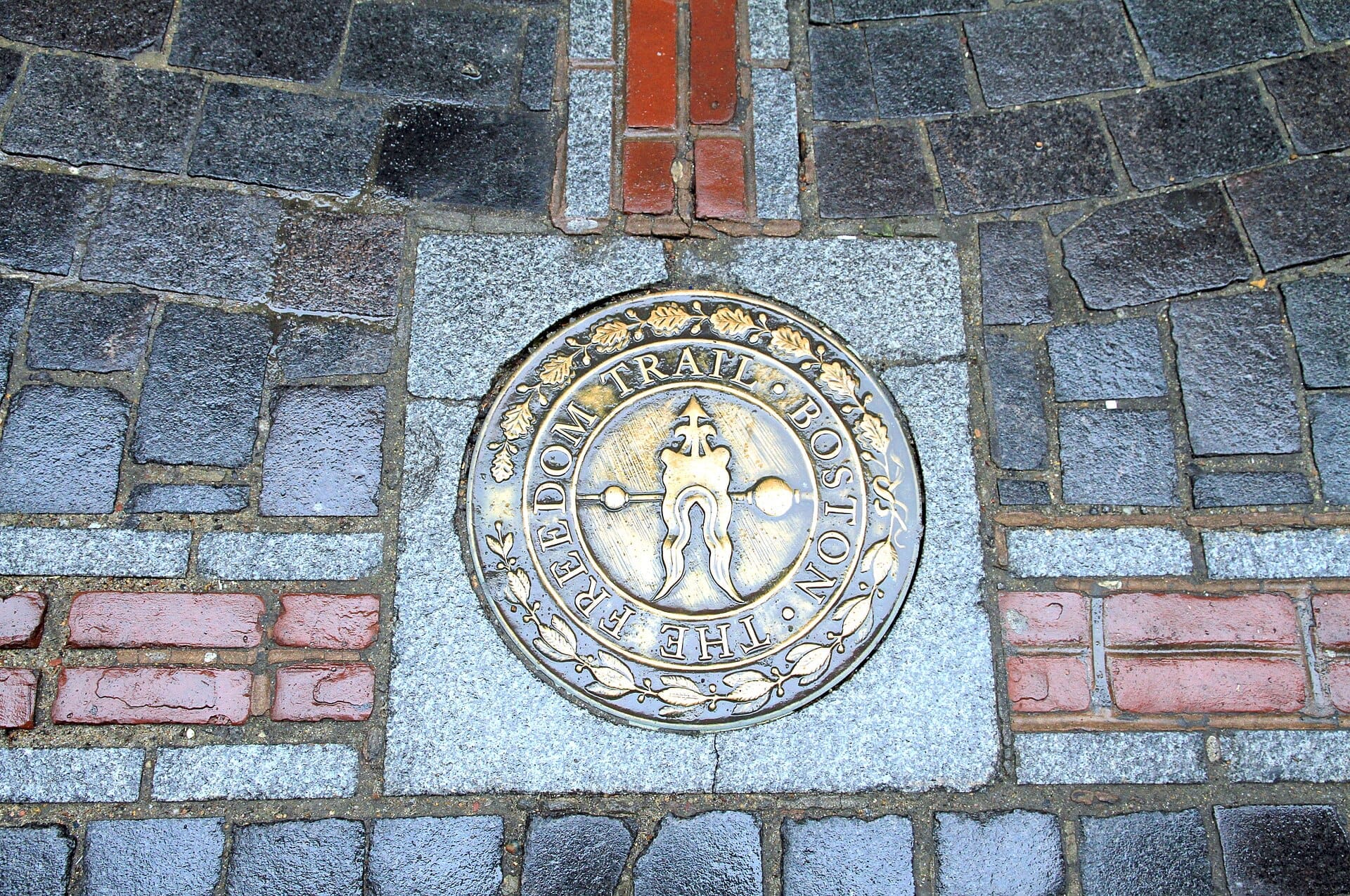
What the Freedom Trail Actually Is
The Freedom Trail is a 2.5-mile walking route marked by a continuous line of red brick (and in some sections, red paint) set into Boston's sidewalks. It connects 16 historic sites spanning the colonial, Revolutionary, and early Federal periods of American history. The route begins at Boston Common and ends at the Bunker Hill Monument in Charlestown, threading through some of the city's oldest and most architecturally distinct neighborhoods.
The trail was conceived in 1951 by journalist William Schofield and formally established shortly after, making it one of the earliest urban heritage trails in the United States. Today the Freedom Trail Foundation manages tours and promotion of the trail, while the National Park Service operates a visitor center at Faneuil Hall along the route. The red line on the pavement does the navigating for you: follow it and you will not get lost, even in the denser parts of downtown.
Importantly, the Freedom Trail is not a single attraction but a sequence of them. Some sites, like Boston Common and the Granary Burying Ground, are free and open year-round. Others, like the Old South Meeting House and the Paul Revere House, charge a small separate admission. Budget accordingly if you plan to go inside.
The 16 Sites: What You're Actually Walking To
The trail's 16 official sites are not evenly distributed in quality or interest. Some are entire museums with substantial interiors. Others are a plaque on a building or a few grave markers behind a fence. Knowing the difference in advance helps you pace yourself rather than rushing through the standouts to reach something underwhelming.
The sequence, roughly south to north, runs: Boston Common (established 1634, the oldest public park in the United States), the Massachusetts State House (completed 1798), Park Street Church, the Granary Burying Ground, King's Chapel and its adjacent burying ground, the Boston Latin School site/Statue of Benjamin Franklin, the Old Corner Bookstore building, the Old South Meeting House, the Old State House, the site of the Boston Massacre, Faneuil Hall, the Paul Revere House, the Old North Church, Copp's Hill Burying Ground, and finally the USS Constitution and the Bunker Hill Monument in Charlestown.
💡 Local tip
If your time is limited, prioritize the Old State House, the Paul Revere House, and the Old North Church. These three offer the densest combination of surviving original architecture, interior access, and interpretive depth.
The Charlestown end of the trail adds about a mile beyond the Paul Revere House and requires crossing the Charles River via the Charlestown Bridge on foot. The payoff is the USS Constitution, the oldest commissioned warship still afloat in the world, and the Bunker Hill Monument, a 221-foot granite obelisk. Both are free to visit, though the Constitution has specific boarding hours. If you are short on time or energy, this Charlestown section can reasonably be saved for a separate trip.
Tickets & tours
Hand-picked options from our booking partner. Prices are indicative; availability and final rates are confirmed when you complete your booking.
Freedom Trail self-guided walking audio tour in Boston
From 9 €Instant confirmationFree cancellationBoston Freedom Trail a self-guided audio tour
From 9 €Instant confirmationDowntown Freedom Trail to Back Bay via Beacon Hill walking tour
From 38 €Instant confirmationFree cancellationBoston, beyond the freedom trail private half-day walking tour
From 438 €Instant confirmationFree cancellation
How the Trail Feels at Different Times of Day
Early mornings on the Freedom Trail, particularly before 9 am on weekdays, belong to commuters and dog walkers. The sites are quiet, most interiors are still closed, and the brick sidewalks around the Granary Burying Ground and King's Chapel carry a stillness that disappears quickly once tour groups arrive. This is the best window for photography: even light, no crowds blocking the Old State House facade, and the smell of coffee drifting from the handful of cafes near Downtown Crossing.
By mid-morning, the trail fills steadily. School groups concentrate near Faneuil Hall and the Boston Common end. Organized tour groups in colonial costume (the Freedom Trail Foundation's guided tours) begin their departures around 10 am from the Boston Common Visitor Information Center. The North End section, around the Paul Revere House and Old North Church, tends to peak between 11 am and 2 pm, when the combination of tourists and lunch crowds from the surrounding Italian restaurants creates genuine congestion on the narrow streets.
Late afternoon, from around 3 pm onward, is arguably the most pleasant window if you are self-guided. Many of the day-tripping school groups have departed, the light is warmer and lower for photographs, and the North End neighborhood in particular takes on a different character as residents return home and the bakeries along Hanover Street get busy. The trail itself has no closing time, and several of the exterior sites and burial grounds are perfectly walkable in the evening, though most interiors close by 5 pm.
Getting There and Walking the Route
The practical starting point is the Boston Common Visitor Information Center at 139 Tremont Street, where you can pick up a map and, if needed, purchase guided tour tickets. The nearest MBTA stations are Park Street (served by the Red and Green Lines) and Downtown Crossing (Red and Orange Lines), both less than a five-minute walk from the Common. There is no meaningful advantage to driving: parking near the Common is expensive and scarce, and the trail itself is designed to be walked.
The full 2.5-mile route from the Common to the USS Constitution takes most adults about two hours at a brisk pace without stopping at any interiors. With site visits factored in, three to four hours is more realistic. If you want to fold in a meal in the North End, which makes geographical sense as it falls roughly at the trail's midpoint, allow at least a half-day. For context on how the Freedom Trail fits into a broader Boston itinerary, the 3 days in Boston guide lays out a practical sequence that avoids doubling back across the same neighborhoods.
⚠️ What to skip
Wear comfortable, flat-soled shoes. Cobblestones and uneven brick are present throughout, particularly around the North End and on the Charlestown Bridge approach. Some sections also involve stairs with no accessible alternative route; if you have mobility concerns, check the National Park Service accessibility notes before you go.
Guided Tours vs. Walking It Yourself
The Freedom Trail Foundation offers official guided tours departing daily from the Boston Common Visitor Information Center. Scheduled departures are typically at 10 am, 11 am, 12 noon, and 1 pm, with additional times on weekends (confirm current schedule at thefreedomtrail.org before visiting, as hours vary seasonally). Guides dress in period-appropriate clothing and lead groups through roughly the first half of the trail, ending near the North End. Published tour prices are approximately $14 for adults, $12 for students and seniors, and $8 for children, though these should be verified directly as they are subject to change.
The guided tour adds genuine value if you are visiting with children, have limited knowledge of American colonial history, or simply want the interpretive framework to make the sites feel connected rather than arbitrary. The guides are trained specifically for this route and consistently draw out details, like the significance of specific engravings in the Granary Burying Ground or the acoustics of Faneuil Hall, that a first-time visitor would walk past. The limitation is that the tour covers roughly half the trail and does not include interior visits to most sites.
Self-guided walkers get complete flexibility: you can linger inside the Old South Meeting House for twenty minutes, skip Copp's Hill Burying Ground if you have already seen two burial grounds, or split the trail across two days. The National Park Service also offers free ranger-led programs at several sites along the route, particularly around Faneuil Hall and the Old South Meeting House. These are worth checking at the NPS Boston National Historical Park visitor center before you start.
Practical Considerations: Weather, Crowds, and Seasons
The Freedom Trail operates year-round, and each season offers a distinctly different experience. Summer (June through August) brings the largest crowds and the most tour departures, but also the highest heat and humidity. Walking the full 2.5 miles on a July afternoon in direct sun, with the brick and pavement radiating heat, is more demanding than it sounds. Bring water and plan to take shade breaks.
Fall is widely considered the most comfortable season for walking the trail. Temperatures in September and October typically sit in the 55–70°F range, crowds thin noticeably after Labor Day, and the trees in Boston Common and around Copp's Hill take on color. For a broader picture of what to expect seasonally, the Boston in fall guide covers the city's rhythm during this period in detail.
Winter walking is entirely viable. The sites and red-brick line are visible even through light snow, and the trail is far less crowded. January and February bring genuine cold, with average lows around 22°F (-6°C), so layer appropriately. Some smaller interior sites may have reduced hours in winter. Spring arrives gradually, with March often still cold but April and May becoming pleasant.
Rain affects the experience but does not ruin it: the trail is mostly outdoors with minimal shelter between sites. A compact umbrella or rain jacket is worth carrying from October through April. The burial grounds, in particular, become slippery when wet, so take care on the grass paths.
Is the Freedom Trail Worth It?
The Freedom Trail is the single most efficient way to orientate yourself in Boston. No other itinerary compresses this much architectural history, this many original surviving structures, and this much interpretive context into a walkable distance. For a first-time visitor, it earns its reputation.
That said, there are limitations. The trail's framing is narrowly focused on the Revolutionary period and its major white male figures. It does not substantially engage with the parallel histories of Boston's Black community or Indigenous peoples on the same streets. For a fuller picture, the Black Heritage Trail on Beacon Hill runs 1.6 miles and covers 14 sites specifically documenting the history of Boston's free Black community in the 19th century. It is an important complement, not an afterthought.
Visitors who have already spent time in Boston and know the major sites well may find the Freedom Trail format too linear and too focused on the same concentrated cluster of landmarks. For them, the city's lesser-known corridors likely offer more discovery. But for the vast majority of travelers with a day or two and a genuine interest in American history, the Freedom Trail delivers exactly what it promises.
Insider Tips
- Pick up a free paper trail map at the Boston Common Visitor Information Center rather than relying entirely on your phone. The map shows site hours and which ones charge admission, which saves you from being surprised at the door of the Paul Revere House.
- The Granary Burying Ground is one of the most historically dense sites on the entire trail and takes only 15–20 minutes, yet many walkers rush through it. Buried here are Samuel Adams, John Hancock, Paul Revere, and the victims of the Boston Massacre. Arrive before 9 am to have it nearly to yourself.
- If you plan to eat in the North End (which you should: it falls midway along the trail and the bakeries and restaurants on Hanover Street are quite good), go slightly off Hanover Street one block in either direction to avoid the most tourist-concentrated spots and find shorter lines.
- The NPS ranger programs at Faneuil Hall are free and run multiple times per day. Rangers cover the hall's history as a marketplace, meeting place, and abolitionist gathering point in detail that most guidebooks skip entirely. Check the posted schedule when you arrive.
- If you want to walk the Charlestown section but not the whole trail, take the MBTA ferry from Long Wharf to the Charlestown Navy Yard and walk the Charlestown sites first, then follow the trail back toward the North End. This avoids the Charlestown Bridge crossing and gives you a harbor view as a bonus.
Who Is Freedom Trail For?
- First-time visitors to Boston who want historical and geographical orientation in a single outing
- Families with school-age children who benefit from the structured, walk-and-see format
- History enthusiasts interested in the American Revolution, colonial architecture, and early Federal-era civic buildings
- Solo travelers who want a self-paced, free activity that covers significant ground without requiring advance booking
- Visitors with only one day in Boston who need to prioritize efficiently
Nearby Attractions
Other things to see while in Downtown & Financial District:
- Boston Common
Founded in 1634, Boston Common is the oldest public park in the United States and the civic anchor of downtown Boston. Free to enter and open year-round, it serves as a gathering place for locals, a landmark on the Freedom Trail, and the starting point for exploring everything the city has to offer.
- Boston Harbor Whale Watching
The New England Aquarium Whale Watch presented by Boston Harbor City Cruises sends a high-speed catamaran from Long Wharf out to Stellwagen Bank National Marine Sanctuary, one of the most productive whale feeding grounds on the East Coast. With onboard aquarium naturalists and a whale-sighting guarantee, it is one of the few Boston experiences that delivers on its premise.
- Boston Public Market
Open daily from 8:00 AM to 8:00 PM and free to enter, Boston Public Market brings together more than 30 New England farmers, fishers, and food artisans in a year-round indoor market above Haymarket Station. It is the first public market in the United States to require that everything sold is produced in or originates from New England.
- Custom House Tower
Standing 496 feet above McKinley Square, the Custom House Tower was Boston's tallest building for about half a century until 1964. Today it operates as a Marriott Vacation Club property, and its free public observation deck tours remain a lesser-known opportunity for a panoramic view of the harbor and skyline.