Old South Meeting House: Where the Boston Tea Party Began
Built in 1729, the Old South Meeting House is where roughly 5,000 colonists assembled on December 16, 1773, setting in motion the Boston Tea Party. Today it operates as a museum and working civic space on the Freedom Trail, offering one of Boston's most direct connections to the American Revolution.
Quick Facts
- Location
- 310 Washington Street (at Milk Street), Downtown Boston, MA 02108
- Getting There
- Downtown Crossing (Red Line), State Street (Blue/Orange Lines), Government Center (Green Line)
- Time Needed
- 45–90 minutes
- Cost
- Adults $15 | Seniors (65+) $14 | Students $10 | Ages 12 & under free (verify current rates)
- Best for
- American Revolution history, Freedom Trail walkers, families with school-age kids
- Official website
- revolutionaryspaces.org/discover/old-south-meeting-house
What the Old South Meeting House Actually Is
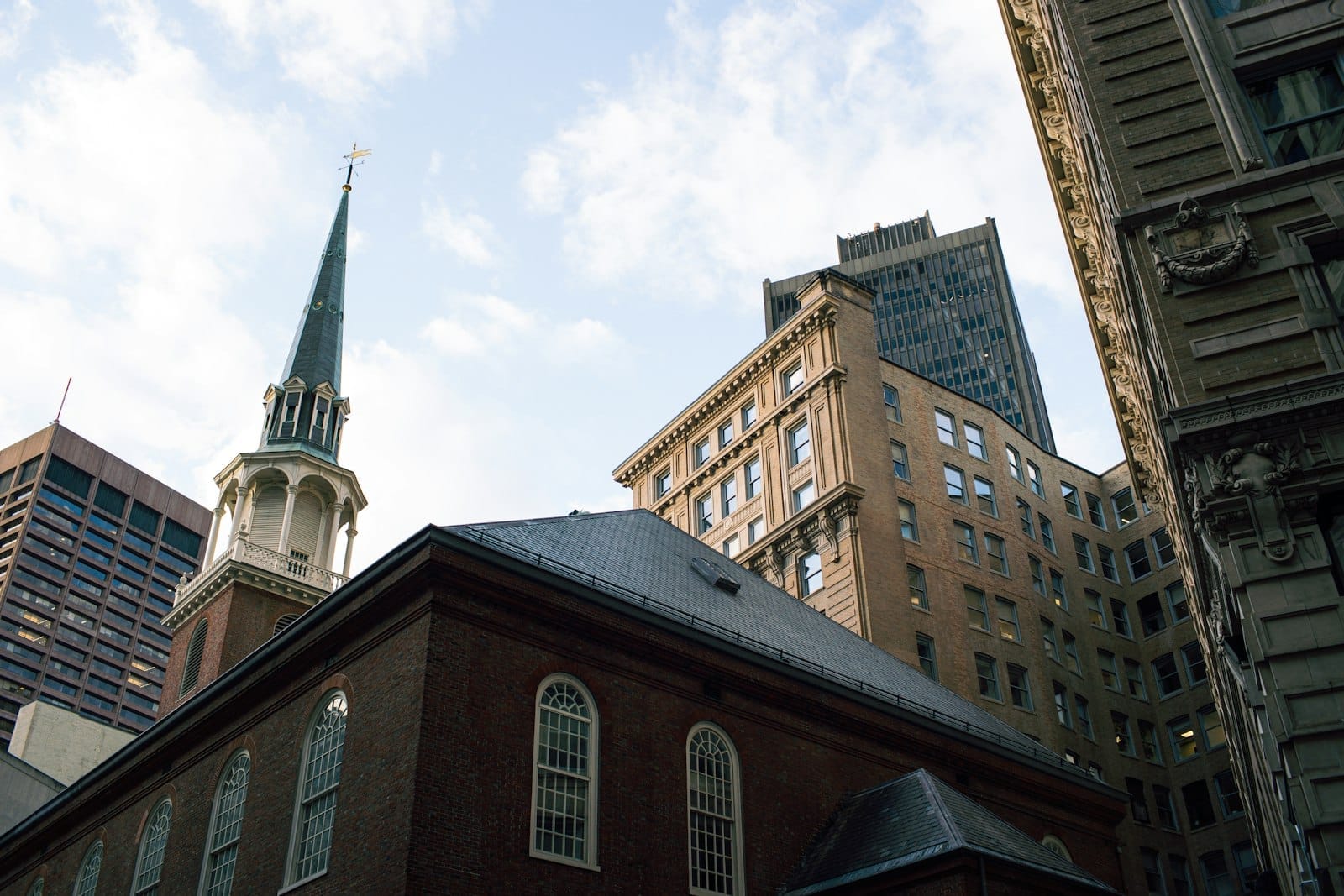
The Old South Meeting House is a 1729 Congregationalist church turned civic flashpoint turned museum, standing at the corner of Washington and Milk Streets in Downtown Boston. It is not a reconstructed replica or a living history performance space. It is the actual building where approximately 5,000 colonists packed the pews and galleries on the night of December 16, 1773, and where Samuel Adams gave the signal that sent the Sons of Liberty marching toward Griffin's Wharf to dump 342 chests of British East India Company tea into Boston Harbor.
That makes this one of the few structures in the United States where a specific, world-altering decision was made in the room you are standing in. The floorboards creak under your feet. The galleries lean over the central floor. The scale of the space, large by colonial standards but modest by modern ones, makes the December 1773 crowd feel extraordinary.
The Old South Meeting House sits on the Freedom Trail, Boston's 2.5-mile walking route connecting 16 revolutionary-era sites. Most visitors encounter it mid-trail, after the Old State House and before Faneuil Hall. It is managed by Revolutionary Spaces, the nonprofit that also oversees the Old State House.
💡 Local tip
Admission is kept deliberately affordable: $15 for adults, with discounted and free options for kids depending on age and ticket type. If you are traveling with kids, this is a rare case where the price-to-impact ratio strongly favors going inside rather than photographing the exterior and moving on.
The Building: What You Are Actually Looking At
The current structure was completed in 1729, replacing an earlier wooden meeting house on the same site. The design follows a Georgian meetinghouse form: red brick exterior, tall arched windows, a clock tower added later, and a clean, box-like interior designed for assembly rather than liturgy. The space is wide and open, with box pews on the ground floor, galleries supported by wooden columns on three sides, and a raised pulpit at the south end.
When you stand at ground level and look up at the galleries, you get an immediate sense of how the colonists used sound and spatial pressure to amplify a meeting. Voices carry across the interior without modern amplification. The building was one of the largest structures in colonial Boston, chosen for mass meetings precisely because it could hold more people than any other available space.
The Great Fire of Boston in November 1872 swept through much of the surrounding blocks and came close enough to scorch the neighborhood, but the structure survived. British forces used it as a riding school during their occupation of Boston in the Revolutionary War period, stripping the pews for firewood and tearing out the pulpit. The building was restored and opened to the public as a museum and meeting place in 1877, making it one of the earlier history museums in the United States. It was designated a National Historic Landmark in 1960 and listed on the National Register of Historic Places in 1966.
Tickets & tours
Hand-picked options from our booking partner. Prices are indicative; availability and final rates are confirmed when you complete your booking.
Boston Summer Night Trolley Tour and River Cruise
From 27 €Instant confirmationFree cancellationLEGOLAND Discovery Center Boston tickets
From 26 €Instant confirmationFree cancellationGhosts and Gravestones tour of Boston
From 39 €Instant confirmationFree cancellationBest of Boston tour
From 182 €Instant confirmationFree cancellation
Inside the Museum: What to Expect
The ground floor and lower level hold the museum's permanent exhibits, which trace the site's history from Puritan congregation to revolutionary assembly hall to civic institution. Interpretive panels, artifacts, and audio components give context to specific events: the 1770 meetings demanding British troop removal after the Boston Massacre, the 1773 Tea Act crisis, and the building's survival through fire, occupation, and near-demolition.
One of the more effective elements is an audio re-creation of the December 16, 1773 meeting, which helps visitors grasp not just the outcome but the tension: the crowd had been deliberating for hours, a last-minute attempt at compromise had failed, and the moment Adams spoke was decisive rather than theatrical. The exhibit makes clear that what happened here was a political meeting that turned into a direct action, not a costume event.
The main hall itself is the exhibit. Plan to spend time simply sitting in the pews and observing the space at rest. Docents are generally available during museum hours and can provide additional context, particularly around specific architectural details and the building's post-Revolutionary uses, including its period as a commercial space in the 19th century.
ℹ️ Good to know
The main floor and lower level are wheelchair accessible. If mobility is a concern, confirm specific access details with Revolutionary Spaces before your visit, as the historic structure has physical limitations in some areas.
How the Experience Changes by Time of Day
Early morning, shortly after the 10:00 am opening during the main season, the building is at its quietest. Light comes through the tall windows at a low angle, the wood of the pews and columns takes on a warm tone, and the ambient sound of the street outside is muffled. This is the best time to absorb the scale and atmosphere of the hall without the distraction of crowd noise.
By mid-morning, school groups begin arriving, particularly on weekdays between April and June and again in September and October. The energy shifts: the space fills with the sound of children, docents project their voices to the back galleries, and the interpretive rhythm picks up pace. This is not necessarily a worse experience, but it is a different one. If you prefer contemplative over educational-tour mode, aim for opening time or late afternoon.
Late afternoon in summer, in the hour before the 5:00 pm close, the crowds thin considerably. The low western light through the windows is striking for photography. Many winter schedules have the site closing earlier in the afternoon, often around 4:00 pm, and the shortened days give the interior a noticeably cooler, more austere quality that arguably suits the building's history better than a bright summer afternoon.
⚠️ What to skip
The Old South Meeting House is typically closed on major holidays such as Thanksgiving, Christmas Day, and New Year's Day. Hours shift seasonally, with longer hours in spring and summer and shorter hours in fall and winter; check current schedules before visiting. Always verify current hours at revolutionaryspaces.org before visiting.
Getting There and What to Wear
The address is 310 Washington Street at Milk Street in Downtown Boston. Downtown Crossing station on the MBTA Red Line is one of the closest stops, roughly a two-minute walk. State Street station (Blue and Orange Lines) is about four minutes on foot. Parking in this part of downtown is limited and expensive; public transit is by far the easier option. If you are walking the Freedom Trail, the Old South Meeting House sits naturally between the Old State House to the north and Faneuil Hall to the northeast.
There is no dress code. The interior temperature is regulated, but in winter the entrance area can be cold briefly. Comfortable walking shoes are appropriate since the Freedom Trail typically extends this visit into a longer walk. The surrounding Washington Street corridor is urban and active at all hours.
Photography and Practical Caveats
Interior photography is generally permitted. The main hall photographs well from the gallery level, where you can capture the full sweep of the box pews and the pulpit in a single frame. The light from the tall windows creates strong contrasts, so shooting in the direction of the windows without a wide dynamic range can be challenging. Early morning light from the east side produces the most even illumination.
The exterior brick facade photographs well against a clear sky, but Washington Street is narrow and the opposite side of the street does not provide much distance. The building's clock tower is most visible from the Milk Street corner. If you want exterior context shots for the broader Freedom Trail walk, the short block south toward the Old State House gives you a better sightline down the street.
In practice: the Old South Meeting House is not a spectacle. There are no dramatic period tableaux, no interactive simulations, and the permanent collection is modest in size. What it offers is authenticity and spatial immediacy. Visitors who come expecting a polished multi-media experience comparable to the Boston Tea Party Ships and Museum a few blocks south will find it understated. Visitors who want direct contact with an original, still-standing piece of American revolutionary history will find it absorbing.
Travelers with very limited time in Boston who are trying to cover major sites efficiently should know that the Old South Meeting House and the nearby Boston Tea Party Ships and Museum cover overlapping historical ground. They complement each other well on a full day, but if you must choose one, the Museum offers more interactive programming while the Meeting House offers the authentic space where events occurred.
Insider Tips
- Visit on a weekday before 10:00 am if possible. School groups typically arrive mid-morning, and the window between opening and their arrival gives you the hall largely to yourself.
- Ask a docent about the 1872 fire. The story of how the building survived while the surrounding neighborhood burned, and the subsequent 1877 campaign to preserve it as a museum, is as interesting as the Revolutionary War history and is often skipped in standard audio tours.
- The Milk Street entrance angle gives a better sense of how the building sits in its urban block than the main Washington Street facade. Approach from that corner if you want to understand the building's relationship to the surrounding streetscape.
- Check the Revolutionary Spaces event calendar before your visit. The Old South Meeting House still hosts public forums and civic events in keeping with its history as an assembly space, and occasionally these are open to visitors.
- Combine this stop with the Granary Burying Ground a short walk northwest on Tremont Street, where Samuel Adams, Paul Revere, and other figures directly connected to the December 1773 meeting are buried.
Who Is Old South Meeting House For?
- American history enthusiasts who want to stand in the actual room where pivotal events occurred
- Freedom Trail walkers building a full-day itinerary across multiple sites
- Families with school-age children studying the American Revolution
- Architecture and preservation-minded travelers interested in colonial Georgian meetinghouse design
- Budget-conscious visitors seeking high historical significance at low admission cost
Nearby Attractions
Other things to see while in Downtown & Financial District:
- Boston Common
Founded in 1634, Boston Common is the oldest public park in the United States and the civic anchor of downtown Boston. Free to enter and open year-round, it serves as a gathering place for locals, a landmark on the Freedom Trail, and the starting point for exploring everything the city has to offer.
- Boston Harbor Whale Watching
The New England Aquarium Whale Watch presented by Boston Harbor City Cruises sends a high-speed catamaran from Long Wharf out to Stellwagen Bank National Marine Sanctuary, one of the most productive whale feeding grounds on the East Coast. With onboard aquarium naturalists and a whale-sighting guarantee, it is one of the few Boston experiences that delivers on its premise.
- Boston Public Market
Open daily from 8:00 AM to 8:00 PM and free to enter, Boston Public Market brings together more than 30 New England farmers, fishers, and food artisans in a year-round indoor market above Haymarket Station. It is the first public market in the United States to require that everything sold is produced in or originates from New England.
- Custom House Tower
Standing 496 feet above McKinley Square, the Custom House Tower was Boston's tallest building for about half a century until 1964. Today it operates as a Marriott Vacation Club property, and its free public observation deck tours remain a lesser-known opportunity for a panoramic view of the harbor and skyline.