Boston Common: 50 Acres at the Heart of American History
Founded in 1634, Boston Common is the oldest public park in the United States and the civic anchor of downtown Boston. Free to enter and open year-round, it serves as a gathering place for locals, a landmark on the Freedom Trail, and the starting point for exploring everything the city has to offer.
Quick Facts
- Location
- Tremont, Park, Beacon, Charles & Boylston Streets, Downtown Boston, MA 02108
- Getting There
- Park Street Station (Red & Green Lines) and Boylston Station (Green Line), both directly adjacent
- Time Needed
- 30 minutes for a walk-through; 2+ hours if combining with the Freedom Trail or Public Garden
- Cost
- Free to enter
- Best for
- History seekers, families, picnickers, Freedom Trail walkers, and anyone who wants a quiet break in the city center
- Official website
- www.boston.gov/parks/boston-common
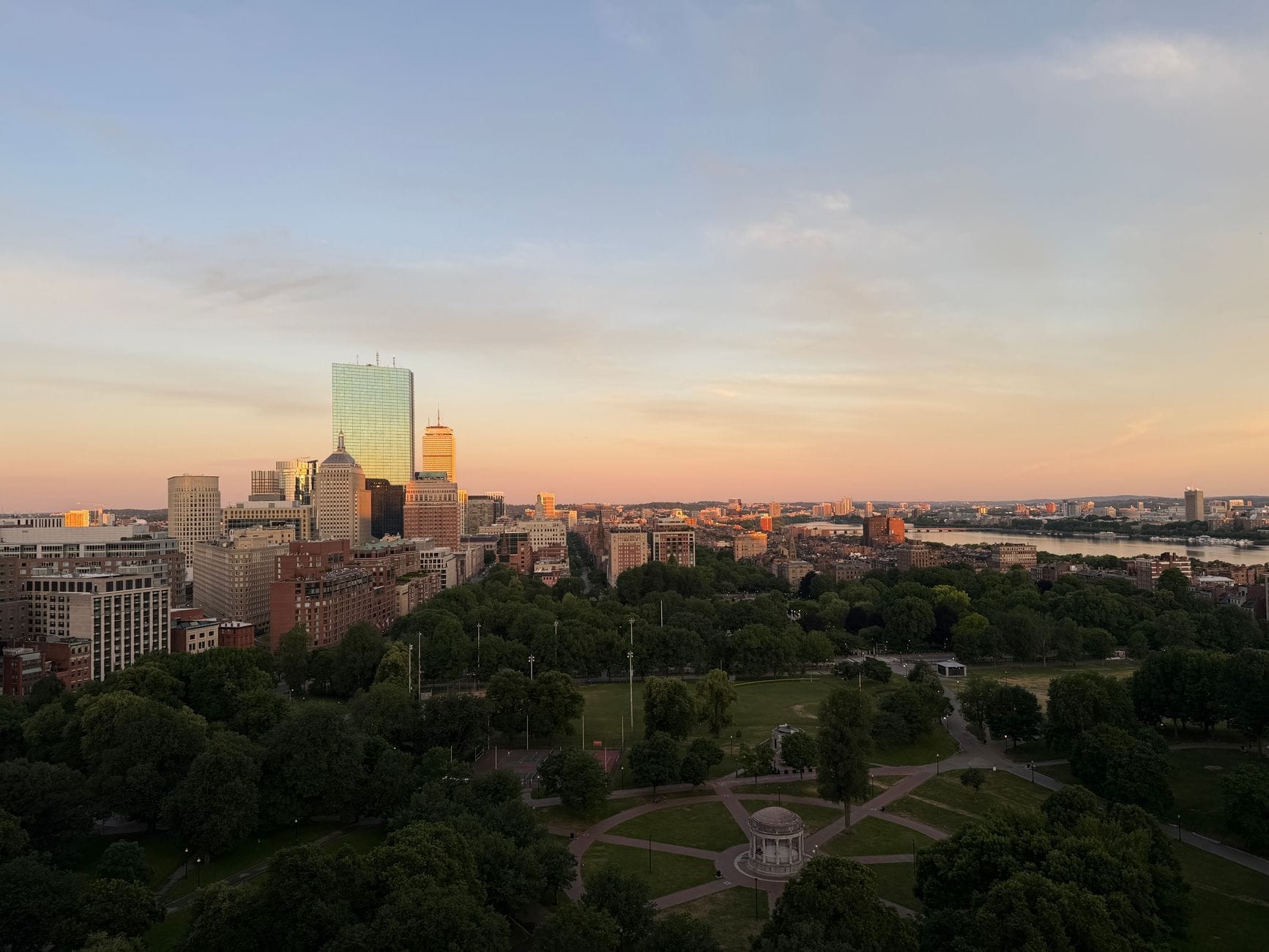
What Boston Common Actually Is
Boston Common is not a manicured botanical garden or a ticketed attraction. It is 50 acres of open urban parkland sitting at the geographic and symbolic center of the city, bounded by Tremont, Park, Beacon, Charles, and Boylston Streets in downtown Boston. Founded in 1634, it is the oldest public park in the United States, predating the nation itself by more than 140 years.
The Common was originally purchased by the Massachusetts Bay Colony to serve as a shared pasture, a militia training field, and a place of public assembly. Cows grazed here until 1830. Public hangings took place here. British Redcoats camped on this ground before marching to Lexington and Concord in April 1775. Today, the same lawn hosts food trucks, protest rallies, ice skaters, and office workers eating lunch. That continuity is the point: this is civic space in the truest sense, belonging to everyone and shaping the character of the city for nearly four centuries.
💡 Local tip
Boston Common is the official start of the Freedom Trail. Look for the red-brick path or painted red line beginning near the Visitor Information Center on Tremont Street, close to the Park Street Station entrance.
How the Park Feels at Different Times of Day
Early mornings are the most peaceful time on the Common. By 7 a.m., joggers circle the perimeter paths and dog walkers cluster near the Charles Street edge. The air carries the faint smell of damp grass and the distant exhaust of the first MBTA buses. The park's central Frog Pond, a shallow concrete basin, reflects the morning light quietly. There are almost no tourists at this hour, and the scale of the space becomes easier to appreciate without the midday crowds.
By late morning, especially on weekdays, the park fills with a particular Boston rhythm: students, commuters cutting through from Park Street Station to Tremont Street, and clusters of visitors who have just arrived at the Freedom Trail information kiosk. On warm afternoons, the Frog Pond lawn is covered with people reading, sunbathing, and letting children run. Vendors sometimes operate near the Boylston Street side. The noise level rises noticeably, and the sense of solitude disappears entirely.
Late afternoons in summer draw a different mix: families wrapping up sightseeing, teenagers on the benches near Tremont Street, and the occasional organized event on the central grounds. By dusk, the park transitions again. In summer, evenings can be lively and comfortable. In winter, the paths empty quickly after dark, and the park feels much larger and quieter than the surrounding streets would suggest.
Tickets & tours
Hand-picked options from our booking partner. Prices are indicative; availability and final rates are confirmed when you complete your booking.
Boston Summer Night Trolley Tour and River Cruise
From 27 €Instant confirmationFree cancellationLEGOLAND Discovery Center Boston tickets
From 26 €Instant confirmationFree cancellationGhosts and Gravestones tour of Boston
From 39 €Instant confirmationFree cancellationBest of Boston tour
From 182 €Instant confirmationFree cancellation
The Frog Pond and Seasonal Highlights
The Frog Pond is the park's most flexible amenity. In summer, it operates as a spray pool and wading area, shallow enough for toddlers and popular with families on hot July afternoons. The water is cool, the concrete edges are wide, and the surrounding lawn offers shade under the older elms. In winter, the Frog Pond converts to a public ice skating rink with skate rentals available on-site. The rink is one of the more affordable seasonal activities in the city and draws a genuine cross-section of Boston residents, not just tourists.
December brings a modest holiday lighting installation to the Common, and in recent years the skating rink has generally operated from late November into early March, depending on weather and operating decisions. The seasonal shift transforms the character of the park significantly. If you visit in fall, the Common's mature trees, a mix of oaks, elms, and other hardwoods, produce solid foliage color, particularly in October. This is also when the park is at its most photogenic and most crowded with visitors.
Winter visitors should note that Boston's climate brings genuine cold from December through February, with average January lows around 22°F (-6°C). Paths can be icy after snow. Dress accordingly and check conditions if you're planning to visit the skating rink. For more seasonal context, the Boston in winter guide covers what to expect across the city during the colder months.
Historical and Cultural Significance
Few public spaces in North America carry as much layered history as Boston Common. Its founding in 1634 makes it older than Harvard University, older than the city's first newspaper, older than almost every institution in American civic life. The Common served as a site of military assembly through multiple colonial conflicts and the Revolutionary War, where British troops encamped before key battles of 1775.
The Soldiers and Sailors Monument, standing at the top of the central hill, was dedicated in 1877 to honor Massachusetts soldiers and sailors who died in the Civil War. It is a large, serious piece of Victorian civic sculpture, easy to walk past without registering its scale. The Central Burying Ground, in the southeast corner near Boylston Street, has been in continuous use since 1756 and contains the grave of artist Gilbert Stuart, known for the portrait of George Washington that appears on the U.S. one-dollar bill.
The Common also marks the beginning of the Freedom Trail, the 2.5-mile walking route connecting 16 historical sites across downtown Boston and Charlestown. The Visitor Information Center on Tremont Street is where most organized Freedom Trail experiences begin, and it's worth stopping in for a free map even if you plan to walk independently.
The Common's western edge borders Charles Street, which separates it from the Boston Public Garden, established in 1837 as the first public botanical garden in the United States. The two parks are often conflated by first-time visitors. They are distinct spaces with different characters: the Common is older, larger, flatter, and more utilitarian; the Public Garden is formal, landscaped, and centered on its famous lagoon and Swan Boats.
Getting There and Getting Around the Park
Park Street Station on the MBTA Red and Green Lines is the most convenient transit stop, depositing you directly at the Tremont Street entrance. Boylston Station on the Green Line lets you enter from the southern end near the Frog Pond. Both stations are within steps of the park boundary. The Common is also walkable from many downtown hotels within 10 to 15 minutes.
The park has multiple paved paths crossing it diagonally and laterally, and the terrain is mostly gentle with some incline toward the central hill and the Soldiers and Sailors Monument. The Freedom Trail website lists the Common as wheelchair accessible, and the paved paths support that adequately in dry conditions. Snow and ice in winter can make some areas uneven; the main paths are generally cleared first.
If you are planning a broader downtown walking route, the Common connects naturally to the Granary Burying Ground just a block north on Tremont Street, and to Park Street Church at the corner of Park and Tremont. Both are Freedom Trail sites and take less than five minutes to reach on foot from the Common's main entrance.
Practical Notes and Who Should Think Twice
Boston Common is free, open year-round, and central to understanding the city. It is not a landscaped showpiece and it does not try to be. The grass shows wear, especially in summer. Some areas near the main paths can attract panhandlers, particularly around the Tremont Street side. This is common to urban parks of this scale and does not meaningfully diminish the experience, but it is worth knowing if you are traveling with children who may have questions.
Visitors seeking a formal garden experience should cross into the Boston Public Garden instead. Those looking for a quiet, uncrowded nature retreat would be better served by the Arnold Arboretum or Jamaica Pond in Jamaica Plain. The Common is at its best when you treat it as what it is: a living piece of civic infrastructure, not a polished tourist attraction.
ℹ️ Good to know
No food concessions operate inside the park year-round, though vendors appear in warmer months. If you want coffee or a meal before or after, Tremont Street and the surrounding blocks have multiple cafes and delis within a two-minute walk.
For a broader orientation to the downtown area and neighboring attractions, the Boston history guide provides useful context on how the Common fits into the city's wider historical narrative.
⚠️ What to skip
The Common can get extremely crowded during major events such as Fourth of July celebrations, political rallies, and summer concerts. Crowds in these cases can be very large and the surrounding MBTA stations become heavily congested. Plan extra time if visiting on a known event day.
Insider Tips
- Enter from the Boylston Street side (Green Line, Boylston Station) rather than the more crowded Tremont Street entrance if you want to start near the Frog Pond without navigating the Freedom Trail foot traffic.
- The Soldiers and Sailors Monument at the top of the hill provides one of the best elevated views of the downtown skyline, particularly to the north toward the State House dome. Most visitors walk past it without pausing.
- The Central Burying Ground in the southeast corner is far less visited than the Granary Burying Ground on Tremont Street. You can often have it nearly to yourself, and the 18th-century slate headstones are well-preserved.
- If you're visiting with young children in summer, arrive at the Frog Pond wading area before 11 a.m. on weekdays. By midday on a warm day it can be extremely crowded, and the surrounding lawn fills quickly.
- The park's perimeter path is a consistent loop used by local runners. If you want to jog it yourself, the full perimeter is roughly one mile, making it an easy landmark-based workout in the middle of the city.
Who Is Boston Common For?
- First-time visitors to Boston who want to orient themselves before exploring further
- Families with young children, especially for the Frog Pond in summer and the skating rink in winter
- History and architecture enthusiasts starting or finishing the Freedom Trail
- Travelers who want free outdoor space in the middle of a dense city day
- Fall visitors looking for accessible foliage color without leaving downtown
Nearby Attractions
Other things to see while in Downtown & Financial District:
- Boston Harbor Whale Watching
The New England Aquarium Whale Watch presented by Boston Harbor City Cruises sends a high-speed catamaran from Long Wharf out to Stellwagen Bank National Marine Sanctuary, one of the most productive whale feeding grounds on the East Coast. With onboard aquarium naturalists and a whale-sighting guarantee, it is one of the few Boston experiences that delivers on its premise.
- Boston Public Market
Open daily from 8:00 AM to 8:00 PM and free to enter, Boston Public Market brings together more than 30 New England farmers, fishers, and food artisans in a year-round indoor market above Haymarket Station. It is the first public market in the United States to require that everything sold is produced in or originates from New England.
- Custom House Tower
Standing 496 feet above McKinley Square, the Custom House Tower was Boston's tallest building for about half a century until 1964. Today it operates as a Marriott Vacation Club property, and its free public observation deck tours remain a lesser-known opportunity for a panoramic view of the harbor and skyline.
- Faneuil Hall Marketplace
Faneuil Hall Marketplace occupies four connected historic buildings in downtown Boston, anchored by the 1742 Faneuil Hall and stretching across the Quincy Market colonnade. Free to enter and open daily, it serves as both a working food and shopping destination and one of the most significant civic sites in American history.