Granary Burying Ground: Boston's Most Storied Cemetery
Established in 1660 on land carved from Boston Common, Granary Burying Ground holds the remains of some of the most consequential figures in American history. Free to enter and located steps from Park Street Station, it's one of the most historically dense stops on the Freedom Trail.
Quick Facts
- Location
- 95 Tremont Street, Downtown Boston, MA 02108
- Getting There
- Park Street Station (Red & Green Lines) — 2-minute walk
- Time Needed
- 30–60 minutes
- Cost
- Free admission
- Best for
- History enthusiasts, Freedom Trail walkers, photography
- Official website
- www.boston.gov/cemeteries/granary-burying-ground
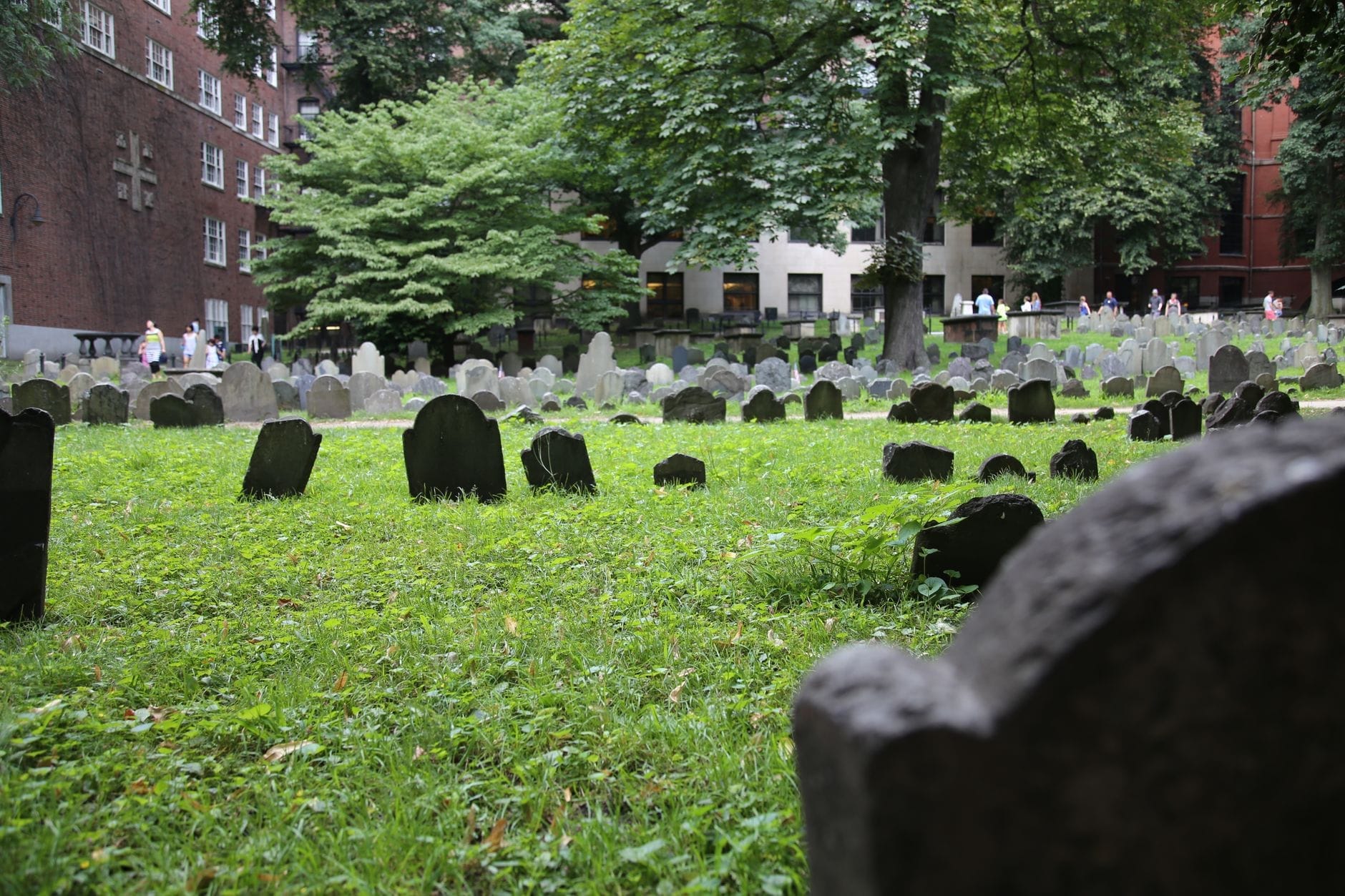
What Granary Burying Ground Actually Is
Granary Burying Ground is Boston's third-oldest cemetery, established in 1660 on a plot that was once the outer edge of Boston Common. It sits on Tremont Street in downtown Boston, directly beside Park Street Church, and contains roughly 2,345 gravestones and tombs, though estimates suggest more than 5,000 individuals are buried here. The discrepancy tells you something about the place: stones were moved, consolidated, and re-arranged over centuries, particularly in the 1800s when the grounds were landscaped for aesthetic reasons. What you see today is a curated arrangement, not the original layout.
The name comes from a grain storage building that stood nearby. The cemetery was originally called the South Burying Ground, then the Middle Burying Ground, before the Granary name stuck in 1737. That kind of layered, slightly improvised history runs through everything here, from the repurposed name to the stones themselves.
It is one of the most-visited stops on the Freedom Trail, and its position beside Park Street Church and within easy walking distance of Boston Common means it fits naturally into a broader day of historic exploration.
Who Is Buried Here: The Short Version
The three names that draw most visitors are Paul Revere, Samuel Adams, and John Hancock. All three are buried here, and their stones are among the most visited in the cemetery. But the full roster is considerably wider in historical significance.
James Otis Jr., whose legal arguments against British writs of assistance are considered a direct intellectual spark for the American Revolution, is interred here. So are five victims of the Boston Massacre of 1770, including Crispus Attucks, whose death became a rallying point for the colonial cause. Peter Faneuil, the merchant who funded the construction of Faneuil Hall, is also buried in these grounds.
Perhaps the most underappreciated monument is the 25-foot obelisk near the center of the grounds. It marks the tomb of Josiah and Abiah Franklin, the parents of Benjamin Franklin himself, who was born in Boston but lived most of his famous life elsewhere. Franklin is not buried here, but the obelisk is a striking focal point that many visitors photograph without knowing exactly why it is there.
ℹ️ Good to know
The graves of Samuel Adams and John Hancock are clearly marked and easy to locate near the main path. The Crispus Attucks monument, shared with the other Boston Massacre victims, is worth seeking out deliberately — it is toward the far side of the grounds and often overlooked.
Tickets & tours
Hand-picked options from our booking partner. Prices are indicative; availability and final rates are confirmed when you complete your booking.
Boston's Historic Underground Donut Tour
From 46 €Instant confirmationFree cancellationBoston Summer Night Trolley Tour and River Cruise
From 27 €Instant confirmationFree cancellationLEGOLAND Discovery Center Boston tickets
From 26 €Instant confirmationFree cancellationGhosts and Gravestones tour of Boston
From 39 €Instant confirmationFree cancellation
The Experience at Different Times of Day
The cemetery generally opens at 10 a.m. and closes at 4 p.m. according to the City of Boston's posted hours, though these are subject to change and worth confirming before you visit. The window is narrower than many visitors expect, so arriving mid-morning or early afternoon gives you the most comfortable experience.
On weekday mornings, around 10 to 11 a.m., the grounds are relatively quiet. You can read the inscriptions on the older slate stones without crowds pressing around you, and the light from the east falls across the carved faces and winged skulls at a low angle that makes them especially striking. The older stones, many carved from slate in the 17th and early 18th centuries, feature mortality symbols: hourglasses, scythes, and the characteristic winged death's heads that gradually evolved into more cherubic imagery as the 18th century progressed. That shift is actually visible if you walk the grounds in rough chronological order.
By midday in summer, the place fills with Freedom Trail tour groups, school trips, and independent visitors. The narrow paths between stones become congested, and guided commentary competes from multiple directions. If you are visiting between June and August, arriving right at 10 a.m. makes a real difference. In autumn, particularly September and October, the crowds thin on weekday mornings and the lower sun creates excellent photographic light through the iron fence.
💡 Local tip
For photography: the ornate Egyptian Revival gateway on Tremont Street frames beautifully in the morning light. The winged skull carvings on older stones photograph well on overcast days when shadows are soft and detail is visible without harsh contrast.
Historical and Architectural Context
The granite gateway at the Tremont Street entrance was added in 1840 and designed in the Egyptian Revival style, a fashionable aesthetic for cemeteries at the time, associated with themes of death, permanence, and the afterlife. The style was chosen deliberately to signal solemnity and antiquity. It stands in sharp contrast to the much older stones inside, some of which predate the American nation by more than a century.
The gravestones themselves are a compressed history of colonial American material culture. The earliest markers are simple fieldstone or rough slate. By the early 18th century, skilled carvers were producing detailed imagery, and the stones of prominent families became elaborate. The transition from death's-head imagery to cherubs to willow-and-urn motifs across the 18th century mirrors broader shifts in Protestant theology, from an emphasis on mortality and judgment toward a gentler focus on resurrection and mourning.
The cemetery exists within a few hundred meters of several other major historical sites. Park Street Church, immediately adjacent, was built in 1809. Boston Common is across the street. The Massachusetts State House is a short uphill walk. This density of historically significant sites within a two-block radius is unusual even by Boston standards.
Practical Walkthrough: How to Navigate the Grounds
The cemetery is not large, roughly 1.5 acres, and you can cover the main sightlines in about 20 minutes at a brisk pace. But to read inscriptions, examine carvings, and locate specific graves, allow at least 45 minutes. The entrance gate on Tremont Street is the main access point. There is no ticketing or queuing.
The paths are historic and uneven in places. The ground between the stones is mostly grass with brick and stone edging, and some sections have compacted gravel. The Freedom Trail lists the site as wheelchair accessible, but visitors with mobility concerns should be aware that the terrain is not uniformly smooth. Comfortable walking shoes are a practical necessity.
Signage within the grounds helps orient visitors to the major graves, and the tomb locations of notable figures are generally well-marked. The Franklin obelisk in the center is impossible to miss. The perimeter of the cemetery features a series of tombs built into the wall, belonging to prominent Boston families, with heavy iron doors and carved inscriptions. These are worth examining closely.
⚠️ What to skip
Do not step on or lean against the gravestones. Many are fragile and over 300 years old. Rubbing gravestones with paper, a common practice in past decades, is now understood to cause lasting damage and is not permitted.
Who Will Get the Most From This Site, and Who Might Not
Granary Burying Ground rewards visitors who come with some preparation. If you know who Paul Revere, Samuel Adams, or Crispus Attucks were and why they mattered, the experience of standing at their graves carries genuine weight. The site also rewards those with an interest in early American material culture, typography, or funerary art — the variety of stone-carving styles across three centuries is surprisingly rich.
Visitors who have little interest in colonial American history may find the site underwhelming. It is a working historic cemetery, not a museum with interpretive displays. There are no audio guides on site, though guided Freedom Trail tours do pass through. If you are looking for a more structured historical experience, the Old South Meeting House nearby offers fuller interpretation, and the Paul Revere House in the North End has room-by-room exhibits with context.
Families with young children can visit comfortably, and many children are engaged by the skull carvings and the age of the stones. The open-air format means there is room to move around, and the visit can be kept short without missing the essential graves. Very young children in strollers may find the uneven terrain challenging.
The site also connects naturally into a broader walk through downtown Boston history. If you are spending time in the area, the Old State House and King's Chapel are both within easy walking distance, as is King's Chapel Burying Ground — founded in 1630, Boston's oldest cemetery — making for a coherent half-day historical loop.
Insider Tips
- Arrive at 10 a.m. on a weekday, especially in summer, to have the grounds largely to yourself before the first wave of Freedom Trail tour groups arrives around 10:30 to 11 a.m.
- The tomb doors set into the perimeter walls are original 18th-century ironwork. Look for family names carved into the stone lintels above each door — several belong to families whose names are woven throughout early Boston history.
- The 19th-century landscaping reorganization moved many stones from their original burial locations. This means the grave markers are not always directly above the person they commemorate. Keep this in mind if you are trying to take a precise geographic inventory.
- On overcast days, the slate carving detail on older stones becomes far more legible and photographs more clearly than in direct sunlight, where shadows can obscure the shallow relief work.
- If you want a guided experience, the National Park Service offers free ranger-led Freedom Trail tours that include Granary. Check the NPS Boston National Historical Park schedule — these tours add context that is difficult to replicate with self-guided visits.
Who Is Granary Burying Ground For?
- American history and Revolutionary War enthusiasts
- Photographers interested in funerary art and 17th–18th century stone carving
- Freedom Trail walkers building a full-day historic itinerary
- Families with older children (8+) who can appreciate historical context
- Travelers with limited time who want high historical density in a short visit
Nearby Attractions
Other things to see while in Downtown & Financial District:
- Boston Common
Founded in 1634, Boston Common is the oldest public park in the United States and the civic anchor of downtown Boston. Free to enter and open year-round, it serves as a gathering place for locals, a landmark on the Freedom Trail, and the starting point for exploring everything the city has to offer.
- Boston Harbor Whale Watching
The New England Aquarium Whale Watch presented by Boston Harbor City Cruises sends a high-speed catamaran from Long Wharf out to Stellwagen Bank National Marine Sanctuary, one of the most productive whale feeding grounds on the East Coast. With onboard aquarium naturalists and a whale-sighting guarantee, it is one of the few Boston experiences that delivers on its premise.
- Boston Public Market
Open daily from 8:00 AM to 8:00 PM and free to enter, Boston Public Market brings together more than 30 New England farmers, fishers, and food artisans in a year-round indoor market above Haymarket Station. It is the first public market in the United States to require that everything sold is produced in or originates from New England.
- Custom House Tower
Standing 496 feet above McKinley Square, the Custom House Tower was Boston's tallest building for about half a century until 1964. Today it operates as a Marriott Vacation Club property, and its free public observation deck tours remain a lesser-known opportunity for a panoramic view of the harbor and skyline.