Old State House: Boston's Oldest Surviving Public Building
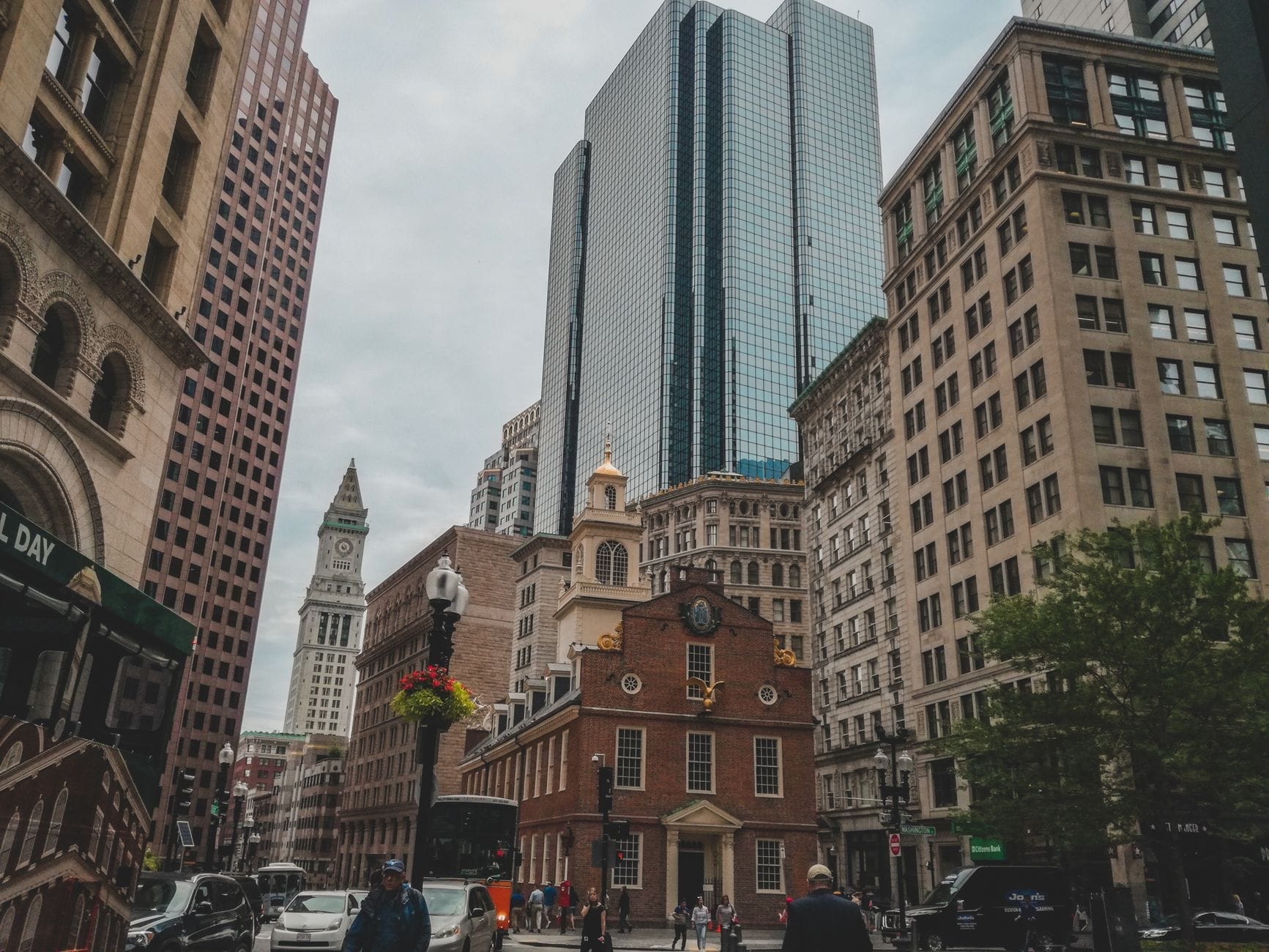
Built in 1713 and reconstructed after a 1748 fire, the Old State House at 206 Washington Street is Boston's oldest surviving public building. It stands on the Freedom Trail as one of the most consequential sites of the American Revolution, where the Declaration of Independence was first read aloud to Bostonians and British soldiers clashed with colonists in the Boston Massacre just steps from its east wall.
Quick Facts
- Location
- 206 Washington Street, Downtown Boston, MA 02109 (intersection of Washington & State Streets)
- Getting There
- State Street Station (Blue Line, MBTA) — the building is visible from the station exit
- Time Needed
- 45 minutes to 1.5 hours depending on how deeply you explore the exhibits
- Cost
- Adults ~$10, Seniors/Students ~$8.50, Children 18 and under free (verify current rates at revolutionaryspaces.org before visiting)
- Best for
- American history enthusiasts, Freedom Trail walkers, families with older children, architecture lovers
- Official website
- revolutionaryspaces.org
What the Old State House Actually Is
The Old State House is a three-story brick Georgian structure dating to 1713, making it the oldest surviving public building in Boston and one of the oldest in the United States. It was originally built as the seat of colonial government in Massachusetts, housing the Massachusetts General Court and the Governor's Council. After a fire in 1748, it was largely reconstructed, though the building's core character and footprint were preserved. It served as the seat of the Massachusetts General Court until 1798, when the new State House on Beacon Hill opened.
Today the building is managed by Revolutionary Spaces, a nonprofit that also operates Old South Meeting House. The interior functions as a history museum focused on the Revolutionary era, with two floors of exhibits. What makes the Old State House remarkable is not just its age but its location: it sits at the exact intersection where colonial governance, commercial trade, and violent confrontation overlapped. The building has not been relocated or reconstructed on a replica site. It stands precisely where it has stood for more than three centuries, surrounded now by glass towers and the rushing foot traffic of Downtown Boston.
💡 Local tip
State Street Station on the Blue Line deposits you almost directly in front of the building. You will see the Old State House the moment you surface from the subway stairs. No navigation required.
The History You Need to Understand What You're Looking At
To stand in front of the Old State House without knowing its history is to miss most of what makes it worth your time. The building was the nerve center of colonial Massachusetts for decades. British governors issued proclamations from its upper chambers. The Massachusetts General Court debated taxes, liberties, and the growing friction with the Crown within its walls. The building's east balcony, which still projects over State Street today, is where the Declaration of Independence was first read aloud to Bostonians on July 18, 1776.
But the site's most charged moment came before independence. On March 5, 1770, a confrontation between colonists and British soldiers outside the east wall of the building ended with soldiers firing into the crowd, killing five people. The event, which became known as the Boston Massacre, was seized upon by patriot leaders as evidence of British tyranny. Paul Revere's engraving of the scene was distributed across the colonies as propaganda within weeks. A circle of cobblestones in the street still marks the spot where the victims fell, just steps from the building's entrance.
The building's east facade features two prominent symbols that feel deliberately incongruous to modern eyes: a lion and a unicorn, representing the British Crown. These are reproductions; the originals were torn down and burned during a public reading of the Declaration in 1776. Their reinstallation during a 19th-century restoration was a deliberate historical acknowledgment rather than loyalist sentiment. For context on the broader arc of Boston's revolutionary history, the Boston history guide covers the colonial period through the Revolution in useful depth.
Tickets & tours
Hand-picked options from our booking partner. Prices are indicative; availability and final rates are confirmed when you complete your booking.
Boston Summer Night Trolley Tour and River Cruise
From 27 €Instant confirmationFree cancellationLEGOLAND Discovery Center Boston tickets
From 26 €Instant confirmationFree cancellationGhosts and Gravestones tour of Boston
From 39 €Instant confirmationFree cancellationBest of Boston tour
From 182 €Instant confirmationFree cancellation
The Visit: What You See Floor by Floor
Entering from Washington Street, you pass through a narrow doorway that immediately signals the building's age. The ceilings are low by modern standards, the floorboards creak with authentic wear, and the smell inside is faintly musty in the way that old brick buildings often are, especially on damp days. The ground level offers orientation exhibits and introductory displays, including artifacts, documents, and period reproductions. The exhibits are well-labeled and accessible to visitors who arrive without prior knowledge of the colonial period.
The upper floors carry more interpretive weight. Exhibits detail the Boston Massacre, the political debates that led to independence, and the building's role as a commercial exchange as well as a government seat. Original documents, period maps, and objects tied to specific events are displayed in cases. The east balcony, the very ledge from which the Declaration was read in 1776, can be viewed from inside the upper level. Depending on the day and staffing, docents are sometimes present to answer questions and point out details visitors typically overlook.
⚠️ What to skip
Accessibility limitation: The Old State House is only accessible via stairs. There is no elevator. Visitors who cannot use stairs will not be able to access the upper exhibit floors. Confirm current accessibility arrangements with Revolutionary Spaces before your visit.
The museum is compact. Most visitors with a genuine interest in the content spend 45 minutes to an hour inside. If you read every panel and engage with a docent, you can stretch the visit to 90 minutes. If you are moving through the Freedom Trail efficiently and treating this as one stop among several, 30 to 45 minutes is enough to absorb the main exhibits and step out onto or near the balcony level.
How the Experience Changes by Time of Day
The intersection of Washington and State Streets is one of the more relentlessly trafficked pedestrian junctions in downtown Boston. During morning rush hour on weekdays, office workers pour out of State Street Station and stream past the building's facade in both directions. The Old State House at 8:30 a.m. on a Tuesday looks like a museum that survived in spite of the city rather than because of it: ancient brick hemmed by glass towers, with commuters barely glancing at the cobblestone massacre marker underfoot.
For visitors, midmorning on a weekday offers the quietest interior conditions. Tour groups from cruise ships and school groups typically arrive in late morning and peak around midday, particularly from late spring through early fall. If you want the exhibits to yourself, aim for a 9:00 or 9:30 a.m. entry. On summer afternoons, the ground-floor space can feel crowded given its small footprint, though the upper floors tend to thin out quickly. Weekend mornings draw Freedom Trail walkers and are busier than equivalent weekday windows.
From late October through early December, crowds drop noticeably. The exterior is particularly atmospheric in fall when the light is lower and the surrounding trees (in the small pockets of green near Faneuil Hall) show color. Winter visits are uncrowded, and the absence of foot traffic outside makes it easier to stand at the massacre marker without being jostled, which gives that moment more gravity.
The Old State House on the Freedom Trail
The Old State House is one of 16 official stops on the Freedom Trail, the 2.5-mile walking route through Boston's revolutionary and colonial sites. It sits roughly in the middle of the trail's downtown cluster, making it a natural pivot point. From here, you can walk north toward Faneuil Hall and the North End, or continue south toward the Granary Burying Ground and Boston Common. The building's location at a major intersection means it requires no detour: the trail passes directly through it.
If you are combining the Old State House with other downtown stops, consider pairing it with the nearby Faneuil Hall Marketplace (a three-minute walk north) and the Granary Burying Ground (about ten minutes on foot). Together, these three sites provide a compressed but meaningful survey of Boston's colonial and revolutionary period without requiring a full day.
Practical Details for Visiting
The building typically opens at 10:00 a.m. daily during the main season, with closing times commonly around 5:00 p.m., though exact hours vary by time of year. These hours are subject to change, so verify with Revolutionary Spaces at revolutionaryspaces.org before your visit. Admission is approximately $10 for adults, $8.50 for seniors and students, and free for children 18 and under. Boston residents may have access to discounted or free admission programs; check the operator's website for current offers.
Getting there is straightforward. State Street Station, on the MBTA Blue Line with an Orange Line transfer via the connected downtown complex, is directly adjacent. You will not need to look at a map once you exit the station. If you are walking from Faneuil Hall, it is a three-minute walk south along Congress Street. From Boston Common, it is roughly a ten-minute walk northeast along Tremont and then Washington Street.
Photography inside is generally permitted without flash. The exterior, particularly the east facade with the lion and unicorn carvings, photographs best in morning light when Washington Street is less crowded. If you are traveling with children, note that the exhibits are text-heavy and most engaging for kids ages ten and up. Younger children may enjoy the building's visible age and the story of the massacre marker in the street, but the interior will hold their attention for 20 minutes at most. For a broader look at family-friendly options in the city, the Boston with kids guide covers planning in useful detail.
ℹ️ Good to know
The massacre marker in the street outside the east entrance is easy to miss. Look for a circle of cobblestones set into the pavement on State Street, just east of the building's corner. It marks where five people were killed on March 5, 1770.
Is It Worth Your Time?
The Old State House rewards visitors who engage with the context. The building itself is modest in scale and the exhibits, while informative, are not as lavishly produced as those at the Boston Tea Party Ships and Museum a few blocks south. If you are primarily interested in spectacle or interactive experiences, this will feel understated. If you are drawn to authentic physical spaces where documented history unfolded, the Old State House delivers something those newer, larger attractions cannot: the actual room, the actual building, the actual street corner.
Visitors doing the full Freedom Trail in a single day sometimes feel that the Old State House, slotted between bigger-name sites, is easy to rush through. That is a mistake worth avoiding. Spending 45 focused minutes here, including time outside at the massacre marker and a look at the balcony, produces a more textured understanding of the Revolution than a much longer visit to a reconstructed site. For those who want even more historical depth, the Boston Tea Party history guide connects many of the same events and figures in a useful narrative thread.
Insider Tips
- The cobblestone Boston Massacre marker in State Street is embedded in an active pedestrian and vehicle lane. Do not stand in traffic to photograph it. Step onto the adjacent sidewalk curb and shoot from the side for a clean angle that shows both the marker and the building's east facade.
- Ask staff at the entrance whether a docent-led tour is running during your visit. These tours, when available, surface details about specific artifacts and the building's architectural history that the exhibit panels do not cover.
- The east balcony level, where the Declaration was first read, gives you an unusual elevated view of State Street and the surrounding glass towers pressing in on all sides. That contrast between the 1713 brick and the modern skyline is one of the more visually striking compositions in downtown Boston, and it is only visible from inside the upper floor.
- Combination tickets that bundle the Old State House with Old South Meeting House (also operated by Revolutionary Spaces) are available and offer meaningful savings if you plan to visit both. These two sites together tell a more complete story of the lead-up to revolution in Boston.
- If you visit in winter, the State Street area is considerably less crowded and the building's brick exterior against a grey sky photographs with far more drama than the same shot in summer when awnings, crowds, and harsh light compete for the frame.
Who Is Old State House For?
- American history enthusiasts who want to stand in the actual spaces where the Revolution took shape, not a reconstruction
- Freedom Trail walkers looking for a meaningful mid-trail stop rather than a quick photo opportunity
- Architecture and preservation travelers interested in Georgian colonial civic buildings and adaptive reuse
- Families with children ages 10 and older who are studying American history and benefit from on-site context
- Visitors who prefer small, focused museums over large, overwhelming institutions
Nearby Attractions
Other things to see while in Downtown & Financial District:
- Boston Common
Founded in 1634, Boston Common is the oldest public park in the United States and the civic anchor of downtown Boston. Free to enter and open year-round, it serves as a gathering place for locals, a landmark on the Freedom Trail, and the starting point for exploring everything the city has to offer.
- Boston Harbor Whale Watching
The New England Aquarium Whale Watch presented by Boston Harbor City Cruises sends a high-speed catamaran from Long Wharf out to Stellwagen Bank National Marine Sanctuary, one of the most productive whale feeding grounds on the East Coast. With onboard aquarium naturalists and a whale-sighting guarantee, it is one of the few Boston experiences that delivers on its premise.
- Boston Public Market
Open daily from 8:00 AM to 8:00 PM and free to enter, Boston Public Market brings together more than 30 New England farmers, fishers, and food artisans in a year-round indoor market above Haymarket Station. It is the first public market in the United States to require that everything sold is produced in or originates from New England.
- Custom House Tower
Standing 496 feet above McKinley Square, the Custom House Tower was Boston's tallest building for about half a century until 1964. Today it operates as a Marriott Vacation Club property, and its free public observation deck tours remain a lesser-known opportunity for a panoramic view of the harbor and skyline.