Boston Public Market: The Best of New England Under One Roof
Open daily from 8:00 AM to 8:00 PM and free to enter, Boston Public Market brings together more than 30 New England farmers, fishers, and food artisans in a year-round indoor market above Haymarket Station. It is the first public market in the United States to require that everything sold is produced in or originates from New England.
Quick Facts
- Location
- 100 Hanover Street, Downtown Boston, MA 02108
- Getting There
- Haymarket Station (Green & Orange Lines), directly below the market
- Time Needed
- 30–60 minutes for browsing; longer if you stop to eat
- Cost
- Free entry; purchases vary by vendor
- Best for
- Food lovers, local produce shoppers, and travelers curious about New England cuisine
- Official website
- bostonpublicmarket.org
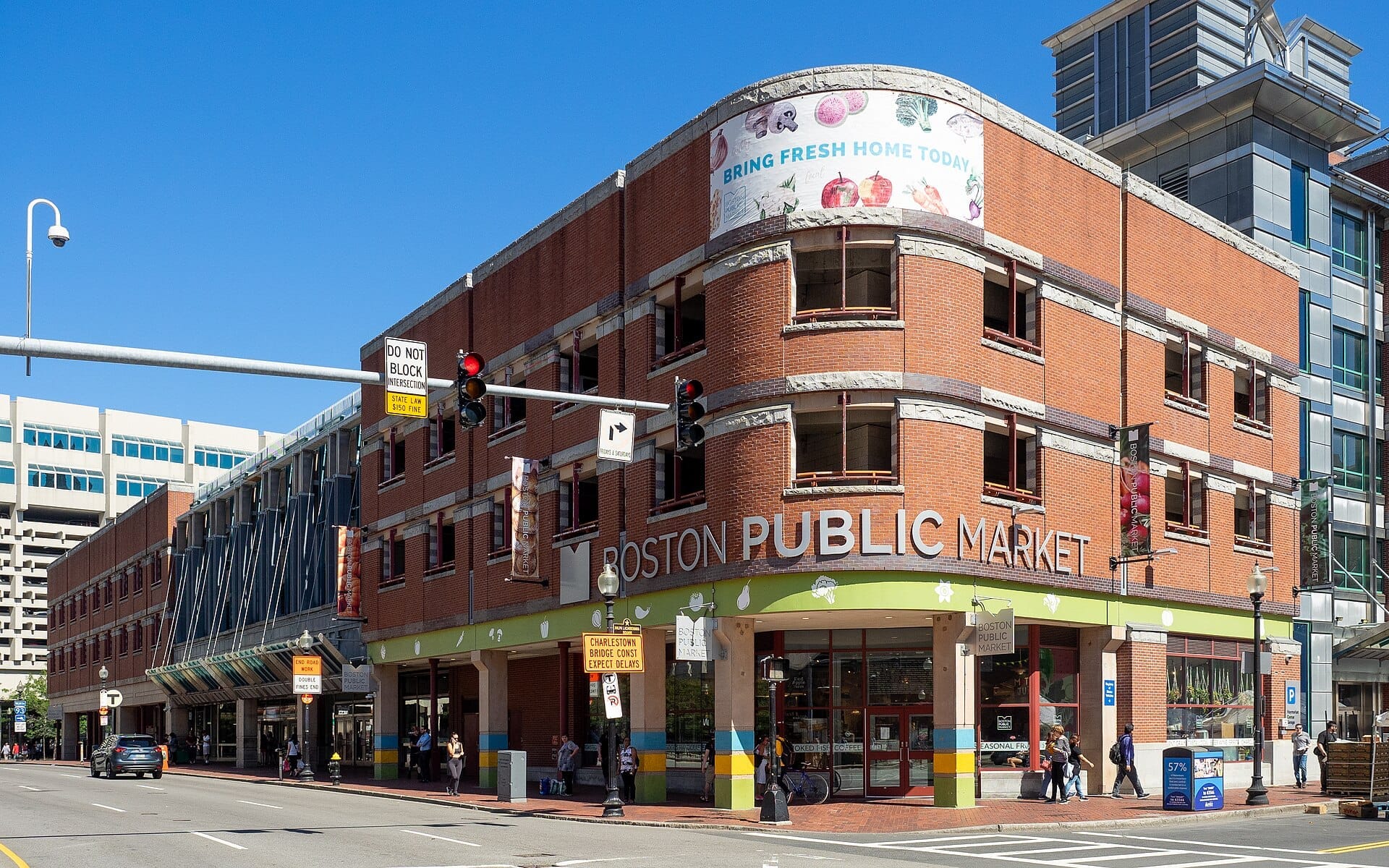
What Boston Public Market Actually Is
Boston Public Market opened in July 2015 in the heart of downtown and holds a distinction that no other market in the United States can claim: every single product sold inside must be grown, caught, raised, or produced in or originate from New England, with limited exceptions for items that cannot be grown locally. It is a condition written into every vendor agreement, with narrowly defined exceptions for items that cannot be sourced from New England. When you pick up a wedge of cheese, a jar of honey, or a bunch of kale here, it came from somewhere in the six-state region, full stop.
The result is a market with genuine coherence. More than 30 vendors operate year-round in fixed stalls across the single-floor indoor space, which has more than 28 vendor stalls and covers roughly 28,000 square feet. You will find fresh vegetables and fruit, sustainably caught seafood from the Gulf of Maine, grass-fed meats, artisan cheeses, local wine and spirits, freshly baked bread, and prepared foods ready to eat on the spot. The seasonal rotation of produce means the market looks and smells different in February than it does in September.
ℹ️ Good to know
Entry is completely free and no tickets are required. The market is open daily from 8:00 AM to 8:00 PM, year-round — rain, snow, or summer heat, though individual vendor hours and occasional holiday closures vary.
How the Market Changes Through the Day
Early morning, between opening at 8:00 AM and around 10:00 AM, is the quietest window. Vendors are arranging displays, the coffee stall line is short, and the produce sections are at their most fully stocked. The light inside is softer at this hour, filtered through the front windows, and the ambient noise is low enough that you can actually talk to the farmers behind the stalls. If you want a genuine conversation about where a product comes from, this is when to have it.
Midday on weekdays draws the lunch crowd from nearby offices and from tourists doing the Freedom Trail. The prepared food counters get busy, and the narrow central walkway fills up enough that navigation with a stroller or large bag requires patience. Weekends, particularly Saturday between 11:00 AM and 2:00 PM, are the most crowded by a significant margin. The atmosphere is social and energetic, but browsing at your own pace is harder.
Late afternoon, roughly 4:00 PM to 6:00 PM on weekdays, offers a second sweet spot. Commuters picking up dinner ingredients create a purposeful energy, but the tourist rush has typically subsided. Some produce vendors begin light discounting near closing to move perishable stock, which rewards flexible shoppers.
Tickets & tours
Hand-picked options from our booking partner. Prices are indicative; availability and final rates are confirmed when you complete your booking.
Boston Summer Night Trolley Tour and River Cruise
From 27 €Instant confirmationFree cancellationLEGOLAND Discovery Center Boston tickets
From 26 €Instant confirmationFree cancellationGhosts and Gravestones tour of Boston
From 39 €Instant confirmationFree cancellationBest of Boston tour
From 182 €Instant confirmationFree cancellation
Getting There and Getting Around Inside
The market sits directly above Haymarket MBTA Station, which serves the Green and Orange Lines. You can step off the train and be inside in under two minutes. It is also a short walk from North Station and sits at the edge of the North End, making it a natural stop on a broader downtown loop. The address is 100 Hanover Street.
If you are driving, validated parking is available at the Haymarket Garage at 136 Blackstone Street. Validation at the market reduces the cost to $3 for up to three hours, which is an unusually reasonable rate for downtown Boston. That said, the MBTA connection is so direct that driving here specifically adds unnecessary complexity.
Inside, the layout is a single floor with a main central corridor and stalls arranged on either side and around the perimeter. There are no stairs between sections. The floor is smooth and level, making navigation straightforward for wheelchairs and strollers. The space can feel dense when crowds peak, but the layout does not create dead ends or confusing branches.
💡 Local tip
Bring a reusable bag. Many vendors prioritize minimal packaging, and walking out with produce, bread, and a wedge of cheese in a single tote is far more manageable than juggling individual small bags.
What to Buy and What to Eat Here
The produce stalls are the backbone of the market. Depending on the season, expect winter squash and root vegetables from November through March, strawberries and asparagus in late spring, tomatoes and sweet corn in August, and apple varieties from September into November. Massachusetts and Vermont farms supply most of the fresh vegetables; the turnover is fast enough that stock is fresh rather than warehouse-aged.
The seafood counter is one of the more distinctive features of the market. Gulf of Maine fish, including species like haddock, pollock, and Atlantic mackerel, appear regularly alongside shellfish from New England coastal operations. This is a useful stop for anyone renting accommodation with a kitchen who wants to cook something local rather than eating out every meal.
For eating on the premises, the prepared food options range from fresh oysters to grain bowls to locally roasted coffee. The market also hosts regular cooking demonstrations and events, which are listed on the official site. If you are visiting downtown Boston for a longer trip, this pairs naturally with a walk to Faneuil Hall Marketplace nearby, though the two experiences are quite different in character: Faneuil Hall skews toward tourist-facing retail, while Boston Public Market is oriented toward local food production.
Historical and Cultural Context
The site has a longer history than the 2015 building suggests. The Haymarket area has been associated with public food vending in Boston for centuries. The outdoor Haymarket vendors who still operate on Fridays and Saturdays on Blackstone Street just outside the market's doors represent one of the oldest continuously operating open-air markets in the United States. The indoor Boston Public Market was deliberately established in dialogue with that tradition, creating a permanent, weather-protected complement to the seasonal outdoor stalls.
The all-New England sourcing requirement was not simply a branding choice. It reflects a broader movement in the region toward regional food systems, supporting small farms that might otherwise struggle to reach urban consumers. The Boston Public Market Association operates the market as a nonprofit 501(c)(3), which distinguishes it from purely commercial food halls. For travelers interested in how cities are approaching food sustainability, the market fits into a larger story worth exploring alongside Boston's culinary identity.
Photography and Sensory Notes
The interior is well-lit for a market, with overhead lighting supplemented by display lights at individual stalls. Colors are vivid when produce is in season, and the fish and cheese counters offer texture-rich close-up shots without requiring special equipment. Early morning provides the cleanest compositions without the crowds; midday shooting requires patience and the willingness to photograph around other shoppers.
The smell of the market shifts noticeably by section. The bread and pastry area near the entrance releases a warm, yeasty warmth in the morning. Moving toward the produce section, the smell becomes greener and earthier. Near the seafood counter, the briny, clean scent of fresh-caught fish is present but not overwhelming. These are not the artificial perfume-counter smells of a food hall designed for Instagram; they are actual working food smells.
Who Will Get the Most Out of This — and Who Might Not
Travelers who cook, who shop at farmers markets at home, or who are curious about regional American food culture will find the Boston Public Market especially rewarding. It also works well as a practical food stop during a day of sightseeing: grab coffee and a pastry in the morning, or pick up lunch before heading to the Rose Kennedy Greenway directly outside. Families with children do fine here; the space is manageable, and there are enough interesting things to look at to keep kids engaged for 30 minutes or so.
The market is less suited to travelers who are purely looking for a souvenir shopping experience or a buzzy food hall with international cuisine options. The local-only requirement means the vendor lineup does not include options from outside New England. If you are not particularly interested in regional produce or artisan food products, 30 minutes here is probably sufficient. It is also not a destination for late-night visits; the 8:00 PM closing time is firm.
⚠️ What to skip
The market closes at 8:00 PM daily. If you are planning an evening visit after dinner, you will likely find it shut. Check the official site for holiday hours, which may differ from the standard schedule.
Insider Tips
- Visit on a weekday morning if you want to talk to vendors directly. Staff have more time to explain sourcing and production when the crowd is thin, and you will get a much better sense of where specific products come from.
- The outdoor Haymarket vendors on Blackstone Street, operating Fridays and Saturdays, offer some of the cheapest produce in Boston. Combining both markets in a single visit gives you a full picture of the area's food culture — and lets you compare prices and variety.
- Check the Boston Public Market events calendar before you go. Cooking demonstrations, tasting events, and seasonal programming happen regularly and are often free. Showing up during a demo adds considerable depth to the visit.
- Validated parking at Haymarket Garage drops your cost to around $3 for three hours, but spaces fill quickly on weekends. Arrive before 11:00 AM if you plan to drive, or simply take the T and save yourself the stress.
- Some vendors sell products that are available in limited weekly quantities, particularly small-batch preserves, specialty cheeses, and certain smoked fish. If you see something specific you want, buy it when you see it rather than planning to return on a second loop.
Who Is Boston Public Market For?
- Food-curious travelers who want to understand New England's agricultural and fishing traditions firsthand
- Visitors staying in apartments or short-term rentals who want to cook with distinctly local ingredients
- Families looking for a practical, free, indoor activity that doubles as a meal stop
- Anyone combining a Freedom Trail walk with a look at contemporary Boston food culture
- Shoppers seeking locally produced pantry items — jams, honey, cheese, maple syrup — as gifts or souvenirs with a clear regional identity
Nearby Attractions
Other things to see while in Downtown & Financial District:
- Boston Common
Founded in 1634, Boston Common is the oldest public park in the United States and the civic anchor of downtown Boston. Free to enter and open year-round, it serves as a gathering place for locals, a landmark on the Freedom Trail, and the starting point for exploring everything the city has to offer.
- Boston Harbor Whale Watching
The New England Aquarium Whale Watch presented by Boston Harbor City Cruises sends a high-speed catamaran from Long Wharf out to Stellwagen Bank National Marine Sanctuary, one of the most productive whale feeding grounds on the East Coast. With onboard aquarium naturalists and a whale-sighting guarantee, it is one of the few Boston experiences that delivers on its premise.
- Custom House Tower
Standing 496 feet above McKinley Square, the Custom House Tower was Boston's tallest building for about half a century until 1964. Today it operates as a Marriott Vacation Club property, and its free public observation deck tours remain a lesser-known opportunity for a panoramic view of the harbor and skyline.
- Faneuil Hall Marketplace
Faneuil Hall Marketplace occupies four connected historic buildings in downtown Boston, anchored by the 1742 Faneuil Hall and stretching across the Quincy Market colonnade. Free to enter and open daily, it serves as both a working food and shopping destination and one of the most significant civic sites in American history.