Paul Revere House: Inside Boston's Oldest Surviving Urban Dwelling
Built around 1680 and home to the patriot silversmith from 1770 to 1800, the Paul Revere House is the oldest remaining structure in downtown Boston. Set in the heart of the North End on the Freedom Trail, this compact but richly layered historic house museum rewards visitors who take the time to look closely.
Quick Facts
- Location
- 19 North Square, North End, Boston, MA 02113
- Getting There
- Haymarket Station (Green/Orange Line), then a 10-minute walk through the North End
- Time Needed
- 45–75 minutes for the house and courtyard; longer if you linger in the surrounding North Square
- Cost
- Adults $6 | Seniors & college students $5.50 | Children (5–17) $1 | Ages 5 and under free
- Best for
- History enthusiasts, Freedom Trail walkers, families with older children, architecture lovers
- Official website
- www.paulreverehouse.org
What the Paul Revere House Actually Is
The Paul Revere House is a timber-framed colonial dwelling built around 1680, making it the oldest surviving structure in downtown Boston and one of the few remaining 17th-century urban homes in the entire United States. It sits on North Square in the North End, a small plaza that feels old in a way that most of Boston's historic sites — surrounded as they often are by modern traffic and signage — do not.
Paul Revere, the silversmith and patriot best known for his midnight ride of April 18, 1775, owned the house from 1770 to 1800. That thirty-year tenure covered the most consequential period of his life and of early American history. The house opened as a museum in April 1908, making it one of the earliest historic house museums in the nation.
The house sits directly on the Freedom Trail, Boston's 2.5-mile walking route connecting 16 historic sites. Most visitors arrive as part of a Freedom Trail walk, which is the most logical way to sequence the North End stops.
ℹ️ Good to know
Hours vary by season. April 15–October 31: open daily 10:00–17:15. November 1–April 14: open 10:00–16:15, but closed Mondays in January, February, and March. Closed Thanksgiving, Christmas Eve, Christmas Day, and New Year's Day. Verify current hours at paulreverehouse.org before visiting.
The Architecture: Why the Building Itself Matters
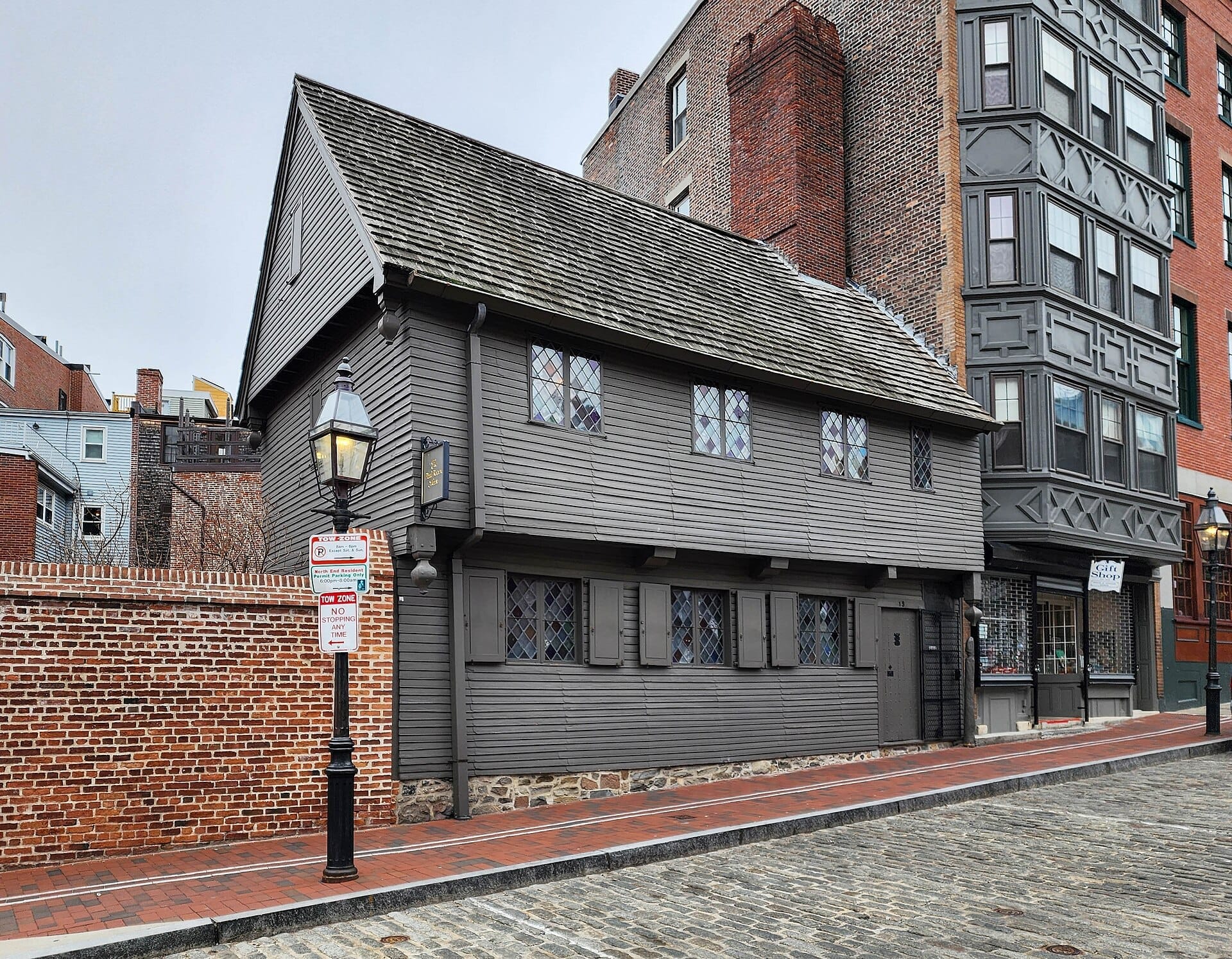
Most visitors come for Revere's story but leave with the architecture in their heads. The house is a two-and-a-half-story timber structure with a distinctive overhanging second floor — a design feature common to 17th-century English colonial construction but almost entirely gone from Boston's streetscape. The exterior cladding, the steep roof pitch, and the small casement windows with diamond-patterned glass are accurate restorations based on historical research conducted when the building was rehabilitated in the early 20th century.
Standing in North Square and looking at the facade, the scale is the first thing that registers. It is smaller than expectations built up by its reputation. The rooms inside are correspondingly compact: low ceilings, narrow doorways, and floors that creak in ways that feel structurally informative rather than theatrical. The house was built on the site of the former Second Church of Boston parsonage, and the ground beneath it has layers of history going back to the earliest decades of European settlement in Massachusetts.
Tickets & tours
Hand-picked options from our booking partner. Prices are indicative; availability and final rates are confirmed when you complete your booking.
Boston Summer Night Trolley Tour and River Cruise
From 27 €Instant confirmationFree cancellationLEGOLAND Discovery Center Boston tickets
From 26 €Instant confirmationFree cancellationGhosts and Gravestones tour of Boston
From 39 €Instant confirmationFree cancellationBest of Boston tour
From 182 €Instant confirmationFree cancellation
What You See Inside: A Room-by-Room Reality Check
The ground floor contains the hall and parlor, furnished with pieces that reflect the period of Revere's ownership. Some items belonged to Revere's family; others are period-appropriate reproductions or acquisitions. Interpretive panels are present but not overwhelming, and the rooms are small enough that you read the context naturally as you move through them. The smell is a mixture of old wood and the faint mustiness that comes with any structure of this age, not unpleasant, and oddly authenticating.
The second floor is accessible via elevator in the visitor center and a connecting walkway, which means most of the experience is available to visitors with mobility limitations. The upper rooms include the chamber where Revere and his large family slept, and the displays here deal more directly with his personal biography: his work as a silversmith and engraver, his role in the Sons of Liberty, and the logistics of the midnight ride itself. The famous signal — one lantern if by land, two if by sea — is explained in clear, non-sensationalized terms.
The courtyard behind the house connects to the Pierce-Hichborn House next door, a 1711 brick structure also owned by the Paul Revere Memorial Association and occasionally open for tours. The courtyard itself is calm and shaded, a useful pause point if you're walking the full Freedom Trail on a warm day.
💡 Local tip
Photography is permitted throughout the house without flash. The courtyard offers the best exterior angle for photographs of the overhanging second story — try arriving before 11:00 AM when direct light hits the facade.
Timing Your Visit: How the Experience Changes by Hour
The house is at its most atmospheric in the first hour after opening. The rooms are quieter, the staff have more time to answer questions, and North Square itself has not yet filled with tour groups making their way down the Freedom Trail. By late morning, particularly on summer weekends, the small interior rooms can feel crowded, and the experience becomes less contemplative.
Midday visits in summer are the least rewarding. Tour groups cycle through on tight schedules, the courtyard fills up, and the narrow rooms can get warm. If midday is your only option, it is still worth coming — the site is important and efficiently laid out — but go in with adjusted expectations.
Winter visits have a particular quality that summer cannot replicate. With fewer visitors and the North End quieter than usual, the 17th-century scale of the building and the square feel more present. The reduced hours (closing at 16:15) mean you need to plan carefully, and the Monday closures in January through March catch people off guard.
⚠️ What to skip
The house is closed on Mondays in January, February, and March. Many visitors combining this with a winter weekend in Boston miss this. Double-check the schedule at paulreverehouse.org, especially around Thanksgiving, Christmas Eve, Christmas Day, and New Year's Day.
Getting There and Navigating the North End
The most practical transit approach is the Green or Orange Line to Haymarket Station, followed by a ten-minute walk northeast through the North End. The walk takes you past the Blackstone Block and along Hanover Street, the neighborhood's main commercial spine, lined with Italian bakeries and cafes. The smell of fresh bread and espresso from the pastry shops is a consistent feature of this walk at almost any hour.
From Haymarket, head north on Congress Street, cross under the elevated expressway ramp, and follow the red-brick Freedom Trail line painted on the sidewalk. The route passes Old North Church further along, making it natural to continue north after the Revere House if you are walking the full trail.
Parking in the North End is limited and expensive; driving here is not recommended. If you are coming from the waterfront side, the Rose Kennedy Greenway connects the Seaport area to the North End entrance at surface level, and the walk from Long Wharf takes about ten to twelve minutes on foot.
Payment at the house accepts cash and major credit cards (with a small minimum for card transactions). The admission price is one of the lowest of any major historic site in Boston, which makes it accessible for families and budget travelers who may be skipping pricier museums.
Historical Context: Revere Beyond the Midnight Ride
Paul Revere's popular image collapses nearly entirely into one event, but the house complicates that reduction in useful ways. Revere was a working craftsman who operated a silversmith shop not far from this house, a successful businessman who later expanded into copper production, and a community figure deeply embedded in Boston's political life. The house connects to the broader story of colonial and revolutionary Boston that the history of Boston makes plain: this was a city where artisans, merchants, and radicals lived within blocks of each other, sharing the same narrow streets and the same grievances against British taxation.
Revere bought the house in 1770, a decade after it had been converted from a single-family home into a two-family dwelling, and then into a tenement. He and his second wife Rachel Walker lived here with their children during the years leading up to the Revolution and the early decades of the new republic. He sold the house in 1800, and by the late 19th century the building had cycled through various commercial uses including a candy store and a bank. The preservation effort that produced the current museum was driven by Revere's great-grandson John P. Reynolds Jr., who recognized the building as the last surviving 17th-century structure in downtown Boston.
Who Will Get the Most Out of This Visit
Visitors with a genuine interest in early American history, colonial architecture, or the mechanics of the Revolutionary period will find the Paul Revere House substantive and well-presented. Families with children aged eight and older tend to engage well with the human-scale story of Revere and the clearly explained significance of the midnight ride.
The house is less suited to visitors whose primary interest is grand interiors or sweeping exhibition design. The rooms are small, the displays are modest, and the experience is quiet rather than theatrical. If you are expecting the production values of a large national museum, you will feel the gap. This is a historic house museum in the truest sense: the building is the exhibit, and attention to detail rewards more than speed.
Visitors doing a compressed Freedom Trail in a single day sometimes skip the interior to save time. That is a reasonable choice if time is very tight, but the exterior of the house and North Square are worth at least a brief stop regardless. For a fuller picture of how to pace the trail, the Boston walking tours guide covers sequencing options in detail.
Insider Tips
- Arrive at or just after 10:00 AM opening time, particularly on summer weekends. The interior rooms hold only a handful of visitors comfortably, and the difference between a quiet early visit and a midday crowd is significant.
- Check whether the Pierce-Hichborn House next door is offering tours on your visit date. It is owned by the same organization and provides a revealing contrast: the 1711 brick structure shows exactly how Boston's architecture evolved within just one generation.
- The $1 children's admission makes this one of the most affordable history experiences in Boston. Combine it with the free exterior visits to Granary Burying Ground and Park Street Church on the same Freedom Trail walk to keep costs manageable.
- North Square itself is worth a few quiet minutes before you enter the museum. It is one of the oldest public spaces in Boston, and in the early morning before tour groups arrive, it has a stillness that the interior cannot quite replicate.
- If you are visiting in fall or spring, time your trip to include lunch on Hanover Street afterward. The Italian bakeries and cafes in the North End are a legitimate attraction in their own right, and the combination of the house museum and a neighborhood walk makes for a complete half-day.
Who Is Paul Revere House For?
- American history enthusiasts who want depth beyond the surface-level midnight ride narrative
- Freedom Trail walkers looking to understand each site rather than simply check it off
- Families with school-age children studying the Revolutionary War period
- Architecture and preservation buffs interested in 17th-century colonial construction techniques
- Budget-conscious travelers: at $6 for adults and $1 for children, it is one of Boston's best-value historic sites
Nearby Attractions
Other things to see while in North End:
- Old North Church
Built in 1723 and forever linked to Paul Revere's midnight ride, Old North Church (officially Christ Church in the City of Boston) is the oldest standing church building in Boston. A stop on the Freedom Trail in the North End, it rewards visitors who take time to understand what actually happened here on the night of April 18, 1775.