Old North Church: Where the American Revolution Began with Two Lanterns
Built in 1723 and forever linked to Paul Revere's midnight ride, Old North Church (officially Christ Church in the City of Boston) is the oldest standing church building in Boston. A stop on the Freedom Trail in the North End, it rewards visitors who take time to understand what actually happened here on the night of April 18, 1775.
Quick Facts
- Location
- 193 Salem Street, North End, Boston, MA 02113
- Getting There
- Haymarket or North Station (MBTA Orange & Green Lines), both under 1 mile on foot
- Time Needed
- 45 minutes to 1.5 hours depending on tour type
- Cost
- Discovery Pass (self-guided admission, audio, and exhibits) $10 adults / $5 children 6–12; Bell Chamber Tour + Discovery Pass $15 adults / $10 children 6–12; Children 5 and under free
- Best for
- American history enthusiasts, Freedom Trail walkers, architecture admirers, families with older kids
- Official website
- oldnorth.com
What Old North Church Actually Is (and Why It Matters)
Old North Church, formally known as Christ Church in the City of Boston, was completed in 1723 and holds the distinction of being the oldest standing church building in Boston. It is an active Episcopal parish of the Diocese of Massachusetts, which means this is not a museum frozen in amber: Sunday worship at 11:00 a.m. continues alongside the historic site visitation.
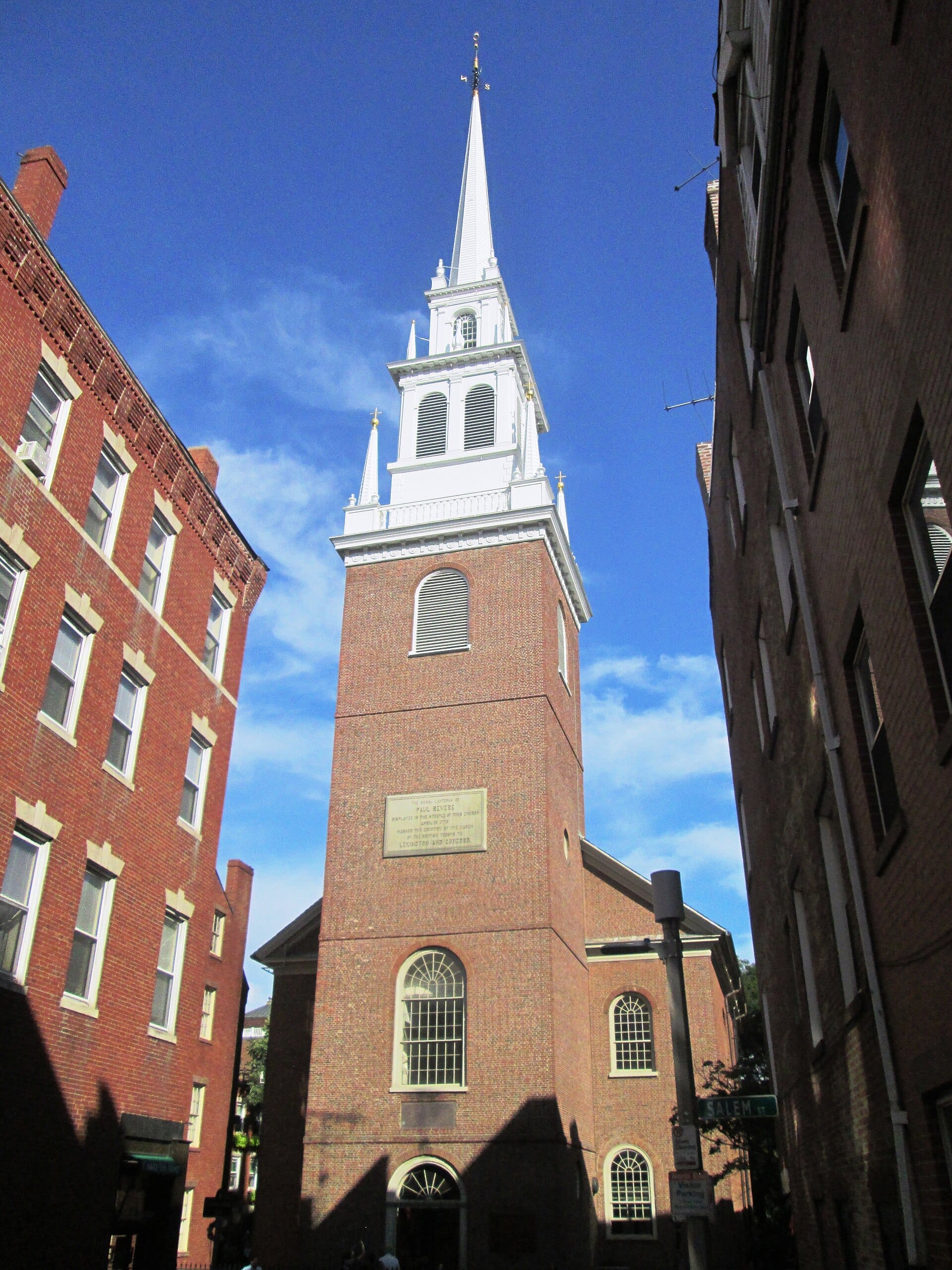
The building's claim on American memory rests on a single night: April 18, 1775. Church sexton Robert Newman is traditionally said to have climbed the steeple and shown two lanterns briefly in the window, signaling to patriots across the Charles River that British troops were moving by water toward Lexington and Concord. That signal set Paul Revere's ride in motion, and within hours the first shots of the American Revolution had been fired at the Battles of Lexington and Concord. The church received a commemorative tablet recognizing it as the 'Old North Church of Paul Revere fame' in 1878, though the event itself had already cemented its place in national memory long before.
It sits on the Freedom Trail, Boston's 2.5-mile walking route connecting 16 historic sites. If you're walking the trail from downtown, Old North Church appears near the northern end of the route, after the Paul Revere House, making it a natural climax to the North End portion of the walk.
💡 Local tip
Hours vary by season. As of the most recent schedule, the site is generally open for visitors and tours daily from 10:00–17:00 Monday–Saturday and 12:30–17:00 on Sunday, with seasonal adjustments—always check oldnorth.com before you visit for current hours, including any winter closures.
Inside the Church: What You'll See
The interior is immediately striking for its restraint. White-painted box pews line the nave in neat rows, each one originally owned by a specific congregation family, with brass plaques still marking some. The pews are tall-sided, designed to retain body heat from small warming boxes in a time before central heating. Sitting in one gives you a visceral sense of how deliberately the colonial congregation separated themselves from one another by social standing.
Natural light enters through clear-paned windows rather than colored glass, which keeps the interior bright and lets you see the Georgian architectural detail clearly: the arched ceiling, the carved wooden galleries along three sides, and the substantial pipe organ above the entry. The organ dates to later than the building itself, but its scale fits the space well. The whole room is more intimate than its historical weight suggests it should be.
Look up toward the steeple from outside: the current steeple is not the original. The first was destroyed in a storm in 1804, and the second was felled by Hurricane Carol in 1954. The current version was rebuilt based on the original design by William Price, who modeled the church on the work of Sir Christopher Wren. The steeple holds eight bells cast in 1744, among the oldest church bells still in active use in the United States.
Tickets & tours
Hand-picked options from our booking partner. Prices are indicative; availability and final rates are confirmed when you complete your booking.
Tour North End Boston with a Mafia Mission City Exploration Game
From 7 €Instant confirmationFree cancellationBoston North End Tourist Scavenger Hunt
From 52 €Instant confirmationNorth End pizza tour
From 0 €Instant confirmationBoston North End guided food tour
From 59 €Instant confirmationFree cancellation
The Lantern Story: What the Guides Explain (and What They Don't)
Most visitors arrive knowing the phrase 'one if by land, two if by sea' from Henry Wadsworth Longfellow's 1861 poem about Paul Revere's ride. The site's interpretive staff is careful to contextualize what the poem gets right and where it dramatizes. The lanterns were not a signal to Revere himself: he had already left by boat before the lanterns were hung. They were a signal to patriots in Charlestown, in case Revere's mission was intercepted and word needed another way across the water.
The Bell Chamber specialty tour (currently bundled with a higher-priced ticket than general admission) goes deeper into this history, including the roles of the other riders that night and the political climate that made the signal necessary. If you have more than a passing interest in the Revolution, the specialty tour is worth the extra cost over general admission alone.
ℹ️ Good to know
The lanterns on display inside the church are replicas. The actual lanterns used on the night of April 18, 1775, do not survive. One period lantern long associated with the event is held at the Concord Museum. The site staff will tell you this directly, which is a mark of interpretive honesty worth noting.
How the Experience Changes by Time of Day
Weekday mornings, particularly Tuesday through Thursday before 11:00, are the quietest times to visit. The church's narrow Salem Street location means tour groups often bottleneck on the sidewalk outside, and the interior can feel cramped when a school group or large guided party is present. Arriving at opening time gives you a chance to stand in the nave without competition and hear the wooden floor creak beneath you without background noise.
Midday on weekends is reliably crowded, especially in July and August when Freedom Trail foot traffic peaks. The small gift shop and the colonial-era garden behind the church can feel overrun. If you visit on a summer Sunday, note that worship at 11:00 means the church itself is not available for tourist access during the service. General visiting resumes at 11:30.
Late afternoon on a weekday in September or October is perhaps the best of all scenarios. The crowds thin after 3:30, the light through the clear windows softens, and the North End's narrow streets outside are at their most atmospheric. The smell of the neighborhood shifts in the late afternoon too: the Italian bakeries and cafes on nearby Hanover Street send aromas through the blocks in a way that feels specific to this corner of Boston.
Getting There and Getting Around the North End
The closest MBTA stops are Haymarket (Orange and Green Lines) and North Station (Orange and Green Lines), each less than a mile and roughly a 10-minute walk from the church. Neither is directly adjacent, and the walk from Haymarket takes you through the edge of the North End along Cross Street and into the neighborhood proper. There is no subway station inside the North End itself, which is part of why the neighborhood has retained its pedestrian character.
Driving is not recommended. Parking in the North End is extremely limited, the streets are narrow and one-way, and paid parking garages near Faneuil Hall add meaningful time and cost to the visit. Ride-hailing (Uber, Lyft) works well for drop-off at the corner of Salem and Hull Streets, and pickup is straightforward once you step back to a slightly wider street.
If you're combining Old North Church with other Freedom Trail stops, a logical sequence puts the Paul Revere House two blocks south as an immediate predecessor on the route. The two sites together take about two hours and tell a coherent story about North End's revolutionary-era history.
💡 Local tip
Wear comfortable walking shoes. Salem Street is cobblestoned in sections, and the North End's streets are uneven. Flat-soled shoes or sneakers are far more practical than anything with a heel.
Photography, Accessibility, and Practical Notes
Photography is permitted inside the church for personal use. The best interior shot is from the back of the nave looking toward the altar, ideally when the box pews are not occupied by other visitors. The exterior steeple photographs well from the small square at the intersection of Salem and Hull Streets, which gives enough distance to capture the full height. In fall, a maple tree near the garden to the rear occasionally frames the rear facade with color.
The Old North Church and Historic Site lists its sanctuary as wheelchair accessible, with accessible restrooms on site. The church itself is on a single level for the main nave, which is manageable, though some of the adjacent historic site areas may have limitations worth confirming in advance at oldnorth.com.
This attraction is suitable for children who have some context for the Revolution, roughly ages 8 and up. Younger children may find the interior visit brief and abstract. For families with very young children, the Boston with kids guide covers nearby alternatives that might better hold their attention.
Who Should Temper Their Expectations
Old North Church is compact. The main church interior takes under 15 minutes to walk through without a tour. Visitors expecting a grand cathedral scale or elaborate museum exhibits will find the experience more modest than the historical significance implies. The site is better understood as an intimate, working parish with strong interpretive programming rather than a large-scale attraction.
If your interest is purely architectural rather than historical, Boston's Trinity Church in Copley Square offers far more dramatic interior architecture. Old North Church's power is almost entirely about what happened here rather than the space itself.
Visitors who have already done a deep dive into the Freedom Trail and American Revolution sites may find general admission without a specialty tour leaves them wanting more depth. In that case, the Discovery Pass plus Bell Chamber tour ($15 adults) is the right choice, not a skip.
Insider Tips
- The colonial-era garden behind the church is free to enter and rarely crowded. It contains a bust of George Washington and a small memorial space, and it offers a quieter corner of the North End that most visitors walk past without entering.
- If you want to visit without paying admission, you can attend Sunday worship at 11:00. The service is open to the public, and you'll experience the space as it was intended to be used, not as a tourist attraction.
- The steeple climb is not a standard part of the public visit and is not regularly offered for general admissions. If steeple access interests you, check oldnorth.com for any scheduled specialty programs before your trip.
- Combine your visit with a walk along Hanover Street afterward. The North End's concentration of Italian bakeries, pastry shops, and cafes means that finishing your historical visit with an espresso and a cannolo is both easy and quite good.
- Come on a weekday in March, April, or May for the best balance of access and crowd size. Spring brings mild temperatures, the seasonal hours have reopened after winter, and summer tour groups haven't yet arrived in full force.
Who Is Old North Church For?
- American history enthusiasts who want direct contact with a primary site of the Revolution rather than a reconstructed or interpreted replica
- Freedom Trail walkers completing the North End stretch of the route
- Families with children aged 8 and up who have some classroom context for Paul Revere and the midnight ride
- Architecture admirers interested in Georgian church design and Christopher Wren's influence on colonial American building
- Solo travelers who appreciate sites that reward slow, attentive visits over passive sightseeing
Nearby Attractions
Other things to see while in North End:
- Paul Revere House
Built around 1680 and home to the patriot silversmith from 1770 to 1800, the Paul Revere House is the oldest remaining structure in downtown Boston. Set in the heart of the North End on the Freedom Trail, this compact but richly layered historic house museum rewards visitors who take the time to look closely.