King's Chapel: Boston's First Anglican Church and a Pivotal Piece of American History
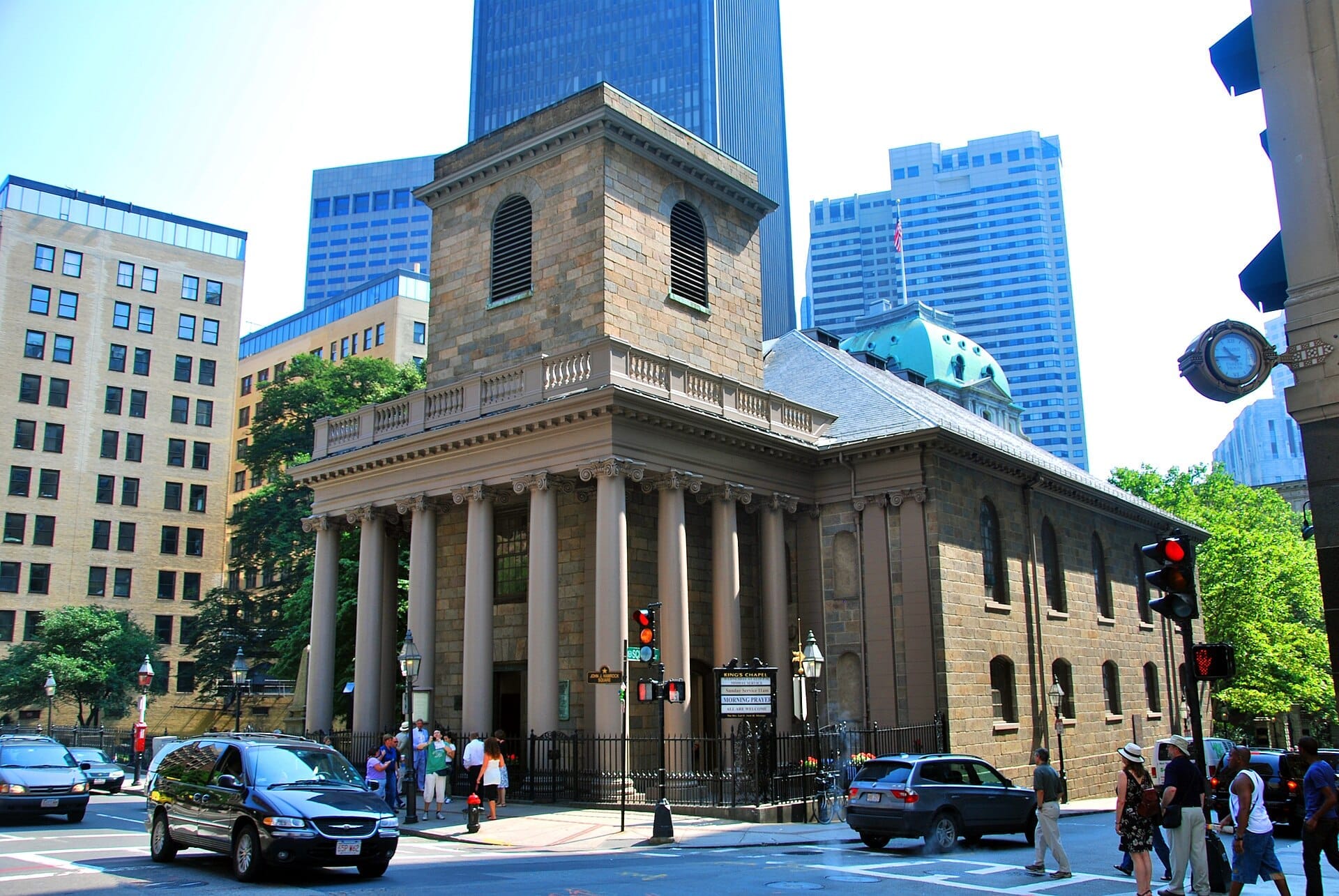
Standing at the corner of Tremont and School Streets in downtown Boston, King's Chapel is a granite landmark completed in 1754 on the site of Boston's first Anglican church. It became the first Unitarian congregation in the United States in 1785 and remains an active house of worship, with public visiting hours typically offered Monday through Saturday.
Quick Facts
- Location
- 58 Tremont Street, corner of School Street, Downtown Boston, MA 02108
- Getting There
- MBTA Park Street Station (Green/Red Line) or Government Center Station (Green/Blue Line), both within about a 5-minute walk
- Time Needed
- 30–60 minutes for self-guided visit; up to 90 minutes with a guided tour
- Cost
- General admission $5 USD (pay at door, no reservation needed); guided tours typically $8–$10 USD
- Best for
- History enthusiasts, Freedom Trail walkers, architecture lovers, and travelers interested in early American religion
- Official website
- www.kings-chapel.org
What King's Chapel Actually Is
King's Chapel is a working Unitarian congregation housed in one of the most historically loaded buildings in the United States. Founded in 1686 as Boston's first Anglican church and the first Anglican church in New England, the current granite structure was designed by architect Peter Harrison and completed in 1754. After the American Revolution drove away its royalist congregation, the remaining members reorganized in 1785 to form the first Unitarian congregation in the United States — a theological pivot that made the chapel a landmark of American religious history, not just colonial architecture.
The building itself is notable for what Peter Harrison did not finish. The original plans called for a wooden steeple, but funds ran short and the tower was never completed. What you see today is a square, flat-topped granite tower that gives the chapel an unusually blunt silhouette among Boston's skyline. That incomplete profile is not a flaw — it is a piece of the building's story.
ℹ️ Good to know
King's Chapel is generally open Monday through Saturday, 10:00 am to 5:00 pm, and closed on Sundays to the general public. Hours are subject to seasonal change — check the chapel's Instagram for real-time updates before your visit.
Stepping Inside: What You See and Feel
The moment you step through the entrance on Tremont Street, the temperature drops noticeably — the thick granite walls work as natural insulation, keeping the interior cool even on humid Boston summer afternoons. The main sanctuary is compact and symmetrical, lined with enclosed box pews that date to the colonial era. These pews were originally rented by wealthy Boston families, who could lock them and furnish them privately. The wood is dark and worn smooth, and the brass hardware on each gate still catches the light.
The pulpit deserves specific attention. It is widely identified as one of the oldest American pulpits still in continuous use, and it stands roughly centered at the front of the sanctuary with a carved canopy above it. Whether or not that claim impresses you on paper, seeing a piece of furniture that has been in active use since before the United States existed tends to make it concrete in a way that a museum display case cannot.
Morning light enters through the arched windows along the nave and falls in wide, warm bands across the white interior walls. If you arrive close to opening time on a clear day, the light is noticeably better for photography and the space feels more open. By midday the light flattens, and by mid-afternoon the western windows cast direct glare. Come before noon if the interior is your primary interest.
💡 Local tip
Photography is generally permitted inside the chapel during visitor hours, but avoid using flash near the historic woodwork. The box pews photograph best from the rear of the nave looking toward the pulpit, especially in morning light.
Tickets & tours
Hand-picked options from our booking partner. Prices are indicative; availability and final rates are confirmed when you complete your booking.
Freedom Trail self-guided walking audio tour in Boston
From 9 €Instant confirmationFree cancellationGhosts of Boston self-guided walking tour
From 9 €Instant confirmationFree cancellationHistoric Plymouth self-guided walking audio tour
From 13 €Instant confirmationFree cancellationDowntown Freedom Trail to Back Bay via Beacon Hill walking tour
From 38 €Instant confirmationFree cancellation
The History Beneath the Granite
The original King's Chapel, built in 1686 on land seized by royal Governor Edmund Andros from the adjacent burying ground, was a wooden structure. The Puritan majority in Boston bitterly resented the imposition of an Anglican church on their colony, and the land grab from the cemetery did not help. The current stone building was constructed around the original wooden one, which was then dismantled and removed through the windows — a construction method chosen specifically to keep the congregation worshipping throughout the building process.
That history of friction between the Anglican establishment and Boston's Puritan community runs directly into the larger story of the American Revolution. The Freedom Trail passes directly in front of King's Chapel, and the chapel's own transformation after the Revolution — from the official church of royal governors to the first Unitarian congregation in America — mirrors the city's own break from British authority.
The burying ground immediately adjacent to the chapel is often cited as the oldest in Boston, predating the chapel itself. It holds the graves of John Winthrop (the first Governor of Massachusetts Bay Colony), William Dawes (who rode alongside Paul Revere on the night of April 18, 1775), and other figures central to early New England history. Entry to the burying ground is free and managed separately by the City of Boston, not tied to chapel admission.
If Boston's colonial and revolutionary past is a primary interest, King's Chapel is one of several interconnected stops worth planning together. The Granary Burying Ground and the Old South Meeting House are both within a few blocks and tell adjacent chapters of the same story.
The Burying Ground: Don't Walk Past It
Most visitors focus on the chapel interior and spend only a few minutes in the adjacent King's Chapel Burying Ground, which is a mistake. Established in 1630, it is the oldest cemetery in Boston, and the contrast between the weathered slate headstones — many carved with winged skulls and hourglasses — and the stone facade of the chapel beside them gives the space a texture you do not find in newer cemeteries.
The inscriptions on many stones are still legible, and reading them takes time. The oldest markers use 17th-century spelling and phrasing that takes a moment to parse. On weekday mornings, the burying ground is often nearly empty, which makes it a quiet spot in a neighborhood that is otherwise densely trafficked. On weekday afternoons and weekends, Freedom Trail groups move through steadily.
⚠️ What to skip
The burying ground has uneven ground and some raised grave markers that create tripping hazards. Wear shoes with grip, particularly after rain, when the brick pathways become slick.
Getting There and Practical Logistics
King's Chapel sits at 58 Tremont Street, at the corner of School Street, in the heart of downtown Boston. The Park Street MBTA Station (served by the Green and Red Lines) is roughly a 4-minute walk along Tremont Street. Government Center Station (Green and Blue Lines) is approximately the same distance in the opposite direction. There is no dedicated visitor parking at the chapel — driving to this location is not advisable, and street parking on surrounding blocks is tightly controlled. Plan to arrive by T.
The chapel sits on the Freedom Trail route, so many visitors arrive as part of a longer walking tour of downtown. The trail is marked with a line of red bricks embedded in the sidewalk, and King's Chapel appears early in the sequence — roughly the third stop if you begin at Boston Common. Allow time to slow down here; it is one of the richer stops on the trail in terms of content per square foot.
General admission is $5 USD per person, paid at the door. No advance reservation is required for individual visitors. Guided tours carry an additional fee, typically $8 to $10 USD and offer considerably more interpretive depth, particularly regarding the chapel's transition from Anglicanism to Unitarianism and the architectural decisions Peter Harrison made with the stone building. If your visit time is limited to 30 minutes, the self-guided option covers the key spaces. If you have an hour, the guided tour is worth the addition.
The chapel is listed as wheelchair accessible by the Freedom Trail Foundation. Visitors with specific accessibility needs are encouraged to contact the chapel by email in advance, particularly for group visits.
How the Experience Changes by Time of Day
Arriving at opening, around 10:00 am on a weekday, gives you something rare in downtown Boston: a quiet moment inside a old building. The sanctuary is empty, the light from the eastern windows is clean and angled, and the creaking of the wooden floors is the only sound. This is the window for photography and unhurried reading of the interpretive materials.
By late morning and into the lunch hour, Freedom Trail groups begin moving through in larger numbers. Guided groups in the sanctuary can fill the space quickly, and the acoustic quality of the stone-and-wood interior means conversation carries. If you prefer solitude, Tuesday through Thursday mornings are generally quieter than Fridays and Saturdays.
The chapel is closed to general visitors on Sundays, when it holds regular worship services. If your Boston visit falls on a Sunday, plan King's Chapel for another day. There are no exceptions to general visitor access on Sundays.
Who This Attraction Suits and Who It Does Not
King's Chapel works well for travelers following the Boston history trail, architecture enthusiasts interested in pre-Revolutionary Georgian design, and anyone who wants to understand the religious and political tensions of colonial New England in a concrete setting rather than through a textbook. The $5 admission is low enough that it is worth the stop even on a tight budget.
Visitors expecting dramatic scale or ornate decoration may find the interior understated. King's Chapel is not a cathedral — it is a mid-sized colonial church with a spare, well-preserved interior. Its power comes from age and historical context, not spectacle. Travelers focused primarily on contemporary culture, nightlife, or outdoor experiences will find this stop less relevant to their itinerary.
Young children can be engaged here with a specific focus — the box pews with their latching doors are tactilely interesting, and the burying ground captures attention — but the chapel requires a slower pace than most family-oriented attractions. If you are traveling with children, pairing it with a stop at Boston Common directly afterward helps balance the energy.
Insider Tips
- The Tuesday noon recital series (held most Tuesdays at 12:15 pm) offers free or low-cost organ and chamber music performances inside the sanctuary — a chance to hear the building's acoustics at their best. Check the King's Chapel website for the current schedule before your visit.
- The Paul Revere bell hanging in the tower is one of the bells Revere himself cast. It is described on the King's Chapel website as 'the sweetest bell we ever made' — Revere's own words. You cannot see it from inside during a standard visit, but knowing it is there adds a layer to the tower's stubby silhouette.
- If you are reading the burying ground markers, look for the graves along the northern wall closest to the chapel building — these tend to be the oldest and most legible, with the best-preserved 17th-century carvings.
- Freedom Trail crowds peak between 11:00 am and 2:00 pm, especially on weekends. A visit before 10:30 am or after 3:30 pm significantly reduces the number of tour groups moving through the space simultaneously.
- The granite exterior changes appearance significantly in different weather. On overcast days the stone looks almost gray-blue; in direct sunlight it reads as warm buff. If exterior photography matters to you, an overcast morning produces more even tones.
Who Is King's Chapel For?
- History travelers following the Freedom Trail or researching colonial and Revolutionary-era Boston
- Architecture enthusiasts interested in Georgian design and Peter Harrison's work
- Travelers interested in the origins of American Unitarianism and religious history
- Budget-conscious visitors looking for substantive historical content at low cost
- Solo travelers and couples who appreciate unhurried, quiet spaces with interpretive depth
Nearby Attractions
Other things to see while in Downtown & Financial District:
- Boston Common
Founded in 1634, Boston Common is the oldest public park in the United States and the civic anchor of downtown Boston. Free to enter and open year-round, it serves as a gathering place for locals, a landmark on the Freedom Trail, and the starting point for exploring everything the city has to offer.
- Boston Harbor Whale Watching
The New England Aquarium Whale Watch presented by Boston Harbor City Cruises sends a high-speed catamaran from Long Wharf out to Stellwagen Bank National Marine Sanctuary, one of the most productive whale feeding grounds on the East Coast. With onboard aquarium naturalists and a whale-sighting guarantee, it is one of the few Boston experiences that delivers on its premise.
- Boston Public Market
Open daily from 8:00 AM to 8:00 PM and free to enter, Boston Public Market brings together more than 30 New England farmers, fishers, and food artisans in a year-round indoor market above Haymarket Station. It is the first public market in the United States to require that everything sold is produced in or originates from New England.
- Custom House Tower
Standing 496 feet above McKinley Square, the Custom House Tower was Boston's tallest building for about half a century until 1964. Today it operates as a Marriott Vacation Club property, and its free public observation deck tours remain a lesser-known opportunity for a panoramic view of the harbor and skyline.