Park Street Church: Boston's Landmark at the Corner of History
Standing at the corner of Park and Tremont Streets since 1809, Park Street Church anchors one of Boston's most historically charged intersections. Free to visit and steps from the MBTA's Park Street station, it is a key stop on the Freedom Trail and one of downtown Boston's most recognizable architectural landmarks.
Quick Facts
- Location
- 1 Park Street, Boston, MA 02108 (corner of Park & Tremont Streets, edge of Boston Common)
- Getting There
- Park Street Station (MBTA Green & Red Lines) — directly adjacent
- Time Needed
- 20–40 minutes for a self-guided visit; allow more time if joining a Freedom Trail tour
- Cost
- Free admission; no ticketing required
- Best for
- History enthusiasts, Freedom Trail walkers, architecture admirers, and first-time Boston visitors
- Official website
- www.parkstreet.org
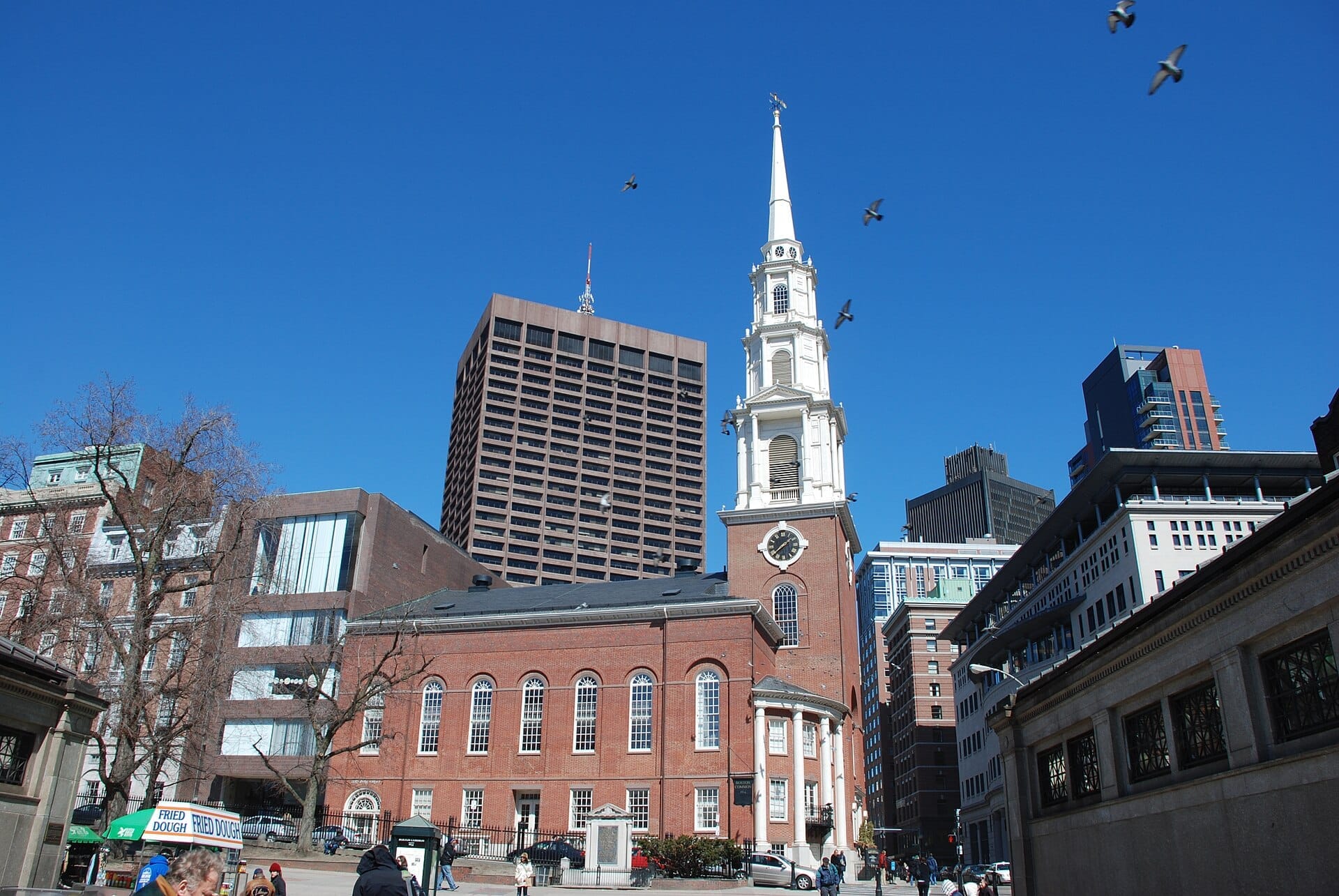
What You're Looking At: The Steeple That Defined a Skyline
Park Street Church rises 217 feet above the corner of Park and Tremont Streets, its white steeple in the Federal style visible for a considerable distance across downtown Boston. Designed by architect Peter Banner and completed in 1809, it occupied a site that had previously served as the town's grain storage facility, the so-called granary, which gave the adjacent Granary Burying Ground its name. At the time of construction, the steeple was the tallest point in Boston, and for travelers arriving by road or sea it functioned as the city's most legible landmark.
The building's proportions remain striking even in a modern streetscape. The red-brick facade is organized in the Federal tradition, with a projecting portico and an arcaded base beneath the tower. Banner drew on Christopher Wren's English church designs, which influenced much of early American ecclesiastical architecture, and the result is a structure that looks settled and purposeful rather than decorative. Stand at the foot of the steps and look up: the steeple narrows through three distinct stages before terminating in a small copper dome, a detail that photographs rarely capture at full scale.
💡 Local tip
Visitor access to the interior is seasonal, generally limited to summer months. If you are traveling outside that window, the exterior and its position at the edge of Boston Common still make it worth a stop on any Freedom Trail walk.
Historical Weight: What Happened Here
Park Street Church sits on the Freedom Trail, the 2.5-mile marked route connecting 16 sites of historical significance across downtown Boston and Charlestown. But even among those sites, Park Street Church carries a particular density of American history. The church is associated with some of the most consequential social movements of the 19th century.
William Lloyd Garrison delivered his first major public antislavery address from this pulpit in 1829, a speech that helped set the course of the American abolitionist movement. The hymn "America" ("My Country, 'Tis of Thee") was sung publicly for the first time here on July 4, 1831. During the War of 1812, the church's crypt was reportedly used to store gunpowder, earning the intersection the early nickname "Brimstone Corner." That nickname has never entirely disappeared from local usage.
The church is an active Congregationalist congregation, not a preserved monument. That distinction matters: the building is maintained as a living institution, which means the interior reflects careful stewardship rather than museum-style restoration. For visitors interested in the broader sweep of Boston's religious and civic history, the nearby Granary Burying Ground is directly adjacent and provides a natural extension of any visit to this block.
Tickets & tours
Hand-picked options from our booking partner. Prices are indicative; availability and final rates are confirmed when you complete your booking.
Boston Summer Night Trolley Tour and River Cruise
From 27 €Instant confirmationFree cancellationLEGOLAND Discovery Center Boston tickets
From 26 €Instant confirmationFree cancellationGhosts and Gravestones tour of Boston
From 39 €Instant confirmationFree cancellationBest of Boston tour
From 182 €Instant confirmationFree cancellation
The Intersection Itself: What to Expect at Different Times of Day
The corner of Park and Tremont is one of the busiest pedestrian intersections in downtown Boston. The Park Street MBTA station entrance sits at the base of the church steps, which means commuter and tourist foot traffic overlap continuously from early morning through early evening. On weekday mornings between roughly 7:30 and 9:00 am, the sidewalk is almost entirely commuters moving quickly with coffee cups, and the church functions as backdrop rather than destination. By mid-morning the character shifts: tour groups assemble, Freedom Trail walkers slow down to read the informational plaques, and the steps of the church become a natural gathering point.
In summer, the light hits the steeple most cleanly in the late afternoon, when the angle from the southwest catches the white paintwork against whatever the sky is doing. Midday light is flatter and less useful for photography. Early morning, before commuter crowds peak, offers the quietest conditions if you want an unobstructed view from the Common side of Tremont Street.
The church faces the upper end of Boston Common, and the spatial relationship between the two is worth noticing. The Common stretches downhill toward the Public Garden from here, giving the church a slight elevation advantage that reinforces its visual prominence. On warm evenings in summer and early fall, the steps and the Common's perimeter become informal gathering spaces, with people sitting on the granite and watching the foot traffic on Tremont.
Visiting the Interior: Seasonal Access and What to Know
Interior access for general visitors is available during summer months. In-season Freedom Trail tours of the church generally begin at 10:00 am, with the last tour departing at 5:00 pm, and on Fridays and Saturdays an additional early tour typically starts at 9:30 am. Admission is free. These tour times are organized by the Freedom Trail Foundation and should be confirmed before your visit, as scheduling can change seasonally.
Inside, the sanctuary is large and uncluttered: box pews, a gallery level, and clear windows that let in natural light without stained glass color. The acoustic properties of the room are immediately apparent, which explains something of the church's historical role as a venue for public oratory and music. The crypt beneath the church is not open to general visitors.
ℹ️ Good to know
The church holds regular Sunday worship services that are open to visitors. Times are listed on the official site at parkstreet.org. If you attend a service rather than a tour, dress modestly and arrive a few minutes early.
Wheelchair access is available, and restrooms are on-site, both of which are worth noting since options along this stretch of the Freedom Trail are limited. The entrance accessible to wheelchairs is not the main front steps; check with the church directly for current access details.
Practical Walkthrough: Getting There and Fitting It Into Your Day
Park Street Church is as straightforward to reach as any attraction in Boston. Take the MBTA Green or Red Line to Park Street station and you exit immediately adjacent to the church's front steps. There is no easier transit connection in the city. From the station, the church is visible before you reach street level.
If you are walking the Freedom Trail, Park Street Church appears early in the route, typically as the second or third site when following the commonly used sequence from Boston Common Visitor Center. It pairs naturally with the Granary Burying Ground immediately to the north (where Paul Revere, Samuel Adams, and John Hancock are buried) and with the Boston Common immediately to the west, across Tremont Street. These three sites together form a compact historical cluster that requires no more than 90 minutes to cover thoughtfully.
For visitors planning a fuller day in downtown Boston, the Massachusetts State House is a short uphill walk along Park Street, and Old South Meeting House is a few minutes further down Tremont and Washington Streets. The Boston history guide covers how these sites connect across the broader narrative of colonial and Revolutionary-era Boston.
Photography and Weather Considerations
The church's white steeple photographs best against blue sky or clouds with texture. Overcast flat-grey days reduce contrast and flatten the architectural detail, though they do eliminate the problem of harsh shadows on the brick facade. If you want a full-frame shot of the steeple, cross Tremont Street to the Common side and use a moderate focal length. The trees along the Common's perimeter partially frame the church from that angle, which either helps or hinders depending on the season: in leaf, they add context; in winter, the bare branches create interesting lines.
Boston's weather is variable year-round, with no guaranteed dry season. Rain is evenly distributed across months, so there is no reliable "dry" window for a visit. A waterproof layer is practical on any trip to the city. In winter, the intersection can be icy: the granite steps of the church require careful footing when temperatures drop below freezing, which in Boston typically means November through March.
⚠️ What to skip
Summer weekends bring heavy tourist traffic to this corner, particularly between 10:00 am and 2:00 pm when multiple tour groups converge. If crowds make the experience less enjoyable for you, a weekday morning visit is noticeably quieter.
Insider Tips
- For the cleanest exterior photographs without tour-group congestion, arrive before 9:30 am on a weekday. The Park Street station commuters have largely cleared out, and the Freedom Trail tour groups haven't assembled yet.
- The Granary Burying Ground directly to the north of the church closes at dusk and can be surprisingly uncrowded on weekday afternoons after 3:00 pm — a good time to visit both sites back-to-back without rush.
- If you are attending a Sunday service rather than a tour, the church's website lists worship times that change seasonally. The congregation is active and welcoming to visitors, but the service runs the full liturgical format, so plan for 60-75 minutes.
- The intersection of Park and Tremont is one of the best orientation points in downtown Boston. From the church steps you can see the dome of the Massachusetts State House uphill and get your bearings for the full Freedom Trail route heading toward the North End.
- The nickname 'Brimstone Corner' is still used by long-time Bostonians — it refers to the gunpowder stored in the crypt during the War of 1812, not any commentary on the sermons. It is a useful conversational detail if you want to seem like you know the city.
Who Is Park Street Church For?
- Freedom Trail walkers covering downtown Boston in a single day
- History enthusiasts interested in abolitionism and early American civic life
- Architecture admirers drawn to Federal-style ecclesiastical design
- First-time Boston visitors getting oriented in the city center
- Travelers attending Sunday worship at a historic active congregation
Nearby Attractions
Other things to see while in Downtown & Financial District:
- Boston Common
Founded in 1634, Boston Common is the oldest public park in the United States and the civic anchor of downtown Boston. Free to enter and open year-round, it serves as a gathering place for locals, a landmark on the Freedom Trail, and the starting point for exploring everything the city has to offer.
- Boston Harbor Whale Watching
The New England Aquarium Whale Watch presented by Boston Harbor City Cruises sends a high-speed catamaran from Long Wharf out to Stellwagen Bank National Marine Sanctuary, one of the most productive whale feeding grounds on the East Coast. With onboard aquarium naturalists and a whale-sighting guarantee, it is one of the few Boston experiences that delivers on its premise.
- Boston Public Market
Open daily from 8:00 AM to 8:00 PM and free to enter, Boston Public Market brings together more than 30 New England farmers, fishers, and food artisans in a year-round indoor market above Haymarket Station. It is the first public market in the United States to require that everything sold is produced in or originates from New England.
- Custom House Tower
Standing 496 feet above McKinley Square, the Custom House Tower was Boston's tallest building for about half a century until 1964. Today it operates as a Marriott Vacation Club property, and its free public observation deck tours remain a lesser-known opportunity for a panoramic view of the harbor and skyline.