Boston Public Garden: America's First Botanical Garden
The Boston Public Garden is a 24-acre city park and National Historic Landmark between Beacon Hill and Back Bay, free to enter and generally open daily from dawn to dusk. From the famous Swan Boats on the lagoon to flowering magnolias in spring and snow-dusted statuary in winter, the garden rewards visitors in every season.
Quick Facts
- Location
- 4 Charles St, Boston, MA 02108 (Beacon Hill/Back Bay border, bordered by Beacon, Boylston, Arlington, and Charles Streets)
- Getting There
- Green Line – Arlington Station (main entrance); Boylston Station also walkable
- Time Needed
- 45 minutes to 2 hours depending on season and Swan Boat ride
- Cost
- Free entry; Swan Boat rides charge a separate seasonal fee (confirm current prices at swanboats.com)
- Best for
- Families, photographers, history enthusiasts, picnickers, and anyone needing a calm center in a busy city itinerary
- Official website
- www.boston.gov/parks/public-garden
What the Boston Public Garden Actually Is
The Boston Public Garden is a 24-acre municipal park and the first public botanical garden established in the United States, dating to 1837 as a public garden and formally established as a public botanical garden in 1839. It sits directly west of Boston Common, separated by Charles Street, and together the two form a continuous green corridor in the heart of the city. Where Boston Common retains an open, somewhat rugged character, the Public Garden is formally designed: curved Victorian pathways, a central lagoon, ornamental flower beds replanted each season, and statuary positioned with deliberate care. The whole park is a National Historic Landmark, reflecting nearly two centuries of designed landscape history, though specific plantings and details have evolved over time.
The garden occupies reclaimed land. In the early 19th century, the site was tidal marsh along the edge of the original Shawmut Peninsula. The transformation into an ornamental garden was gradual, shaped by civic advocates who pushed back against proposals to develop the land for commercial use. By the mid-1800s, the bones of today's landscape were in place: the lagoon, the weeping willows, the cast-iron suspension bridge, and the formal plantings that change character with each season.
💡 Local tip
The garden's main entrance gate on Arlington Street (at the corner of Beacon Street) is the most photographed approach, but the Charles Street entrance offers a direct sightline across the lagoon to the suspension bridge — a better opening shot if you're carrying a camera.
How the Garden Changes by Season and Time of Day
Few urban parks in Boston shift as dramatically with the calendar as this one. Late April and May bring the garden's most photogenic stretch: the ornamental cherry trees and magnolias along the perimeter paths bloom in sequence, drawing families with strollers and photographers jostling for unobstructed angles. The Swan Boats return to the lagoon in mid-April, operated by the same family since 1877, and the lines for a ride are shortest on weekday mornings before 10am.
Summer turns the garden into a midday lunch destination. Office workers from Back Bay spread out on the grass near the lagoon, and the flower beds along the central promenade reach peak density in July and August. Early morning visits in summer, before 8am, give you the garden nearly to yourself: the light is soft, the duck families that nest near the lagoon are active, and the smell of damp grass and cut flowers is distinct. By noon in July, the park can feel crowded on weekends, though it never reaches the compression of a ticketed attraction.
Fall is underrated here. The weeping willows around the lagoon go golden in October, and the deciduous trees along the perimeter provide the same leaf color that draws visitors to the rest of Back Bay without requiring a commuter rail trip out of the city. By early November the Swan Boats have closed for the season, and the garden takes on a quieter, more contemplative quality. Winter is worth experiencing at least once: after a snowfall, the statues and iron fencing carry a thin layer of white, and the garden is especially peaceful in a way that it isn't in the warmer months.
For a broader look at when to time a visit to Boston, the best time to visit Boston guide covers seasonal trade-offs across the city in practical detail.
Tickets & tours
Hand-picked options from our booking partner. Prices are indicative; availability and final rates are confirmed when you complete your booking.
Boston Celtics Basketball Game at TD Garden
From 95 €Instant confirmationBoston Bruins ice hockey game ticket at TD Garden
From 52 €Instant confirmationBoston Summer Night Trolley Tour and River Cruise
From 27 €Instant confirmationFree cancellationLEGOLAND Discovery Center Boston tickets
From 26 €Instant confirmationFree cancellation
The Lagoon, the Swan Boats, and the Bridge
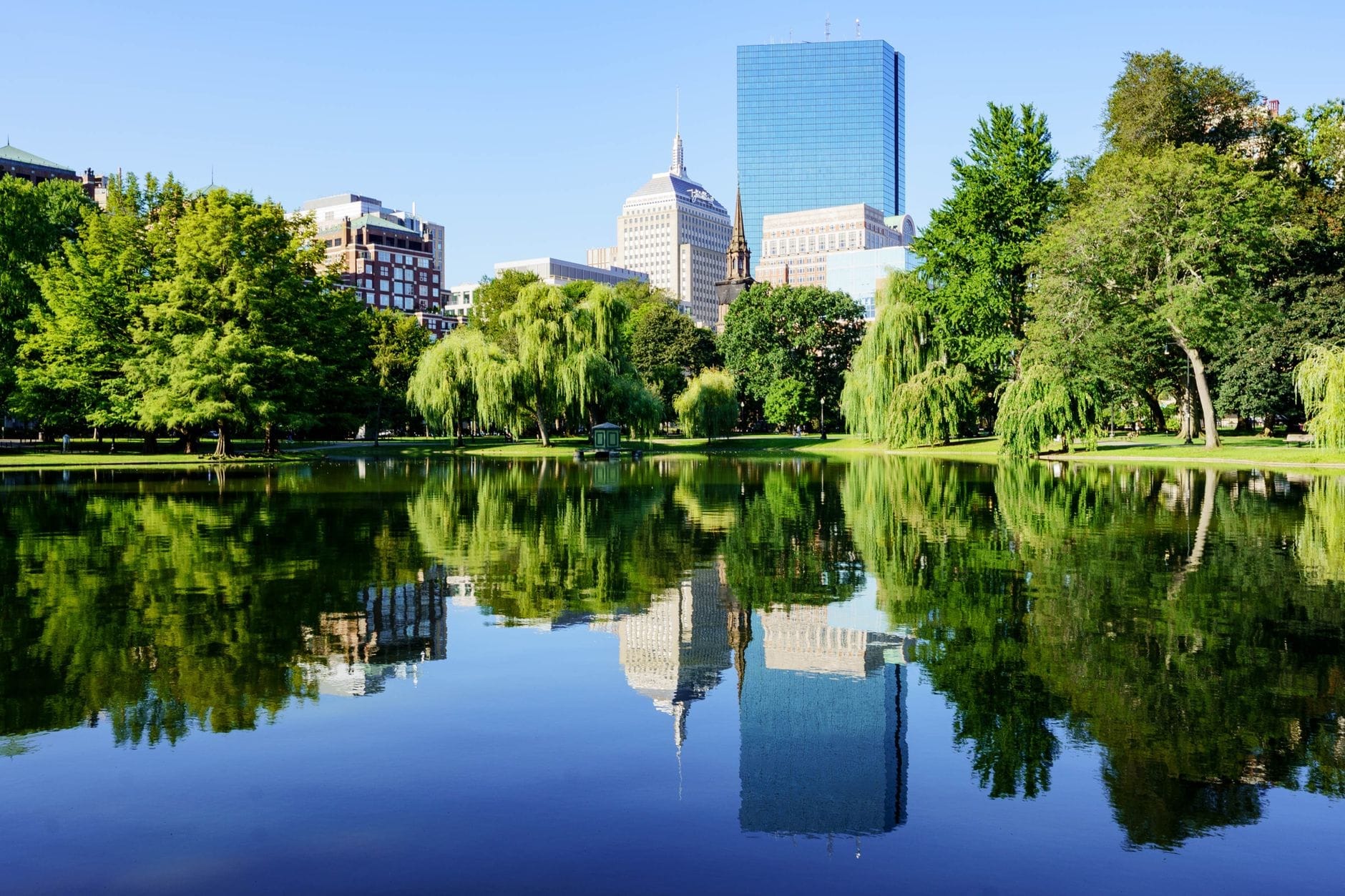
The lagoon at the center of the garden is the park's defining feature. It is shallow and calm, framed by weeping willows whose branches skim the water surface in summer. The pedestrian suspension bridge crossing the lagoon is one of the most photographed spots in all of Back Bay: small, Victorian in proportion, and surrounded by a view that looks almost deliberately composed. The bridge was originally built in the 1860s and has often been described as one of the smallest suspension bridges in the United States.
The Swan Boats have operated on the lagoon since 1877, making them one of the longest-running family-operated attractions in the country. The boats are pedal-powered, with a large decorative swan at the stern concealing the operator. Each ride circles the lagoon and takes roughly 15 minutes. They operate seasonally, generally from early April through late September, but confirm current dates and prices at the Swan Boats' official site before visiting, as schedules shift year to year.
ℹ️ Good to know
The lagoon's resident ducks are directly tied to the 1941 children's book 'Make Way for Ducklings' by Robert McCloskey, which is set in the Public Garden. The bronze sculpture of Mrs. Mallard and her eight ducklings near the Charles Street entrance has been a fixture since 1987, featuring Mrs. Mallard and eight ducklings arrayed along the path and is worth finding, especially if you're visiting with children.
Historical and Cultural Context
Established in the late 1830s, the Public Garden predates Central Park in New York by more than two decades and holds the distinction of being the first public botanical garden in America. The land was formally set aside after years of civic debate, with early advocates arguing that Boston's growing population needed ornamental green space rather than more commercial development on the filled marsh. The Victorian landscape design reflects a broader 19th-century urban philosophy about the restorative function of formal nature within a city.
The most prominent statue in the garden is the equestrian George Washington near the Arlington Street entrance, cast in bronze in 1869 by sculptor Thomas Ball. It anchors the central promenade and is large enough to be visible from the street. Other statues include memorials to Edward Everett Hale and Charles Sumner, placing the garden within Boston's broader landscape of 19th-century civic commemoration. The park's National Historic Landmark designation, conferred by the National Park Service, reflects both its physical integrity and its cultural significance.
The garden sits at the edge of Back Bay, a neighborhood that was itself built on filled land through the second half of the 19th century. Understanding that context — that virtually everything you see west of the garden's Arlington Street border was underwater in 1850 — changes how you read the landscape.
Navigating the Garden: A Practical Walkthrough
The Public Garden is compact enough that there is no wrong way to enter or walk it, but a rough circuit takes 30 to 40 minutes at a relaxed pace. Most visitors enter from the Arlington Street gate and walk toward the Washington statue before turning left or right toward the lagoon. The central promenade running from Arlington Street to Charles Street is the backbone of the formal garden, flanked by seasonal flower beds that are replanted multiple times a year.
Paths are paved and generally level, making the garden accessible for wheelchairs and strollers. Multiple entrances from surrounding streets provide curb-cut access, and none of the main garden routes require navigating steps. The iron benches along the lagoon fill up on warm days, but the Boylston Street edge of the park is less trafficked and offers quieter seating. Restrooms are limited inside the garden itself; facilities are available at the adjacent Boston Common.
The Public Garden connects directly to Boston Common via the Charles Street crossing, and many visitors combine both parks in a single morning or afternoon. The Common is larger, less formal, and better for open-field activities; the garden is better for quiet observation and photography.
⚠️ What to skip
The garden closes at dusk and is not open through the night. Hours are not rigidly posted at every entrance, so plan to be out before dark. On summer evenings, the surrounding streets are lively, but the park’s gates are typically closed and locked.
Getting There and Practical Planning
The easiest approach by public transit is the MBTA Green Line to Arlington Station, which deposits you directly at the park's main entrance on Arlington Street. The Boylston Station stop on the same line is a short walk to the southern edge of the garden along Boylston Street. If you're driving, the Boston Common Garage on Charles Street is the most practical nearby parking option; street parking in the area is limited and metered.
No tickets are required to enter the garden. The Swan Boats charge a separate fee during their operating season, payable on-site. Bring cash as a backup, especially for the Swan Boats, and check their website for current pricing before you visit. Food vendors sometimes operate near the Boylston Street side in warmer months, but the garden has no permanent food concession. Newbury Street, one block west of Arlington Street, has cafes and restaurants within a five-minute walk.
If you're mapping out a full day in the area, the Commonwealth Avenue Mall runs parallel to the garden's western edge and extends through Back Bay as a walkable green corridor worth extending your route into.
Photography Tips and What to Realistically Expect
The suspension bridge over the lagoon is the single most requested shot in the garden, but it is almost never empty of other people during daylight hours from April through October. The cleanest window is early morning, before 8am on weekdays in spring or fall. The weeping willows framing the lagoon from the eastern bank, with the bridge in the middle distance, make a strong composition that doesn't require a long lens.
The Make Way for Ducklings sculpture near the Charles Street entrance is a ground-level bronze, meaning any photo that includes it requires crouching or shooting from a low angle. Morning light from the east hits it well. During peak tourist seasons, there will often be families posing with the ducklings, which either adds life to a shot or complicates it depending on your intent. In winter, the ducklings sometimes wear hand-knitted seasonal scarves, placed by locals — a detail worth looking for.
The garden is not the place for dramatic or sweeping cityscape photography. There are no elevated vantage points within the park, and the surrounding buildings are mostly residential brownstones. What the garden offers photographically is texture, intimacy, and seasonal color at close range. It rewards a slow walk with a camera more than a quick circuit.
Insider Tips
- The flower beds along the central promenade are replanted several times a year by the City of Boston Parks Department; visiting in early May, late June, and again in September will show three completely different planting schemes.
- The Swan Boat line moves quickly but visibly from the gate — if you arrive and the queue extends past the lagoon path, expect a 20-30 minute wait. Weekday mornings in May, the first hour after opening, are reliably short.
- The garden shares a boundary with Boston Common via the Charles Street crosswalk by the mid-block pedestrian underpass to the Common Garage. Locals use the connection constantly; tourists often miss it and treat the two parks as separate destinations requiring a cab or T stop between them.
- In winter, the park's iron fencing and lamp posts were restored as part of a long-term effort by the Friends of the Public Garden, a nonprofit conservancy that funds improvements the city budget doesn't cover. Their website also tracks seasonal planting and event schedules more reliably than the city's parks page.
- The equestrian Washington statue faces Arlington Street, not the lagoon. Most photos of it are taken from inside the garden looking outward, which positions the statue against the Back Bay brownstones rather than sky — a more interesting background than the open promenade.
Who Is Boston Public Garden For?
- Families with young children, especially for the Swan Boats and the Make Way for Ducklings sculpture
- Photographers looking for Victorian garden compositions, seasonal bloom color, and low-key urban nature shots
- Travelers combining a morning walk with the adjacent Boston Common and a coffee stop on Newbury Street
- History-focused visitors interested in 19th-century landscape design, civic history, and American public parks
- Anyone needing a free, accessible, low-stimulus break from the denser tourist corridors downtown
Nearby Attractions
Other things to see while in Back Bay:
- Boston Marathon Finish Line
The Boston Marathon Finish Line on Boylston Street is one of the most emotionally charged strips of pavement in American sports. Free to visit any day of the year, it carries 120-plus years of athletic history and the weight of a city's resilience. Here is everything you need to know before you go.
- Boston Public Library
The Boston Public Library's Central Library in Copley Square is one of the most architecturally significant buildings in New England, and it costs nothing to enter. From its Renaissance Revival McKim Building to its modern Johnson Addition, it rewards visitors who are curious about art, history, and civic ideals equally.
- Charles River Esplanade
The Charles River Esplanade is a 3-mile public park running along the south bank of the Charles River Basin in Boston's Back Bay and West End. Free to enter year-round, it draws joggers, cyclists, sailors, and concert-goers across every season. This guide covers what to expect at different times of day, how to get there, and what makes it worth your time.
- Commonwealth Avenue Mall
The Commonwealth Avenue Mall is a 32-acre linear park running along Commonwealth Avenue in Back Bay, lined with mature elms, historic bronze statues, and flanked by some of Boston's finest brownstone architecture. Free and open around the clock, it connects the Boston Public Garden to Charlesgate at the edge of the Back Bay Fens and serves as an important precursor and connector to Boston’s Emerald Necklace park system.