Boston Marathon Finish Line: What to See, When to Go, and Why It Matters
The Boston Marathon Finish Line on Boylston Street is one of the most emotionally charged strips of pavement in American sports. Free to visit any day of the year, it carries 120-plus years of athletic history and the weight of a city's resilience. Here is everything you need to know before you go.
Quick Facts
- Location
- Boylston Street between Exeter & Dartmouth Streets, Back Bay, Boston, MA
- Getting There
- Copley Station (MBTA Green Line), Copley Square
- Time Needed
- 15–30 minutes for the finish line; 1–2 hours if exploring Copley Square
- Cost
- Free, year-round
- Best for
- Sports history enthusiasts, runners, photo seekers, Boston first-timers
- Official website
- www.baa.org/races/boston-marathon
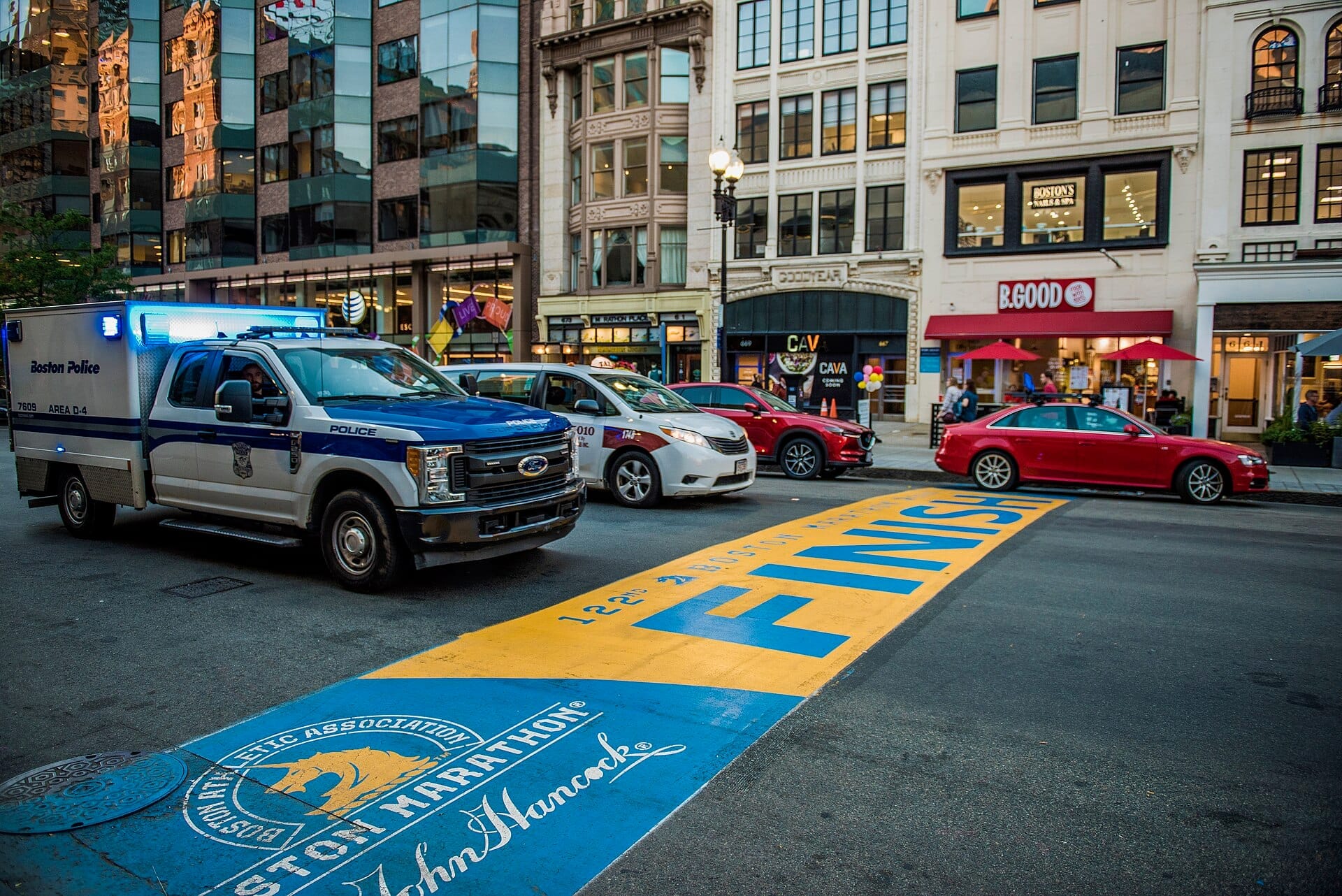
What the Finish Line Actually Is
The Boston Marathon Finish Line is a painted stripe on Boylston Street in the Back Bay neighborhood, positioned in front of the Boston Public Library between Exeter Street and Dartmouth Street at Copley Square. It is not a monument, a museum, or a ticketed attraction. It is a stretch of public road you can stand on any morning of the year, look down at the bold blue and gold paint, and feel the pull of something larger than the asphalt beneath your feet.
The Boston Marathon itself dates to April 19, 1897, making it the world's oldest annually contested marathon. The finish line has been anchored on Boylston Street for roughly four decades, with its current placement between Exeter and Dartmouth Streets established in 1985 when John Hancock became the race's principal sponsor. The standard marathon distance of 26 miles 385 yards (42.195 km) that ends here has been consistent since 1924.
ℹ️ Good to know
The finish line is painted in the Boston Athletic Association's signature blue and gold and is refreshed annually. It sits on a working city street, so expect cars, cyclists, and delivery trucks sharing the frame if you arrive without a plan.
The Experience: What You See, Hear, and Feel
On any given weekday morning, Boylston Street is a working urban corridor. Taxis cut across the intersection at Dartmouth, a coffee cart usually parks near the library steps, and commuters move briskly past without glancing down. The finish line stripes are easy to miss in the morning rush if you are not looking for them. But once you stop and stand on those painted bands, the geometry of the street shifts: you are looking east down a long, gently curving avenue that runners have charged along for generations.
The surrounding architecture adds weight to the moment. The Boston Public Library's McKim Building, a Beaux-Arts landmark completed in 1895, forms the backdrop immediately behind the line. Old South Church rises near the corner of Boylston and Dartmouth, its Gothic tower visible in virtually every finish-line photograph. These are not incidental backdrops: both buildings predate the marathon itself, lending the finish area a permanence that temporary race infrastructure can never replicate.
On quiet afternoons, particularly on weekdays between 10 a.m. and 2 p.m., you can spend several minutes at the line without being crowded out. Tourists pose with one foot across the stripe. Runners sometimes jog the last block of Boylston in full training kit, arms raised as if crossing it for real. The sidewalks in front of the Boston Public Library provide a natural elevated vantage point for watching this behavior, and for photographing the line from above.
Tickets & tours
Hand-picked options from our booking partner. Prices are indicative; availability and final rates are confirmed when you complete your booking.
Boston Summer Night Trolley Tour and River Cruise
From 27 €Instant confirmationFree cancellationLEGOLAND Discovery Center Boston tickets
From 26 €Instant confirmationFree cancellationGhosts and Gravestones tour of Boston
From 39 €Instant confirmationFree cancellationBest of Boston tour
From 182 €Instant confirmationFree cancellation
Historical and Cultural Weight
Boston's Patriots' Day holiday, observed on the third Monday of April, is the race's traditional date. The marathon is woven into the city's civic calendar in a way that few sporting events in the world can match: schools close, the Red Sox play a morning game, and Boylston Street becomes the emotional center of the city for several hours each spring.
The finish line carries a specific historical gravity tied to April 15, 2013, when two bombs detonated near the finish area during the race, killing three spectators and injuring hundreds more. The city's response in the days and years that followed transformed the finish line into a symbol of collective resolve. The phrase 'Boston Strong' was coined in that aftermath, and the line on Boylston became, and remains, a site of quiet pilgrimage for many visitors who lived through those events or were moved by them from afar.
That history is not commemorated with a formal memorial at the finish line itself, though the broader arc of Boston's history is marked throughout the city. The 2013 bombings and the city's recovery are part of the story any serious visitor should understand before arriving at Boylston Street.
Race Weekend: A Completely Different Experience
Visiting the finish line during Boston Marathon weekend, held annually in April, transforms the experience entirely. The B.A.A. coordinates public programming around the finish area, including designated time slots when Boylston Street is partially open for finish-line photos before the race. In recent years, Friday afternoon and evening slots have been scheduled for this purpose, though specific hours change annually and should be confirmed on the B.A.A. website before you plan around them.
Race day itself is one of the most kinetically charged public events in New England. The professional wheelchair divisions start the day, followed by the professional women, then the professional men and the open field. By the time the lead runners arrive on Boylston, the crowd noise along that final stretch is audible from blocks away: a deep, sustained roar that builds as each runner enters the finish corridor. Standing behind the barriers on Boylston while a runner crosses in front of the Public Library is a memorable experience, even for people with no particular interest in distance running.
⚠️ What to skip
On race day, Boylston Street is closed to pedestrian traffic in the finish area from early morning until the finish area reopens later in the day. Security checkpoints control access to viewing zones. Arrive early, expect bag checks, and check the B.A.A. spectator guide for the current year's access map before assuming you can walk up freely.
Spectator access to the Boylston Street finish area is free, but space fills up hours in advance. The bleachers flanking the final few hundred meters are reserved through official channels, while the general public watches from behind barriers on the sidewalks. The best unreserved sightlines tend to be on the north side of Boylston, closer to Exeter Street, where the road is wider and the crowd slightly thinner than it is immediately in front of the library.
Photography and Practical Logistics
For photography outside of race weekend, the optimal window is early morning on a weekday, roughly 7 to 8:30 a.m., before delivery vehicles fill the street and tourist foot traffic picks up. The low-angle morning light from the east travels directly down Boylston, illuminating the finish line paint and the library facade simultaneously. On overcast days, the blue and gold paint reads more cleanly without harsh shadows.
A wide-angle lens or a phone camera stepped back to Exeter Street captures both the finish line and the Old South Church steeple in the same frame. For a finish-line selfie from ground level, the south sidewalk near the library entrance gives you the clearest unobstructed background looking west.
The finish line is a short walk from Copley Station on the MBTA Green Line. It sits at the eastern edge of Copley Square, making it straightforward to combine with the square's other landmarks in a single visit. Parking on Boylston itself is limited and metered; arriving by T is considerably easier.
💡 Local tip
The Boston Public Library's main entrance is steps from the finish line. Entry to the library is free, and its courtyard and reading rooms offer a quiet contrast to the street-level scene outside. Worth pairing with a finish-line visit.
Who Will Get the Most Out of This Visit
Runners and anyone who has followed marathon culture will feel this spot immediately. So will people interested in recent American history and the finish line events of 2013. First-time visitors to Boston who want to understand what the city cares about should walk this stretch of Boylston alongside the Freedom Trail and the neighborhoods around it — together they sketch a portrait of a city that takes its history seriously.
If you are building a Back Bay walking itinerary, the finish line connects naturally to Newbury Street one block north, and to the Commonwealth Avenue Mall two blocks further. Allow two hours for a relaxed loop that covers Copley Square, the mall, and a stretch of Newbury.
Anyone expecting an elaborate memorial, interpretive signage, or formal visitor infrastructure will be disappointed. This is a painted line on a street. Its power is proportional to what you bring to it: context, curiosity, or some personal connection to the race. Without that context, it is easy to walk past without registering its significance at all.
Insider Tips
- The finish line paint is typically freshened up in the weeks before Marathon Monday each April. If you visit in mid-April before the race, you may catch it looking sharper than at any other point in the year.
- During race weekend, the Lenox Hotel near the corner of Boylston and Exeter has historically offered lobby access and an elevated view of the finish area from upper-floor windows for guests. Booking a stay here for race weekend requires planning many months in advance.
- The B.A.A. posts official finish-line information on its materials. Standing on the precise center of the line for a photo means positioning yourself at the center of the painted line.
- For a crowd-free finish-line photo during marathon week itself, an early-morning window on race day can give you an unusually clear shot of the empty street.
- The blue and gold color scheme mirrors the official colors of the Boston Athletic Association and intentionally matches the decorative banners that line Boylston Street in the weeks surrounding the race.
Who Is Boston Marathon Finish Line For?
- Runners and triathletes who want to stand where legends have crossed
- History and current-events travelers with an interest in the 2013 Boston Marathon bombings and the city's recovery
- First-time Boston visitors building a Back Bay walking loop
- Sports photographers looking for an iconic urban composition
- Families with older children interested in American endurance sports culture
Nearby Attractions
Other things to see while in Back Bay:
- Boston Public Garden
The Boston Public Garden is a 24-acre city park and National Historic Landmark between Beacon Hill and Back Bay, free to enter and generally open daily from dawn to dusk. From the famous Swan Boats on the lagoon to flowering magnolias in spring and snow-dusted statuary in winter, the garden rewards visitors in every season.
- Boston Public Library
The Boston Public Library's Central Library in Copley Square is one of the most architecturally significant buildings in New England, and it costs nothing to enter. From its Renaissance Revival McKim Building to its modern Johnson Addition, it rewards visitors who are curious about art, history, and civic ideals equally.
- Charles River Esplanade
The Charles River Esplanade is a 3-mile public park running along the south bank of the Charles River Basin in Boston's Back Bay and West End. Free to enter year-round, it draws joggers, cyclists, sailors, and concert-goers across every season. This guide covers what to expect at different times of day, how to get there, and what makes it worth your time.
- Commonwealth Avenue Mall
The Commonwealth Avenue Mall is a 32-acre linear park running along Commonwealth Avenue in Back Bay, lined with mature elms, historic bronze statues, and flanked by some of Boston's finest brownstone architecture. Free and open around the clock, it connects the Boston Public Garden to Charlesgate at the edge of the Back Bay Fens and serves as an important precursor and connector to Boston’s Emerald Necklace park system.