Copley Square: Boston's Most Architecturally Charged Public Space
Copley Square sits at the heart of Back Bay, framed by some of Boston's most significant 19th-century architecture. Free to enter as a public square, though park hours may apply overnight, it rewards visitors who take time to move slowly around its edges, not just cut across it.
Quick Facts
- Location
- Bounded by Boylston St, Clarendon St, St. James Ave, and Dartmouth St, Back Bay, Boston, MA
- Getting There
- Copley Station (Green Line, B/C/D branches); Back Bay Station (Orange Line, commuter rail) is a 5-minute walk
- Time Needed
- 30–60 minutes for the square itself; 2–3 hours if you visit surrounding buildings like Trinity Church and the Boston Public Library
- Cost
- Free; no ticket required
- Best for
- Architecture lovers, history buffs, photographers, casual walkers, and anyone who wants a central Back Bay landmark without a queue
What Copley Square Actually Is
Copley Square is a roughly 2.4-acre public square in Boston's Back Bay neighborhood, formally named in 1883 and named after the colonial-era portrait painter John Singleton Copley. Before that, it was known informally as Art Square, reflecting the cluster of cultural institutions that had already begun gathering around its edges. Today it functions as both a civic gathering place and an outdoor architectural gallery, ringed by Trinity Church, the Boston Public Library's McKim Building, and the John Hancock Tower.
Back Bay itself was built on filled land, a 19th-century engineering project that transformed a tidal estuary into one of America's most coherent Victorian streetscapes. Copley Square sits near the center of that grid, and its proportions feel intentional: broad enough for open-air events, tight enough that you can read the facades of surrounding buildings without crossing the street.
💡 Local tip
Arrive on foot from Copley Station (Green Line) and exit onto Boylston Street. You'll face the Boston Public Library's Dartmouth Street facade directly, which gives you the full visual impact of the square's western edge before you step into it.
The Architecture Around the Edges
The square's dominant building is Trinity Church, completed in 1877 to designs by Henry Hobson Richardson. It's considered one of the finest examples of Richardsonian Romanesque architecture in the United States, characterized by rough-cut granite, rounded arches, and a central tower that anchors the whole composition. The polychrome stonework and the mural program inside are worth at least a brief visit. Trinity faces Copley Square from the east side, and its reflection in the glass curtain wall of the John Hancock Tower across Clarendon Street is one of the most photographed architectural pairings in Boston.
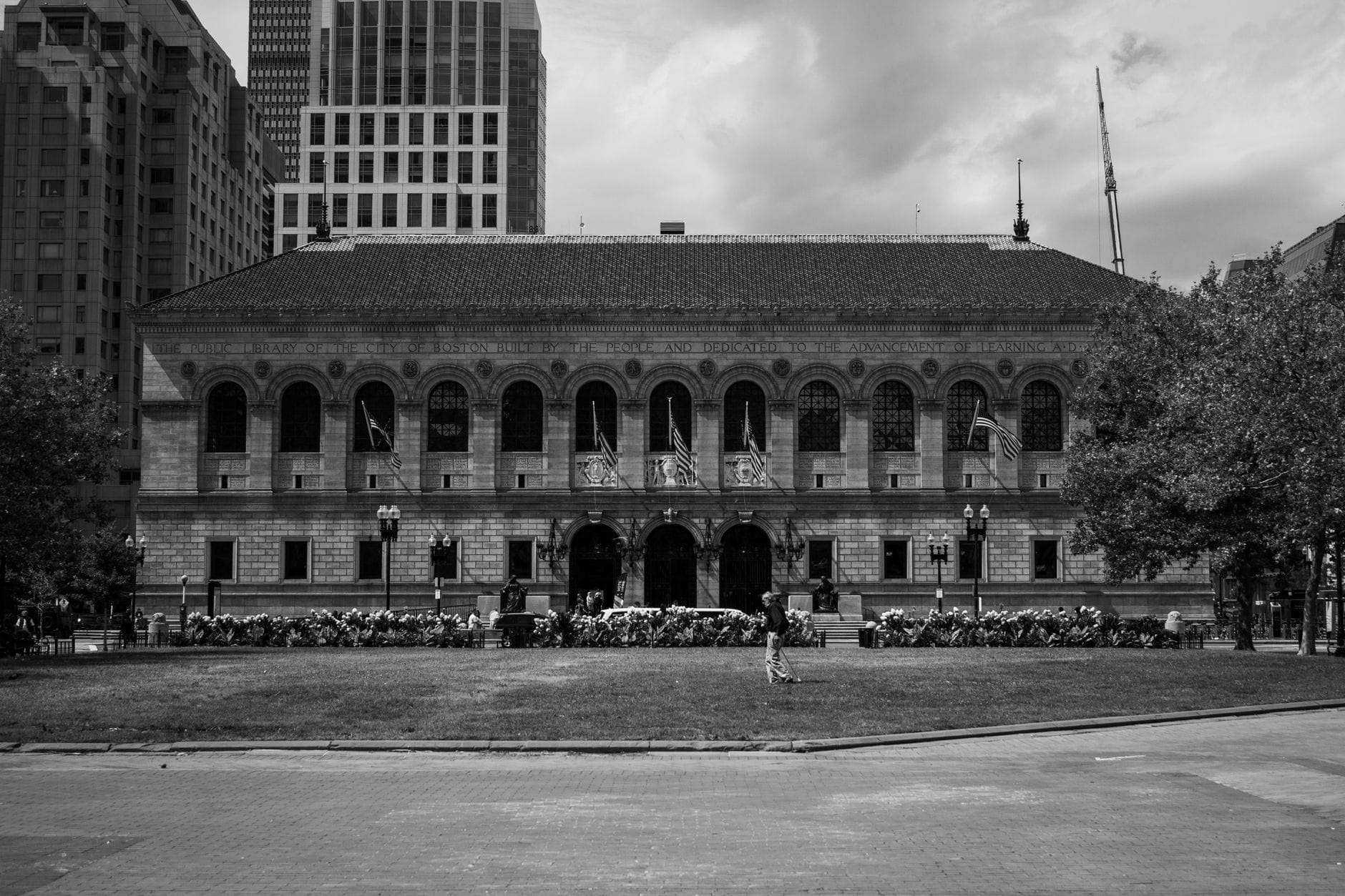
Directly across on the western edge stands the Boston Public Library's McKim Building, designed by Charles Follen McKim and completed in 1895. Its Italian Renaissance facade, with arched windows and inscribed names of great thinkers along the cornice, reads almost like a civic manifesto. The library is free to enter, and its interior courtyard and Bates Hall reading room are among the most beautiful public interiors in the city.
The John Hancock Tower, now officially 200 Clarendon Street, rises 62 stories above the square. Designed by I.M. Pei and Partners and completed in 1976, its mirrored blue glass surface was controversial during construction (several hundred window panes fell out during high winds in the early 1970s, a structural problem that required redesign). From the square, the tower functions as a foil: its modernist verticality throws the 19th-century masonry of Trinity and the library into sharper relief.
Tickets & tours
Hand-picked options from our booking partner. Prices are indicative; availability and final rates are confirmed when you complete your booking.
Boston Summer Night Trolley Tour and River Cruise
From 27 €Instant confirmationFree cancellationLEGOLAND Discovery Center Boston tickets
From 26 €Instant confirmationFree cancellationGhosts and Gravestones tour of Boston
From 39 €Instant confirmationFree cancellationBest of Boston tour
From 182 €Instant confirmationFree cancellation
How the Square Changes Through the Day
Early morning, before 8am, Copley Square belongs to commuters cutting through on their way to Back Bay Station and to the occasional runner who has drifted down from the Charles River Esplanade. The fountain at the center is often already running in warmer months, and the light on Trinity's tower is at its warmest. This is the quietest window for photography: no food trucks, no crowds on the library steps.
Midday from late spring through early fall, the square fills fast. Office workers eat on the low granite seating walls, tourists line up outside Trinity Church, and the farmers market (held on Tuesdays and Fridays from May through November in a typical season) spreads along the Boylston Street edge. The market is one of the older outdoor markets in the city, and the produce and prepared food vendors make it a useful stop before or after exploring the neighborhood.
Late afternoon brings softer light and slightly thinner crowds. The Back Bay buildings cast long shadows across the square by around 4pm in autumn and winter, which changes the mood significantly. If you're visiting in October or November, that window between 3pm and sunset produces the best combination of warm light and manageable foot traffic. In summer, the square stays active until well after dark, with people sitting on the steps of the library and gathering around the fountain.
ℹ️ Good to know
The Copley Square Farmers Market generally runs Tuesdays and Fridays, May through November, in a typical season. Check the Boston Public Market Association's current schedule before planning around it, as dates and vendor lineups vary by season.
The Marathon Finish Line Connection
Boylston Street, which forms the southern edge of Copley Square, is where the Boston Marathon finish line is painted on the pavement. The blue-and-yellow painted line is a permanent fixture on Boylston, a short walk west of the square toward Exeter Street. On most days it's just a stripe on the ground surrounded by tourists taking photos. On Marathon Monday in April, it becomes the focal point of one of the world's oldest and most watched road races.
The April 2013 bombings near this stretch of Boylston Street are part of the square's recent history. A small memorial and the presence of the finish line mark it as a place of significance beyond tourism. Most visitors treat the area respectfully; the square itself absorbed much of the community grief and resilience that followed, hosting vigils and ceremonies in the weeks after.
Practical Walkthrough: What to Actually Do Here
A good starting point is the Dartmouth Street entrance to the square, directly in front of the library. Spend a few minutes reading the facade before going inside. The library's interior is free and open to the public during regular operating hours; the courtyard in the center of the McKim Building is one of the most underused quiet spaces in Back Bay. If you're short on time, the courtyard alone justifies a 15-minute detour.
From the library, cross the square diagonally toward Trinity Church. Even if you don't go inside, walk around the exterior to see the apse end and the careful stonework up close. The rough-faced Milford granite has a texture and warmth that photographs don't convey. Trinity's interior is open to visitors for a fee during most daytime hours; the painted murals by John La Farge are the main draw inside.
Allow time to simply sit. The low stone walls and the fountain plaza in the center of the square are designed for lingering, and the experience of watching the Hancock Tower reflect Trinity's roofline is better absorbed slowly than in passing. The square is at its most photogenic from the corner of Dartmouth and Boylston, where you can frame Trinity, the fountain, and the Hancock Tower in a single composition.
💡 Local tip
Photography tip: To capture Trinity Church's reflection in the Hancock Tower, stand on the Copley Square side of Clarendon Street and shoot from a low angle in the morning. The reflection is clearest when the sky is partly cloudy, which diffuses glare on the glass.
Weather, Seasons, and What to Expect
Boston has a humid continental climate, with cold winters and warm summers. Copley Square is an outdoor space with limited shelter: there are a few trees but no canopy structures. In January and February, temperatures regularly drop below freezing, and the square can be icy around the fountain area. Winter visits are entirely possible and the buildings look striking under low gray skies, but dress for wind coming off Boylston Street. For more on timing a Boston visit, the best time to visit Boston guide covers seasonal considerations in detail.
Spring and fall are the most comfortable seasons for spending time in the square. May and early June bring reasonable temperatures and long daylight hours. September and October offer the same, with the added quality of lower humidity and better light for photography. Summer afternoons can be consistently hot and the square gets crowded with tour groups and convention attendees from nearby hotels. If you're visiting in summer and want a quieter experience, early morning or early evening are the most practical options.
As for whether Copley Square is overhyped: it depends on what you expect. If you arrive looking for an animated town square with cafes spilling onto the pavement, you may be underwhelmed. It's primarily an open urban plaza with extraordinary architecture around its perimeter, not a destination in itself. Pair it with the library interior and Trinity Church and it earns its place on any Back Bay itinerary. Treated as a quick photo stop on a walking tour, it's over in five minutes.
⚠️ What to skip
The square can be very crowded during the Boston Marathon (Patriots' Day, third Monday in April) and during large-scale events on the MBTA Green Line corridor. Check Boston's events calendar if you're visiting in April, as road closures around Boylston Street affect access.
Getting There and Getting Around
Copley Station on the MBTA Green Line (B, C, and D branches) puts you directly at the corner of Boylston and Dartmouth, steps from the square's main entrance. Back Bay Station, served by the Orange Line and MBTA commuter rail, is roughly a 5-minute walk east along Boylston Street. From either station, the route is straightforward. The square sits comfortably within the broader walking tour circuit of Back Bay: Newbury Street is one block north, and the Commonwealth Avenue Mall begins just across Dartmouth Street.
Driving to Copley Square is not recommended. Parking in Back Bay is limited and expensive, and the neighborhood's one-way grid makes navigation frustrating. The Green Line is direct and reliable from most parts of central Boston. If you're coming from the airport, the Silver Line SL1 to South Station connects to the Orange Line, which reaches Back Bay Station in one stop.
Insider Tips
- The best unobstructed view of Trinity Church's full exterior is from the northeast corner of the square, near the Dartmouth and St. James Avenue intersection, not from directly in front on Clarendon Street where parked vehicles and foot traffic compete with your sight line.
- The Boston Public Library's McKim Building courtyard is almost never crowded, even when the square outside is packed. Enter on Dartmouth Street, walk through the main hall, and you'll find a quiet Renaissance-style courtyard with a central fountain that most visitors walk past entirely.
- If you're in Boston in late April for the Marathon, arrive at Copley Square the evening before race day. The finish line area is calm, accessible, and well-lit, and you can stand on the actual finish line without anyone around.
- Trinity Church does not charge admission to attend Sunday services, so if you want to experience the interior, including John La Farge's painted murals, without paying the standard visitor fee, attending a Sunday morning service is an option, though the primary purpose is worship rather than sightseeing.
- The Copley Square Farmers Market vendors on Tuesday and Friday mornings typically sell out of the most popular items by early afternoon. If you want the best selection of local produce and prepared foods, arrive before noon.
Who Is Copley Square For?
- Architecture enthusiasts who want to compare Richardsonian Romanesque and Italian Renaissance buildings side by side in a single open space
- Photographers looking for the Trinity Church reflection in the Hancock Tower glass, especially in morning light
- Travelers on a Boston budget, since the square itself and the Boston Public Library interior are both free
- Visitors following a Back Bay walking route between Newbury Street, Commonwealth Avenue, and the South End
- Anyone interested in the Boston Marathon's history and wanting to see the finish line in context
Nearby Attractions
Other things to see while in Back Bay:
- Boston Marathon Finish Line
The Boston Marathon Finish Line on Boylston Street is one of the most emotionally charged strips of pavement in American sports. Free to visit any day of the year, it carries 120-plus years of athletic history and the weight of a city's resilience. Here is everything you need to know before you go.
- Boston Public Garden
The Boston Public Garden is a 24-acre city park and National Historic Landmark between Beacon Hill and Back Bay, free to enter and generally open daily from dawn to dusk. From the famous Swan Boats on the lagoon to flowering magnolias in spring and snow-dusted statuary in winter, the garden rewards visitors in every season.
- Boston Public Library
The Boston Public Library's Central Library in Copley Square is one of the most architecturally significant buildings in New England, and it costs nothing to enter. From its Renaissance Revival McKim Building to its modern Johnson Addition, it rewards visitors who are curious about art, history, and civic ideals equally.
- Charles River Esplanade
The Charles River Esplanade is a 3-mile public park running along the south bank of the Charles River Basin in Boston's Back Bay and West End. Free to enter year-round, it draws joggers, cyclists, sailors, and concert-goers across every season. This guide covers what to expect at different times of day, how to get there, and what makes it worth your time.