Commonwealth Avenue Mall: Back Bay's Grand Promenade
The Commonwealth Avenue Mall is a 32-acre linear park running along Commonwealth Avenue in Back Bay, lined with mature elms, historic bronze statues, and flanked by some of Boston's finest brownstone architecture. Free and open around the clock, it connects the Boston Public Garden to Charlesgate at the edge of the Back Bay Fens and serves as an important precursor and connector to Boston’s Emerald Necklace park system.
Quick Facts
- Location
- Commonwealth Avenue median, Back Bay, Boston, MA 02116–02215
- Getting There
- MBTA Green Line: Arlington (near eastern end), Copley, Hynes Convention Center, or Kenmore (near western end at Charlesgate)
- Time Needed
- 30–90 minutes for a full end-to-end walk; shorter if you dip in for a single block
- Cost
- Free; no admission fee
- Best for
- Leisurely walks, architecture lovers, history, autumn foliage, photography
- Official website
- www.boston.gov/parks/commonwealth-avenue-mall
What the Commonwealth Avenue Mall Actually Is
The Commonwealth Avenue Mall is not a shopping mall. It is a long, tree-shaded pedestrian promenade occupying the wide median strip of Commonwealth Avenue, stretching roughly a mile through Boston's Back Bay neighborhood from the Public Garden to Charlesgate. At 32 acres, it is one of the most significant examples of 19th-century American boulevard design still intact today.
The Mall runs from Arlington Street at its eastern end, where it meets the Boston Public Garden, all the way west to Charlesgate at the edge of Kenmore Square and the Back Bay Fens. Every few hundred feet, a cross street interrupts the path with a standard traffic light, so this is a linear park threaded through a working urban grid rather than a self-contained green space. That distinction matters for how you move through it.
The Mall sits squarely in Back Bay, one of Boston's most architecturally coherent neighborhoods, and functions as the spine of the whole district. Walking it end to end gives you a fuller sense of Back Bay than almost any other single route.
💡 Local tip
Start at the Arlington Street end, near the Boston Public Garden, and walk west. You get the best light on the brownstone facades in the morning and the canopy closes overhead as you move deeper into the Mall.
History: From Landfill to Landmark
Back Bay was, until the mid-19th century, exactly what its name suggests: a tidal flat of the Charles River. The neighborhood was created wholesale through one of the largest land reclamation projects in American history, filling in the bay with gravel and soil between roughly 1857 and 1882. Architect Arthur Gilman designed the street grid around 1856, modeled partly on the grand Parisian boulevards that Baron Haussmann was simultaneously cutting through the French capital. Commonwealth Avenue was conceived from the start as the prestige address of the new district, and the Mall in its median was designed to anchor that ambition.
Frederick Law Olmsted, the landscape architect behind New York's Central Park, oversaw the extension of the Mall westward from Massachusetts Avenue to Charlesgate in the mid‑1880s, integrating it into his emerging Emerald Necklace park system. That extension connected the Mall to the Back Bay Fens and eventually to parks stretching all the way to Franklin Park, creating a continuous green corridor through Boston. Today, the Commonwealth Avenue Mall is designated a Boston Landmark (1978) and is listed on the National Register of Historic Places as part of the Back Bay Historic District.
If you want to understand how this stretch of park fits into the larger system Olmsted designed, the full context is covered in the guide to the Emerald Necklace, which traces the chain of parks from the Common to Franklin Park.
Tickets & tours
Hand-picked options from our booking partner. Prices are indicative; availability and final rates are confirmed when you complete your booking.
Boston Summer Night Trolley Tour and River Cruise
From 27 €Instant confirmationFree cancellationLEGOLAND Discovery Center Boston tickets
From 26 €Instant confirmationFree cancellationGhosts and Gravestones tour of Boston
From 39 €Instant confirmationFree cancellationBest of Boston tour
From 182 €Instant confirmationFree cancellation
The Walk: What You Actually See
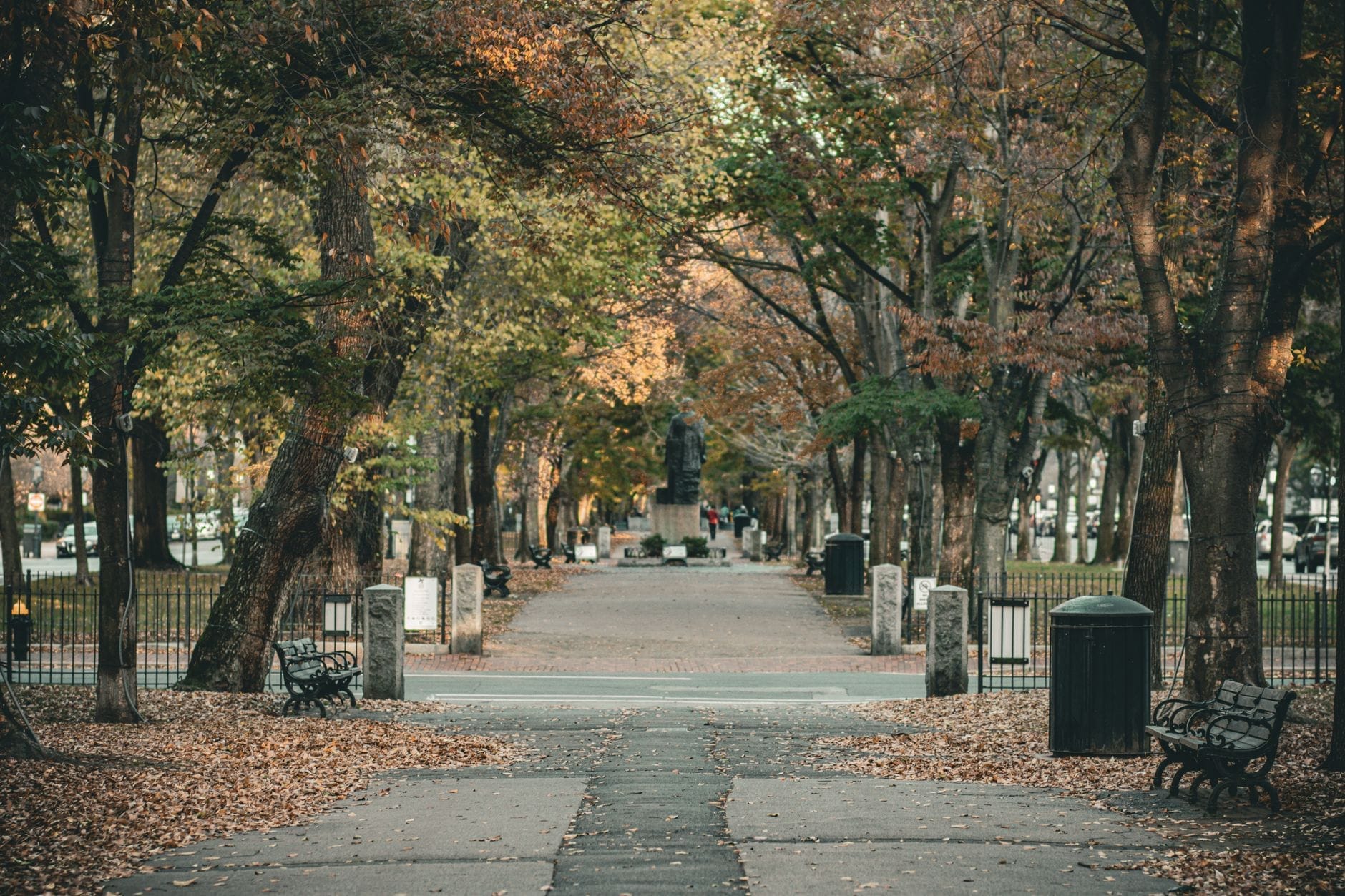
The promenade itself is paved and level, wide enough that it never feels crowded even on busy afternoons. Mature American elm trees form a partial canopy along much of the route, though the density of the tree cover varies by block. Park benches face inward on both sides of the central path, and the lawns between the benches and the roadway are kept clear, giving the whole Mall a tidy, almost formal feel.
The statues are worth pausing for. A series of bronze monuments punctuate the Mall at intervals, including memorials to William Lloyd Garrison, Samuel Eliot Morison, Patrick Andrew Collins, and Domingo Faustino Sarmiento, among others. These are not grandiose monuments demanding extended study, but the accumulation of figures gives the walk a quiet civic texture that most urban parks lack. The Garrison statue in particular, depicting the abolitionist seated in a characteristic pose, is worth a close look.
On either side of the Mall, the brownstone townhouses of Commonwealth Avenue present what is, block for block, one of the most consistently handsome streetscapes in any American city. The buildings are primarily four and five stories, bay-windowed, with stoops rising from the sidewalk. Many have been converted to apartments or university buildings, but the exterior character of the blocks is largely preserved. Architecture enthusiasts will want to walk slowly and look up.
The eastern end of the Mall deposits you directly at the Boston Public Garden, and from there it is a short walk to Boston Common. Many visitors combine all three in a single morning.
How the Mall Changes Through the Day and the Seasons
Early mornings on the Mall are calm and often beautiful. Dog walkers and joggers have the path largely to themselves. The light slants through the elm canopy and catches the upper floors of the brownstones at a low angle. This is the time for photography: before the traffic on Commonwealth Avenue builds and before crowds dilute the mood. By 9 or 10 AM on weekdays, Boston University students and Back Bay residents begin filling the path with purpose rather than leisure.
Afternoons, particularly on weekends, bring families, tourists, and local residents out in genuine numbers. The benches fill up. The tone is sociable rather than quiet. Weekend afternoons between May and September have an almost park-like energy, with people sitting on the grass and children running on the lawns. It is not unpleasant, just different in character.
The most visually spectacular time to visit is autumn, roughly mid-October through early November. The elms and other deciduous trees turn yellow and gold, the light becomes amber in the afternoons, and the contrast between the warm foliage and the reddish-brown brick of the townhouses is striking. This is one of the best places in the city to experience fall color at street level.
Winter visits are quieter and, on clear days, have their own appeal. Snow on the Mall lawns with the bare tree canopy overhead creates a spare, spare composition that photographs well. The path is maintained by the city, but ice can collect at street crossings after freezing rain, so appropriate footwear matters from December through February.
ℹ️ Good to know
Fall foliage on the Mall typically peaks between mid-October and the first week of November. Peak timing varies year to year depending on temperature patterns.
Practical Walkthrough: Getting There and Moving Through
The Mall is directly accessible from several MBTA Green Line stops. The Arlington station puts you at the eastern end of the Mall, steps from the Public Garden. Copley station and Hynes Convention Center station provide mid-Mall access. Kenmore station is convenient for the western end near Charlesgate. There is no admission gate, no ticket required, and no official entrance: you simply descend to street level and step onto the promenade.
Street crossings occur at each intersection along Commonwealth Avenue. Traffic moves in both directions on the outer roadways, and the pedestrian signals are standard Boston intersections, meaning they require a button press and do not always have long crossing windows. Families with strollers will find the crossings manageable but should plan for brief stops. The path itself is paved and generally flat, making it accessible for most mobility needs.
There are no food or drink vendors on the Mall itself. Newbury Street, one block north and running parallel to Commonwealth Avenue, offers a dense concentration of cafes, bakeries, and restaurants accessible at any cross street. This makes it easy to break the walk mid-route for coffee or a meal.
If you are combining the Mall with a broader Back Bay itinerary, Newbury Street is the obvious companion: one long walk down the Mall, then a return along Newbury with stops for shopping or eating.
⚠️ What to skip
The Mall borders an active roadway. Children should be supervised at street crossings, and cyclists should note that the central path is a pedestrian promenade, not a bike lane.
Who Will Love It — and Who Might Not
For anyone with an interest in urban design, 19th-century American history, or simply in beautiful streetscapes, the Commonwealth Avenue Mall consistently delivers. It is one of the best free things to do in Boston, and it requires no planning beyond arriving and walking.
That said, travelers expecting a lush, immersive park experience may find it underwhelming. The Mall is a median strip, not a park in the Central Park sense. Traffic noise from Commonwealth Avenue is constant. The width of the lawns is narrow, and the shade coverage is uneven. On hot summer days with full sun and light foot traffic, certain blocks can feel exposed and dull. The best blocks aesthetically are between Arlington and Dartmouth Streets, where the brownstone streetscape is most intact and the tree coverage most generous. Further west, toward Kenmore, the character becomes less cohesive.
Visitors primarily motivated by history will find more concentrated content on the Freedom Trail, which covers Boston's colonial and revolutionary past in detail. The Mall's historical significance is architectural and urban-planning rather than political or military.
Insider Tips
- The block between Clarendon and Dartmouth Streets has the densest concentration of well-preserved brownstone architecture. If you only have time for one section, make it this one.
- The Mall is one of the best urban locations in Boston for fall foliage photography. Come in the hour before sunset on a clear October afternoon and shoot westward down the Mall toward the fading light.
- Cross to Newbury Street at any point for cafes. The block between Dartmouth and Exeter Streets has several good options for a mid-walk coffee stop.
- The statues along the Mall are rarely crowded and easy to examine closely. Read the inscriptions: several honor figures who were prominent nationally but are now less well known, and the texts give unexpected insight into Boston's 19th-century civic priorities.
- If you are visiting in winter after a snowfall, the section between Arlington and Berkeley Streets photographs beautifully, with the Public Garden visible at one end and the snow-covered lawns framed by brownstones.
Who Is Commonwealth Avenue Mall For?
- Architecture and urban design enthusiasts who want to see Victorian Back Bay at its best
- Walkers and joggers looking for a flat, scenic route with easy transit access at both ends
- Autumn foliage seekers wanting a street-level experience with brownstone context
- Photographers, especially in morning light or late afternoon in fall
- Budget travelers: entirely free, no booking required, and easily combined with other free sites nearby
Nearby Attractions
Other things to see while in Back Bay:
- Boston Marathon Finish Line
The Boston Marathon Finish Line on Boylston Street is one of the most emotionally charged strips of pavement in American sports. Free to visit any day of the year, it carries 120-plus years of athletic history and the weight of a city's resilience. Here is everything you need to know before you go.
- Boston Public Garden
The Boston Public Garden is a 24-acre city park and National Historic Landmark between Beacon Hill and Back Bay, free to enter and generally open daily from dawn to dusk. From the famous Swan Boats on the lagoon to flowering magnolias in spring and snow-dusted statuary in winter, the garden rewards visitors in every season.
- Boston Public Library
The Boston Public Library's Central Library in Copley Square is one of the most architecturally significant buildings in New England, and it costs nothing to enter. From its Renaissance Revival McKim Building to its modern Johnson Addition, it rewards visitors who are curious about art, history, and civic ideals equally.
- Charles River Esplanade
The Charles River Esplanade is a 3-mile public park running along the south bank of the Charles River Basin in Boston's Back Bay and West End. Free to enter year-round, it draws joggers, cyclists, sailors, and concert-goers across every season. This guide covers what to expect at different times of day, how to get there, and what makes it worth your time.