The Emerald Necklace: Boston's 7-Mile Chain of Parks, Explained
Designed by Frederick Law Olmsted and completed in 1895, the Emerald Necklace links nine parks across about 1,100 acres from Boston Common to Franklin Park. It is free to enter, walkable or bikeable end to end, and offers a completely different character depending on which section you explore.
Quick Facts
- Location
- Boston, MA — stretches about 7 miles from Boston Common to Franklin Park
- Getting There
- Multiple MBTA stops along the route; Green Line (B/C/D branches) and Orange Line serve various parks
- Time Needed
- 1–2 hours per section; full end-to-end walk or ride takes most of a day
- Cost
- Free to enter all parks
- Best for
- Walkers, cyclists, picnickers, nature lovers, and fall foliage seekers
- Official website
- www.emeraldnecklace.org
What Is the Emerald Necklace?
The Emerald Necklace is an approximately 1,100-acre chain of nine interconnected parks and parkways running roughly 7 miles through Boston, from the Boston Common at the city's commercial core to the sprawling Franklin Park in Roxbury and Dorchester. Designed by Frederick Law Olmsted, the same landscape architect behind New York's Central Park, the system was completed in 1895 and designated a Boston Landmark in 1989. It remains one of the most ambitious urban green space projects in American history.
The name comes from the way the parks appear on a map: a series of green spaces strung together like gems on a chain, wrapping around the city's southwestern neighborhoods. Unlike a single, contained park, the Emerald Necklace is a system you move through, with each section having its own landscape character, ecology, and atmosphere. You can walk or cycle the entire length using the connected parkways and waterways Olmsted wove into the design.
ℹ️ Good to know
The Shattuck Visitor Center at 125 The Fenway, Boston, MA 02115 is operated by the Emerald Necklace Conservancy and serves as the best starting point for orientation. It is open Monday through Friday, 9 a.m. to 5 p.m. The Conservancy also offers a printed map for US$5.00 (shipping and handling) via their website.
The Nine Parks: What Each Section Offers
The chain begins with the Boston Common and the adjoining Boston Public Garden, Boston's most recognized green spaces. These two parks anchor the northern end of the Necklace and receive the heaviest foot traffic by far. On a warm afternoon, every bench is occupied and the paths through the Public Garden fill with joggers, dog walkers, and tourists photographing the Swan Boats on the pond. The formal geometry of the Public Garden, with its flower beds and cast-iron bridge, gives way to the more open, commons-style layout of Boston Common.
Moving southwest, the Commonwealth Avenue Mall connects the Public Garden to the Back Bay Fens along a broad, tree-lined median boulevard. The elm and linden canopy here is particularly striking in late October when the leaves turn gold, and in spring when the flowering trees along the side streets come into bloom. The mall is narrow but long, with statues punctuating the route at intervals.
The Back Bay Fens is where the Necklace shifts in tone. Originally a tidal mudflat transformed by Olmsted into a freshwater marsh, the Fens today contains the Fenway Victory Gardens (the oldest remaining World War II victory gardens in the country), community rose gardens, and the Muddy River. It sits between major cultural institutions: the Museum of Fine Arts and the Isabella Stewart Gardner Museum are both within walking distance from the Fens. The rose garden, best visited in late June through early July when it peaks, is often surprisingly quiet given how close it sits to one of Boston's busiest corridors.
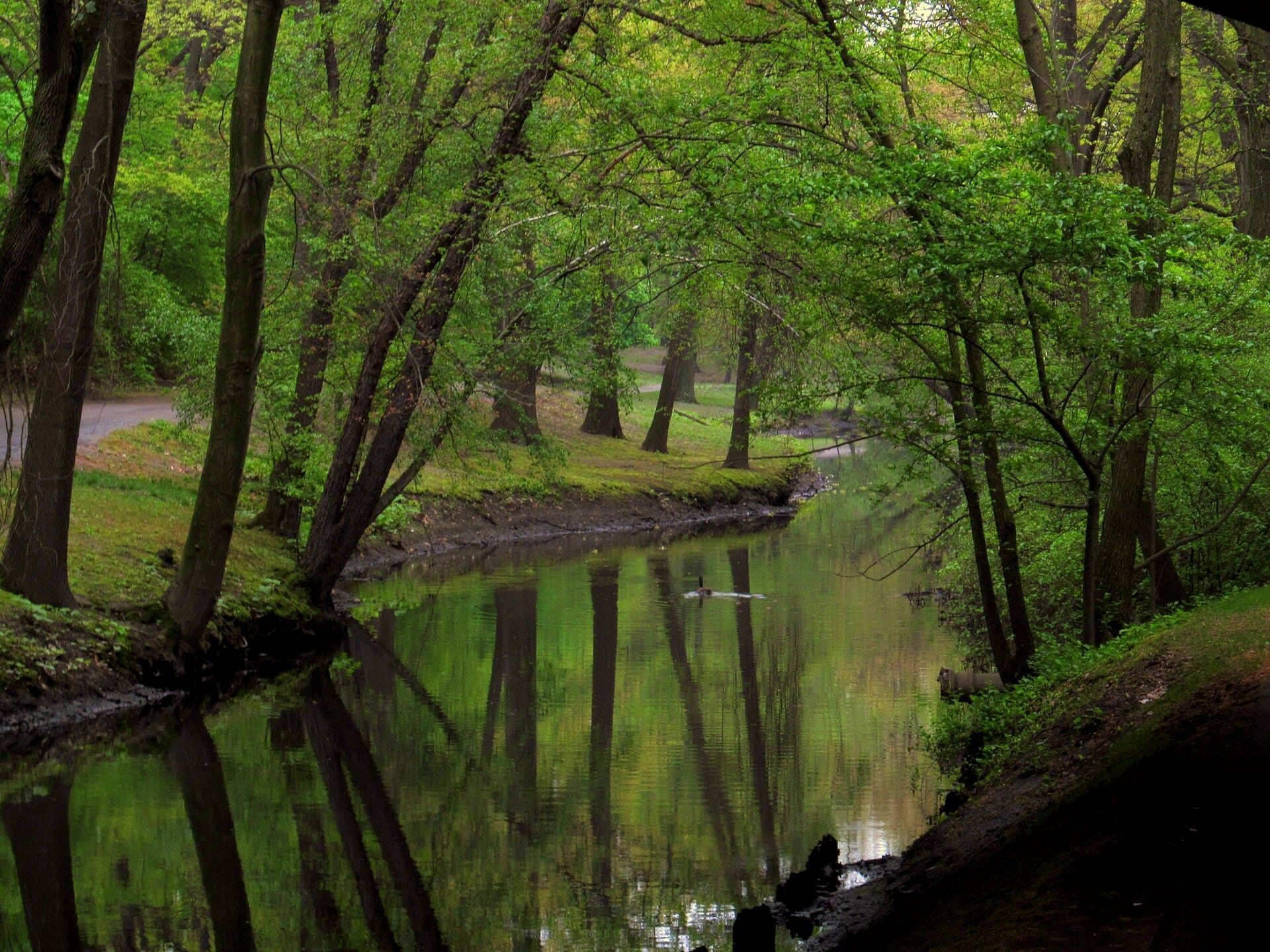
Further along, the Riverway and Olmsted Park follow the winding Muddy River through a narrow green corridor before opening into Jamaica Pond. The pond, a kettle lake formed by glacial activity, is about 1.5 miles in circumference and has a paved path used by runners, walkers, and cyclists at all hours. Early mornings here have a particular quiet: mist on the water, the sound of geese, the occasional rower pulling a shell across the surface. Jamaica Pond is often the section of the Necklace that surprises first-time visitors most, feeling removed from the surrounding city.
The southern end of the chain concludes with the Arnold Arboretum and Franklin Park. The Arboretum, maintained in partnership with Harvard University, covers 281 acres and contains one of the most significant collections of trees and woody plants in North America. Its Lilac Sunday, held each May, draws thousands of visitors for the blooming of over 400 lilac specimens. Franklin Park is the largest individual park in the chain at 527 acres, offering fields, woodland paths, a golf course, and the Franklin Park Zoo.
Tickets & tours
Hand-picked options from our booking partner. Prices are indicative; availability and final rates are confirmed when you complete your booking.
Boston Summer Night Trolley Tour and River Cruise
From 27 €Instant confirmationFree cancellationLEGOLAND Discovery Center Boston tickets
From 26 €Instant confirmationFree cancellationGhosts and Gravestones tour of Boston
From 39 €Instant confirmationFree cancellationBest of Boston tour
From 182 €Instant confirmationFree cancellation
How the Necklace Changes Through the Day
The Emerald Necklace is not a static experience. Early mornings, roughly 6 to 8 a.m., belong to runners, dog owners, and a few dedicated birdwatchers. The light at Jamaica Pond at 7 a.m. on a clear morning is well worth waking up for. The path is quiet enough that you can hear the water lapping and the red-winged blackbirds calling from the reeds. The Fens at the same hour has an almost otherworldly stillness, the rose garden empty and dew-covered.
By midday on weekends, the more accessible sections fill up. The Commonwealth Avenue Mall becomes a steady stream of pedestrians. Jamaica Pond's path gets crowded with families and cyclists. If you want the parks at their liveliest, this is when to come. If you want space to think, go early or visit on a weekday.
Late afternoons in fall are the Necklace at its most photogenic. The tree canopy along the Riverway, the Olmsted Park path beside the pond, and the Arnold Arboretum's hillside collections turn amber, copper, and deep red from mid-October through early November. This is peak season for visitors and the crowds at the Arboretum in particular reflect that.
💡 Local tip
If you visit during fall foliage season (mid-October to early November), arrive at the Arnold Arboretum before 10 a.m. on weekends to secure parking and find the main paths relatively uncrowded. Weekday afternoons are notably calmer.
The History and Design Behind the Parks
Frederick Law Olmsted began work on what would become the Emerald Necklace in the 1870s, when Boston commissioned him to address the sanitation crisis of the Back Bay Fens, a malodorous tidal flat that was polluting the surrounding neighborhoods. Rather than simply filling it in, Olmsted designed a freshwater park that doubled as an ecological buffer. The project expanded as Olmsted and the city recognized the opportunity to connect a series of green spaces from the existing Common and Public Garden all the way to the undeveloped land that would become Franklin Park.
The system was officially completed in 1895, though Olmsted himself had retired by then, his vision carried forward by his firm. What makes the design distinctive is not any single dramatic element, but the way each park transitions into the next: the formal to the naturalistic, the open meadow to the dense woodland, the ornamental pond to the wild marsh. Olmsted believed urban parks should offer psychological relief from city life, and the Necklace was designed to do exactly that, pulling residents through varied landscape experiences as they moved through the system.
For visitors interested in the deeper history of Boston's landscape and urban development, the Boston history guide provides useful context for understanding how the city's physical form was shaped by land reclamation, immigration, and civic ambition across the 19th century.
Getting Around: Transit, Walking, and Cycling
There is no single entrance or starting point for the Emerald Necklace. Most visitors pick a section based on what interests them and use the MBTA to get there. The Green Line's B, C, and D branches serve different parts of the Fenway and Brookline portions of the route. The Orange Line's Green Street and Forest Hills stations serve the Jamaica Plain end, putting you within easy walking distance of Jamaica Pond and the Arnold Arboretum respectively. Verify current MBTA schedules and fares at mbta.com before your visit.
Cycling the full length is possible and popular, though the route is not a single protected bike path throughout. Some sections follow dedicated parkway paths, while others require navigating residential streets. The Emerald Necklace Conservancy website provides routing guidance. If you want to rent a bike, Bluebikes, Boston's bike-share system, has stations near several access points along the route.
For a first visit, entering at the Back Bay Fens and walking south to Jamaica Pond covers the most varied terrain in a manageable distance, roughly 3 to 4 miles depending on how much you explore. Wear comfortable shoes regardless of season: the paths are paved in some sections and packed dirt or grass in others. In winter, ice can form on shaded paths near the Muddy River and along the Jamaica Pond loop, so traction cleats are worth considering from January through early March.
⚠️ What to skip
The Emerald Necklace passes through several distinct neighborhoods with varying levels of activity and foot traffic. Franklin Park's more remote woodland sections are best explored during daylight hours and are quieter than the northern parks. Solo visitors should plan accordingly.
Seasonal Highlights and Weather Considerations
Spring is exceptional in the Arnold Arboretum, where the flowering sequence of magnolias, cherries, crabapples, and lilacs runs from late March through mid-May. Lilac Sunday, held in May, is a genuine local tradition and draws large crowds. The Fens rose garden peaks in late June. Summer brings the full green canopy to the Riverway and Olmsted Park, making those sections shaded and cooler than the surrounding streets on hot days, though Boston's July and August humidity means even the parks can feel oppressive in the early afternoon.
Fall is the most visited season for good reason. The combination of kettle ponds, meadows, and a dense mixed-canopy forest in Franklin Park creates a wide range of foliage colors. For a broader picture of the city in this season, the Boston in fall guide covers timing, crowds, and how to combine park visits with other autumn experiences across the city.
Winter is underrated. On a clear January day after snowfall, the Jamaica Pond loop is one of the quieter and more beautiful walks you can take in Boston. The bare tree canopy along the Riverway reveals the underlying landform Olmsted shaped, and the Fens takes on a spare, architectural quality. Dress in layers and expect some icy patches on north-facing paths.
Photography Tips and Accessibility
The best photography along the Necklace tends to come from two locations: the Jamaica Pond boathouse at golden hour, with the light skimming across the water, and the hilltop overlooks in the Arnold Arboretum, particularly Peters Hill, which gives a panoramic view over the tree collections and toward the Boston skyline. Neither requires any special access or permits.
Most of the main paths are paved and accessible to wheelchairs and strollers, particularly around Jamaica Pond and through the Fens. The Riverway section is narrower with some uneven surfaces. The woodland trails in Franklin Park and the hillside paths in the Arnold Arboretum are steeper and less suitable for mobility devices. The Shattuck Visitor Center at 125 The Fenway can provide specific accessibility information for individual sections.
The Necklace is one of several major green spaces covered in the Boston outdoor activities guide, which also covers the Charles River Esplanade, Harbor Islands, and Blue Hills Reservation for visitors planning a nature-focused trip.
Insider Tips
- The Fenway Victory Gardens are open to the public from spring through fall and offer an unusually intimate glimpse into how Bostonians use their parks: hundreds of individual plots tended by residents, each with its own personality. Walk through on a weekend afternoon in August and you will rarely see this mentioned in standard tourist itineraries.
- Peters Hill in the Arnold Arboretum is one of the best elevated viewpoints in the city and costs nothing to reach. The climb is gentle, roughly 10 minutes from the main path, and the view south toward the Blue Hills and north toward downtown is clearest on cold, dry days in late fall and winter.
- The Shattuck Visitor Center at 125 The Fenway occasionally hosts free guided walks led by Emerald Necklace Conservancy staff. These are worth checking for in advance on the Conservancy's website, particularly during spring bloom season and fall foliage.
- If you are cycling the full length, the Jamaicaway section between Olmsted Park and Jamaica Pond has a dedicated parkway path that is one of the smoothest and most pleasant stretches of urban cycling in Boston, especially on Sunday mornings when traffic is light.
- The rose garden in the Back Bay Fens is at its absolute best in the third week of June, when the bulk of the 1,500-plus bushes are in simultaneous bloom. The scent is noticeable from the main path. Arrive before 9 a.m. to have the garden almost entirely to yourself.
Who Is Emerald Necklace For?
- Runners and cyclists who want a longer, connected route through the city rather than a loop
- Visitors with a full day who want to combine green space with cultural institutions like the MFA and Gardner Museum along the Fenway section
- Families with children looking for open outdoor space, picnic areas, and the Jamaica Pond loop
- Fall foliage seekers who want variety beyond the standard New England destinations
- Anyone interested in American landscape design and urban planning history
Nearby Attractions
Combine your visit with:
- Arnold Arboretum
Founded in 1872, the Arnold Arboretum is the oldest public arboretum in North America — a free, 281-acre landscape in Jamaica Plain managed by Harvard University. With over 15,000 accessioned plants and sweeping hillside views, it draws botanists, dog walkers, and curious visitors in equal measure across all four seasons.
- Blue Hills Reservation
Ten miles south of downtown Boston, Blue Hills Reservation spreads across more than 7,000 acres of forested hills, rocky ridgelines, and glacial wetlands. Free to enter and open year-round from dawn to dusk, it offers 125 miles of trails ranging from easy pond-side loops to a genuine summit climb at 635-foot Great Blue Hill.
- Boston Duck Tours
Boston Duck Tours puts you aboard a replica World War II DUKW amphibious vehicle for an 80-minute circuit of the city's most historic landmarks, finishing with a splash into the Charles River. Running seasonally from late March through late November, it's one of the few tours in Boston that covers both street-level sights and a Charles River perspective in a single trip.
- Boston Harbor Islands
Boston Harbor Islands National and State Park puts 34 islands and peninsulas within easy ferry reach of downtown Boston. From Civil War earthworks on Georges Island to the oldest lighthouse station in the United States on Little Brewster, the park rewards visitors who are willing to trade the city's brick sidewalks for salt air and open water.