Boston Duck Tours: Land, Water, and 400 Years of History in 80 Minutes
Boston Duck Tours puts you aboard a replica World War II DUKW amphibious vehicle for an 80-minute circuit of the city's most historic landmarks, finishing with a splash into the Charles River. Running seasonally from late March through late November, it's one of the few tours in Boston that covers both street-level sights and a Charles River perspective in a single trip.
Quick Facts
- Location
- Museum of Science (1 Science Park), Prudential Center (Back Bay), New England Aquarium (Central Wharf)
- Getting There
- Science Park/West End stop (Green Line E); Hynes Convention Center (Green Line B/C/D) for Prudential; Aquarium (Blue Line) for New England Aquarium
- Time Needed
- Approximately 80 minutes per tour; allow extra time for check-in and queuing
- Cost
- Tiered pricing by age (Adult, Senior/Military, Child 3-11, Child under 3); check bostonducktours.com for current rates — prices vary by date and departure location
- Best for
- First-time visitors, families with children, history enthusiasts, anyone wanting a quick city overview
- Official website
- bostonducktours.com
What Boston Duck Tours Actually Is
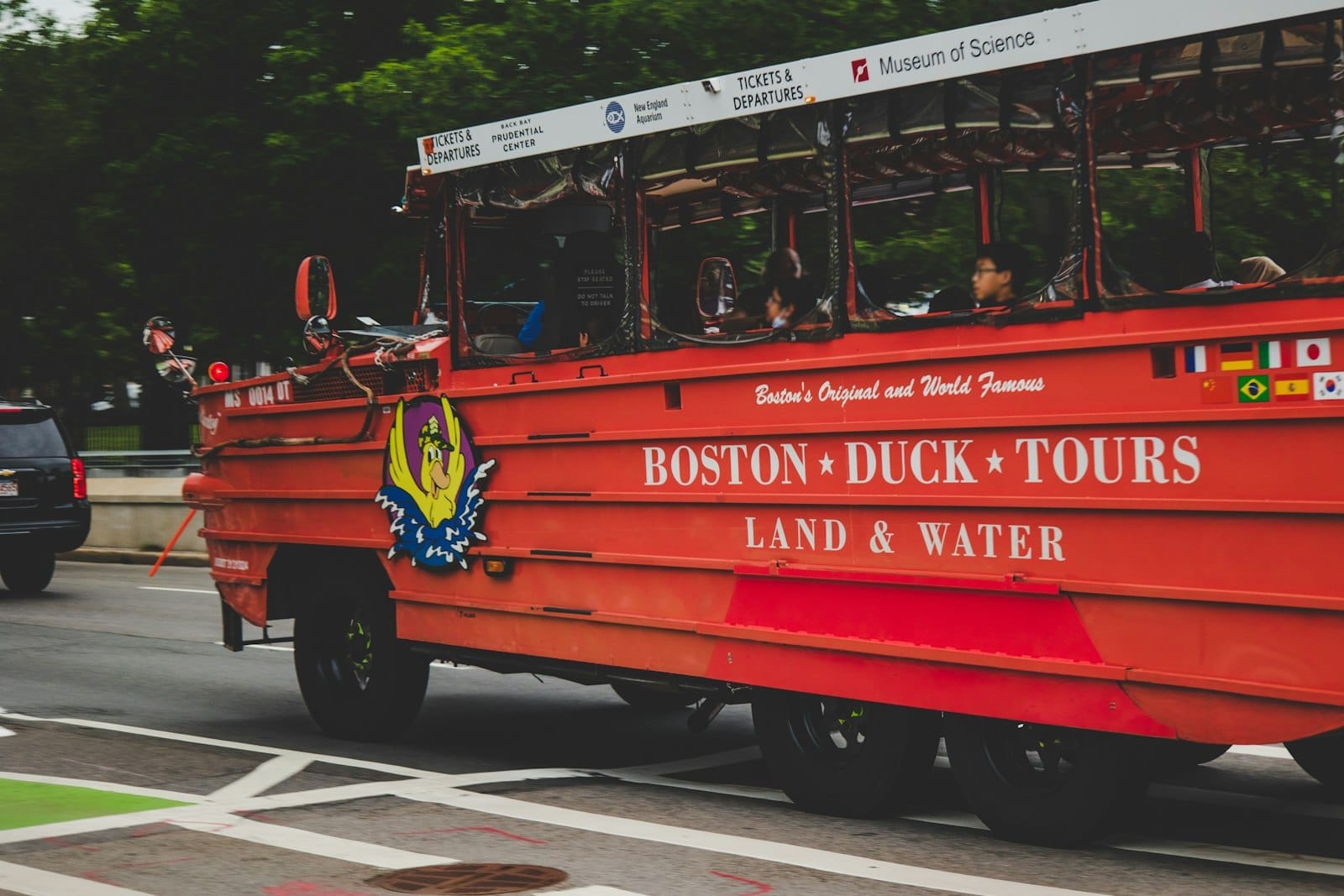
Boston Duck Tours operates a fleet of brightly painted replica DUKW vehicles, the same amphibious craft the U.S. military used during World War II to move troops and supplies between ship and shore. The civilian version seats around 25 to 30 passengers, rolls through city streets on rubber tires, then drives directly into the Charles River, where the hull takes over as it transitions from land to water. The transition, which takes place near the Museum of Science dam, never gets old regardless of how many times you've seen photos of it.
The company launched on October 5, 1994, and has operated since, making it one of Boston's longest-running commercial tour operators. Three departure points serve different parts of the city: the Museum of Science on the Charles River, the Prudential Center in Back Bay, and the New England Aquarium on the waterfront. Each location covers a slightly different opening stretch of the route before the vehicles converge on the same core circuit.
💡 Local tip
Tickets sell out on peak summer weekends. Book online at least two to three days in advance during July and August. Walk-up availability is far more reliable on weekday mornings in May, June, or September.
The Route: What You'll Actually See
Depending on your departure point, the land portion of the tour covers a substantial sweep of central Boston. Expect to roll past or near Beacon Hill, the Massachusetts State House with its gold dome, the edge of Boston Common, Copley Square, the Back Bay brownstones along Commonwealth Avenue, and sections of the waterfront. The commentary is delivered live by a tour conductor called a ConDUCKtor, and the quality of the narration varies with the individual guide. The better ones work in genuine historical detail; the less experienced ones lean harder on the duck-call humor.
Boston's urban history is dense, and the tour is intentionally broad rather than deep. You'll hear about the Freedom Trail, the Great Boston Fire of 1872, the infilling of Back Bay from tidal flats, and the story behind the Charles River dam. For any single topic that catches your interest, the Duck Tour functions better as an appetizer than a full meal. It tells you what exists; the follow-up walks fill in the meaning.
The water portion lasts roughly 20 minutes on the Charles River Basin. You get a perspective of the Boston skyline and the Cambridge shoreline that is hard to replicate on foot. On clear days, the reflected light off the water and the scale of the skyline from river height is one of the cleaner photographic moments the tour offers. Bring a wide-angle lens or use your phone's panorama mode.
Tickets & tours
Hand-picked options from our booking partner. Prices are indicative; availability and final rates are confirmed when you complete your booking.
Old Town Trolley tours of Boston
From 0 €Instant confirmationBoston Summer Night Trolley Tour and River Cruise
From 27 €Instant confirmationFree cancellationGhosts and Gravestones tour of Boston
From 39 €Instant confirmationFree cancellationBest of Boston tour
From 182 €Instant confirmationFree cancellation
Seasonality and Time of Day: When the Experience Changes
Tours operate seasonally, generally from late March through late November, weather permitting. The season opening in late March means you're often riding through a city still shaking off winter: bare trees, low crowds, and crisp air that makes the open-sided vehicle feel bracing. By contrast, late September and October bring foliage color to the Commonwealth Avenue Mall and the Esplanade that elevates the land portion of the tour.
Summer is the most popular window by a significant margin, which creates two problems: heat and crowds. The DUKW vehicles are open-sided, which is pleasant in mild weather but uncomfortable in July's humidity. Peak-season tours at midday in August can feel crowded and warm. Morning departures (the first or second slot after 10:00 a.m.) tend to run cooler and see softer light on the Charles River. If you're planning a summer visit to Boston, you can find seasonal timing advice in this guide to Boston in summer.
At the Museum of Science departure point, tours typically begin around mid-morning and run at regular intervals until late afternoon or early evening, often ending about an hour before sunset. This means late-afternoon departures in midsummer can put you on the Charles River at golden hour, which is worth targeting if you care about photography. Check sunset times for your specific travel date and count back one hour to identify the last available departure.
ℹ️ Good to know
The Museum of Science location has an on-site parking garage, which the operator notes offers the best parking rate among its three departure points. If you're driving from outside Boston, this is the most practical starting point.
Choosing Your Departure Location
The Museum of Science departure at 1 Science Park, Boston, MA 02114, is the most logistically convenient for visitors staying in Beacon Hill, Cambridge, or the West End. Boarding takes place in front of the museum next to a life-size T. rex sculpture, which doubles as a meeting point if you're with children. The Green Line's Science Park/West End stop is the closest T station, and the operator notes that all departure points are within a 15-to-20-minute walk of many central Boston locations.
The Prudential Center departure suits visitors staying in Back Bay or the South End. The Back Bay location puts you close to Newbury Street and Copley Square, so you can pair the Duck Tour with a morning of independent walking before or after. The New England Aquarium departure works well if you're already spending time on the waterfront or combining with the aquarium itself.
Practical Details: Language, Accessibility, and Photography
Boston Duck Tours offers a GPS-activated foreign-language commentary app in Spanish, German, Mandarin, French, Japanese, Italian, Brazilian Portuguese, Korean, and Cantonese. Guests must bring their own mobile devices and headphones. The app syncs to location automatically, so you don't need to manually trigger commentary as the vehicle moves.
On wheelchair and mobility access, the operator does not provide consolidated information on a single web page. Visitors with specific mobility needs should contact Boston Duck Tours directly before booking to confirm current provisions. The vehicles are DUKW-derived military craft, and boarding involves steps, which may be a consideration for some travelers.
Photography on board is casual and expected. The open sides mean nothing obstructs your sightlines, though the vehicle does move at regular traffic speeds on city streets, so panning shots require a fast shutter speed. The water section is the most photogenic: position yourself on the river-facing side as you enter the Charles to capture the Boston skyline before the vehicle turns.
⚠️ What to skip
Children under three typically ride free but must sit on a lap. Strollers cannot be accommodated on board and must be stored separately. Confirm the current stroller and luggage policy when booking.
Who Gets the Most Out of This Tour
The Duck Tour delivers real value for first-time visitors who want a spatial orientation to Boston's layout within their first day of arrival. The city's street grid is not intuitive, and 80 minutes on a Duck Tour does more to build a mental map than an hour with a paper guide. If you've never stood on the edge of the Charles River and looked back at the skyline, the water section alone justifies the ticket price. For deeper historical context, resources like the Boston history guide will fill in what the tour can only touch on.
For repeat visitors, history buffs who already know the material, or solo travelers who prefer to move at their own pace, the format offers less. The commentary is structured for mixed audiences and keeps the tone light, which means depth is sacrificed for accessibility. If you've already walked the Freedom Trail or spent a day in Beacon Hill, the Duck Tour will cover familiar ground without adding much.
Families with children between roughly four and twelve tend to respond well to the vehicle novelty and the ConDUCKtor's interactive style. The duck-call tradition, where passengers are handed quackers and encouraged to call out at pedestrians, is entertaining for younger riders. Pair it with a visit to the Boston Children's Museum or the Museum of Science Boston for a full family day.
Travelers with limited mobility who find long walking tours difficult may find the Duck Tour a useful way to cover a lot of ground without physical strain, provided they can manage the boarding steps. Check accessibility provisions in advance, but for people who want to see the city without a multi-mile walk, this format has real practical appeal.
Insider Tips
- The last departure of the day frequently has fewer passengers than midday tours. If you want a less crowded experience and your schedule is flexible, aim for the final slot rather than the first.
- Seats are not assigned. Board early to claim a position on the left side of the vehicle when departing from the Museum of Science — that side faces the Cambridge shoreline on the outbound leg and Boston's skyline on the return river crossing.
- The GPS-activated language app requires a data connection or pre-download. If you're using an international SIM or relying on roaming, download the app and any required content before leaving your accommodation.
- ConDUCKtors vary considerably in their historical knowledge and performance energy. If you get a guide who rushes through commentary, the vehicle's physical route still delivers. The skyline from the river is the same regardless.
- Boston's weather shifts quickly, particularly in spring and fall. The open-sided vehicles provide no rain protection. Check the forecast the morning of your tour; light drizzle makes the experience miserable in a way that indoor attractions do not.
Who Is Boston Duck Tours For?
- First-time visitors wanting a quick orientation to Boston's geography and history
- Families with children aged 4 to 12 who respond well to interactive, novelty-driven tours
- Travelers with limited mobility who want broad city coverage without long walks
- International visitors using the foreign-language commentary app
- Anyone who wants to see the Boston skyline from the Charles River without booking a separate boat tour
Nearby Attractions
Combine your visit with:
- Arnold Arboretum
Founded in 1872, the Arnold Arboretum is the oldest public arboretum in North America — a free, 281-acre landscape in Jamaica Plain managed by Harvard University. With over 15,000 accessioned plants and sweeping hillside views, it draws botanists, dog walkers, and curious visitors in equal measure across all four seasons.
- Blue Hills Reservation
Ten miles south of downtown Boston, Blue Hills Reservation spreads across more than 7,000 acres of forested hills, rocky ridgelines, and glacial wetlands. Free to enter and open year-round from dawn to dusk, it offers 125 miles of trails ranging from easy pond-side loops to a genuine summit climb at 635-foot Great Blue Hill.
- Boston Harbor Islands
Boston Harbor Islands National and State Park puts 34 islands and peninsulas within easy ferry reach of downtown Boston. From Civil War earthworks on Georges Island to the oldest lighthouse station in the United States on Little Brewster, the park rewards visitors who are willing to trade the city's brick sidewalks for salt air and open water.
- Castle Island
Castle Island is a 22-acre state park in South Boston where a granite fort built between 1834 and 1851 anchors one of the city's most satisfying free outings. The park sits along Pleasure Bay, connected to the mainland by walkways, and offers harbor views, a loop walk popular with locals, and seasonal guided tours of Fort Independence.