Castle Island and Fort Independence: Boston's Free Waterfront History Park
Castle Island is a 22-acre state park in South Boston where a granite fort built between 1834 and 1851 anchors one of the city's most satisfying free outings. The park sits along Pleasure Bay, connected to the mainland by walkways, and offers harbor views, a loop walk popular with locals, and seasonal guided tours of Fort Independence.
Quick Facts
- Location
- 2010 William J Day Blvd, South Boston, MA 02127
- Getting There
- MBTA Bus Route 11 (City Point) stops nearby; parking available on site
- Time Needed
- 1 to 2.5 hours depending on whether you join a fort tour
- Cost
- Free — park entry and fort tours are both no charge
- Best for
- Waterfront walks, military history, harbor photography, families
What Castle Island Actually Is
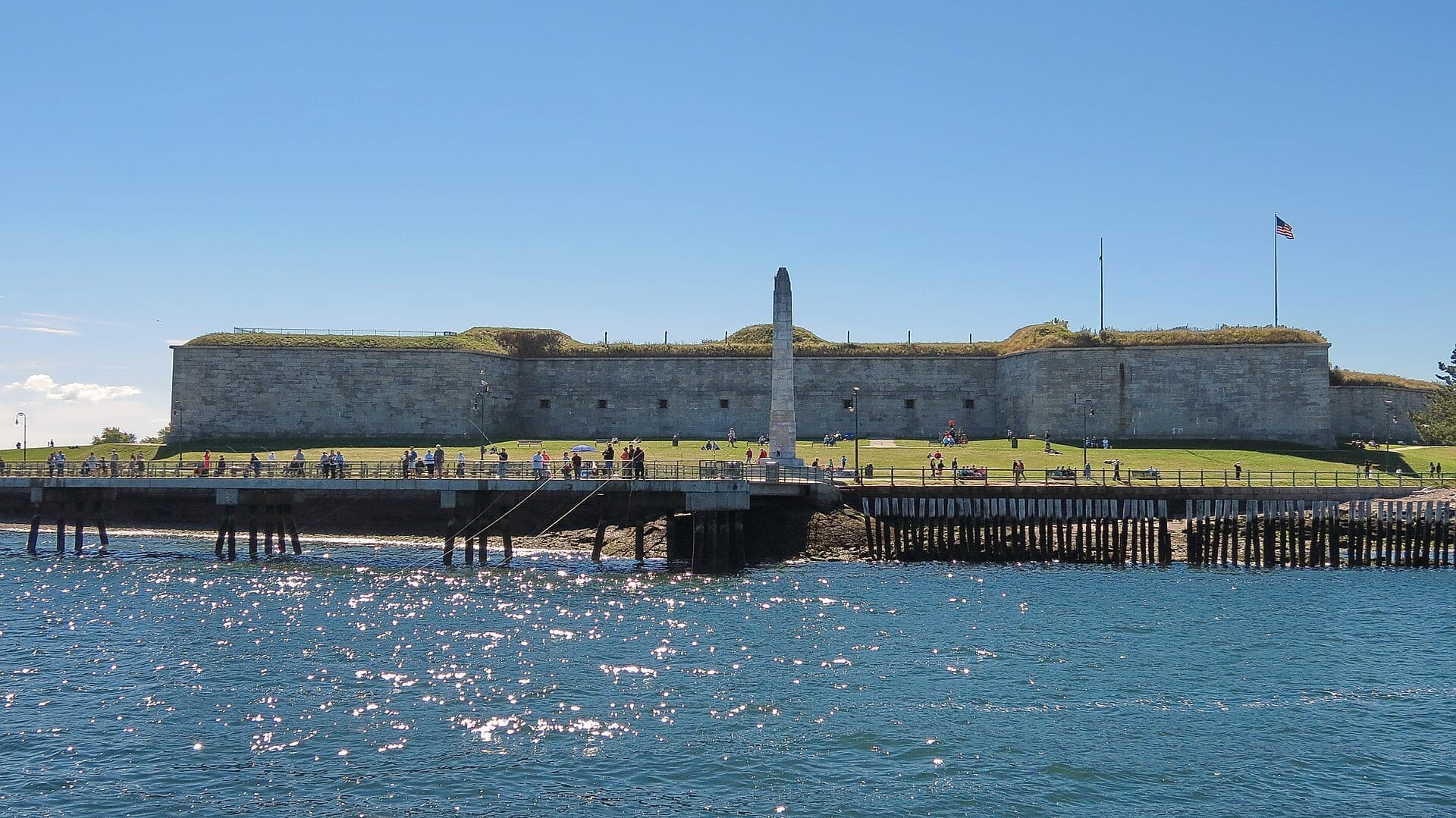
Despite the name, Castle Island has not been an island since 1928, when a concrete causeway permanently connected it to the South Boston shoreline. What you get today is a 22-acre peninsula jutting into Boston Harbor, anchored by the hulking granite walls of Fort Independence, a pentagonal fortification completed in 1851 after nearly two decades of construction. The fort is the eighth military structure to occupy this site; the first was ordered by Governor John Winthrop in the 1630s, making it one of the longest-continuously fortified locations in North America.
The park is operated by the Massachusetts Department of Conservation and Recreation and is listed on both the State and National Registers of Historic Places. On a Tuesday afternoon it draws joggers, dog walkers, and retirees eating lunch on the benches facing the harbor. On a summer Sunday it fills with families from across the city. Both versions of the park are worth knowing about before you plan your visit.
💡 Local tip
Sullivan's, a food stand at the park entrance, has been serving hot dogs and clam chowder since 1951 and is practically a civic institution in South Boston. Lines form fast on weekends in summer.
The Walk: Pleasure Bay Loop and Harbor Promenade
The main draw for most visitors is the paved loop around Pleasure Bay, a calm protected cove formed between Castle Island and the mainland seawall. The full circuit runs roughly 1.5 miles at a relaxed pace. The inner side faces the sheltered bay, where the water in summer is calm enough for small children to wade and where you can sometimes spot cormorants perched on the breakwater. The outer side, along the harbor promenade, faces the main shipping channel.
That outer promenade is where Castle Island earns its reputation for views. Planes from Logan International Airport bank low directly overhead on their approach, close enough to read the airline livery clearly. Cargo ships and tankers pass at close range. On clear days the Boston skyline appears to the north, and the harbor islands dot the southern horizon. It is one of the few places in the city where you can feel the full scale of Boston Harbor without paying for a boat ticket.
Photographers should note that the morning light hits the fort's eastern facade cleanly between roughly 7 and 10 a.m. For skyline shots with soft light, the northern end of the promenade works best in the hour after sunrise. The park is open year-round, and the winter loop walk on a cold clear day, when crowds thin and the harbor is steel-gray, has a different quality entirely. For more outdoor options in and around the city, see the Boston outdoor activities guide.
Tickets & tours
Hand-picked options from our booking partner. Prices are indicative; availability and final rates are confirmed when you complete your booking.
Boston Summer Night Trolley Tour and River Cruise
From 27 €Instant confirmationFree cancellationLEGOLAND Discovery Center Boston tickets
From 26 €Instant confirmationFree cancellationGhosts and Gravestones tour of Boston
From 39 €Instant confirmationFree cancellationBest of Boston tour
From 182 €Instant confirmationFree cancellation
Fort Independence: Inside the Walls
Fort Independence is a granite pentagonal fort with walls several feet thick, built between 1834 and 1851. The design follows the classic Third System of American coastal fortification, the same approach used at Fort Sumter in South Carolina, with a low profile intended to absorb cannon fire rather than present a high target. The Boston Harbor version never saw combat, but it served as a prison and training facility through the Civil War era and into the early 20th century.
The Castle Island Association offers free guided tours of the fort interior during the seasonal schedule. Tours in June and July run Saturdays and Sundays from noon to 3 p.m., with Thursday evening twilight skyline viewing from 7 p.m. to dusk; in August tours run Saturdays and Sundays from noon to 3 p.m., and in September and October Sunday-only access is offered from noon to 3 p.m. through Columbus Day weekend, which offer a different perspective on the harbor and skyline as the sun drops. The fort's first floor is wheelchair accessible; upper levels are not.
The interior courtyard is worth seeing even if you have limited interest in military history. The scale of the construction, granite quarried and laid by hand over 17 years, reads differently from inside than it does from the parade ground. The casemated gun rooms facing the harbor give a clear sense of how the fort was designed to control the shipping channel. Guides are knowledgeable and the tours run about 45 minutes.
ℹ️ Good to know
Fort interior tours are seasonal and weather-dependent. If you specifically want to go inside, visit between early June and Columbus Day and aim for a weekend afternoon. Outside those dates, you can walk the grounds and exterior but the interior is closed.
How the Experience Changes by Time of Day and Season
Early mornings on weekdays are the quietest. By 7 a.m. you will find a steady stream of local runners and dog walkers, but the benches facing the harbor are largely empty and the food stand is not yet open. This is the best time to walk the loop without crowds, and the harbor light at that hour is exceptional.
Weekend afternoons in July and August are the most crowded. The parking lot fills by mid-morning, the line at Sullivan's can stretch 20 people deep, and the benches along the bay are fully occupied by noon. If you visit then, arrive before 10 a.m. or after 4 p.m. to avoid the peak. The park does not feel unpleasant at its busiest, but it is a distinctly local crowd rather than a tourist scene, which can be a plus or minus depending on what you are after.
Fall is arguably the strongest season here. September and October bring cooler temperatures, cleaner air, and lower crowds. The Thursday twilight tours end in July, but Sunday fort tours continue through Columbus Day weekend. The harbor views in October, with less haze than summer and a sharper light, are among the better free photographic opportunities in the city.
Winter visits are possible and rewarding for the right traveler. The park stays open year-round, the loop is walkable in cold weather, and the contrast of the granite fort against a gray winter sky is stark and memorable. Dress for wind off the water, which is colder than it seems from shore. For context on what Boston weather actually looks like across the year, the best time to visit Boston guide breaks down the seasons in detail.
Historical and Cultural Context
The fortification of this site began in the 1630s, within a decade of the founding of Boston, which tells you something about how strategically the early colonists read the harbor. Every nation and government that controlled Boston maintained a fort here through more than 200 years: colonial, British, revolutionary, and federal. The existing structure is the eighth fort on the site, which means there is nearly four centuries of military occupation layered under what you are walking on.
Edgar Allan Poe reportedly served as a soldier at Fort Independence in 1827, an assignment he found miserable and from which he eventually went AWOL. Local legend holds that a story he heard there about a soldier bricked into one of the casements inspired 'The Cask of Amontillado,' published two decades later. The claim is unverifiable but plausible, and the tour guides will tell you the version with appropriate relish.
Castle Island sits within the broader arc of Boston Harbor history, a harbor that has been central to the city's economy and identity since the 17th century. If you want more context for Boston's relationship with the water and its role in American history, the Boston history guide covers the full sweep, and the Boston Harbor Islands offer more of the same harbor landscape with deeper wilderness access.
Getting There and Practical Logistics
Castle Island is in South Boston, roughly three miles from downtown. By public transit, MBTA Bus Route 11 (City Point) runs from Downtown Crossing and stops close to the park entrance. The trip takes about 20 to 25 minutes from downtown. If you are driving, there is a free parking lot at the site, though it fills quickly on summer weekends. On foot from the Broadway Red Line station, the walk is approximately 1.5 miles along East Broadway, a flat and straightforward route.
The park itself is flat and paved, making the loop entirely manageable with a stroller. The fort's first floor is wheelchair accessible; the upper levels involve stairs with no lift. Restrooms are available on site. There is no admission fee for either the park or the fort tours. Bring cash if you plan to eat at Sullivan's.
Castle Island fits naturally into a South Boston afternoon that also includes the nearby beaches. Carson Beach and M Street Beach are directly adjacent along the same shoreline. If you are putting together a longer day in this part of the city, the Boston beaches guide covers the waterfront options in detail.
Who This Attraction Suits and Who Should Skip It
Castle Island works particularly well for travelers who want to see a part of Boston that does not feel staged for tourists. The Pleasure Bay loop is a genuine neighborhood routine, not a curated visitor experience. The fort is the real thing, historically significant and free to enter, which is rare for a site of this quality.
If you are making a short trip to Boston and are trying to choose between this and the city's more famous historical sites, the fort interior at Castle Island is less polished than something like the Old State House but the overall experience, waterfront walk plus fort plus harbor views, offers more variety for your time. It is a strong choice if you have a half-day to spend south of downtown.
Skip it if you are visiting specifically for the fort interior and your trip falls outside the Memorial Day to Columbus Day window. You can still walk the grounds and the exterior is impressive, but the inside is what makes the fort distinct. Also skip it if your primary interest is shopping or nightlife — this is a park with benches and a clam shack, and that is exactly what it is supposed to be.
Insider Tips
- The Thursday evening twilight skyline viewings in June and July (starting at 7 p.m.) give you the fort at golden hour with the Boston skyline behind you. This is the best photography window at the site by a significant margin.
- Arrive by 9 a.m. on summer weekends if you want parking without circling. The lot is free but small and fills fast once families start arriving.
- The wind off the harbor is consistently 5 to 10 degrees colder than it feels in the city, even in July. A light layer is useful even on warm days.
- Walk the loop counterclockwise (left from the entrance) to hit the open harbor views while you are fresh and save the calmer Pleasure Bay side for the return. The view sequence is better in that direction.
- Sullivan's is primarily a casual takeout stand, and while it long operated as cash only, it now accepts cards as well. There is no ATM at the park. If you are planning to eat there, bring small bills.
Who Is Castle Island For?
- History travelers who want a free, substantive military site without a museum admission fee
- Families with children who need open space, a flat walk, and food nearby
- Photographers looking for harbor and skyline angles that most visitors miss
- Locals and repeat visitors who want to see Boston outside the tourist corridor
- Anyone visiting in fall who wants waterfront scenery with minimal crowds
Nearby Attractions
Combine your visit with:
- Arnold Arboretum
Founded in 1872, the Arnold Arboretum is the oldest public arboretum in North America — a free, 281-acre landscape in Jamaica Plain managed by Harvard University. With over 15,000 accessioned plants and sweeping hillside views, it draws botanists, dog walkers, and curious visitors in equal measure across all four seasons.
- Blue Hills Reservation
Ten miles south of downtown Boston, Blue Hills Reservation spreads across more than 7,000 acres of forested hills, rocky ridgelines, and glacial wetlands. Free to enter and open year-round from dawn to dusk, it offers 125 miles of trails ranging from easy pond-side loops to a genuine summit climb at 635-foot Great Blue Hill.
- Boston Duck Tours
Boston Duck Tours puts you aboard a replica World War II DUKW amphibious vehicle for an 80-minute circuit of the city's most historic landmarks, finishing with a splash into the Charles River. Running seasonally from late March through late November, it's one of the few tours in Boston that covers both street-level sights and a Charles River perspective in a single trip.
- Boston Harbor Islands
Boston Harbor Islands National and State Park puts 34 islands and peninsulas within easy ferry reach of downtown Boston. From Civil War earthworks on Georges Island to the oldest lighthouse station in the United States on Little Brewster, the park rewards visitors who are willing to trade the city's brick sidewalks for salt air and open water.