Arnold Arboretum: Boston's Living Museum of Trees and Shrubs
Founded in 1872, the Arnold Arboretum is the oldest public arboretum in North America — a free, 281-acre landscape in Jamaica Plain managed by Harvard University. With over 15,000 accessioned plants and sweeping hillside views, it draws botanists, dog walkers, and curious visitors in equal measure across all four seasons.
Quick Facts
- Location
- 125 Arborway, Jamaica Plain, Boston, MA 02130
- Getting There
- MBTA Orange Line – Forest Hills Station (about a 10–15 min walk to the Arborway/Hunnewell Gate)
- Time Needed
- 1.5 to 3 hours depending on route
- Cost
- Free — admission to the landscape is always free
- Best for
- Nature lovers, photographers, walkers, families with older children
- Official website
- arboretum.harvard.edu/visit
What Is the Arnold Arboretum?
The Arnold Arboretum of Harvard University is a 281-acre public landscape in Jamaica Plain, Boston, open every day from sunrise to sunset at no cost. Founded in 1872 through a bequest from New Bedford merchant James Arnold, it is the oldest public arboretum in North America. Harvard's Faculty of Arts and Sciences manages the collection, which contains more than 15,000 individually catalogued plants — each tagged with genus, species, and collection data. This is not just a park for strolling; it functions simultaneously as a research institution, a conservation repository, and one of the most quietly impressive free outdoor experiences in New England.
The arboretum sits at the western edge of Frederick Law Olmsted's Emerald Necklace, a connected chain of parks that stretches from Boston Common down through Brookline and Jamaica Plain. Olmsted himself collaborated on the arboretum's landscape design in the 1880s, which explains the naturalistic road and path network that follows the terrain rather than fighting it. Walking through, you notice how the hillside transitions from low meadow to dense canopy with an unhurried logic that feels deliberate rather than accidental.
ℹ️ Good to know
The Visitor Center at the Hunnewell Building (125 Arborway) is typically open daily 10:00 AM to 4:00 PM, with hours subject to change seasonally. Pick up a printed plant map here — it is far more useful on the ground than the digital version for navigating between collections.
The Collections: What You Actually See
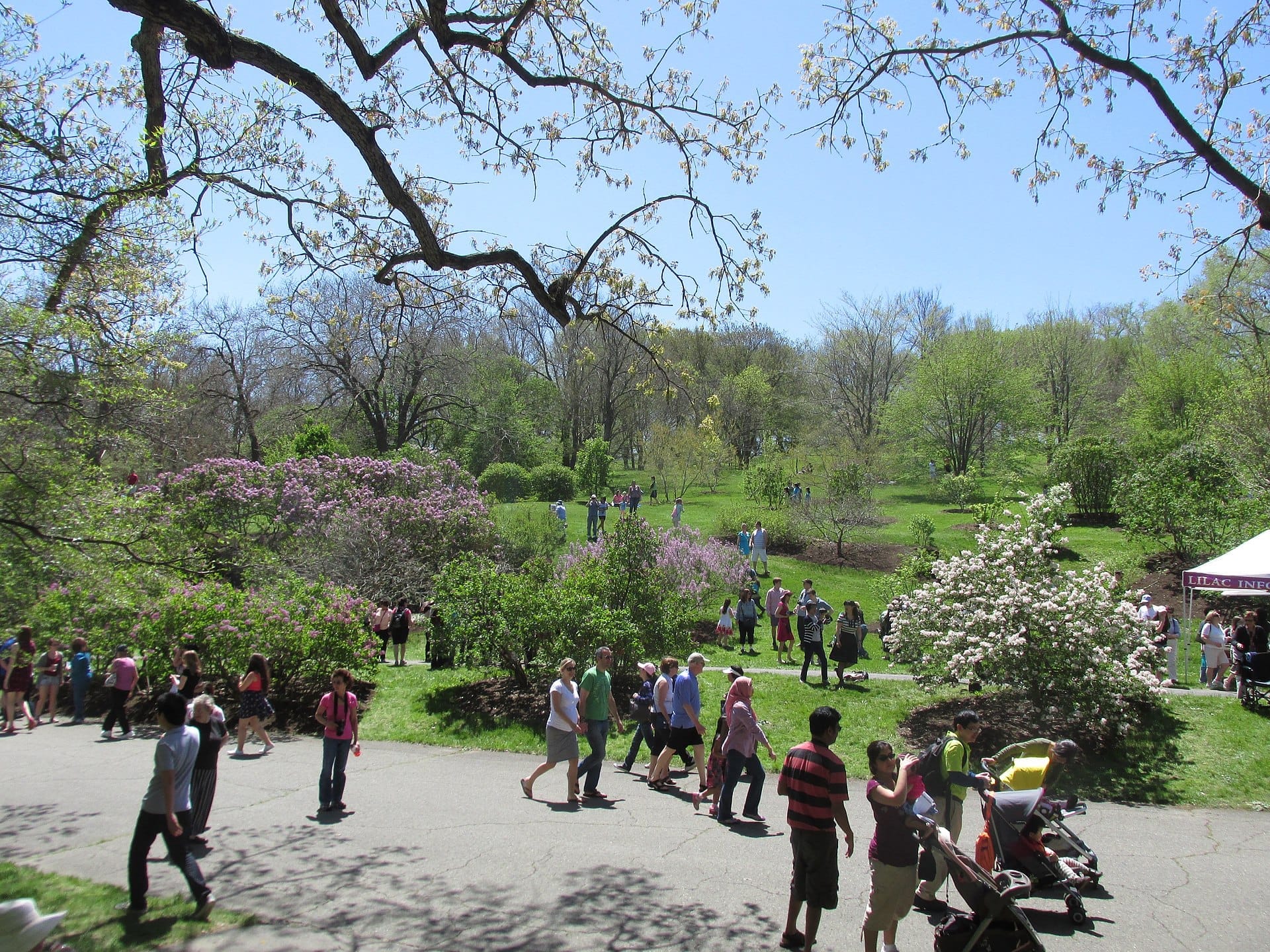
The arboretum's plant collections are organized roughly by taxonomy as you move through the landscape. Near the main Arborway entrance, lilac collections line both sides of a gentle slope — this is where crowds concentrate hard in early to mid-May, when dozens of lilac varieties bloom simultaneously and the air carries that specific dense sweetness that is almost disorienting in its intensity. The Lilac Sunday event, held annually each May, is the arboretum's single most attended day, drawing tens of thousands of visitors; if crowds are not your preference, arrive before 8:00 AM or plan a weekday visit.
Moving further in, the Conifer Collection on Bussey Hill Road offers an entirely different texture: tall, resinous, year-round structural planting that smells of pine and wet earth after rain. The Summit of Bussey Hill is one of the higher points in the arboretum at roughly 240 feet, providing an open view northward toward the Boston skyline on clear days. It is one of the few places in the city where you can take in a recognizable urban panorama from a natural vantage point.
The Bonsai and Penjing Collection, housed in the Case Estates greenhouse facility, is separate and operates on its own schedule. Within the main landscape, the Chinese Path area near the Peters Hill section contains plantings sourced from expeditions to Asia in the late 19th and early 20th centuries — the arboretum has deep historical ties to plant exploration in China and Japan, and that lineage shows in the specificity of what grows here.
Tickets & tours
Hand-picked options from our booking partner. Prices are indicative; availability and final rates are confirmed when you complete your booking.
Boston Summer Night Trolley Tour and River Cruise
From 27 €Instant confirmationFree cancellationLEGOLAND Discovery Center Boston tickets
From 26 €Instant confirmationFree cancellationGhosts and Gravestones tour of Boston
From 39 €Instant confirmationFree cancellationBest of Boston tour
From 182 €Instant confirmationFree cancellation
How the Experience Changes by Season
Spring is the obvious peak. Magnolias flower from late March into April, producing large, waxy blooms on bare branches before the leaves emerge — the visual effect is theatrical, and the Magnolia Collection near the Hunnewell Building draws photographers with long lenses on weekend mornings. By mid-April, crabapples, cherries, and serviceberries add layered color. The entire spring progression unfolds over roughly six to eight weeks, so there is usually something at peak bloom on any given visit between late March and late May.
Summer shifts the arboretum into a green, shaded refuge from city heat. The dense canopy on the main walking paths drops temperatures noticeably compared to surrounding streets. Rose and Korean Evodia collections bloom in July and August, and the overall feel is quieter — fewer visitors, more birdsong, and long stretches of the path system where you pass nobody for ten minutes. This is the season for people who prefer to observe rather than photograph.
Autumn brings reliable color from mid-October into early November, though the specific timing varies year to year with temperature patterns. The arboretum's broad collection of maples, oaks, and tupelos turns in sequence rather than all at once, which extends the display over several weeks. For context on timing, Boston's fall foliage season is covered in detail in the Boston in fall guide. Winter is underrated here: the branching architecture of mature specimens becomes visible without foliage, and the landscape takes on a spare, almost skeletal clarity that serious plant enthusiasts find more revealing than any other season.
Getting There and Getting Around
The most direct public transit option is the MBTA Orange Line to Forest Hills Station, which sits about a five- to ten-minute walk from the nearest South Street gate and closer to ten to fifteen minutes from the main Arborway gate. From downtown Boston, the Orange Line runs frequently and the trip takes approximately 20 minutes from Downtown Crossing. Several MBTA bus routes also stop along the Arborway near the main entrance. Free parking is available along Arborway, Flora Way, and Walter Street, though spaces fill quickly on Lilac Sunday and peak spring weekends — transit is the more reliable choice on those days.
The arboretum is also accessible by bike, and the Emerald Necklace path system connects it to Jamaica Pond directly to the north. A combined visit to Jamaica Pond and the arboretum makes for a natural half-day loop that covers two of the Emerald Necklace's most distinctive sections without requiring any transit.
💡 Local tip
The arboretum has multiple gates; not all are open at all times. The main Arborway Gate near Forest Hills is the most reliably accessible entry point. The Meadow Road Gate off South Street is useful for the Peters Hill section but adds walking distance from transit.
Internal roads are paved and mostly gentle in grade, making the main routes accessible for strollers and most mobility aids. Harvard notes that accessibility resources are available, and the Visitor Center staff can advise on the flattest routes. Some of the informal footpaths — particularly those climbing Bussey Hill and Peters Hill — are unpaved and can be muddy after rain; waterproof footwear is worth considering outside of dry summer months.
Historical and Scientific Context
The arboretum was established in 1872, and in 1882 a unique arrangement between Harvard University and the City of Boston leased the land to Harvard for 1,000 years in exchange for the university maintaining it as a free public park. This structure, still in place today, explains why admission is free and the landscape is technically part of the Boston park system while being managed as a scientific institution. The first director, Charles Sprague Sargent, served from 1873 to 1927 and shaped the collection's identity through decades of plant exploration partnerships, particularly with Ernest Henry Wilson, whose expeditions to China and Japan introduced hundreds of Asian species to Western horticulture.
Each plant in the collection carries an accession tag with a catalogue number tied to its provenance data — where it was collected, when, by whom. This level of documentation is unusual in a public park setting and reflects the dual function of the site as both garden and living laboratory. Harvard researchers continue to use the collection for studies in plant genetics, phenology, and conservation. For visitors with a deeper interest in Boston's scientific and educational legacy, the arboretum connects naturally to the broader university landscape of Boston and Cambridge.
Photography Tips and Practical Details
Morning light before 9:00 AM is consistently the best time for photography throughout the year. The low angle of early sun creates depth in the conifer collections and picks up dew or frost on grass in cooler months. During lilac season, arrive at or just after sunrise to avoid both crowds and harsh midday light that flattens the color of the blooms. The Magnolia Collection shoots best from the west-facing slope looking east, with morning light behind you.
There are no food vendors inside the arboretum. Bring water, especially in warm months — the main walking circuit covers several miles if you take the full loop including Bussey Hill and Peters Hill. Dogs are welcome on leash. The landscape is a genuine all-weather destination: overcast days produce even light that suits botanical photography, and misty mornings in autumn create particularly atmospheric conditions in the denser planted sections.
⚠️ What to skip
No food or drink (other than water) is permitted on the landscape. Picnicking is technically prohibited, which surprises some visitors who expect a standard city park experience. The rules are enforced, particularly on high-attendance days.
Is It Worth Your Time?
For travelers on a tight schedule focused on historic downtown attractions, the arboretum is a detour rather than a central stop — it sits about 25 minutes from the city center by transit. If your Boston itinerary is built around sites like the Freedom Trail or the waterfront, the arboretum requires deliberate time allocation. That said, for visitors spending three or more days in the city, or anyone with an interest in landscape, ecology, or simply sustained quiet, it is among the more rewarding free experiences Boston offers.
Travelers who find themselves frustrated by crowds at Boston Common or the Public Garden will likely appreciate the arboretum's scale and the way it absorbs visitors without feeling congested outside of peak spring events. Families with young children should be aware that the terrain involves hills and uneven paths; it is manageable but not effortless with a stroller. Visitors looking primarily for flat, open lawn space will find the arboretum's dense, planted character less suited to their needs than the Public Garden or the Esplanade.
Insider Tips
- The arboretum publishes a bloom calendar and phenology updates on its website throughout the season — check it the week before your visit to time your trip to what is actually at peak, rather than relying on general seasonal estimates.
- Peters Hill, on the southwest side of the arboretum, is less visited than the main Bussey Hill circuit and offers a different plant palette, including a notable oak collection. It is worth the extra distance if you have time.
- The Hunnewell Building near the main gate houses a small library and herbarium that are accessible to researchers; the building's exterior and surrounding planting are worth pausing at even if you do not go inside.
- Weekday mornings in late October offer some of the most photogenic conditions in the arboretum: peak foliage, low visitor numbers, and raking morning light through the canopy. This window typically lasts only a few days before leaf drop accelerates.
- The Orange Line runs directly to Forest Hills; if you are coming from Back Bay or the South End, the Needham Line commuter rail also stops at Forest Hills and drops you at the same station.
Who Is Arnold Arboretum For?
- Botanical and nature enthusiasts who want a serious plant collection rather than a decorative garden
- Photographers seeking natural light and seasonal subjects across all four seasons
- Runners and walkers looking for a paved loop with elevation change in a car-free setting
- Travelers combining the arboretum with Jamaica Pond for a half-day Emerald Necklace walk
- Anyone seeking free outdoor space well away from downtown crowds
Nearby Attractions
Combine your visit with:
- Blue Hills Reservation
Ten miles south of downtown Boston, Blue Hills Reservation spreads across more than 7,000 acres of forested hills, rocky ridgelines, and glacial wetlands. Free to enter and open year-round from dawn to dusk, it offers 125 miles of trails ranging from easy pond-side loops to a genuine summit climb at 635-foot Great Blue Hill.
- Boston Duck Tours
Boston Duck Tours puts you aboard a replica World War II DUKW amphibious vehicle for an 80-minute circuit of the city's most historic landmarks, finishing with a splash into the Charles River. Running seasonally from late March through late November, it's one of the few tours in Boston that covers both street-level sights and a Charles River perspective in a single trip.
- Boston Harbor Islands
Boston Harbor Islands National and State Park puts 34 islands and peninsulas within easy ferry reach of downtown Boston. From Civil War earthworks on Georges Island to the oldest lighthouse station in the United States on Little Brewster, the park rewards visitors who are willing to trade the city's brick sidewalks for salt air and open water.
- Castle Island
Castle Island is a 22-acre state park in South Boston where a granite fort built between 1834 and 1851 anchors one of the city's most satisfying free outings. The park sits along Pleasure Bay, connected to the mainland by walkways, and offers harbor views, a loop walk popular with locals, and seasonal guided tours of Fort Independence.