Jamaica Pond: Boston's Glacial Lake and Olmsted Masterpiece
Jamaica Pond is the largest body of fresh water in Boston, a 68-acre glacial kettle lake encircled by a 1.5-mile walking path and shaped by Frederick Law Olmsted's 1891 Emerald Necklace vision. Entry is free, the setting is especially peaceful, and the experience shifts dramatically with the seasons.
Quick Facts
- Location
- Between the Jamaicaway and Perkins Street, Jamaica Plain, Boston, MA 02130
- Getting There
- Orange Line, Green Street Station (approx. 10-min walk to pond)
- Time Needed
- 45 minutes (loop walk) to 2+ hours (with boating or picnicking)
- Cost
- Free park entry; seasonal boat rentals available (check Courageous Sailing for current pricing)
- Best for
- Runners, picnickers, families, photographers, and anyone needing a break from central Boston
- Official website
- www.boston.gov/parks/jamaica-pond
What Jamaica Pond Actually Is
Jamaica Pond is not a manicured city fountain or a landscaped ornamental pool. It is a genuine glacial kettle lake, formed roughly 10,000 to 15,000 years ago when retreating glaciers left behind a massive block of buried ice that eventually melted into the earth. The result is a basin more than 50 feet deep at its center, holding clean, cold fresh water across roughly 68 acres. It is, by area, the largest body of fresh water within Boston city limits.
The land around the pond was incorporated into the park system in the late nineteenth century, when Frederick Law Olmsted, the landscape architect behind New York's Central Park, designed Boston's Emerald Necklace: a connected chain of parks running from the Boston Common through the Fens, Jamaica Plain, and out to Franklin Park. Jamaica Pond sits near the midpoint of that chain, and Olmsted treated it as a natural centerpiece rather than something to be engineered. He preserved the kettlehole's wooded slopes and kept the shoreline relatively wild, which is part of why the pond still reads as a natural landscape rather than a civic amenity.
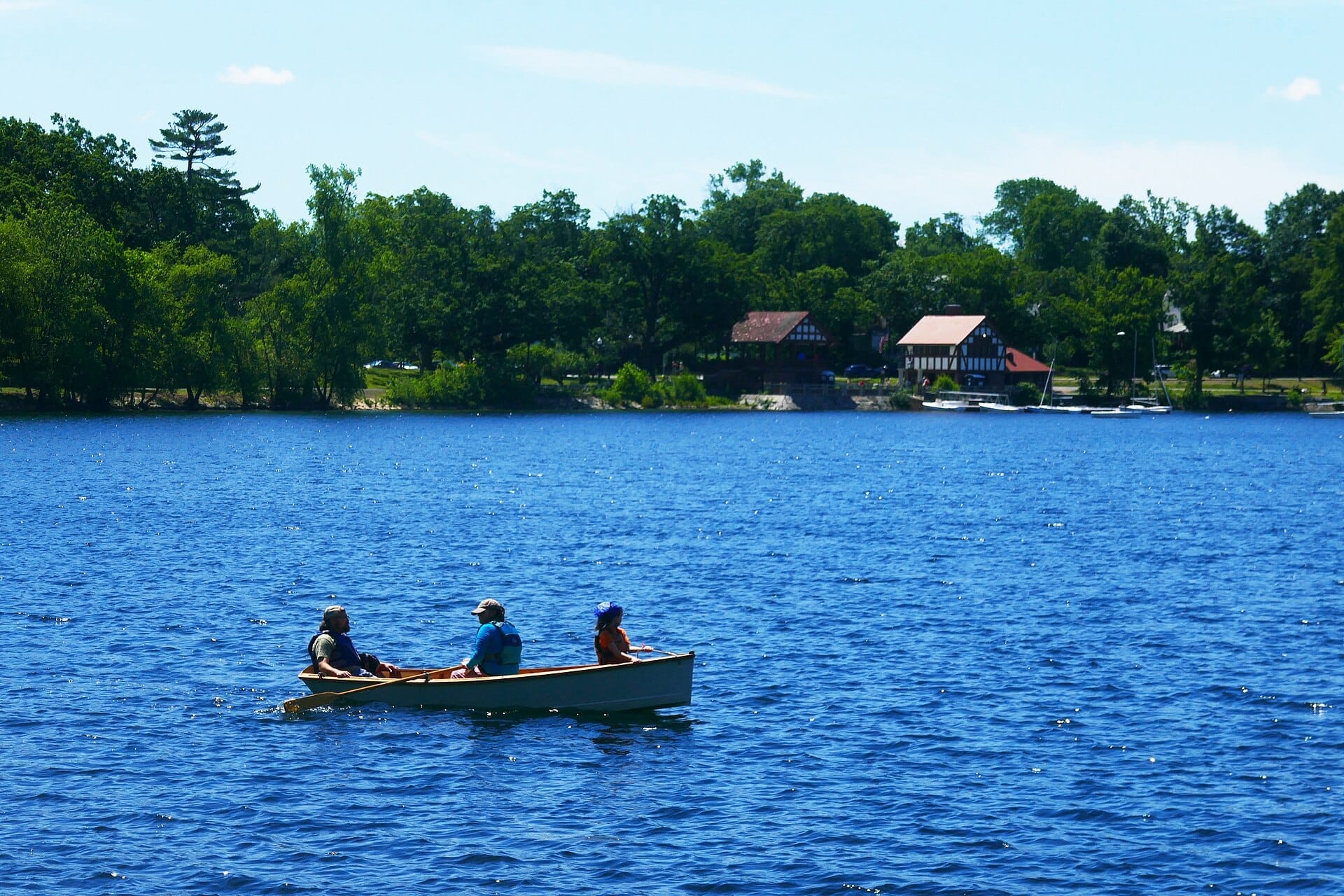
The boathouse and bandstand on the southern shore were added between 1912 and 1913, giving the pond its most photographed architectural detail. For context on how Jamaica Pond fits within Olmsted's full vision, see the Emerald Necklace guide, which covers the broader park system connecting it to the Arnold Arboretum and Franklin Park Zoo.
Walking the Perimeter Path
The pond is ringed by a 1.5-mile (2.4 km) paved and packed-gravel path that most visitors complete in 30 to 45 minutes on foot. The surface is generally flat, with a few gentle undulations near the northern end where the tree cover thickens. Runners use the loop heavily, particularly on weekend mornings, when the path can feel busy between 8 and 10 a.m. If you want the pond mostly to yourself, arrive before 7:30 a.m. on a weekday or come mid-afternoon on overcast days.
The path changes texture as you move around the pond. The eastern side, closest to the Jamaicaway, is more open and sun-exposed in the afternoon. The western side, along Pond Street and near the boathouse, stays shadier and cooler. On summer evenings, the western bank is where most of the informal socializing happens: people spread out on the grass, some with dogs, some with folding chairs, watching the light shift across the water.
💡 Local tip
The path is not formally ADA-certified in all sections. Visitors requiring specific accessibility accommodations should contact the City of Boston Parks and Recreation Department directly before visiting.
Tickets & tours
Hand-picked options from our booking partner. Prices are indicative; availability and final rates are confirmed when you complete your booking.
Boston Summer Night Trolley Tour and River Cruise
From 27 €Instant confirmationFree cancellationLEGOLAND Discovery Center Boston tickets
From 26 €Instant confirmationFree cancellationGhosts and Gravestones tour of Boston
From 39 €Instant confirmationFree cancellationBest of Boston tour
From 182 €Instant confirmationFree cancellation
How the Experience Changes by Season
Boston's climate shifts dramatically across the year, and Jamaica Pond absorbs every one of those transitions in a way that urban plazas and museums simply cannot. In late spring, roughly May through early June, the tree canopy comes in fully green and the water takes on a deep blue-gray color in the mornings. The light at this time of year is softer than summer, and the pond can feel idyllic without the humidity that settles in July and August.
Autumn is the period most worth planning around. From mid-October into early November, the hardwoods around the pond turn amber, orange, and deep red, and their reflections in the still water on calm mornings produce scenes that look almost staged. The crowds thin noticeably compared to summer weekends, and the air is crisp without being cold enough to be uncomfortable. For a broader look at the city during this period, the Boston in fall guide covers what else is worth doing across the city.
Winter is the main trade-off. When temperatures drop below freezing, the pond sometimes develops ice at its edges, and the bare tree branches create a stark, graphic quality that some visitors find beautiful. But it is cold, the path can be slippery after snow or ice, and the boathouse is shuttered. If you come in winter, wear waterproof shoes with grip, bring layers, and accept that this is a 30-minute experience rather than a full afternoon.
Boating on the Pond
During the summer season, Courageous Sailing operates boat rentals from the Jamaica Pond Boathouse on the southwestern shore. The rental fleet typically includes rowboats and sailboats, and the scale of the pond, roughly a quarter mile across at its widest, makes it appropriate for casual paddling without requiring experience. Being on the water with Boston's Jamaica Plain neighborhood rising behind the tree line gives you a perspective on the pond's size that the shore walk does not fully convey.
Rental pricing and exact hours change seasonally. The City of Boston's official park page points visitors to Courageous Sailing for current availability and rates. This is worth checking in advance, particularly on summer weekends when boats can be claimed early in the day.
ℹ️ Good to know
Fishing is also permitted at Jamaica Pond. The pond is stocked with trout, and anglers are regularly visible along the path, particularly in early morning hours near the northern and eastern banks.
Getting There and Practical Navigation
The most direct public transit route is the MBTA Orange Line to Green Street Station. From there, the pond is roughly a 10-minute walk through the Jamaica Plain neighborhood. The walk itself is straightforward and passes through a low-key residential commercial strip. Alternatively, the Forest Hills Orange Line station is slightly farther but places you at the southern end of the Emerald Necklace, where you could walk through the Arnold Arboretum and arrive at Jamaica Pond from the south.
If you are arriving by car, street parking is available along the Jamaicaway and Perkins Street, though spaces fill quickly on weekend mornings. For visitors combining Jamaica Pond with a broader Boston park day, the Arnold Arboretum is walkable to the south and makes for a natural half-day pairing, particularly in spring when the arboretum's flowering trees are at their peak.
The park is open daily from sunrise until around 11:30 p.m., according to recent published guidance. For a morning visit, plan to arrive between 7 and 9 a.m. to catch the best light on the water before foot traffic peaks.
Photography and Sensory Details
The boathouse, built in the Colonial Revival style with white clapboard and a shingled roof, photographs best in the late afternoon when the sun hits its western-facing facade directly. The bandstand nearby, a small open-sided structure on the waterfront, frames well against the pond's surface. Mornings offer the most consistent still-water reflections, especially on windless days in late spring or early fall when there is mist at the water's edge.
Sound is part of the experience here in a way that is easy to underestimate. The pond has no motorized boats, which means the dominant sounds are wind through tree canopy, the soft percussion of water against the bank, and bird calls. Red-winged blackbirds are common in the reedy margins from spring through summer. The absence of traffic noise, despite the Jamaicaway running along one edge, is more complete than you might expect.
💡 Local tip
For reflection shots, position yourself on the western bank with the boathouse behind you in the early morning. The angle puts you looking northeast across the pond with the treeline as a backdrop and minimal glare from the rising sun.
Who Should Know Before Coming
Jamaica Pond is not the right choice for visitors with only a day in Boston whose priority is historic sites, waterfront access, or iconic city views. It sits in Jamaica Plain, several miles from the Freedom Trail, Faneuil Hall, and the waterfront. Visitors focused on Boston's compact historic core should look at the Boston Common and Boston Public Garden instead, which are central and walkable from most major hotels.
The pond is also not a great destination in heavy rain. The path does not drain quickly in some sections, puddles form on the packed-gravel stretches, and the tree canopy, while pleasant in light drizzle, does not provide real shelter. There are no covered facilities beyond the seasonal boathouse. Thunderstorm warnings mean leaving the exposed shoreline path promptly.
For families, this works well for children who are comfortable with a moderate walk, have energy to burn, or are excited by boats and water. It pairs well with a visit to the Franklin Park Zoo, which is part of the same Emerald Necklace system and accessible from the same Orange Line branch.
Insider Tips
- The northern end of the path, away from the boathouse and bandstand, sees significantly less foot traffic even on busy weekend mornings. If you want a quiet stretch to sit or photograph, go there first.
- Autumn foliage peaks around mid-October to early November in Jamaica Plain. The pond's reflections are most dramatic on calm, windless mornings within this window, typically before 9 a.m.
- Courageous Sailing's boat rental operation can sell out of available slots on warm summer weekends by mid-morning. If boating is a priority, arrive at or before the boathouse opening time and check their schedule online beforehand.
- The Jamaicaway itself is a parkway and the driving behavior can be aggressive during commute hours. When crossing from street parking on the Jamaicaway side, use the marked crosswalks and wait for a full gap in traffic.
- Jamaica Pond is part of Boston's urban watershed and the water quality is monitored regularly. Swimming is not permitted, though fishing with a valid Massachusetts fishing license is allowed.
Who Is Jamaica Pond For?
- Runners and walkers who want a car-free, flat-to-gentle loop in a natural setting
- Families with children interested in rowboats or sailing on a calm, enclosed freshwater lake
- Photographers working in early morning light, especially in fall when foliage reflects in the water
- Visitors staying in Jamaica Plain or the Fenway area who want a genuine park experience without commuting to the city center
- Travelers building a half-day Emerald Necklace itinerary that connects Jamaica Pond with the Arnold Arboretum
Nearby Attractions
Combine your visit with:
- Arnold Arboretum
Founded in 1872, the Arnold Arboretum is the oldest public arboretum in North America — a free, 281-acre landscape in Jamaica Plain managed by Harvard University. With over 15,000 accessioned plants and sweeping hillside views, it draws botanists, dog walkers, and curious visitors in equal measure across all four seasons.
- Blue Hills Reservation
Ten miles south of downtown Boston, Blue Hills Reservation spreads across more than 7,000 acres of forested hills, rocky ridgelines, and glacial wetlands. Free to enter and open year-round from dawn to dusk, it offers 125 miles of trails ranging from easy pond-side loops to a genuine summit climb at 635-foot Great Blue Hill.
- Boston Duck Tours
Boston Duck Tours puts you aboard a replica World War II DUKW amphibious vehicle for an 80-minute circuit of the city's most historic landmarks, finishing with a splash into the Charles River. Running seasonally from late March through late November, it's one of the few tours in Boston that covers both street-level sights and a Charles River perspective in a single trip.
- Boston Harbor Islands
Boston Harbor Islands National and State Park puts 34 islands and peninsulas within easy ferry reach of downtown Boston. From Civil War earthworks on Georges Island to the oldest lighthouse station in the United States on Little Brewster, the park rewards visitors who are willing to trade the city's brick sidewalks for salt air and open water.