Museum of Science, Boston: What to Expect Before You Go
Straddling the Charles River between Boston and Cambridge, the Museum of Science is one of the largest science centers in the United States. With over 700 interactive exhibits, the Charles Hayden Planetarium, and a five-story domed Omni Theater, it rewards both quick visits and full-day exploration. Here is everything you need to know to make the most of your time there.
Quick Facts
- Location
- 1 Science Park, Boston, MA 02114 (on the Charles River Basin, between Boston and Cambridge)
- Getting There
- Green Line – Science Park/West End station (direct from many downtown stations via any Green Line branch)
- Time Needed
- 2.5 to 5 hours depending on add-ons (Planetarium or Omni Theater each add 45 minutes)
- Cost
- Paid admission; combo tickets available for Planetarium and Omni Theater. Check mos.org/visit/hours for current pricing.
- Best for
- Families with school-age children, curious adults, rainy-day visits, first-time Boston visitors
- Official website
- www.mos.org
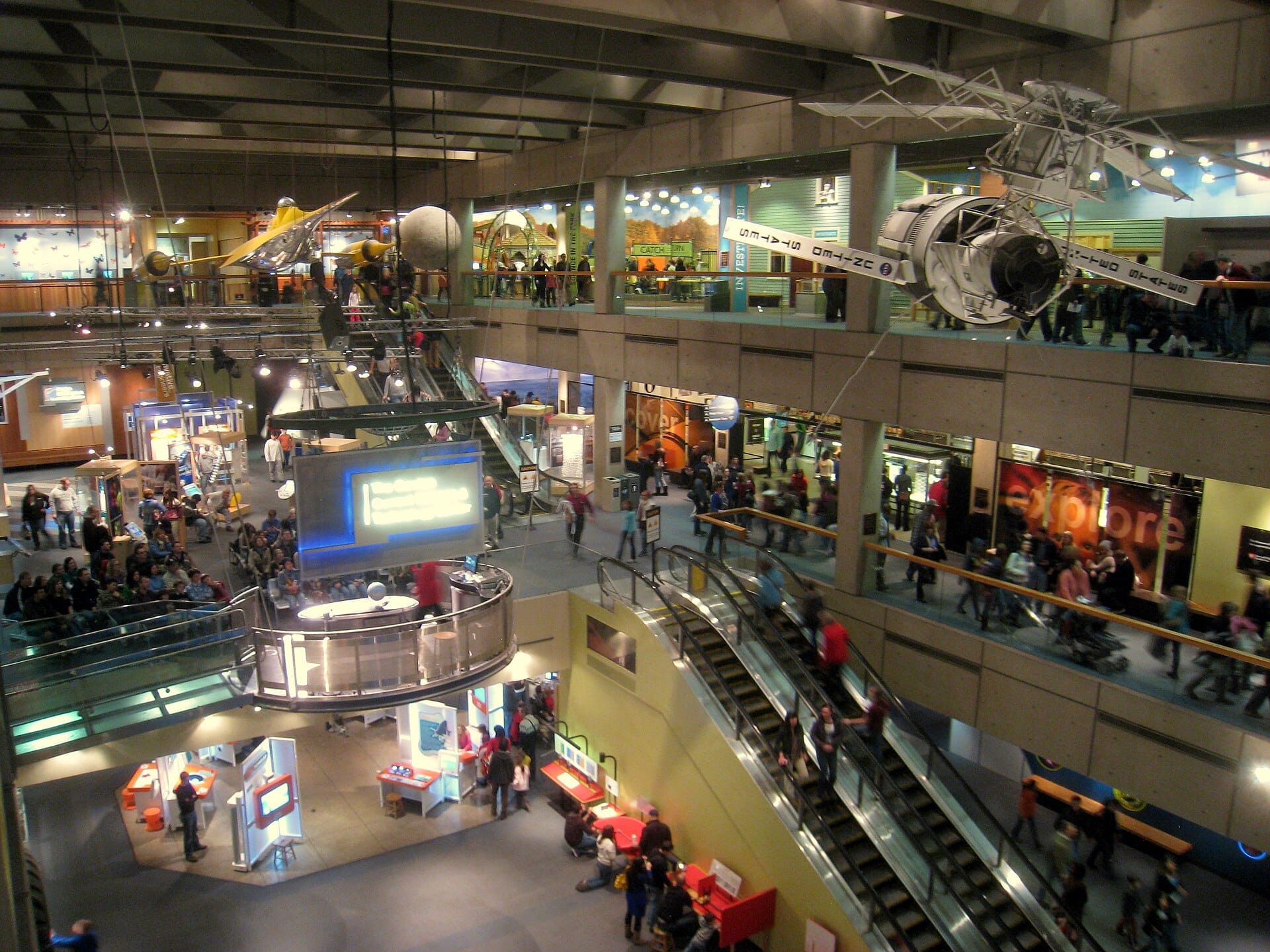
What the Museum of Science Actually Is
The Museum of Science, Boston sits on a narrow causeway called Science Park, technically bridging the city of Boston and Cambridge across the Charles River Dam. That position is not just a geographical curiosity. It means the building itself is surrounded by water on multiple sides, and on a clear day the windows in certain galleries frame the Boston skyline and the Cambridge riverbank simultaneously.
The institution traces its origins to 1830, when it was founded as the Boston Society of Natural History. It moved to permanent quarters in 1864 as the New England Museum of Natural History, then relocated to its current site in 1948, when it became the Boston Museum of Science. The word 'Boston' was eventually dropped to reflect its regional reach. Today it houses more than 700 interactive exhibits spread across multiple floors, along with the Charles Hayden Planetarium (opened 1958) and a five-story domed Omni Theater showing large-format films.
The scale can surprise first-time visitors. This is not a compact gallery you can cover in 90 minutes. The main building is sprawling and layered, with exhibit halls branching off in directions that feel slightly unpredictable. A map from the welcome desk is worth picking up before you start.
💡 Local tip
Buy tickets online in advance, especially for weekend visits or school-vacation weeks. The Planetarium and Omni Theater sell out independently from general admission, and shows can reach capacity by mid-morning on busy days.
The Experience Floor by Floor
The museum's permanent collection covers a wide arc of topics: human biology, earth science, astronomy, engineering, ecology, and computing. The exhibit design leans heavily toward hands-on interaction rather than passive display. Buttons, levers, screens, and physical demonstrations are built into nearly every section. For children roughly ages 5 to 14, the density of things to touch and try is extremely high. Adults without children will still find plenty to engage with, particularly in the engineering and space science sections.
One of the most reliably popular permanent installations is the Theater of Electricity, a cavernous hall housing two Van de Graaff generators originally built in the early 1930s. Staff-led demonstrations with dramatic electrical arcs run on a schedule and draw crowds. The sound alone, a sharp crackling that you feel in your chest, makes it one of the more memorable sensory moments in the building. Arrive a few minutes early for a seat with a clear sightline.
The live animal collection includes native New England species: turtles, snakes, insects, and birds, many of them rescues that cannot be returned to the wild. The Natural Mysteries exhibit area, focused on ecological relationships and biodiversity, is quieter and often less crowded than the main interactive floors, which makes it a good option if you need a pause from the noise level in the busier halls.
Tickets & tours
Hand-picked options from our booking partner. Prices are indicative; availability and final rates are confirmed when you complete your booking.
Boston Summer Night Trolley Tour and River Cruise
From 27 €Instant confirmationFree cancellationLEGOLAND Discovery Center Boston tickets
From 26 €Instant confirmationFree cancellationGhosts and Gravestones tour of Boston
From 39 €Instant confirmationFree cancellationBest of Boston tour
From 182 €Instant confirmationFree cancellation
The Planetarium and Omni Theater
The Charles Hayden Planetarium is a traditional domed projection theater used for astronomy shows and occasional special programming. Shows run throughout the day and last roughly 45 minutes. The reclining seats and the slow rotation of the projected night sky tend to put younger children to sleep, which is either a benefit or a problem depending on your situation.
The Omni Theater is a separate five-story domed IMAX venue with a steep seating rake that gives every row a full view of the curved screen. Films rotate seasonally and typically focus on natural environments, space exploration, or engineering subjects. The sound system is powerful enough that the theater itself becomes part of the experience. Neither venue is included in standard general admission, so factor in the extra cost and the need to book specific show times when planning your visit.
ℹ️ Good to know
The Planetarium and Omni Theater each require separate tickets in addition to general admission. Check showtimes on the official site before arrival and book them alongside your general admission ticket to lock in your preferred times.
Getting There and Getting Around Once Inside
The most straightforward way to arrive is by MBTA Green Line to the Science Park/West End station, which deposits you almost directly at the museum entrance. From downtown Boston, you can pick up the Green Line at Park Street or Government Center stations. From the Red Line, transfer to the Green Line at Park Street. From the Orange Line, transfer at either Haymarket or North Station. Blue Line riders can transfer to the Orange Line at State Street, then connect to the Green Line.
The museum has an on-site parking garage, but it fills quickly during peak periods, particularly weekend mornings from late spring through summer. If you are driving from outside Boston, arriving before 10:00 a.m. significantly improves your chances of finding a space without circling. Public transit is a more reliable option for most visitors. For more on getting around the city, see the getting around Boston guide.
Inside the building, the layout requires some orientation. The main entrance opens onto a large lobby level, and exhibits extend both upward and laterally through connected wings. Elevators and ramps are available throughout, and the museum's accessibility documentation is available on its official site. Visitors with mobility considerations are encouraged to contact the museum in advance to confirm which specific exhibits are fully accessible on a given day.
When to Visit and What to Expect at Different Times
Weekday mornings between 9:00 a.m. and 11:30 a.m. are the quietest window for most of the year. School groups arrive during this time in significant numbers on weekdays from September through June, but they tend to cluster in specific exhibit halls on organized routes, leaving other areas relatively clear. If you want unobstructed access to the most popular interactive stations, Tuesday and Wednesday mornings in late September through November or in February and March offer the lowest overall visitor density.
Summer weekends, school-vacation weeks (February, April, and late June through August), and rainy Saturdays are the peak congestion periods. During these times the lobby becomes loud, queues form for the most popular demonstrations, and the food court on the upper level gets crowded around noon. If you must visit on a busy day, start on the upper floors or in the less-advertised wing exhibits and work downward, hitting the Theater of Electricity and the main interactive hall later in the afternoon when family groups with young children start leaving.
The museum’s exhibit halls are open daily from 9:00 a.m. to 5:00 p.m., with occasional extended hours during peak seasons or special events. Hours extend during busy summer months. The museum is closed on Thanksgiving and Christmas Day and typically closes early on Christmas Eve and the day before Thanksgiving. Always verify the current daily closing time at mos.org/visit/hours before you go, as the schedule changes. For broader timing considerations when planning a Boston trip, the best time to visit Boston guide provides seasonal context.
Photography, Food, and Practical Logistics
Photography for personal use is permitted throughout the general exhibit areas. The theatrical lighting in the Planetarium and Omni Theater is not well-suited to phone cameras, and the shows move quickly, so expect limited results there. The Charles River views from the exterior walkway near the entrance offer one of the better understated skyline perspectives in the area, particularly in morning light when the water is relatively calm.
The museum has a food court on the upper level with standard cafeteria-style offerings. The food is adequate but not a reason to visit on its own. If you want a better meal, the surrounding area along the Cambridge riverbank has options within a 10 to 15-minute walk, and the North End neighborhood is a short walk or Green Line ride away.
There is a well-stocked museum shop near the main entrance with science kits, books, and educational toys. It is one of the better gift shop selections among Boston's major cultural institutions, particularly for children's items. If you are visiting Boston with kids and thinking about other family-oriented stops, the Boston Children's Museum in the Seaport District offers a complementary experience focused on younger children, while the Boston with kids guide covers the full range of family options across the city.
Strengths and Limitations
The Museum of Science is strong in interactive, hands-on science education. The physical demonstrations, the live animals, and the space science galleries hold up well against comparable institutions in other major cities. The Planetarium is a legitimately good venue for astronomy programming.
Where it falls short for some visitors: the building feels dated in certain wings, the exhibit signage in older sections is dense and text-heavy in ways that feel more like a school textbook than a museum experience, and the cafeteria-level food options are a real gap on a full-day visit. The admission price, particularly when adding Planetarium and Omni Theater tickets, adds up for a family group. Budget-conscious visitors should check the museum's website for occasional discount programs or free admission evenings.
Visitors primarily interested in art, Boston history, or colonial-era heritage will find the museum less relevant to their itinerary. The Museum of Fine Arts or a walk along the Freedom Trail will serve those interests far better. For a broader overview of Boston's museum landscape, the
For a broader overview of Boston's museum landscape, the best museums in Boston guide compares the major options across different interests and age groups.
⚠️ What to skip
The museum is closed on Thanksgiving and Christmas Day and closes early on certain holidays such as Christmas Eve and the day before Thanksgiving. Closing times vary by day and season. Do not assume a standard closing time — check the official schedule at mos.org/visit/hours before your visit.
Insider Tips
- Book your Planetarium or Omni Theater tickets for the earliest available show of the day when you purchase general admission. Late-day shows often sell out by early afternoon on busy days, and you cannot guarantee the show time you want if you wait until you are already inside.
- The exterior walkway along the Charles River Dam, accessible from near the main entrance, gives you an unobstructed view of the Boston skyline and the river basin with almost no crowds. It takes about five minutes and costs nothing extra. Morning light from this angle is particularly clean.
- If you are visiting with children under age 6, head to the Discovery Center on the lower level first. It is designed specifically for young children and tends to be less overwhelming than the main interactive halls, where older kids and school groups dominate the hands-on stations.
- Members get free Exhibit Halls admission and also receive discounted tickets to Planetarium and Omni shows. If you are Boston-based or planning multiple visits in a year, the membership math typically works out in your favor after two adult admissions.
- The gift shop stocks science experiment kits and educational materials that are harder to find elsewhere at comparable prices. If you are buying souvenirs for children, it is worth a dedicated look before you leave rather than rushing through it at the exit.
Who Is Museum of Science For?
- Families with children aged 5 to 14 looking for a full-day activity with hands-on content across multiple topics
- Visitors caught by rain or extreme heat who need an immersive indoor option that goes well beyond a single-hour gallery
- Adults with a genuine interest in astronomy, physics demonstrations, or earth science who want more than passive display cases
- First-time Boston visitors who want a culturally significant, non-historical attraction to balance out a history-heavy itinerary
- Travelers on a longer Boston stay who have already covered the main historical sites and want to explore the city's educational institutions
Nearby Attractions
Other things to see while in Cambridge:
- Harvard Art Museums
The Harvard Art Museums unite three distinct collections — the Fogg, Busch-Reisinger, and Arthur M. Sackler — inside a Renzo Piano-designed building steps from Harvard Yard. Free to all visitors, the complex is one of Cambridge's most rewarding cultural stops, offering everything from ancient coins to German Expressionism under a light-flooded glass canopy.
- Harvard Square
Harvard Square is the commercial and cultural heart of Cambridge, Massachusetts, where a triangular plaza at the intersection of Massachusetts Avenue, Brattle Street, and John F. Kennedy Street anchors a neighborhood of independent bookshops, street musicians, sidewalk chess tables, and some of the best people-watching in greater Boston. Free to explore, open around the clock, and directly served by the MBTA Red Line, it rewards both a quick two-hour detour and a full half-day of wandering.
- Harvard University Campus
Founded in 1636, Harvard University is the oldest institution of higher education in the United States, and its Cambridge campus draws visitors from around the world. Walking through Harvard Yard costs nothing, but knowing how to read the campus, when to go, and what to skip makes the difference between a rewarding afternoon and a confused wander.
- MIT Campus
The Massachusetts Institute of Technology sprawls across 168 acres along the Cambridge bank of the Charles River, blending 19th-century founding ideals with some of the most audacious architecture of the 20th century. Admission is free, the campus is open to the public, and a visit rewards anyone willing to look beyond the surface.