Harvard Square: Cambridge's Intellectual Crossroads
Harvard Square is the commercial and cultural heart of Cambridge, Massachusetts, where a triangular plaza at the intersection of Massachusetts Avenue, Brattle Street, and John F. Kennedy Street anchors a neighborhood of independent bookshops, street musicians, sidewalk chess tables, and some of the best people-watching in greater Boston. Free to explore, open around the clock, and directly served by the MBTA Red Line, it rewards both a quick two-hour detour and a full half-day of wandering.
Quick Facts
- Location
- Massachusetts Ave, Brattle St & JFK St, Cambridge, MA 02138
- Getting There
- Harvard Station, MBTA Red Line — exit directly into the square
- Time Needed
- 2 hours minimum; half a day if you add Harvard Yard or the museums
- Cost
- Free to enter; individual shops and cafés charge their own prices
- Best for
- Book lovers, architecture fans, curious walkers, and university culture
- Official website
- harvardsquare.com
What Harvard Square Actually Is
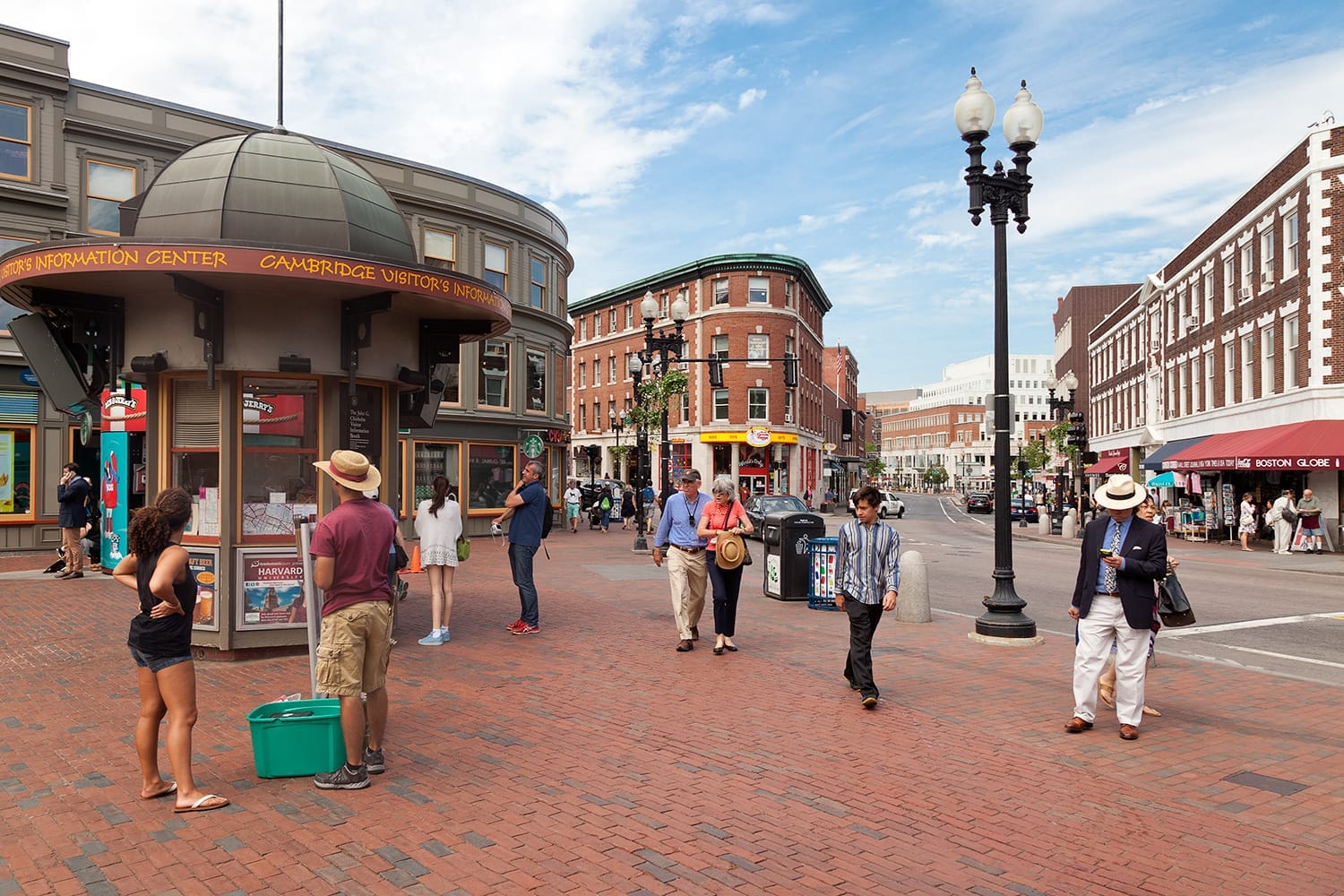
Harvard Square is not a quad or a campus feature. It is a triangular public plaza and surrounding commercial district in Cambridge, Massachusetts, pressed right up against the western gate of Harvard University but independently alive as its own neighborhood. The square proper is where Massachusetts Avenue, Brattle Street, and John F. Kennedy Street converge, and the Harvard Station headhouse sits in the middle of it all, ventilating warm subway air into whatever season is happening above ground.
The character here is layered in a way that takes a little time to read. You have the university crowd: students with overfull backpacks debating outside Au Bon Pain. You have Cambridge lifers who have been playing chess at the sidewalk tables since the 1980s. You have tourists from three continents photographing the same wrought-iron gate on Johnston Gate. And threaded through all of it are the independent businesses — bookshops, tea houses, vintage record stores — that have held on through decades of commercial pressure and still give the square its particular identity.
💡 Local tip
Harvard Square is served directly by Harvard Station on the MBTA Red Line. From downtown Boston, it is roughly a 12-15 minute ride from Park Street Station. No transfers needed.
A Brief History Worth Knowing
The land that became Harvard Square was settled in 1630 as the Colonial village of Newtowne, initially intended by the Massachusetts Bay proprietors to serve as the capital of the colony. That plan changed, but the settlement stayed, and in 1636 Harvard College was founded here, the oldest institution of higher education in the United States. The village was renamed Cambridge in 1638, drawing a deliberate parallel to the English university city.
For most of the 19th and early 20th centuries, Harvard Square functioned as a genuine town center: a market hub, a stop on the old electric streetcar lines, a gathering place for the surrounding residential streets of Cambridge. The subway arrived in 1912 when the Cambridge subway opened as part of what is now the Red Line, and the Harvard Station that exists today — deep underground, with the distinctive barrel-vaulted brick passageways — reflects that era's ambitions for public infrastructure. Riding the escalator up from the platform still feels like emerging from something old.
The square became a center of counterculture activity in the 1960s and 1970s, drawing folk musicians, political organizers, and students into an atmosphere that shaped its reputation for intellectual restlessness. Many of those original independent businesses are gone, replaced by national chains, but enough has survived that the square retains real character. For a deeper look at how Cambridge's academic institutions shaped this neighborhood and the city around it, the Boston and Cambridge university guide is worth reading before you visit.
Tickets & tours
Hand-picked options from our booking partner. Prices are indicative; availability and final rates are confirmed when you complete your booking.
Harvard Square food tour
From 62 €Instant confirmationTour Harvard Yard Boston in The Mysterious Porcelain Exploration Game
From 10 €Instant confirmationFree cancellationHistorical Cambridge and Harvard Square doughnut tour
From 60 €Instant confirmationFree cancellationGo City | Boston All-Inclusive Pass
From 67 €Instant confirmationFree cancellation
How It Feels at Different Times of Day
Mornings in Harvard Square are unhurried. The coffee shops fill early with graduate students and the occasional professor, laptops open, conversations conducted at low volume. The street performers have not yet arrived. The newsstands are busy. There is a certain ease to the sidewalks before 10 a.m. that disappears completely by early afternoon.
Midday is when the square reaches full density. The outdoor chess tables at Winthrop Park attract onlookers. Musicians set up at corners — a classical guitarist near the T entrance, sometimes a full jazz quartet further down JFK Street. The smell of roasting coffee drifts from the independent cafés along Brattle Street, mixing with the exhaust of the No. 1 bus pulling out toward Boston. It is loud, alive, and frankly a bit crowded on warm weekday afternoons.
Evenings shift the balance. The tourist volume drops, the restaurant patios fill, and the bookshops stay open late — particularly the Harvard Book Store on Massachusetts Avenue, which keeps a second-hand book display outside well into the evening hours. Weekend nights bring a lively but generally calm atmosphere; the bars along Brattle and Mt. Auburn Streets fill with a mixed crowd of students and Cambridge residents.
ℹ️ Good to know
Visit on a weekday morning or early evening for the best experience. Weekend afternoons in summer can feel congested around the main plaza and the T entrance, especially when Harvard is hosting events.
What to Do and See
In short, Harvard Square rewards wandering more than it rewards a checklist. That said, a few specific stops are worth prioritizing.
The Harvard University campus begins immediately east of the square. Johnston Gate on Massachusetts Avenue is the main ceremonial entrance to Harvard Yard, which is free to walk through. The yard itself — a large grassy quadrangle lined with 18th and 19th-century red-brick buildings — is worth twenty minutes on its own. Massachusetts Hall, completed in 1720, is the oldest surviving building on campus and still houses university offices.
Just north of the square on Quincy Street, the Harvard Art Museums house three collections under one roof: the Fogg Museum, the Busch-Reisinger, and the Arthur M. Sackler. The Renzo Piano-designed building, completed in 2014, is itself an architectural argument for natural light. Admission is free for all visitors (permanent policy since 2023), and it is one of the better art museum collections in the region — more cohesive and less exhausting than the larger institutions.
Brattle Street heading west from the square is known historically as Tory Row, because seven loyalist families owned mansions along this stretch before the American Revolution. Several of those 18th-century houses remain, now converted into private residences, offices, and a theater. Walking even four or five blocks along Brattle gives you a completely different sense of Cambridge than the commercial density of the square itself.
Books, Records, and Independent Retail
The Harvard Book Store on Massachusetts Avenue is the central institution. Founded in 1932, it operates an in-store Espresso Book Machine that can print any of millions of titles on demand — a practical oddity that has kept people curious for years. The second-hand section in the basement is quite good, priced honestly, and worth an hour of browsing.
Raven Used Books on JFK Street and the Coop (the Harvard Cooperative Society) across the plaza offer different angles on the book culture of the square. The Coop is technically a department store, selling clothing and supplies alongside Harvard-branded merchandise, but its book section is substantial and properly curated. For music, a handful of independent record shops remain in the side streets off the main plaza.
Practical Information for Getting There and Around
Harvard Station on the MBTA Red Line is the only transit stop you need. Inbound trains go directly to downtown Boston — Park Street, Downtown Crossing, South Station — in about 12-15 minutes. Outbound trains go to Alewife. Multiple bus lines also stop at the square, connecting to other Cambridge neighborhoods and Somerville.
Parking in and around Harvard Square is limited and metered. On weekday afternoons, driving here is essentially not worth it. The Red Line is faster than any surface route from central Boston during normal operating hours.
The square itself is flat and pedestrian-friendly, with wide sidewalks and clearly marked crosswalks. Harvard Station has elevator access. The surrounding streets — particularly Brattle and Mt. Auburn — are navigable in a wheelchair or stroller, though some of the smaller side streets have older, uneven brick paving.
⚠️ What to skip
Weather affects the experience significantly. Harvard Square in heavy rain is not particularly pleasant — many of the best features (outdoor chess, street musicians, café terraces) disappear. Bring layers in shoulder seasons; temperatures in Cambridge can drop sharply after dark in spring and fall.
Eating and Drinking in the Square
The food scene in Harvard Square is more interesting than the tourist-dense surroundings might suggest. The national chains are present — you will find them immediately around the plaza — but they are not the full picture. Café Pamplona on Bow Street was one of the oldest coffeehouses in Cambridge, a tiny basement café that served espresso and bocadillos from 1959 until its closure in 2020. The space has not reopened under that name, but the memory of it still shapes how locals talk about the square's café culture.
For a full meal, the restaurant options along Brattle Street and in the side streets lean toward globally influenced menus and independent ownership. The square also sits within easy walking distance of Cambridge's broader dining scene. If you are planning a full day in Cambridge that extends beyond the square, the Boston and Cambridge food guide has specific recommendations organized by neighborhood.
Who Should Reconsider This Stop
Harvard Square is well worth visiting, but it is not for everyone. Travelers on a tight Boston itinerary who have already visited the Freedom Trail, the waterfront, and Back Bay may find that adding a cross-river trip to Cambridge stretches the day past its natural length. The square is not a single-attraction destination — its value is in the texture of the neighborhood, which takes time to appreciate.
Visitors primarily interested in American Revolutionary history will find more concentrated content on the Freedom Trail or in Charlestown. Harvard Square's historical layers are real but subtle — they reward curiosity rather than announcing themselves. Families with very young children will find the commercial density of the square a bit relentless; the open spaces are limited compared to, say, Boston Common.
Insider Tips
- The Out of Town News kiosk in the center of the plaza no longer sells international newspapers as it once did, but the structure itself — a landmark of the square — has been redeveloped as a cultural and community space and event venue rather than a traditional newsstand. Stop here first for maps and orientation.
- The Harvard Book Store's basement holds the best-value used books in the square. Prices are marked in pencil, the selection is rotated frequently, and the narrow aisles are considerably quieter than the main floor.
- If you are visiting in warmer months, the outdoor chess tables at Winthrop Park (behind Au Bon Pain on Massachusetts Ave) are free to use. Games between regulars and strangers happen all day — watching or joining is equally welcome.
- The alley passageway between Brattle Street and Church Street, lined with small independent shops, gets overlooked by most visitors moving between the main plaza and Brattle Theatre. It is worth the fifteen-second detour.
- Early September brings the arrival of new Harvard classes, which makes the square unusually electric but also unusually crowded. Mid-October, when the academic year has settled and the fall foliage on the Cambridge streets is near peak, is arguably the single best week to visit.
Who Is Harvard Square For?
- Book lovers who want to browse seriously rather than buy souvenirs
- Architecture and urban history enthusiasts interested in Colonial-era Cambridge
- Solo travelers who enjoy observing a place more than checking it off a list
- Visitors adding a half-day Cambridge extension to a longer Boston trip
- Anyone who wants to understand what a genuine American university town feels and sounds like
Nearby Attractions
Other things to see while in Cambridge:
- Harvard Art Museums
The Harvard Art Museums unite three distinct collections — the Fogg, Busch-Reisinger, and Arthur M. Sackler — inside a Renzo Piano-designed building steps from Harvard Yard. Free to all visitors, the complex is one of Cambridge's most rewarding cultural stops, offering everything from ancient coins to German Expressionism under a light-flooded glass canopy.
- Harvard University Campus
Founded in 1636, Harvard University is the oldest institution of higher education in the United States, and its Cambridge campus draws visitors from around the world. Walking through Harvard Yard costs nothing, but knowing how to read the campus, when to go, and what to skip makes the difference between a rewarding afternoon and a confused wander.
- MIT Campus
The Massachusetts Institute of Technology sprawls across 168 acres along the Cambridge bank of the Charles River, blending 19th-century founding ideals with some of the most audacious architecture of the 20th century. Admission is free, the campus is open to the public, and a visit rewards anyone willing to look beyond the surface.
- Mount Auburn Cemetery
Established in 1831 and designated a National Historic Landmark, Mount Auburn Cemetery is a roughly 175-acre landscape of glacial ponds, flowering trees, and historic monuments that shaped how Americans think about both death and public green space. Free to enter and open year-round, it draws historians, birders, and quiet-seekers in equal measure.