Harvard Art Museums: Three Collections, One Extraordinary Building, Zero Admission Fee
The Harvard Art Museums unite three distinct collections — the Fogg, Busch-Reisinger, and Arthur M. Sackler — inside a Renzo Piano-designed building steps from Harvard Yard. Free to all visitors, the complex is one of Cambridge's most rewarding cultural stops, offering everything from ancient coins to German Expressionism under a light-flooded glass canopy.
Quick Facts
- Location
- 32 Quincy Street, Cambridge, MA 02138 (Harvard University campus)
- Getting There
- Harvard Station (Red Line), approx. 5-minute walk
- Time Needed
- 1.5 to 3 hours depending on depth of interest
- Cost
- Free for all visitors, Tuesday through Sunday (verify before visiting)
- Best for
- Art lovers, architecture enthusiasts, students, and curious travelers on a budget
- Official website
- harvardartmuseums.org
What the Harvard Art Museums Actually Are
The Harvard Art Museums is not one museum but three collections sharing a single, architecturally significant building. The Fogg Museum anchors the complex with its broad survey of Western art from the Middle Ages forward. The Busch-Reisinger Museum, one of only a handful of institutions in North America dedicated to Central and Northern European art, holds a particularly strong collection of German Expressionism and Bauhaus material. The Arthur M. Sackler Museum contributes ancient, Asian, Islamic, and later Indian art. Together, the collections number over 250,000 objects, making this one of the largest university art museums in the world.
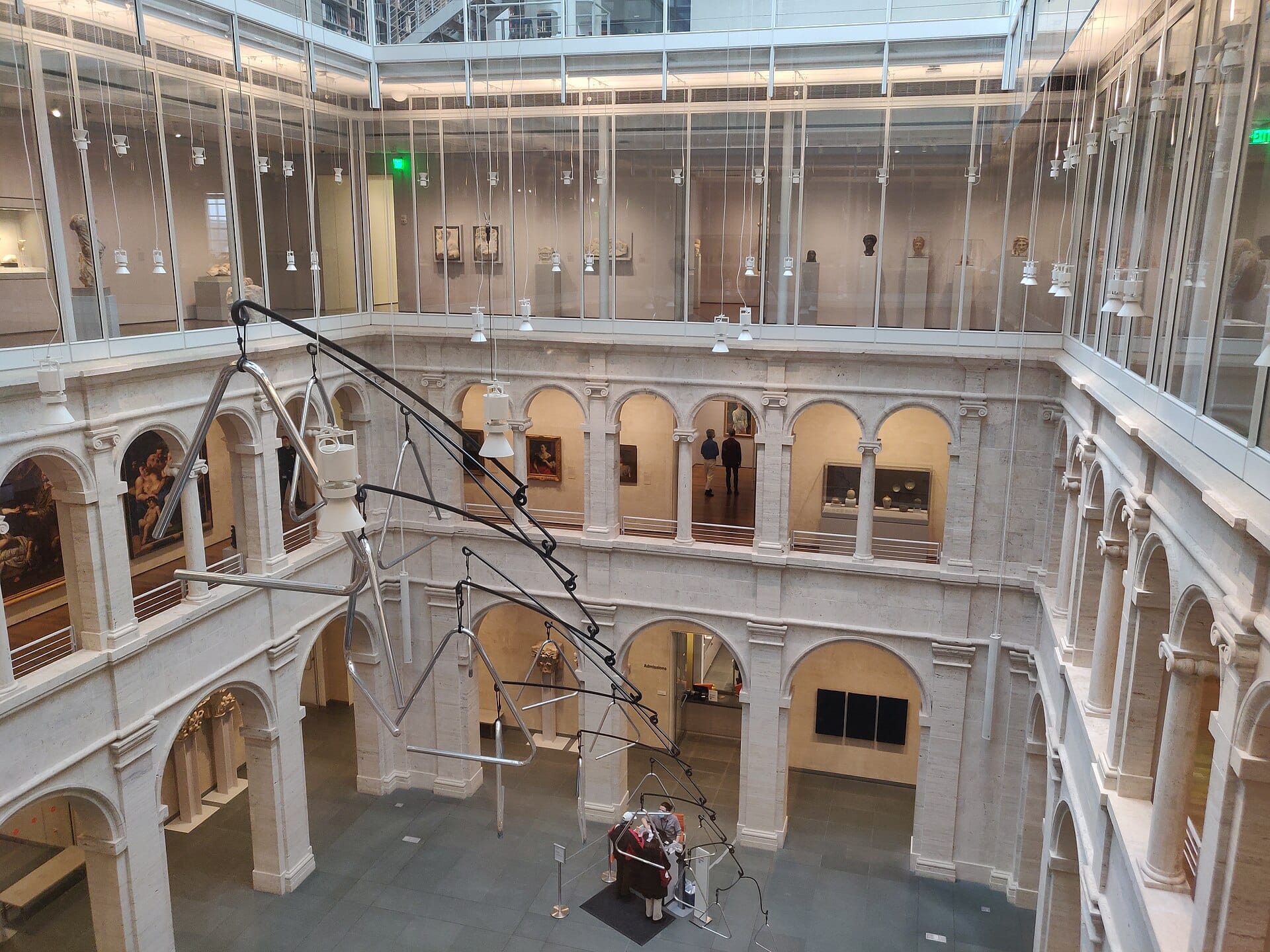
The physical building is itself worth the trip. Italian architect Renzo Piano redesigned and unified the complex, reopening it in 2014 after a years-long renovation. The centerpiece is a soaring interior courtyard with a climate-controlled glass canopy that filters natural light down into the galleries below. It reads simultaneously as a working research facility and a public museum, because it is both: conservation studios and art storage are partly visible from the upper floors, giving visitors a rare look at the behind-the-scenes infrastructure of a major collection.
💡 Local tip
Admission is free to all visitors, and hours are Tuesday through Sunday, 10:00 to 17:00. The museums are closed Mondays. Confirm current hours at harvardartmuseums.org before you visit, as holiday closures apply.
Getting There from Cambridge and Boston
The museums sit at 32 Quincy Street on the Harvard University campus, about a five-minute walk from Harvard Station on the MBTA Red Line. Exit the station toward Harvard Yard, cross the Yard diagonally, and Quincy Street runs along the eastern edge. The building is easy to identify: a contemporary glass-and-concrete structure immediately adjacent to the older brick architecture of the surrounding campus.
Harvard Square itself is worth the approach on foot. The square is dense with bookshops, cafes, and street life, and serves as a practical orientation point for the broader Cambridge neighborhood. If you're arriving from downtown Boston, the Red Line from Park Street or Downtown Crossing reaches Harvard Station in about 15 to 20 minutes depending on your starting point.
If you're combining this visit with the broader university experience, the Harvard University campus surrounds the museums, and Harvard Yard is a worthwhile five-minute detour before or after. The Harvard Square area offers plenty of dining options when you're ready to decompress.
Tickets & tours
Hand-picked options from our booking partner. Prices are indicative; availability and final rates are confirmed when you complete your booking.
Boston Tea Party Ships and Museum tickets
From 27 €Instant confirmationFree cancellationGo City | Boston All-Inclusive Pass
From 67 €Instant confirmationFree cancellationDay Trip to Martha's Vineyard from Boston with optional Island tour
From 106 €Instant confirmationFree cancellationHarvard Square food tour
From 62 €Instant confirmation
What to See Inside: A Practical Walkthrough
The building is organized across multiple floors, with the courtyard functioning as the spatial anchor. When you enter, the light in the atrium shifts perceptibly depending on the time of day and season. On overcast winter mornings, it has a cool, contemplative quality. On bright spring afternoons, the glass roof throws warm light into the lower galleries, and the marble floors of the courtyard glow noticeably. This is not a generic white-box museum experience.
The Fogg collection occupies much of the gallery space and spans medieval altarpieces, Italian Renaissance paintings, 19th-century French Impressionism, and 20th-century American work. The depth is genuine: this is not a highlights-only survey. Monet, Renoir, Degas, and Picasso appear alongside less-celebrated works that reward slow looking. Budget at least 45 minutes here if painting is your primary interest.
The Busch-Reisinger galleries require a specific interest to fully appreciate, but they are quietly exceptional. The Bauhaus holdings include furniture, textiles, and graphic design that are rarely seen outside of Germany. If you have any interest in early 20th-century design history, this section alone justifies the visit. The German Expressionist paintings, including works by Beckmann and Kirchner, are displayed without the crowds those names attract at larger institutions.
The Sackler galleries extend the chronological and geographic range dramatically. Ancient Greek coins, Chinese jade, Persian manuscripts, and South Asian sculpture occupy these rooms. The scale shifts constantly, from objects you could hold in your palm to architectural fragments that fill entire alcoves. Give yourself permission to slow down in these galleries even if world art is not your usual focus.
ℹ️ Good to know
The upper floors contain visible conservation and storage areas. Floor-to-ceiling glass walls allow you to see objects in storage and conservators at work. This is an unusual transparency for any museum and is interesting even for visitors without an academic background in art.
Best Time to Visit and How the Experience Changes
Weekday mornings between 10:00 and noon are the quietest windows. The galleries are largely empty of tourists, though Harvard students and researchers move through with purpose. The atmosphere is more library than spectacle, which suits the collection well. By early afternoon on weekends, particularly in fall when Harvard's campus fills with visitors, the ground floor courtyard and main Fogg galleries see noticeable crowds, though rarely the queues associated with major urban art museums.
Seasonally, fall is the most atmospheric time to visit. The campus foliage peaks in October, the walk from the Red Line is at its most visually rewarding, and the museum's interior light is particularly warm in the afternoon hours. Winter visits have their own appeal: the heated interior provides genuine respite, and the collection feels more intimate when the building is less populated.
If you're planning a broader cultural day in the Boston area, this museum pairs naturally with the MIT campus further down Massachusetts Avenue, or with a longer exploration of Cambridge's academic landscape. Those interested in a dedicated art-museum day across the metro area should consult our guide to the best museums in Boston to prioritize itinerary order.
Photography, Accessibility, and Practical Logistics
Photography for personal, non-commercial use is generally permitted in the permanent collection galleries. Flash photography and tripods are not allowed. The courtyard is the most photogenic architectural element: shoot upward toward the glass canopy from the ground floor for the most compelling composition. Natural light varies considerably by time of day, and midday on clear days produces the most dramatic interior light effects.
The building is fully accessible, with elevators connecting all gallery floors and step-free entry from Quincy Street. The museum's official website lists detailed accessibility services, including large-print materials and programs for visitors with visual or hearing impairments. Coat check is available near the entrance, useful in winter when bulky layers are impractical inside narrow gallery spaces.
There is a cafe on site for light meals and coffee. Given the free admission, spending a few dollars here is a reasonable way to support the institution. A well-stocked museum shop sits near the main entrance and carries exhibition catalogs, art books, and reproductions. It is one of the better museum shops in the Cambridge area for serious art publications.
⚠️ What to skip
The museums are closed on Mondays and on certain university holidays. If your Cambridge visit falls on a Monday, plan accordingly and consider nearby alternatives. Always verify hours at harvardartmuseums.org before making the trip.
Is This Worth Your Time?
For most travelers, yes. The combination of free admission, architectural quality, and collection depth is unusual at any price point. This is not a tourist-trap version of a university museum padded with mediocre work. The Fogg holds objects that would command entire wings at paid institutions, and the Busch-Reisinger is extraordinary by any standard for German art outside of Europe.
That said, visitors primarily motivated by blockbuster, single-artist retrospectives or large-scale contemporary installations may find the permanent collection underwhelming. The Harvard Art Museums excels at breadth and scholarly depth, not spectacle. Travelers who prefer to engage with art at their own pace, without interpretive noise, will find this environment close to ideal. Those who need curated audio tours and highly contextual wall text for every object may find the galleries somewhat spare by modern museum standards, though interpretive materials are available on request.
Visitors seeking a more hands-on, narrative-driven museum experience might be better served by starting at the Museum of Science Boston or, for a more comparable fine-arts context, the Museum of Fine Arts Boston across the Charles River in Fenway, which offers a different scale and character.
Insider Tips
- The conservation and study center on the upper floors is accessible to the public during regular hours. Most visitors overlook it entirely. Take the elevator to the top floor and walk the perimeter for views down into the art storage visible through the glass walls — it is one of the more unusual museum experiences in the region.
- The courtyard's light changes dramatically depending on weather and time of day. If you arrive on a sunny afternoon, spend a few minutes in the atrium before moving into the galleries. The way the glass roof interacts with direct sunlight is distinctly different from overcast conditions.
- Free admission does not require registration or advance booking for standard visits. Walk in directly from Quincy Street during opening hours. However, for special exhibitions or events, check the museum calendar in advance as these may have separate requirements.
- The Busch-Reisinger galleries are the least visited in the building despite holding some of the most significant Bauhaus objects outside of Germany. If the Fogg galleries feel crowded on a weekend afternoon, the Busch-Reisinger rooms are often nearly empty.
- Street parking near Harvard Square is extremely limited and meter-enforced. The Red Line is far more practical than driving. If you are arriving by car for other Cambridge activities, the University Place Garage on University Road is one of the nearest parking structures, but rates apply and availability varies.
Who Is Harvard Art Museums For?
- Art enthusiasts who want depth over spectacle across multiple traditions and periods
- Travelers interested in architecture, particularly Renzo Piano's approach to institutional design
- Budget-conscious visitors who want a world-class museum experience without an admission fee
- Students and researchers with specific interest in European modernism, German Expressionism, or Bauhaus design
- Anyone spending a day in Cambridge who wants to combine a campus walk with a meaningful cultural stop
Nearby Attractions
Other things to see while in Cambridge:
- Harvard Square
Harvard Square is the commercial and cultural heart of Cambridge, Massachusetts, where a triangular plaza at the intersection of Massachusetts Avenue, Brattle Street, and John F. Kennedy Street anchors a neighborhood of independent bookshops, street musicians, sidewalk chess tables, and some of the best people-watching in greater Boston. Free to explore, open around the clock, and directly served by the MBTA Red Line, it rewards both a quick two-hour detour and a full half-day of wandering.
- Harvard University Campus
Founded in 1636, Harvard University is the oldest institution of higher education in the United States, and its Cambridge campus draws visitors from around the world. Walking through Harvard Yard costs nothing, but knowing how to read the campus, when to go, and what to skip makes the difference between a rewarding afternoon and a confused wander.
- MIT Campus
The Massachusetts Institute of Technology sprawls across 168 acres along the Cambridge bank of the Charles River, blending 19th-century founding ideals with some of the most audacious architecture of the 20th century. Admission is free, the campus is open to the public, and a visit rewards anyone willing to look beyond the surface.
- Mount Auburn Cemetery
Established in 1831 and designated a National Historic Landmark, Mount Auburn Cemetery is a roughly 175-acre landscape of glacial ponds, flowering trees, and historic monuments that shaped how Americans think about both death and public green space. Free to enter and open year-round, it draws historians, birders, and quiet-seekers in equal measure.