USS Constitution (Old Ironsides): Boarding the World's Oldest Warship
USS Constitution, launched in 1797 and still an active U.S. Navy vessel, sits at Charlestown Navy Yard in Boston. Free to tour Tuesday through Sunday, it offers a rare chance to walk the decks of a ship that fought in the War of 1812 and earned the nickname 'Old Ironsides.' Plan at least 90 minutes and combine the visit with the adjacent USS Constitution Museum.
Quick Facts
- Location
- 1 Constitution Road, Charlestown Navy Yard, Boston, MA 02129
- Getting There
- MBTA Green Line to North Station, then walk across Charlestown Bridge (~15 min); or MBTA Ferry to Charlestown
- Time Needed
- 90 minutes to 2.5 hours (ship + museum)
- Cost
- Free (no reservation required; adults 18+ must show valid state or federal photo ID or passport to board)
- Best for
- History enthusiasts, families, first-time Boston visitors, Freedom Trail walkers
- Official website
- www.navy.mil/USS-CONSTITUTION/Hours-Visitor-Info
What USS Constitution Actually Is
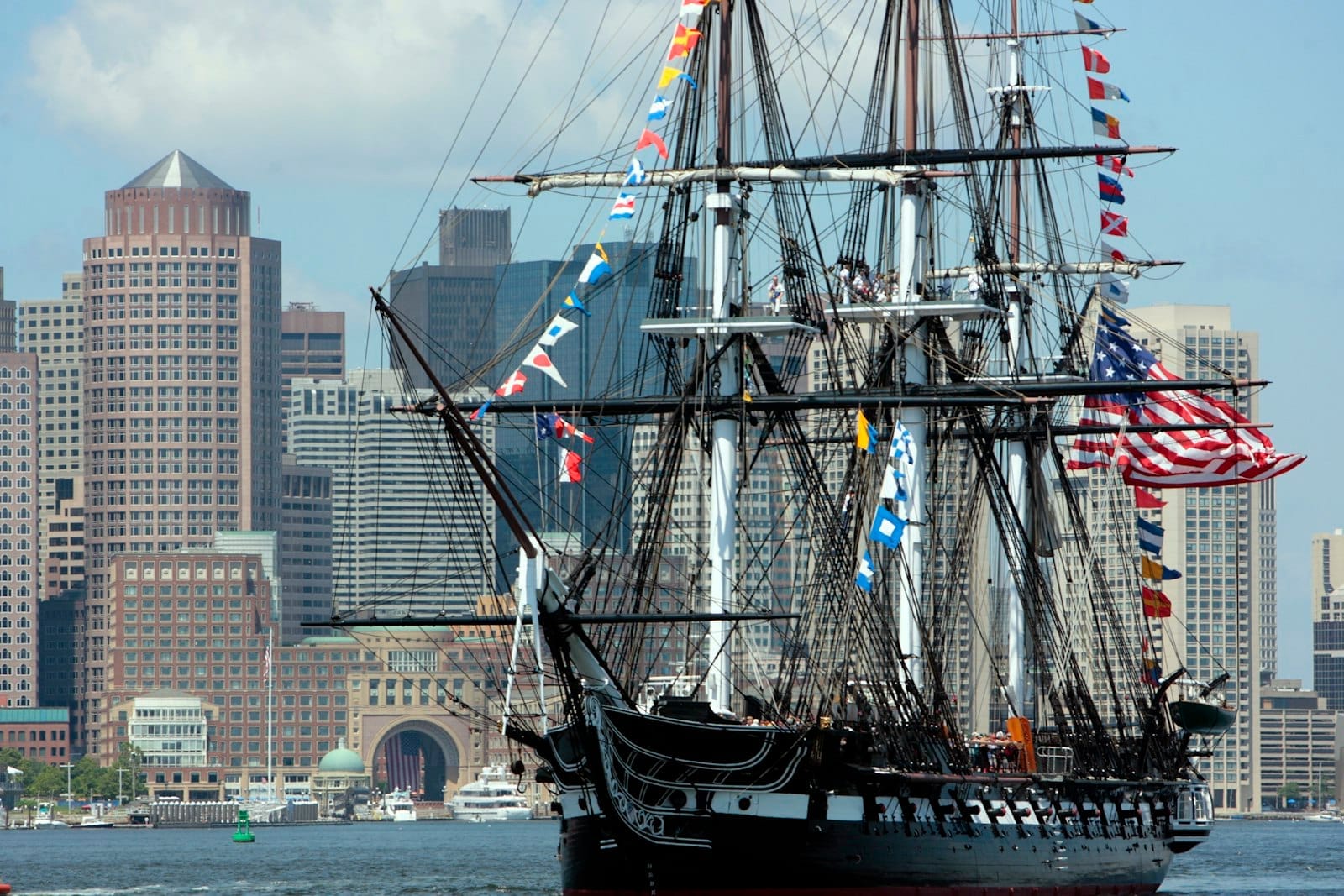
USS Constitution is not a museum replica or a decommissioned relic. She is an active United States Navy warship, the oldest commissioned warship afloat in the world, and she has remained a commissioned U.S. Navy warship since her launch in Boston in 1797, with her status periodically reaffirmed through major restorations and ceremonial events. That distinction matters: the sailors you meet on deck are active-duty U.S. Navy personnel, not costumed interpreters. When they explain how a 24-pound cannon was loaded and fired, they are drawing on institutional knowledge that runs in an unbroken line back more than two centuries.
The ship was authorized by the Naval Act of 1794 as one of six original frigates built to protect American merchant shipping. At 204 feet (62 meters) in length on deck, with a beam of 43 feet (13 meters) and a draft of 22 feet (6.7 meters), she was among the largest and most powerful frigates of her era. Her hull's thick live-oak construction, combined with her speed, made her nearly impervious to British cannon fire in the War of 1812, earning her the nickname 'Old Ironsides' after British shots reportedly bounced off her sides during the battle with HMS Guerriere in August 1812.
She sits within Boston National Historical Park at the Charlestown Navy Yard, and the visit connects naturally to the broader Freedom Trail, which ends nearby at the Bunker Hill Monument. Most visitors treat the Navy Yard as the final destination on a full Freedom Trail day.
Getting There and Through Security
The most convenient public transit option is the MBTA Green Line to North Station, followed by a roughly 15-minute walk across the Charlestown Bridge, with the Freedom Trail's red-brick path guiding you the entire way. The MBTA ferry from Long Wharf to the Charlestown Navy Yard is a faster crossing and far less crowded than it deserves to be, with views of the harbor that set the nautical tone before you even arrive.
Because Pier One sits inside an active Navy Yard, all visitors pass through a security checkpoint before boarding. Adults aged 18 and older must present a government-issued photo ID. Expect metal detectors and bag inspection. Prohibited items include pocket knives and other standard security-restricted objects. Build this into your timing: on busy summer weekends, the line at the checkpoint can add 10 to 20 minutes to your visit.
⚠️ What to skip
Vehicle access to Pier One is restricted. If driving, use nearby paid parking at Nautica Parking Garage or One Constitution Center on Constitution Road. Do not count on parking at the pier itself.
Tickets & tours
Hand-picked options from our booking partner. Prices are indicative; availability and final rates are confirmed when you complete your booking.
Boston Summer Night Trolley Tour and River Cruise
From 27 €Instant confirmationFree cancellationLEGOLAND Discovery Center Boston tickets
From 26 €Instant confirmationFree cancellationGhosts and Gravestones tour of Boston
From 39 €Instant confirmationFree cancellationBest of Boston tour
From 182 €Instant confirmationFree cancellation
The Experience On Board
Once you clear security and walk up the gangway, the scale of the ship announces itself quickly. The gun deck, lined with long black cannons, is low-ceilinged and slightly dim, and the air smells faintly of old wood and rope. Docents from the ship's crew position themselves at key points and field questions with genuine enthusiasm. Ask them about the rigging or the battle history and most will give you a more interesting answer than any placard would.
The three main areas open to visitors are the spar deck (the open upper deck), the gun deck below it, and portions of the lower spaces. The uneven wooden planking, low door frames, and steep ladder-like stairs are part of the authentic character of the ship, and they also mean that visitors with limited mobility should check accessibility details directly with the site before visiting, as the historic structure has significant physical constraints.
Morning visits, particularly on weekdays, offer a quieter experience. By 11 a.m. on a summer Saturday the spar deck can feel crowded, and the small enclosed spaces below deck become noticeably warm. If you arrive when the ship opens at 10 a.m. Tuesday through Sunday, you may have stretches of the gun deck almost to yourself, which makes the rows of cannons considerably more striking.
💡 Local tip
Photography is permitted on deck. For the best angle on the hull's massive bow and figurehead, walk to the far end of the pier and shoot from below. The bowsprit extends dramatically over the water and reads well in morning light.
The USS Constitution Museum: Do Not Skip It
Adjacent to the ship, the USS Constitution Museum is a separate organization with its own entrance, housed in a granite building on the Navy Yard grounds. It is not included in the Navy tour, but it operates on a pay-what-you-wish admission model (donations encouraged). The museum adds the human dimension that the ship itself cannot fully provide: exhibits on the lives of ordinary sailors, period-accurate models, and hands-on activities that make the space quite good for children. Allow 45 to 60 minutes here in addition to time on the ship.
The combination of ship and museum together takes most visitors between 90 minutes and two and a half hours. If you skip the museum, you are getting about half the story.
How the Visit Changes by Season
Summer (June through August) is peak season. The ship is open, the crew is at full strength for public programming, and the Navy Yard is at its most lively. The trade-off is the largest crowds and the warmest below-deck conditions. Bring water. The spar deck catches whatever breeze is coming off the harbor, but the gun deck does not.
Fall is a strong second choice. September and October bring cooler temperatures, thinner crowds, and the kind of flat, clear harbor light that makes the rigging look exactly as it should. The ship is open through the season, and the walk from North Station through Charlestown is pleasant in early fall.
Winter visits are possible but limited. The ship is open Tuesday through Sunday year-round, but hours are subject to operational changes and weather closures. Boston winters are cold and often windy at the waterfront; dress in layers. For broader seasonal guidance on visiting the city, the best time to visit Boston guide covers the tradeoffs across all four seasons.
ℹ️ Good to know
The ship may close without notice for Navy operations or unsafe weather conditions. Check the official Navy site the morning of your visit, especially if traveling in winter or during storm systems.
Historical Context Worth Knowing Before You Go
Constitution was part of a deliberate American naval strategy at a moment when the young republic had no standing fleet worth the name. The six frigates authorized in 1794 were designed to be faster and more heavily armed than comparable European frigates, a calculated asymmetric advantage. Constitution was built at Edmund Hartt's shipyard in Boston's North End using southern live oak, a wood so dense it resists splitting, which contributed to her combat effectiveness.
Her undefeated record in ship-to-ship combat, three major victories over British warships during the War of 1812, made her a national symbol at a time when American confidence in its military capability was desperately low. When the Navy proposed scrapping her in 1830, Oliver Wendell Holmes wrote a poem protesting the decision, titled 'Old Ironsides,' which generated enough public outrage to save the ship. She has been restored and preserved multiple times since, most recently completing a major restoration in 2017.
The Navy Yard itself was an active shipbuilding and repair facility from 1800 through 1974, and the surrounding buildings tell a separate story of American industrial history. The Charlestown Navy Yard complex is worth a short walk around even after you leave the ship, and the Boston history guide provides broader context for what you are seeing in this part of the city.
Who Should Reconsider This Stop
USS Constitution is one of Boston's most distinctive attractions, but it is not the right stop for every traveler. Visitors with significant mobility limitations will find the ship difficult: the steep interior ladders, uneven decking, and low clearances are features of the original construction, not oversights. The most dramatic below-deck spaces are not wheelchair accessible. The spar deck is more manageable, but the full experience requires a degree of physical agility.
Travelers with only half a day in Boston and no particular interest in naval or military history may find the time better spent elsewhere. The visit rewards curiosity and patience; if you are not inclined to ask questions or linger over the details of 18th-century rigging, the tour can feel brief for the travel time it requires to reach Charlestown.
Insider Tips
- Arrive at 10 a.m. on a Tuesday or Wednesday for the thinnest crowds. By mid-morning on Saturday in July the line at the security checkpoint stretches back noticeably, and the gun deck gets close.
- The MBTA ferry from Long Wharf to the Charlestown Navy Yard takes about 10 minutes and drops you almost at the door. It runs on a limited schedule, so check the MBTA app for times, but it is a far better arrival experience than the bridge walk if the wind is up.
- Active-duty sailors run the tours. If you have a specific question about the ship's construction, battle history, or current operational status, ask them directly rather than reading panels. The answers are usually more detailed and more interesting.
- The USS Constitution Museum runs a 'pay what you wish' admission model. It is worth whatever you can give; the children's activity area alone justifies a family visit, and the sailor-life exhibits fill in the human story the ship itself cannot tell.
- If you are doing the full Freedom Trail, walk it south-to-north and end at Constitution rather than starting here. You will arrive at the ship in the afternoon when crowds have thinned slightly from the morning rush, and you will be walking with the flow of most guided tours rather than against it.
Who Is USS Constitution For?
- American history enthusiasts who want more than a placard experience
- Families with school-age children interested in hands-on history
- First-time Boston visitors completing the Freedom Trail
- Naval history and military heritage travelers
- Travelers who want a free, high-quality attraction with genuine educational depth
Nearby Attractions
Other things to see while in Charlestown:
- Bunker Hill Monument
Standing 221 feet above Charlestown's Breed's Hill, the Bunker Hill Monument is a granite obelisk commemorating one of the American Revolution's earliest and bloodiest confrontations. Admission is free, the history is substantial, and the climb rewards those who make it to the top with some of the best views over Boston Harbor.
- Charlestown Navy Yard
Charlestown Navy Yard is a 30-acre preserved shipyard that operated from 1800 to 1974 and now anchors Boston National Historical Park. Free to enter, the site is home to USS Constitution, the world's oldest commissioned warship still afloat, alongside sweeping views of Boston Harbor and layers of American industrial and military history.