Bunker Hill Monument: Boston's Most Climbed Historical Landmark
Standing 221 feet above Charlestown's Breed's Hill, the Bunker Hill Monument is a granite obelisk commemorating one of the American Revolution's earliest and bloodiest confrontations. Admission is free, the history is substantial, and the climb rewards those who make it to the top with some of the best views over Boston Harbor.
Quick Facts
- Location
- 43 Monument Square, Charlestown, Boston, MA 02129
- Getting There
- Community College Station (Orange Line), then ~15-min walk; or MBTA Ferry to Charlestown
- Time Needed
- 45 minutes to 1.5 hours (including museum and climb)
- Cost
- Free (National Park Service site)
- Best for
- History lovers, Freedom Trail walkers, harbor views, families with older children
- Official website
- www.nps.gov/bost/learn/historyculture/bhm.htm
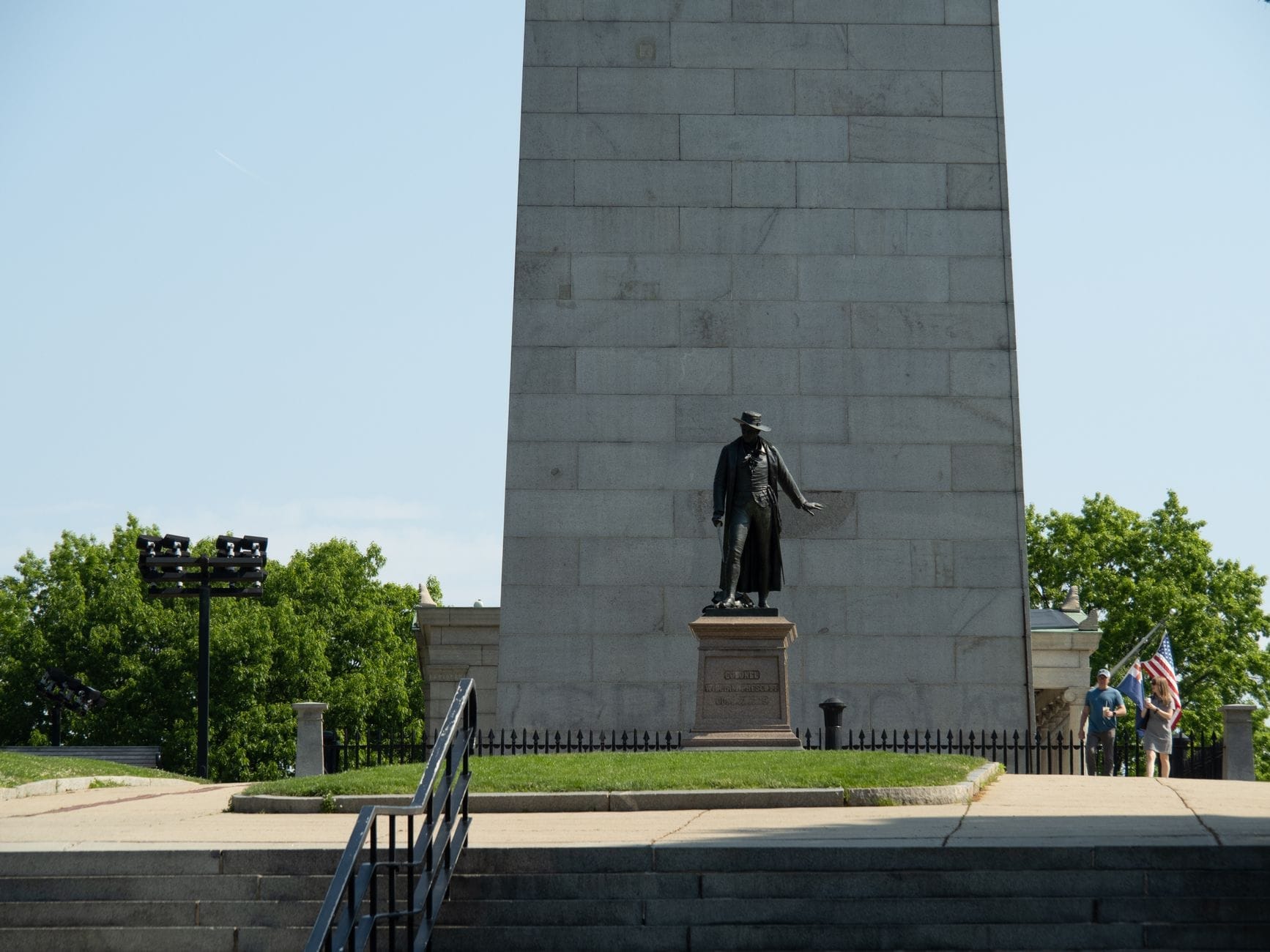
What the Bunker Hill Monument Actually Is
The Bunker Hill Monument is a 221-foot (67-meter) granite obelisk rising from Monument Square in Charlestown, a compact neighborhood north of downtown Boston across the Charles River. It marks the site of the Battle of Bunker Hill on June 17, 1775, one of the earliest and most consequential engagements of the American Revolutionary War. Despite the name, the battle was fought primarily on Breed's Hill, where the monument stands today — a geographical confusion that has persisted for nearly 250 years.
Construction on the current obelisk began in the 1820s, was completed in 1842, and dedicated in 1843 — the 68th anniversary of the battle. The structure was built from Quincy granite, quarried south of Boston and transported by a temporary railroad constructed specifically for the project, one of the first commercial railroads in New England. The result is one of the oldest war monuments in the United States and the tallest structure in Boston for much of the 19th century.
The site is part of Boston National Historical Park, managed by the U.S. National Park Service, and is also one of the stops on the Freedom Trail. The complex includes the obelisk itself, the Bunker Hill Lodge at the base, and the Bunker Hill Museum on the opposite side of Monument Square, all free to enter.
The Climb: 294 Steps and What Waits at the Top
⚠️ What to skip
There is no elevator inside the monument. Reaching the observation chamber at the top requires climbing 294 stairs in a tight spiral stairway. The staircase is tight — two people can pass but only just — and there are no rest platforms until the top. Anyone with claustrophobia, mobility limitations, or vertigo should consider visiting the museum and grounds instead.
Inside the obelisk, the staircase spirals counter-clockwise in a continuous unbroken ascent. The stairs are worn smooth from two centuries of foot traffic, and the interior smells of cool stone and slightly damp granite — a sensory detail that makes the climb feel old. The walls press close. Natural light disappears within the first few turns, replaced by small electric fixtures set into the stone. On busy days in summer, traffic flows in both directions simultaneously, which means pausing in carved-out recesses to let descending visitors pass.
At the top, four small windows open over Boston in each cardinal direction. The views are modest by rooftop-observatory standards but feel earned in a way that glass-elevator viewpoints do not. To the east, Boston Harbor stretches toward the Atlantic, with Logan Airport runways visible on clear days. To the south, the downtown skyline sits low against the sky. To the north, the neighborhoods of Charlestown spread out in rooftop detail. The observation chamber is small, so midmorning on weekdays offers the most comfortable time at the top.
Photographers should note that the window openings are small and set into thick stone walls, making tripod use impractical. A wide-angle phone lens or compact camera works well. For serious exterior photography of the monument, the best light falls on the obelisk in the morning from the southeast corner of Monument Square. The Charlestown Navy Yard to the south offers a striking angle on the obelisk with harbor context behind it.
Tickets & tours
Hand-picked options from our booking partner. Prices are indicative; availability and final rates are confirmed when you complete your booking.
Bunker Hill Monument Self-Guided Walking Audio Tour
From 9 €Instant confirmationFree cancellationBoston Summer Night Trolley Tour and River Cruise
From 27 €Instant confirmationFree cancellationLEGOLAND Discovery Center Boston tickets
From 26 €Instant confirmationFree cancellationGhosts and Gravestones tour of Boston
From 39 €Instant confirmationFree cancellation
The Battle That Made This Place Matter
The Battle of Bunker Hill on June 17, 1775 is often mischaracterized as an American victory. It was not. British forces took the hill after three assaults. But the colonial militia — largely untrained, poorly equipped, and running short of ammunition — inflicted casualties so severe that British commander William Howe later wrote that the tactical win came at a cost that felt like a defeat. Of roughly 2,200 British troops engaged, about 1,000 were killed or wounded. The colonial forces lost around 450 men, including General Joseph Warren, one of the most prominent Patriot leaders of the day.
The strategic significance was clear: the colonies had demonstrated they could fight, and fight effectively, against the most professional army in the world. The battle shifted how both sides understood what the coming war would require. For Boston in particular, Bunker Hill became a founding myth — proof that the city's resistance was more than political posturing.
For a deeper read on the Boston National Historical Park site on the Battle of Bunker Hillevents that led to and followed June 17, 1775, the Boston history guide covers the full arc of the city's Revolutionary War period, from the Boston Massacre through the evacuation of British troops in 1776.
The Bunker Hill Museum: Worth 20 Minutes Before You Climb
The Bunker Hill Museum sits directly across Monument Square from the obelisk, in a brick building operated by the National Park Service. It is small but well-curated. The centerpiece is a large-scale diorama depicting the battle terrain as it appeared in 1775, before the peninsula was reshaped by landfill and development. Exhibit panels cover the political context leading to the battle, the composition and tactics of both forces, and the monument's own construction history — including the community fundraising campaigns that sustained the project over two decades.
NPS rangers are typically on-site and available for questions. Their interpretations tend to go well beyond the exhibit text, covering details like the logistics of colonial fortification-building overnight on June 16, or the contested question of who first issued the famous order about not firing until you see the whites of their eyes. Spending time here before climbing the monument gives the ascent more meaning — you're not just climbing stairs, you're climbing the disputed ground.
💡 Local tip
The museum is a good place to rest and cool down if you've already climbed the monument on a hot day. It's air-conditioned, free, and less crowded than the monument itself in peak season.
How the Experience Changes by Time of Day and Season
Monument Square is quiet before 9 a.m. on most days. The granite benches around the obelisk's base catch morning light from the east, and the surrounding residential streets of Charlestown are calm enough that you can hear pigeons and distant traffic rather than tour groups. This is the best window for contemplative visits and exterior photography.
From late morning through mid-afternoon in summer, Freedom Trail walking tours arrive in sequence. The square becomes noticeably crowded between roughly 11 a.m. and 2 p.m. on warm weekdays, and nearly continuously busy on summer weekends. The staircase queue can extend outside the entrance during peak hours, adding 15 to 25 minutes to the climb. If you plan to visit in July or August, arrive before 10 a.m. or after 3 p.m.
Fall is widely considered the best season. September and October bring cooler temperatures that make the climb more comfortable, the lighting on the granite obelisk takes on a warmer tone against autumn sky, and the crowds thin considerably after Labor Day. Winter visits are entirely possible — the monument and museum typically remain open — but the observation chamber windows offer limited visibility on overcast days, and the stairs become cold. Spring can bring unpredictable weather but offers the advantage of low crowds and long afternoon light in May.
For a comprehensive look at how Boston's seasons affect sightseeing decisions, the Boston National Historical Park seasonal planning guidebest time to visit Boston guide breaks down each month in practical detail.
Getting There and What to Expect Around the Monument
The most straightforward transit option is the Orange Line to Community College Station, followed by about a 15-minute walk through Charlestown's residential streets. The walk is flat until it isn't: the final two blocks rise noticeably as you approach Monument Square, a preview of the climb ahead. Alternatively, the MBTA Ferry from Long Wharf in downtown Boston to the Charlestown Navy Yard dock puts you about a 10-minute walk from the monument and adds a harbor crossing that reframes the whole neighborhood.
The Freedom Trail passes directly through Monument Square, making Bunker Hill a natural endpoint for walkers who start at Boston Common and work their way north through Charlestown. The Freedom Trail runs 2.5 miles and typically takes two to three hours without stops, so plan your energy accordingly if you're climbing the monument at the end.
Street parking exists in the surrounding blocks but is limited and often resident-only during weekday hours. Driving is not recommended. There are no parking facilities at the site itself.
The neighborhood around Monument Square is residential and generally quiet. A handful of cafes and a small grocery store are within a few minutes' walk if you need to refuel before or after the climb. There are no food vendors or ticket booths at the monument itself.
Accessibility and Who Should Manage Expectations
The Bunker Hill Museum is fully accessible by elevator, and the Lodge at the base of the monument is also wheelchair accessible. Viewing the exterior of the obelisk and spending time in Monument Square requires no stairs. However, the monument's observation chamber is reachable only via the 294-step spiral staircase. There is no elevator, no mid-point resting area, and the staircase is narrow. Service animals cannot be accommodated inside the Monument, though they are welcome in the Lodge and Museum.
Young children who are steady on their feet and comfortable with enclosed spaces often do fine on the climb, but parents should assess realistically. The descent can be harder than the ascent for small legs. Children who are carried are not permitted in the staircase. Visitors with heart conditions, respiratory issues, or significant mobility limitations can still have a full and meaningful visit at ground level — the museum alone is worth the trip.
Families considering Bunker Hill as part of a broader Boston itinerary should note that the Boston family-itinerary planning guideBoston with kids guide covers how to sequence historical sites alongside more active or interactive attractions to maintain younger visitors' engagement.
Insider Tips
- Check the NPS website or call ahead to confirm the monument staircase is open before visiting — it occasionally closes for maintenance, high winds, or special events, and the grounds offer no advance notice of closures.
- If you time your visit to coincide with a clear day after a cold front passes through, the observation chamber windows offer visibility stretching well beyond the harbor to the outer islands and, on rare days, Cape Ann to the north.
- The MBTA Ferry from Long Wharf to Charlestown costs a few dollars and takes about 10 minutes — it's a far more atmospheric arrival than the subway, and the view of the monument from the water on approach is especially striking.
- The granite obelisk has limited interior interpretation — all the historical context is in the museum across the square. Visit the museum first, then climb; the ascent is more meaningful when you know what happened on this ground.
- Weekday mornings in May, September, and October hit a sweet spot of good weather, low crowds, and pleasant light on the stone. High summer weekends are the worst combination of heat, long queues, and a crowded observation chamber.
Who Is Bunker Hill Monument For?
- History and American Revolutionary War enthusiasts
- Freedom Trail walkers completing the full route through Charlestown
- Visitors who want a free, physically engaging alternative to paid observation decks
- Photographers seeking rooftop-level harbor and skyline compositions without the tourist-attraction price tag
- Travelers pairing the monument with the nearby USS Constitution for a half-day Charlestown itinerary
Nearby Attractions
Other things to see while in Charlestown:
- Charlestown Navy Yard
Charlestown Navy Yard is a 30-acre preserved shipyard that operated from 1800 to 1974 and now anchors Boston National Historical Park. Free to enter, the site is home to USS Constitution, the world's oldest commissioned warship still afloat, alongside sweeping views of Boston Harbor and layers of American industrial and military history.
- USS Constitution
USS Constitution, launched in 1797 and still an active U.S. Navy vessel, sits at Charlestown Navy Yard in Boston. Free to tour Tuesday through Sunday, it offers a rare chance to walk the decks of a ship that fought in the War of 1812 and earned the nickname 'Old Ironsides.' Plan at least 90 minutes and combine the visit with the adjacent USS Constitution Museum.