Jambiani is a string of small fishing villages on Zanzibar's southeast coast, where seaweed farming still shapes daily life and the beach stretches wide and quiet between the tides. It sits south of Paje and draws travelers who want coast without the crowds, though the tidal lagoon and village pace mean it rewards patience over convenience.
Jambiani sits on Zanzibar's southeast coast as one of the island's most grounded coastal destinations: a series of fishing villages where seaweed frames the shoreline, children play football on coral-sand lanes, and the ocean retreats dramatically twice a day to reveal a vast shallow lagoon. It is not the place for all-inclusive ease or reliable swimming at any hour, but for travelers who want to understand what coastal Zanzibar looks like outside the resort bubble, it is one of the most compelling choices on the island.
Orientation
Jambiani occupies the southern stretch of Zanzibar's southeast coast, running roughly four to five kilometers along the shoreline. The area begins south of Paje, where the kitesurfing scene dominates, and extends southward through a loose cluster of villages sharing the Jambiani name. The coral-sand road that connects them runs parallel to the beach, lined with small guesthouses, local shops, and the occasional beachfront restaurant.
To the north, Paje is close enough to visit on a bicycle or short dala-dala ride, and the two areas share a certain low-key energy, though Paje draws a younger, more activity-focused crowd. Further north along the coast, Matemwe and Kiwengwa serve the reef-diving crowd, while the south of Unguja curves toward Kizimkazi and dolphin territory. Jambiani itself is not a single compact village center; it is more of an extended coastal corridor, so where you base yourself within it matters for how much walking you will do.
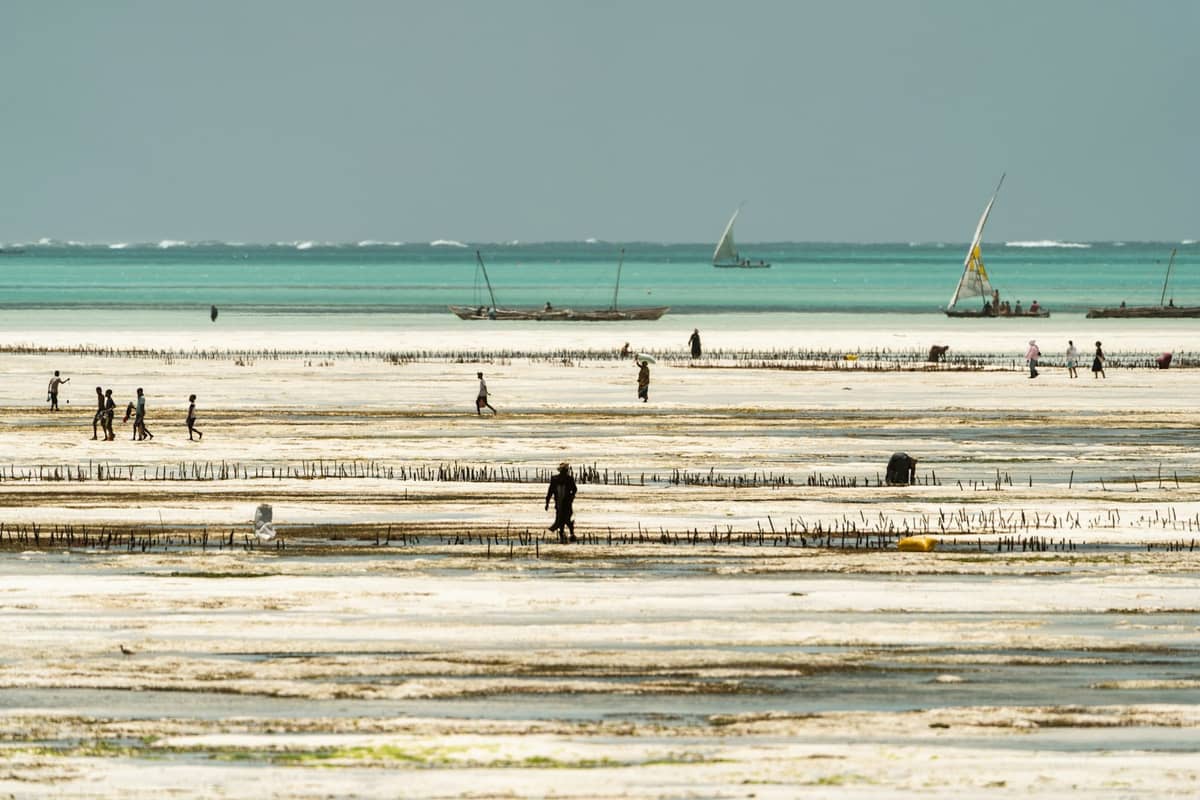
The beach faces east-southeast, which means mornings bring direct sun early and the light softens beautifully in the late afternoon. The reef lying offshore keeps the lagoon water calm, and the tidal cycle is the single most important geographic fact to understand before arriving: at low tide, the water retreats several hundred meters, exposing a broad expanse of seagrass and sand. At high tide, the lagoon fills and swimming becomes genuinely good. Planning your days around the tide table is simply part of life in Jambiani.
ℹ️ Good to know
Jambiani's tidal range is large. Check the day's tide times before planning beach activities, as the lagoon can be entirely dry for several hours around low tide, making swimming impossible.
Character & Atmosphere
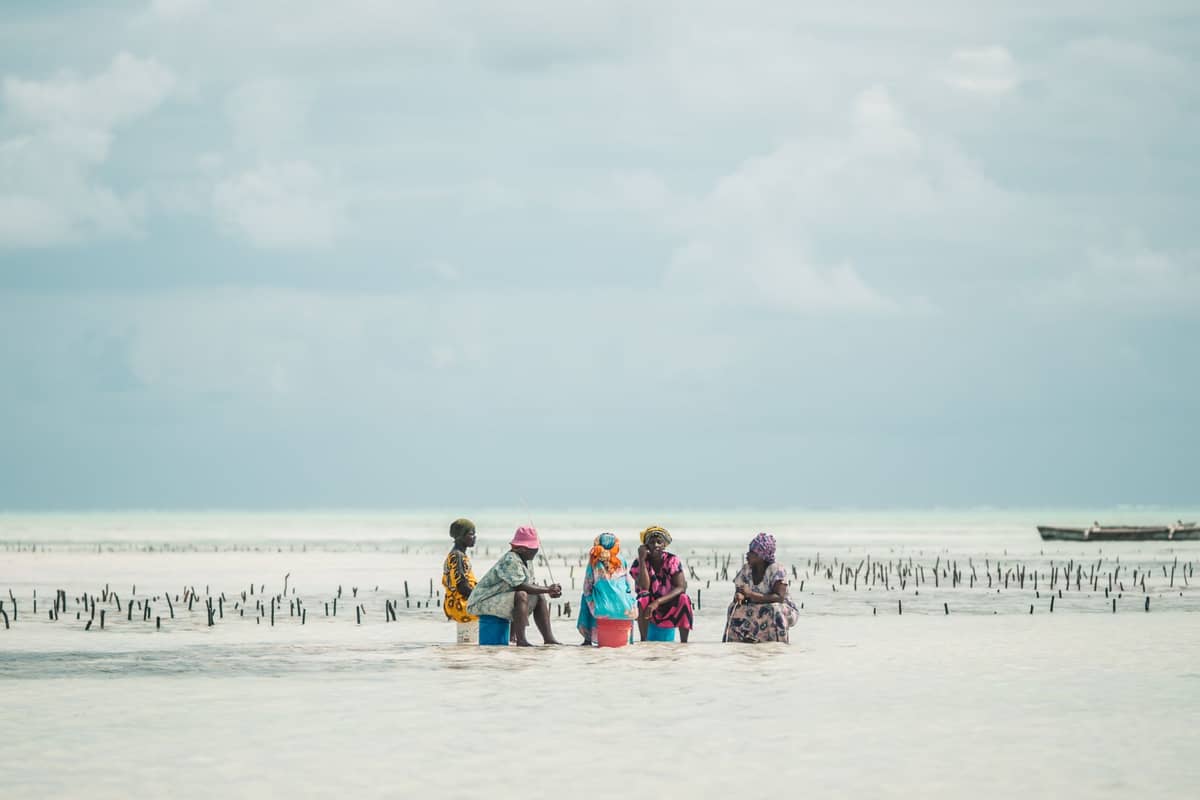
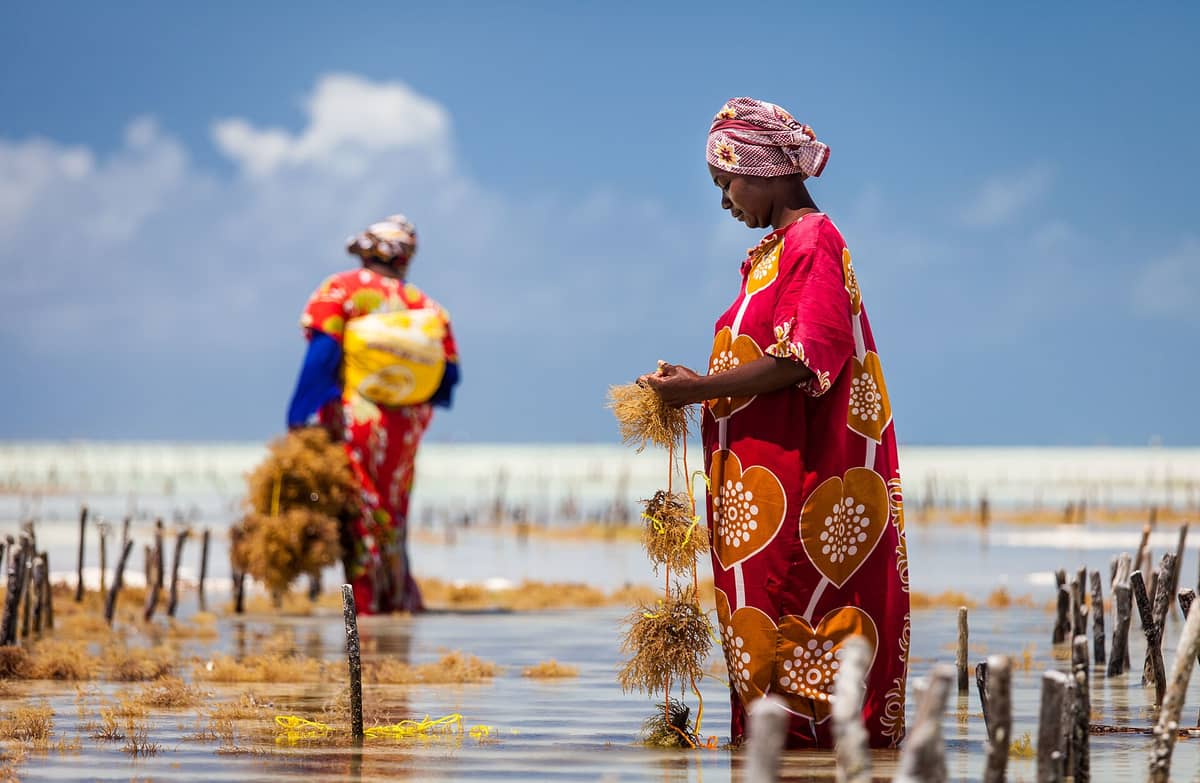
Early mornings in Jambiani belong to the fishing community. Wooden outrigger boats return from overnight trips, and women wade into the shallows to tend their seaweed lines, laying out harvested crops on the sand to dry in long rows. The smell of salt and seaweed is constant along the foreshore. By seven or eight in the morning, the village lanes are already active with schoolchildren and motorcycle taxis threading through the sandy paths.
The seaweed farming is more than scenery. It represents a significant livelihood for local families, and the women who manage the farms are central to the village economy. Several community tourism initiatives allow visitors to learn about the process, connecting seaweed harvesting to cosmetics and food products. This is the kind of context that the Jambiani seaweed farm visits can provide, turning a walk along the beach into something genuinely informative.
Midday settles into a slower rhythm. The heat encourages shade-seeking, and the beach empties as locals retreat for rest. If the tide is out, the lagoon looks almost lunar: vast, flat, and streaked with channels. It is one of the more unusual beach landscapes on the island, and it photographs dramatically, but it is worth understanding that this is normal, not a sign that something is wrong with the location you chose.
By late afternoon, the energy shifts again. Tide permitting, swimmers return to the water. Fishermen prepare their boats for the evening departure. The light goes golden against the white sand and the turquoise water where the lagoon refills. After dark, Jambiani is genuinely quiet by most beach-destination standards. A few guesthouses have bars, small restaurants put out tables under the stars, and that is largely it. If you are looking for nightlife, this is not the right base. If you find nightlife exhausting, this might be exactly what you need.
💡 Local tip
The road running through Jambiani village has sections of exposed coral rock and sharp gravel. Sandals with some grip or light walking shoes are more practical than flip-flops for navigating the lanes between the beach and the main road.
What to See & Do
The beach itself is the primary draw, and Jambiani Beach at high tide offers calm, warm, reef-protected swimming with very little wave action. Snorkeling from the beach is possible, though the reef edge sits offshore and conditions vary with the tide and season. Several local operators offer guided snorkeling excursions to better reef sections.
Kuza Cave is one of the more unusual experiences available near Jambiani. Located inland from the beach, it is a natural freshwater cave used for centuries by local communities and considered sacred in the area. Guided visits are available and provide genuine historical and cultural context, making it more than a novelty stop.
Kitesurfing is possible from Jambiani, though Paje to the north has more established schools and better infrastructure for the sport. Day trips between the two are easy. Kayaking in the lagoon at mid-to-high tide is genuinely pleasant, and several guesthouses offer or arrange rentals. Cycling is another viable way to explore the coast, connecting south to quieter stretches of beach or north through Paje.
Swimming and lagoon paddling at high tide
Seaweed farm community visits and demonstrations
Kuza Cave guided tours
Kayaking in the sheltered lagoon
Cycling north to Paje or south toward quieter beaches
Snorkeling and guided boat excursions to offshore reef sections
Sunset watching from the beach as fishing boats depart
For travelers using Jambiani as a base for wider exploration, the south of the island is accessible for day trips. Kizimkazi and its dolphin-watching excursions are roughly 30 to 40 minutes by road. The Jozani Chwaka Bay National Park, home to the endemic red colobus monkey, lies inland and is manageable as a half-day trip. Both make good reasons to hire a taxi for the day.
Eating & Drinking
Jambiani's food scene is small, locally rooted, and improving steadily without having tipped into the overly curated. Most eating happens at guesthouse restaurants and a scattering of independent beachfront places. Portions are generous and prices are well below what you would pay in Stone Town or at Nungwi's resort strip.
Fresh seafood is the reliable choice: grilled fish, octopus cooked in coconut sauce, and prawns are common across menus. Coconut rice, pilau, and chapati appear alongside them as standard accompaniments. Street food is more limited here than in the urban areas of Zanzibar, but small shops along the village road sell samosas, mandazi (fried dough), and fresh fruit throughout the day.
For broader culinary context, the Zanzibar food guide covers the full range of Swahili coast cuisine, which gives helpful background for understanding what you are ordering and why certain dishes taste the way they do in this part of the world. In Jambiani specifically, look for freshly caught octopus, which is often dried on the beach before preparation and is a village specialty.
Alcohol is available at most guesthouse bars, but Jambiani is a predominantly Muslim fishing community. Drinking in public spaces or on the street is culturally inappropriate and will attract negative attention. Keep alcohol consumption to guesthouse or restaurant settings, dress modestly when moving through the village, and you will find a genuinely warm reception from residents.
⚠️ What to skip
Jambiani is a traditional fishing community with conservative local norms. Beachwear is fine on the sand, but cover up when walking through village lanes or entering shops. Public displays of affection and alcohol consumption outside of designated venues are frowned upon.
Getting There & Around
From Zanzibar City, dala-dalas serve the southeast coast route, though reaching Jambiani typically requires a change in town and a journey of roughly one to two hours depending on connections and waiting time. The dala-dala network is the cheapest option but involves shared, often crowded minibuses on unpaved sections of road. For a more predictable journey, a shared or private taxi from Stone Town takes around 45 to 60 minutes and costs significantly more. For full details on island transport options, the guide to getting around Zanzibar covers all modes of transport with current practical advice.
From Abeid Amani Karume International Airport (ZNZ), located about three miles south of Zanzibar City, a taxi directly to Jambiani takes around 50 to 70 minutes depending on traffic and road conditions. Many guesthouses in Jambiani can arrange airport pickups for a negotiated fixed fare; this is often the most straightforward option for arrival, particularly with luggage.
Within Jambiani itself, the coastal road connects the string of villages and guesthouses. Walking between properties at either end of the strip can take 30 to 45 minutes on soft sand or rough coral track. Bicycle rentals are available through most guesthouses and are the most practical way to move around without hiring a motorbike or negotiating fares. A few boda-boda (motorcycle taxi) operators work the area and can cover ground quickly for short distances.
Ride-hailing apps such as Uber, Grab, and Careem do not operate in Zanzibar. Arrange transport through your accommodation, agree on fares in advance with any taxi driver, and be prepared for prices to be quoted in US dollars as well as Tanzanian shillings.
Where to Stay
Jambiani offers a solid range of accommodation without the mega-resort infrastructure found at Nungwi or Kendwa. The dominant options are small guesthouses, family-run bungalow operations, and mid-range beachfront lodges, most with direct beach access and open-air dining.
Budget travelers will find Jambiani one of the more affordable coastal bases on the island, with basic but clean rooms available at the lower end of the market. Mid-range options offer sea-facing rooms, proper beds, and in-house restaurants without the premium pricing of the north coast. Boutique and eco-lodge style accommodation exists in the area for those wanting a step up in comfort while remaining within a community-scale environment.
Jambiani suits travelers who genuinely want to slow down: couples looking for a quiet beach retreat, solo travelers interested in local life and low-key social environments, and anyone who finds the party beaches of the north exhausting. It is less well suited to families with young children who need reliable swimming access throughout the day, or to travelers who want full-service resort amenities. The guide to where to stay in Zanzibar compares all the main coastal areas and helps match traveler type to destination.
The best-positioned properties sit close to the beach with views over the lagoon. Given the extended nature of the village strip, check the exact location of any property relative to where you want to spend most of your time, as being at the far south end of Jambiani from a restaurant or activity operator you plan to use regularly can mean more walking or more boda-boda fares than expected.
Honest Assessment: Who Jambiani Is For
Jambiani is genuinely good for a specific kind of traveler and wrong for several others. The tidal lagoon is its most divisive feature: at low tide, the beach is dramatically scenic but functionally unusable for swimming. If reliable ocean access at any time of day is a priority, the north coast beaches around Nungwi and Kendwa, which have minimal tidal variation, will serve better.
What Jambiani does offer is a texture of local life that most coastal Zanzibar destinations have traded away. Fishing boats, seaweed farms, a working village economy: these are not stage-set for tourists but genuine components of how the community functions. For travelers who engage with that honestly and respectfully, it adds a dimension to a Zanzibar trip that a beach resort simply cannot. Pairing a few nights in Jambiani with time in Stone Town gives a well-rounded view of what Zanzibar actually is, beyond its postcards.
For those planning a full week on the island, the one week in Zanzibar itinerary positions Jambiani as an excellent southeast-coast anchor, combined with day trips to Jozani forest and Kizimkazi, before moving north. Budget-conscious travelers will also find it one of the better value coastal options, with more detail available in the Zanzibar budget guide.
TL;DR
Jambiani is a string of fishing villages on Zanzibar's southeast coast, defined by a wide tidal lagoon, seaweed farming culture, and a quieter pace than the north coast resorts.
The tidal cycle is the key practical consideration: swimming is excellent at high tide and impossible at low tide, so plan your days around the tide table.
Best suited to couples, solo travelers, and anyone seeking an affordable, community-rooted coastal base rather than a resort experience.
Day-trip access to Jozani forest, Kizimkazi dolphin tours, and Paje's kitesurfing makes it a practical base for southeast island exploration.
Not the right choice for travelers who want reliable all-day swimming, resort-level amenities, or active nightlife.
Zanzibar's beaches are not all equal. Tides, winds, crowds, and access vary dramatically between the north, east, and west coasts. This guide breaks down every major beach so you can pick the right one for how you travel.
Zanzibar's tropical monsoon climate shapes everything from beach conditions to hotel prices. This guide breaks down every month of the year so you can choose the right time for your trip — whether you're chasing perfect skies, dolphin season, or lower prices.
Zanzibar's main island is just the beginning. These day trips take you to pristine coral reserves, ancient ruins, wildlife sanctuaries, and remote beaches that reveal a completely different side of the archipelago. Here are the best excursions worth leaving your resort for.
Freddie Mercury was born in Zanzibar in 1946, and Stone Town still carries the traces of his early life. This guide covers the museum, the birthplace controversy, the Shangani heritage trail, and exactly what to expect when you visit.
From the airport taxi to a dala-dala rattling toward Nungwi, transport in Zanzibar requires some planning. This guide covers every option available on Unguja, with practical advice on costs, routes, and what to avoid.
Zanzibar attracts hundreds of thousands of visitors each year, and most have uneventful trips. But the island has real risks that travel blogs often downplay. This guide covers crime patterns, health hazards, common scams, transport dangers, and practical precautions so you can travel with clear eyes.
Zanzibar delivers a rare combination: a UNESCO-listed historic city, diverse coastlines, and Indian Ocean marine life, all within a few hours of mainland Tanzania. But it is not the right destination for everyone. Here is what you actually need to know before booking.
Seven days is enough time to experience Zanzibar properly — the historic labyrinth of Stone Town, the white-sand beaches of the north and east coasts, a spice tour through the island's interior, and the Indian Ocean reefs just offshore. This itinerary is built around realistic travel times, not a fantasy schedule.
Stone Town is one of East Africa's most historically layered urban environments, a UNESCO World Heritage Site where Swahili, Arab, Indian, and colonial influences converge in a single square kilometre. This self-guided walking tour covers the essential landmarks, practical logistics, and practical observations you need to explore it well.
Zanzibar packs an extraordinary range of experiences into a relatively small island. This guide covers the best things to do in Zanzibar across history, beaches, wildlife, food, and water sports — with clear advice on what's worth your time and what to skip.
Choosing where to stay in Zanzibar is the single most important decision of your trip. The island spans over 1,500 square kilometres, and the right base depends entirely on what you want: history, nightlife, reef diving, kite surfing, or pure seclusion. This guide breaks down every major area with a clear assessment of who each one suits.
Zanzibar's all-inclusive resort scene spans barefoot-luxury bungalows on the north coast to family-friendly complexes along the east. This guide breaks down what's genuinely included, which areas suit which traveler, and the pricing realities you won't find on most booking sites.
Zanzibar has a reputation as a luxury destination, but it is entirely possible to travel the island on a tight budget. This guide covers cheap transport, affordable places to stay, where to eat well for under $5, and which attractions are genuinely worth paying for.
Zanzibar's coral reefs rank among the Indian Ocean's most accessible and biodiverse. This guide covers the top snorkelling sites, what you'll actually see underwater, current pricing, the best seasons to go, and what responsible tourism looks like in practice.
Most travelers treat Zanzibar and Dar es Salaam as an either/or choice. They don't have to be. This guide breaks down exactly how to connect the two destinations, what to spend your time on in each, and how to structure the trip so neither feels rushed.
Zanzibar offers some of the Indian Ocean's most accessible reef diving, from the shallow coral gardens of Mnemba Atoll to the deeper, current-swept walls of Leven Bank. This guide covers the best dive sites, what to pay, when to go, and how to avoid the pricing traps that catch first-time visitors.
Zanzibar's cuisine is one of the most distinctive in East Africa, shaped by centuries of Arab, Indian, and Swahili influence. This guide covers the dishes worth seeking out, where to eat them, what to pay, and a few traps to avoid.
Zanzibar rewards the curious traveller. Beyond the famous beaches and spice tours, the island holds coral-cave slave history, crumbling sultan palaces, a centuries-old mosque, and a sandbank that appears from the sea at low tide. This guide covers the experiences most visitors never find.
Zanzibar delivers the kind of honeymoon backdrop that is hard to fabricate: white coral-sand beaches, warm turquoise water, historic Stone Town, and a spice-scented coastline. This guide covers where to stay, what to do, when to go, and what to watch out for so you can plan with confidence.
Three days in Zanzibar is enough to cover the island's highlights if you plan smart. This itinerary focuses on Stone Town, a spice tour, one great beach, and an island excursion, without wasting hours on unnecessary cross-island transfers.
December brings warm seas, festive energy, and the tail end of the short rains to Zanzibar. Here is what to honestly expect from the weather, where to spend Christmas and New Year, and how to avoid the peak-season pitfalls that catch first-timers off guard.
July sits in the heart of Zanzibar's dry season, making it one of the most popular months to visit. Here's what the weather actually looks like, what cultural events are happening, which beaches perform best, and what to plan ahead for.
Paje is one of the Indian Ocean's most reliable kitesurfing destinations, with two distinct wind seasons, a sheltered reef lagoon, and schools catering to every level. This guide covers the wind windows, tide realities, lesson costs, and practical logistics so you can plan a session that actually works.
Zanzibar delivers a rare combination: Indian Ocean beaches, rich Swahili culture, and some of East Africa's most impressive resort properties. This guide breaks down where to stay, what to expect at each price point, which coasts suit which traveler, and how to avoid the overpriced traps that catch first-timers.
From the fish stalls of Darajani to the grill smoke of Forodhani Gardens at night, Zanzibar's markets are among the most rewarding experiences on the island. This guide covers every major market, what to buy, what to skip, and how to navigate it all without overpaying.
Zanzibar after dark is more varied than most travelers expect. This guide breaks down where to go, what to expect, and how to make the most of evenings across Stone Town, Nungwi, Kendwa, and the southeast coast.
Zanzibar was the largest slave-trading port in East Africa. This guide covers the key sites, museums, and historical context that make Stone Town one of the most significant places to understand this chapter of world history — including what to expect, what gets glossed over, and how to visit responsibly.
Zanzibar rewards independent travelers with spice-scented alleys, turquoise reefs, and some of East Africa's most sociable guesthouses. This guide covers everything you need to plan a confident solo trip: the safest areas, realistic costs, cultural etiquette, and how to move around the island without a group.
A Zanzibar spice tour is one of the most rewarding half-days you can spend on the island, but the experience varies enormously depending on which farm you visit, which operator you book with, and what time of year you go. This guide covers all of it: the best farms near Stone Town, clear price breakdowns, seasonal considerations, and what separates a genuinely good tour from a rushed photo-op.
Stone Town's UNESCO-listed streetscape is one of the most architecturally layered urban environments in the Indian Ocean world. This guide breaks down the building styles, carved door traditions, construction materials, and cultural influences that shaped the historic quarter, with practical advice on what to look for and how to explore it.
Zanzibar's culture is one of the most layered in East Africa, shaped by centuries of Arab, Persian, Indian, and African exchange along the Swahili coast. This guide covers what to wear, how to behave, when to visit, and what most tourists overlook about life here.
Combining a Tanzania safari with a Zanzibar beach stay is one of the most rewarding travel itineraries in Africa. This guide covers the logistics, best timing, route options, costs, and common mistakes to avoid when planning your Tanzania and Zanzibar combo trip.
Zanzibar works surprisingly well as a family destination, but it takes some planning. This guide covers the best beaches, wildlife encounters, cultural experiences, and practical logistics for traveling with children on Unguja, the main island.