Jambiani Beach: Zanzibar's Quiet Southeast Shore
Jambiani Beach stretches roughly 6 kilometres along Unguja's southeast coast, where a working fishing village meets one of Zanzibar's most photogenic shorelines. The water stays shallow and warm for most of the tidal cycle, seaweed farmers work the flats at low tide, and the pace here is noticeably slower than at the island's northern resort hubs.
Quick Facts
- Location
- Southeast coast of Unguja, Zanzibar — approx. 55–75 km from Stone Town
- Getting There
- Taxi or private transfer from the airport (approx. 1–1.5 hrs); dala-dala shared minibuses also serve the area — confirm current routes locally
- Time Needed
- Half a day to a full day; most visitors base themselves here for 2–4 nights
- Cost
- Free — no admission fee
- Best for
- Slow travel, tidal swimming, cultural curiosity, budget travellers, couples
What Jambiani Beach Actually Is
Jambiani Beach is not a resort beach in the conventional sense. It is the shoreline of Jambiani village, a working Swahili fishing community on the southeast coast of Unguja, the main island of the Zanzibar archipelago. The beach runs for roughly 6 kilometres along a shallow, sheltered bay, backed by a low coral-stone seawall, scattered guesthouses, and the quiet lanes of the village itself. There is no gate, no ticket booth, and no formal entrance: the beach simply begins where the road ends.
That absence of infrastructure is precisely the point. Jambiani attracts travellers who have already seen the busier northern beaches and want something closer to ordinary coastal Zanzibar life. The trade-off is real: swimming depends heavily on the tide, the beach is not manicured, and amenities are modest. But the setting, the water colour, and the cultural texture of the place are genuinely distinctive.
ℹ️ Good to know
Tides matter enormously at Jambiani. At low tide the water retreats far across the sand flats, leaving too little depth to swim. Plan any swimming activity around high tide — ask your guesthouse for that day's tide times before heading out.
The Beach by Time of Day
Early morning at Jambiani is the most photogenic window and the coolest for walking. Fishing dhows return to shore before 7 a.m., crews hauling nets and sorting the catch on the sand. The light is flat and golden, the beach is largely empty of tourists, and the smell of salt and seaweed hangs in the warm air. This is when the beach feels most like a living community rather than a destination.
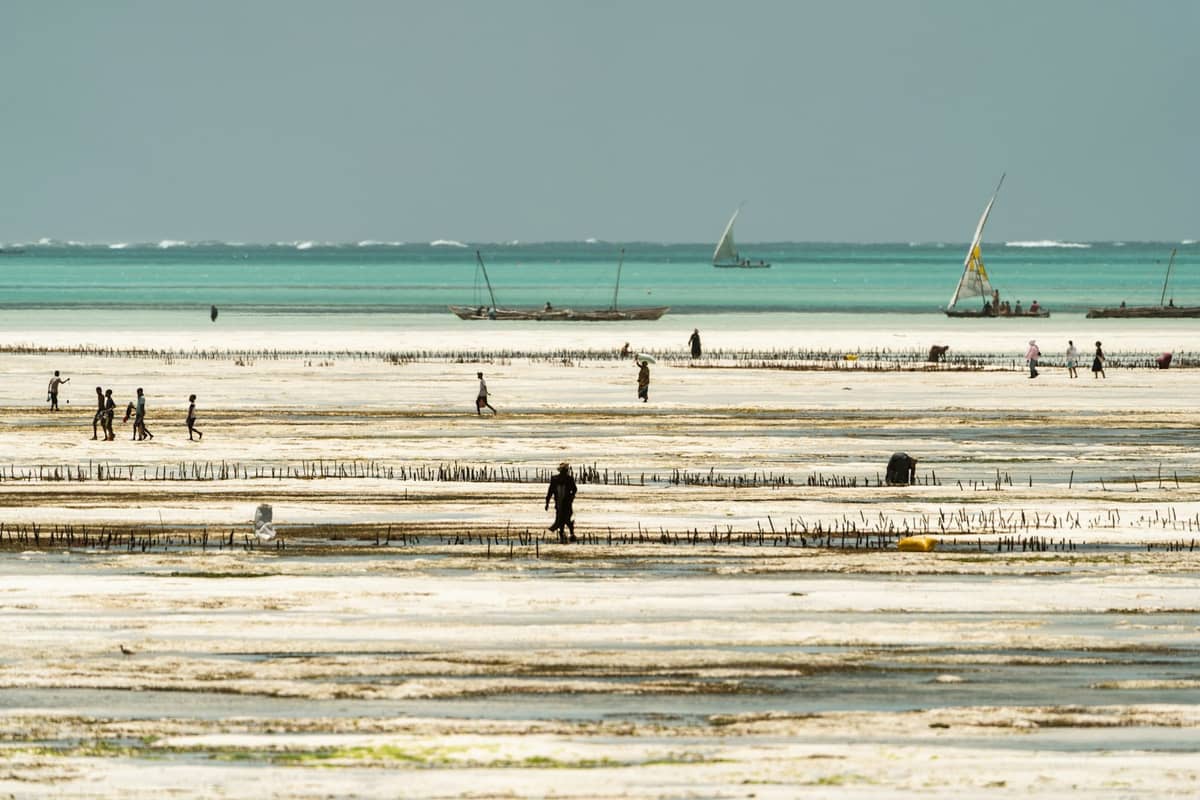
Mid-morning, if the tide allows, is the best time to swim. The water is calm and clear, ranging from pale green in the shallows to a deeper turquoise further out. At knee depth you can walk considerable distances across the sand flats before the bottom drops away. Children from the village often appear at this hour, curious and sociable, while seaweed farmers wade out to tend their lines.
By mid-afternoon the heat is significant and the shade options on the beach itself are limited. Most travellers retreat to their guesthouse terrace or a beach bar. Late afternoon brings softer light and a second opportunity to walk the shoreline as the temperature drops, though the quality of the sunset depends on cloud cover and your position on the bay — Jambiani faces east, not west, so it does not offer dramatic sunset views over the sea.
Tickets & tours
Live prices and dates from our booking partner. If you book, we may earn a commission at no extra cost to you.
Zanzibar catamaran and snorkelling tour to Mnemba Marine Park
From 114 €Instant confirmationFree cancellationNyerere National Park two-day safari with two game drives
From 866 €Instant confirmationFree cancellationSerengeti National Park private three-day safari from Zanzibar
From 2.144 €Instant confirmationFree cancellationZanzibar north coast sunset dhow cruise
From 42 €Instant confirmationFree cancellation
Seaweed Farming: The Industry on the Shoreline
One of the most visible and distinctive aspects of Jambiani Beach is its seaweed farming activity. Rows of staked lines extend across the tidal flats, and at low tide you will see women, mostly, working among them: tying new cuttings, harvesting mature growth, and carrying it ashore in large sacks. Zanzibar became a significant producer of farmed seaweed from the late 1980s onward, and the southeast coast, with its sheltered shallows and consistent tides, became a centre of that industry.
The Jambiani seaweed farm offers a short guided walk and explanation of the farming process — worth an hour if you are curious about the economics and ecology behind what you are seeing on the beach. The seaweed grown here is primarily exported for use in cosmetics, food thickeners, and pharmaceutical products. It is one of the main income sources for women in the village, a fact that has shifted local gender dynamics in measurable ways over decades.
💡 Local tip
Do not walk through the seaweed farming lines, even if they look unoccupied. They are someone's livelihood. Observe from the edge of the flats or join a guided visit that includes explicit permission to walk among the crops.
Swimming, Snorkelling, and Water Conditions
Jambiani's water is shallow, warm, and generally calm thanks to the offshore reef that breaks the Indian Ocean swell before it reaches the beach. For confident swimmers who time their visit to high tide, the snorkelling immediately off the beach can be surprisingly good — the reef is accessible without a boat. For a more structured reef experience, local operators offer snorkelling excursions by dhow to sites further along the coast.
Serious divers and snorkellers often combine a Jambiani stay with a day trip to better-known sites. The Mnemba Atoll, off the northeast tip of Unguja, is regarded as one of East Africa's premier snorkelling and diving destinations, accessible by boat from multiple points on the island. For context on what the southeast coast's reef environment looks like more broadly, the Zanzibar coral reefs guide explains reef health, marine life, and conditions across different parts of the island.
Currents are generally mild close to shore, but conditions can change with the tidal cycle. Non-swimmers and children can safely paddle in the shallows at high tide. The seabed is sandy with occasional patches of seagrass and small rocks; reef sandals or water shoes are useful if you plan to walk far across the flats.
The Village Behind the Beach
Jambiani village runs parallel to the shoreline along a single coral-stone road. The architecture is low-rise and simple: whitewashed walls, carved wooden doors, and small shops selling basics. The pace is genuinely unhurried in a way that can feel unusual if you arrive directly from Stone Town or the northern resorts. There are local restaurants, small guesthouses at a range of prices, and a few beach bars, but the village has not been built specifically around tourism and that shows, positively.
Visitors who appreciate the intersection of everyday Swahili life and beach settings often find Jambiani more rewarding than the more polished northern alternatives. For a broader read on how this coastal culture functions and what shapes it, the Zanzibar Swahili culture guide provides useful background. If you are planning a wider trip around the southeast coast, the Jambiani area guide covers accommodation, food, and practical logistics.
⚠️ What to skip
Jambiani is a predominantly Muslim community. Visitors walking through the village should cover shoulders and knees away from the beachfront. Bikinis and bare torsos are for the beach, not the road or the market.
Getting There and Practical Logistics
Jambiani sits on the southeast coast of Unguja, roughly 55–75 kilometres from Stone Town by road and approximately 1 to 1.5 hours by car or taxi from Abeid Amani Karume International Airport. The road south from Stone Town passes through Paje before reaching Jambiani, and most visitors arrive by pre-arranged taxi or hotel transfer. Dala-dala shared minibuses serve the southeast coast, but routes and departure points change: confirm the current situation locally before relying on them for a tight schedule.
There is no public transport from the airport directly to Jambiani. Agree a fare in advance with any taxi driver, and be aware that quoted prices vary between operators. For a full breakdown of island transport options, the guide to getting around Zanzibar covers taxis, dala-dalas, car hire, and scooter rental with current context on what is and is not reliable.
The beach itself has no formal parking area, no luggage storage, and no lifeguard service. Mobile network coverage is generally adequate for data and calls along the main village road. ATMs are not available in Jambiani village: carry enough Tanzanian shillings or US dollars before you leave Stone Town or the airport area. US dollars are widely accepted at guesthouses but smaller local purchases typically require shillings.
Photography and What to Expect Visually
The colour contrast at Jambiani is striking: the sand is white and fine, the water shifts between mint green and deep turquoise depending on depth and cloud cover, and the fishing dhows provide a traditional wooden counterpoint to the open sea behind them. The best photography light arrives in the first and last two hours of the day. Midday light is harsh and flattens the water colour significantly.
Photographing local people, particularly the seaweed farmers, should always be done with explicit permission and a respectful approach. Some farmers have grown tired of being photographed without acknowledgement; a brief conversation and a small tip for their time is the appropriate norm. Wide landscape shots of the beach and dhows require no special permission.
Insider Tips
- Check the tide table for your specific travel dates before booking activities. On a low-tide morning the beach is beautiful to walk but you cannot swim; on a high-tide morning you can snorkel directly off the sand. Many guesthouses will print or share the weekly tide schedule on request.
- The stretch of beach south of the main village concentration is quieter and often completely empty in the early morning. A 20-minute walk in that direction will typically take you away from any other tourists entirely.
- Jambiani has fewer restaurants than Paje to the north. If you plan to stay several nights, scout the full range of local eating options on your first evening rather than returning to the same place by default — a couple of spots operate only sporadically and it is worth knowing which are reliably open.
- Bargain for any guided activity or dhow trip before departure, not after. Prices for snorkelling excursions and dhow hire are not fixed, and the quoted rate for a tourist who has not asked around is often significantly higher than the rate for one who has.
- If you want to visit the seaweed farm with explanation and proper access, ask your guesthouse to arrange it rather than approaching farmers on the flats independently. Guided visits are short, inexpensive, and mean the income goes to someone who has set time aside to host you.
Who Is Jambiani Beach For?
- Travellers who want a slower, less developed beach experience than Nungwi or Kendwa
- Couples on a mid-range budget looking for atmosphere without a resort price tag
- Culturally curious visitors interested in the intersection of fishing and farming village life with coastal tourism
- Families with older children who can manage tidal swimming and some uncertainty around schedules
- Solo travellers on the Zanzibar budget trail, for whom Jambiani's low-cost guesthouses and local food scene are a practical fit
Nearby Attractions
Other things to see while in Jambiani:
- Jambiani Seaweed Farm
Along Jambiani's shallow east-coast shoreline, rows of seaweed lines stretch across the tidal flats tended by a cooperative of local women known as the Mwani Mamas. This is not a staged cultural display — it is a working farm that has shaped the village economy since 1989, and visiting it on a guided tour offers a grounded, unhurried look at coastal livelihoods that most beach holidays completely miss.
Planning a trip? Discover personalized activities with the Nomado app.