Jozani Chwaka Bay National Park: Zanzibar's Forest Sanctuary
Jozani Chwaka Bay National Park is Zanzibar's only national park, protecting ancient groundwater forest, coastal mangroves, and the endangered Zanzibar red colobus monkey across roughly 50 square kilometres of southern Unguja. It is a serious nature destination, not a theme park, and rewards patient visitors who arrive early and move quietly.
Quick Facts
- Location
- Approx. 35 km southeast of Stone Town, southern Unguja, Zanzibar, Tanzania
- Getting There
- Taxi or organised tour from Stone Town (approx. 45–60 min); no public transit route confirmed to the park gate
- Time Needed
- 2–3 hours for forest trail and mangrove boardwalk; half-day if combining with a spice tour en route
- Cost
- Confirm current admission fees with the park before visiting
- Best for
- Wildlife spotters, families with older children, nature photographers, and anyone wanting a counterpoint to beach days
- Official website
- maliasilismz.go.tz
What Jozani Chwaka Bay National Park Actually Is
Jozani Chwaka Bay National Park, established in 2004, is the only national park on Unguja and one of the most ecologically significant protected areas in the western Indian Ocean. It covers approximately 50 square kilometres of groundwater forest, coral rag thicket, salt marsh, and mangrove fringing Chwaka Bay. In 2016, UNESCO designated the surrounding zone as a biosphere reserve, recognising the park's role in protecting a landscape type that has largely disappeared across East Africa.
The park's official Swahili name is Hifadhi ya Taifa ya Jozani na Ghuba la Chwaka, and it is managed by the Ministry of Tourism and Heritage of Zanzibar. That bureaucratic framing matters to visitors for one simple reason: this is a real conservation area with genuinely protected wildlife, not a curated wildlife experience. Animals are wild, ranger guidance is mandatory, and the ecosystem is fragile enough to require that visitors stay on marked trails.
ℹ️ Good to know
The park is open daily from 7:00 a.m. to 6:00 p.m. The park is open daily from 7:00 a.m. to 6:00 p.m. Admission fees should be confirmed with the park before your visit, as fees can change.
The Zanzibar Red Colobus: Why This Monkey Matters
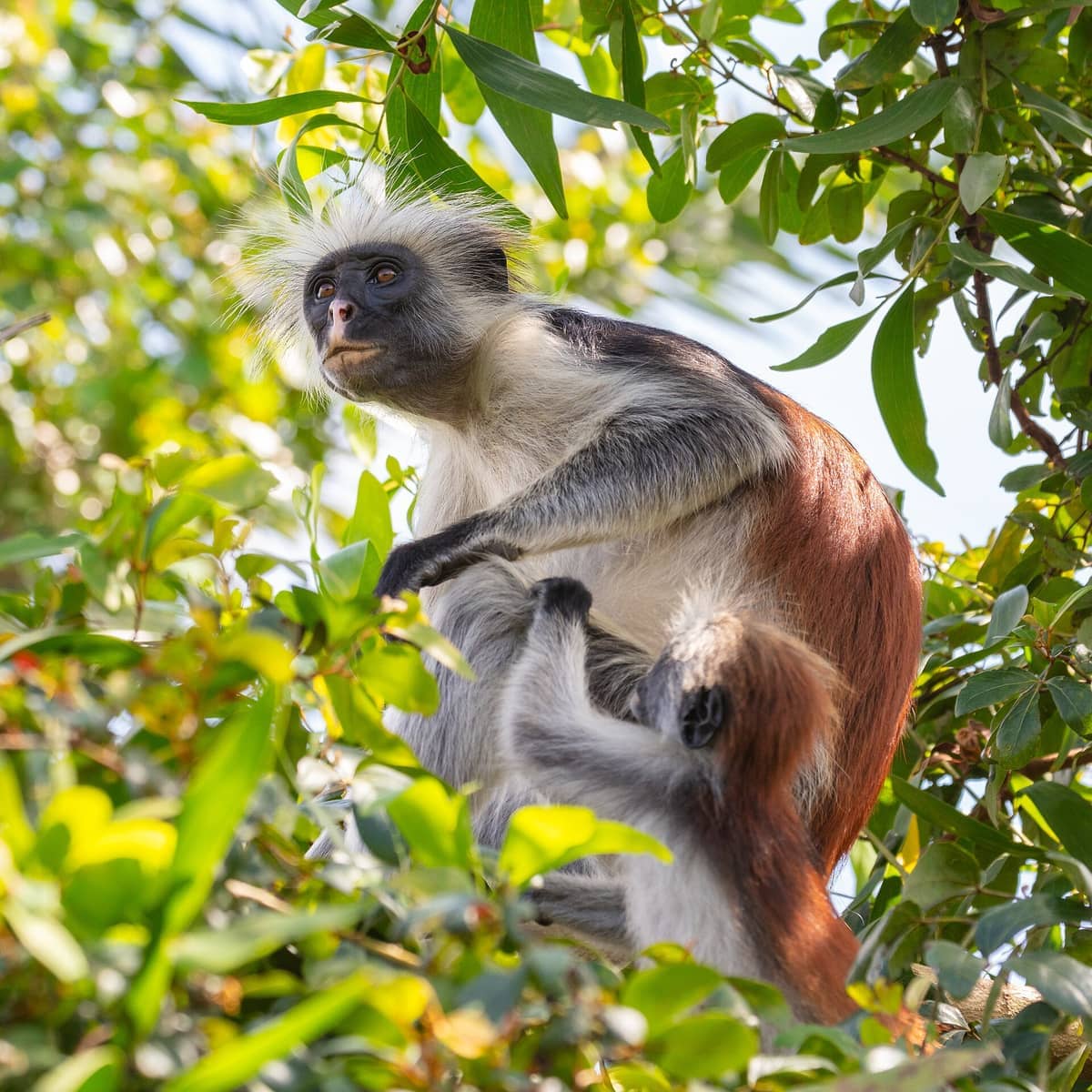
The Zanzibar red colobus (Piliocolobus kirkii) is endemic to Unguja, meaning it exists nowhere else on earth. Classified as endangered, the population numbers in the low thousands, and Jozani's forest is their primary stronghold. Seeing them is the reason most visitors make the 35-kilometre journey from Stone Town.
The colobus live in troops and are genuinely habituated to human presence along the main forest trail, which means sightings are frequent rather than lucky. They move through the canopy in loose family groups, the rust-red fur of adults bright against the green, juveniles scrambling between branches. They are vocal animals: low hoots between troop members, occasional alarm calls, the rustling thud of a leap that is bigger than you expect. You will smell the forest before you hear the monkeys, a combination of damp earth, decaying leaves, and the faint sweetness of fig.
The ranger guide will brief you on distance rules before entering the forest. These are conservation protocols, not theatre. Colobus are susceptible to human respiratory viruses, so the standard advice is to maintain at least three metres of distance, remove yourself if a monkey approaches, and never offer food. Following these rules properly is part of what makes the visit worthwhile.
⚠️ What to skip
Do not feed the colobus, and keep a minimum distance of three metres. Respiratory transmission from humans is a documented threat to this population. Rangers enforce this seriously.
Tickets & tours
Live prices and dates from our booking partner. If you book, we may earn a commission at no extra cost to you.
Zanzibar catamaran and snorkelling tour to Mnemba Marine Park
From 114 €Instant confirmationFree cancellationNyerere National Park two-day safari with two game drives
From 866 €Instant confirmationFree cancellationSerengeti National Park private three-day safari from Zanzibar
From 2.144 €Instant confirmationFree cancellationZanzibar north coast sunset dhow cruise
From 42 €Instant confirmationFree cancellation
The Forest Trail: What the Walk Is Like
The main forest trail is a short loop, approximately one kilometre, through the groundwater forest. The terrain is flat and the path is well-maintained, making it accessible to most visitors. In the dry season (roughly June to October), the forest floor is softer underfoot and the light filters cleanly through the canopy. In the wet season, the path can be muddy and the forest is dramatically lush, with streams running between tree roots, but you should wear shoes that can get dirty.
The groundwater forest feels unexpectedly ancient. Ficus trees with roots like buttresses, wild coffee plants flowering in the understorey, Pandanus palms along the edges. The birding here is underrated: Fischer's turaco, the Zanzibar sunbird, and various hornbills are regularly seen. Bring binoculars if birds matter to you. The light is best in the early morning, when shafts come through the canopy and the forest is at its quietest.
Morning arrivals, particularly before 9:30 a.m., encounter fewer people on the trail and animals that are more active. By late morning, tour groups from Stone Town start arriving in numbers, and the trail can feel crowded relative to its size. If you are self-driving or arriving by private taxi, an early start makes a measurable difference to the quality of the experience.
The Mangrove Boardwalk and Chwaka Bay
The mangrove boardwalk is a separate section of the park, a few hundred metres from the main forest trail. It extends out over tidal flats and into a mangrove system that feeds directly into Chwaka Bay. The boardwalk itself is wooden and runs for roughly 400 metres through a canopy of grey mangrove (Avicennia marina) and red mangrove (Rhizophora mucronata), their aerial roots creating a lattice above the mud at low tide.
At low tide, the mud flat beside the boardwalk is exposed and alive: mudskippers, fiddler crabs, kingfishers working the channel edges. At high tide, the water level rises to the root base and the whole area becomes quieter and more reflective. Both states have their own appeal, but low tide gives you more to observe. The boardwalk terrain is flat and the surface is reasonably stable, though the gaps between planks mean it is not suitable for pushchairs or wheelchairs.
The mangroves are ecologically central to the whole park system: they protect the coastline, serve as nursery habitat for fish that sustain local fishing communities, and store significant quantities of carbon. For more on how marine and coastal ecosystems connect across Zanzibar, the Zanzibar coral reefs guide explains the broader picture.
Historical and Conservation Context
The forest at Jozani has been protected in various forms, though the date of its original forest-reserve designation is not confirmed here. It was formally established as a national park in 2004, making it relatively young by East African standards. The 2016 UNESCO biosphere reserve designation extended the protected zone to include buffer and transition areas around the core park, integrating local fishing villages and agricultural land into a broader conservation framework.
The park represents one of the few remaining fragments of the groundwater forest that once covered much of central and southern Unguja. The surrounding coral rag landscape has been largely cleared for agriculture and settlement. What survives inside the park boundaries is accordingly rare, which is the core reason serious conservationists regard Jozani as more significant than its modest size suggests.
Visitors interested in the broader environmental and cultural history of Zanzibar may find useful background in the spice tour guide, which covers the agricultural transformation of Unguja's landscape under the sultanate, and in the Swahili culture guide, which contextualises the relationship between coastal communities and the land.
Getting There and Practical Logistics
The park is approximately 35 kilometres southeast of Stone Town, a drive of roughly 45 to 60 minutes depending on road conditions and time of day. There is no confirmed public transit route to the park gate. Most visitors arrive by private taxi negotiated in Stone Town or as part of an organised half-day or full-day tour. Tour operators frequently combine Jozani with a spice farm visit or a stop at a nearby beach, which makes good geographic sense given the park's position in the south of the island.
If you are hiring a taxi independently, agree the fare for a round trip before you depart, including waiting time at the park. The park visit itself runs two to three hours for most people, so ensure the driver understands they will be waiting. Organised tours handle this automatically and often include lunch at a local restaurant en route, which can be worthwhile.
For a broader view of how to structure movement around the island, the getting around Zanzibar guide covers taxi, dala-dala, and tour options in practical detail.
💡 Local tip
Wear closed shoes you do not mind getting muddy, particularly in the wet season. Bring insect repellent for the mangrove section. A light layer helps in the forest early morning, when the shade keeps temperatures lower than the open coast.
Photography, Crowds, and Who Should Reconsider
The forest light is challenging: dense canopy means high contrast between bright gaps and dark understorey. A camera that handles mixed light well will serve you better than a smartphone in most conditions. The morning hours before 10 a.m. are significantly better for photography, both for light quality and for the absence of other visitors in frame.
Visitors who want a purely leisurely, air-conditioned, or resort-style experience will find Jozani demanding relative to its rewards. The walks are short and easy, but the forest is genuinely warm and humid, particularly from November to March. There is limited shade at the park entrance area, and facilities are basic: a visitor centre, toilets, and a small souvenir stall. This is not a polished attraction. It is a conservation area that tolerates tourists rather than curating experiences for them, and that is precisely its value for the right visitor.
If you are building an itinerary around the southern part of the island, the park pairs logically with a visit to Kizimkazi Mosque, the oldest standing mosque in sub-Saharan Africa, which lies further south along the same road. The village of Kizimkazi also offers dolphin-watching trips in the bay.
Insider Tips
- Arrive at the gate when it opens at 7:00 a.m. The colobus are most active in the early morning, and you will have the trail largely to yourself before the organised tour groups arrive from Stone Town around 9:30 a.m.
- Ask your ranger guide to take the trail slowly and stop often. The habituated colobus troops can be observed for extended periods if you are patient and quiet; rushing through to tick the box means missing most of the behaviour.
- Check the tide state before you visit if the mangrove boardwalk is important to you. Low tide exposes the mud flat and dramatically increases wildlife visibility: mudskippers, crabs, and wading birds are far more apparent than at high tide.
- The souvenir stall at the exit sells locally made crafts, and purchasing here directly supports the community conservation fund tied to the park. It is worth a few minutes of your time.
- Combining Jozani with a stop at a spice farm on the road south from Stone Town is geographically efficient and gives the day a genuine thematic coherence: forest ecology followed by agricultural history, both on the same route.
Who Is Jozani-Chwaka Bay National Park For?
- Wildlife and nature enthusiasts who want to see an endemic and endangered primate in a genuinely protected habitat
- Photographers looking for forest and mangrove subjects away from the beach-resort circuit
- Families with older children who can follow ranger instructions and walk the trail calmly
- Travellers building a full-day southern Zanzibar itinerary combining forest, spice history, and coastal scenery
- Anyone wanting ecological and cultural depth to balance a beach-heavy Zanzibar trip
Nearby Attractions
Other things to see while in Jozani & Chwaka Bay:
- Zanzibar Butterfly Centre
Tucked beside the road linking Stone Town to Paje, the Zanzibar Butterfly Centre in Pete Village gives visitors a close look at tropical butterflies in a walk-through garden enclosure. It is a calm, low-key stop that pairs naturally with a visit to Jozani Chwaka Bay National Park nearby.
Planning a trip? Discover personalized activities with the Nomado app.