Xintiandi and Huaihai Road form one of central Shanghai's most polished and historically layered neighborhoods, where restored 19th-century shikumen lane houses sit beside flagship luxury boutiques and some of the city's best restaurants. The area straddles Huangpu and Xuhui districts, drawing both expats and well-heeled locals in roughly equal measure.
Xintiandi is where Shanghai decided to preserve its past rather than demolish it, transforming a cluster of 1930s shikumen lane houses into a car-free district of restaurants, bars, and boutiques without losing the texture of the original streetscape. Huaihai Road, running east to west just to the north, is the city's second great commercial boulevard, quieter and more curated than Nanjing Road but lined with international flagship stores and some of the most architecturally interesting mid-century buildings in the city. Together they form a neighborhood that rewards slow walking.
Orientation
Xintiandi sits in the southern part of Huangpu District, roughly at the geographic center of old Shanghai. The core of the development occupies a compact area bounded by Huaihai Road to the north, Fuxing Road to the south, South Huangpi Road to the west, and Madang Road to the east. It is close enough to the Former French Concession that the two areas blur at their edges, particularly along Fuxing Road and the streets heading south toward Sinan Road.
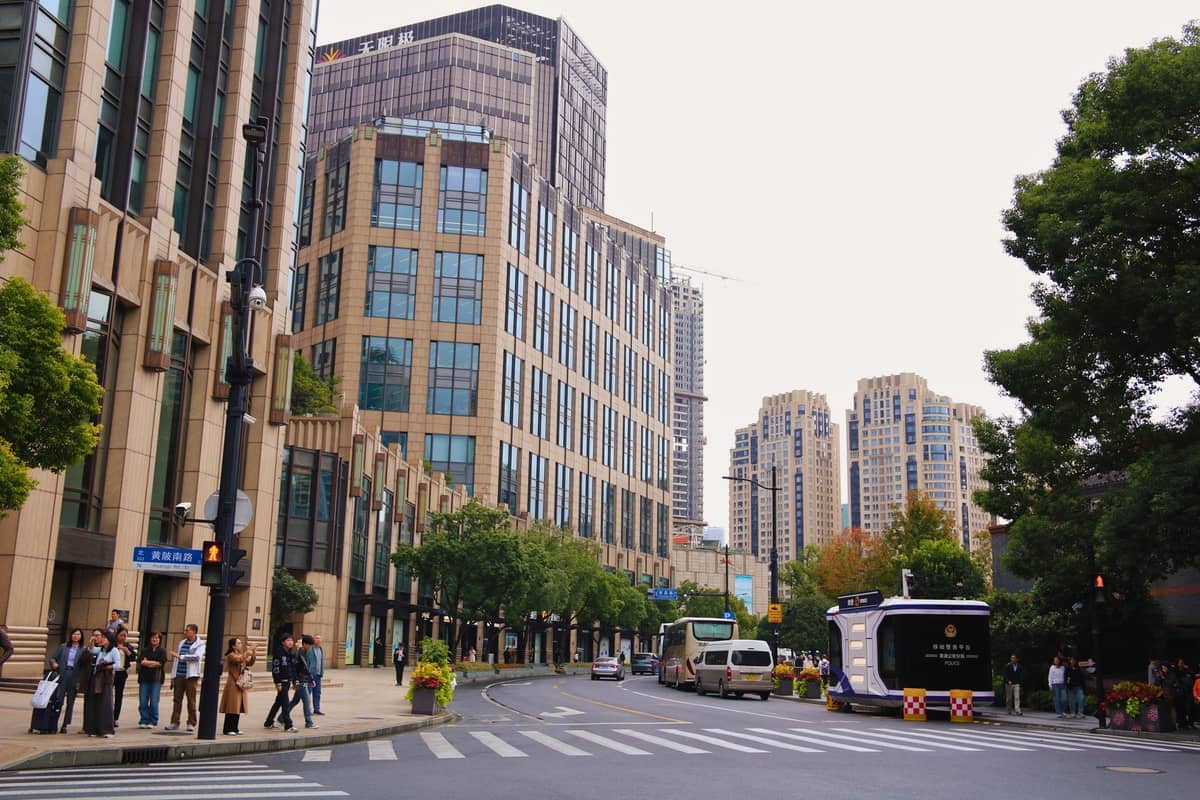
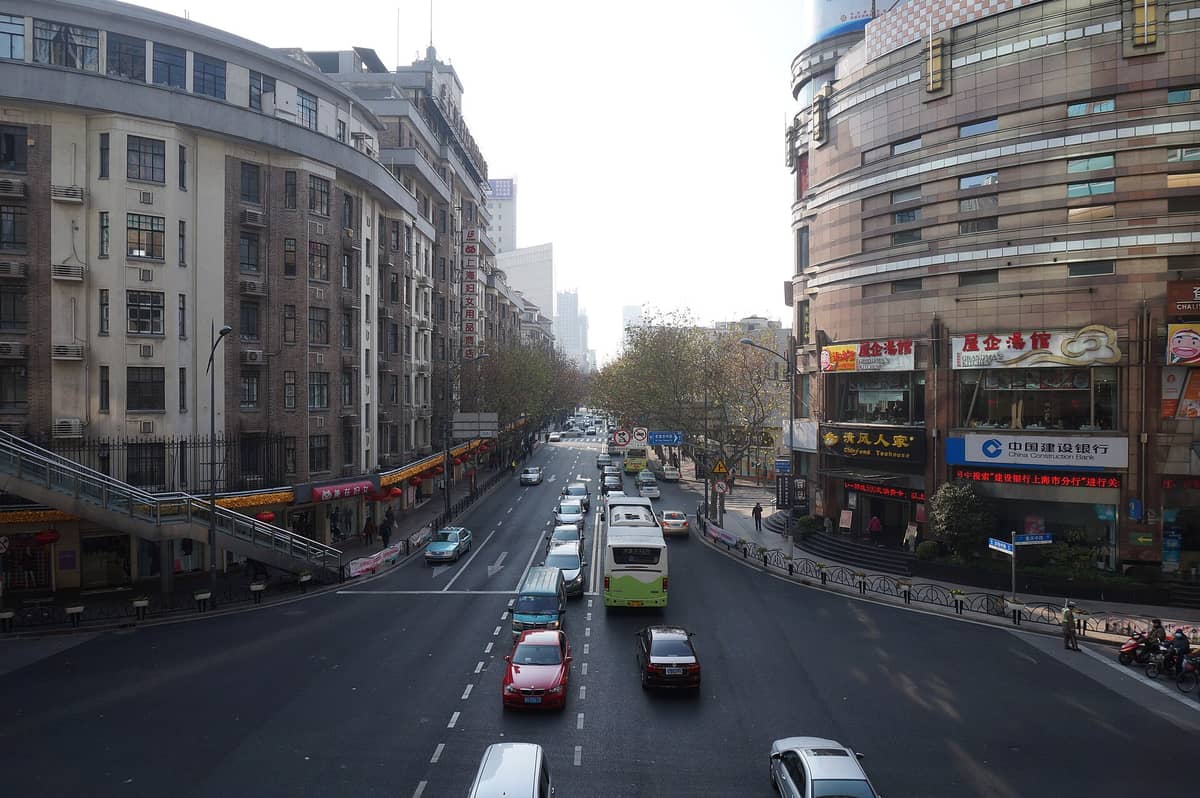
Middle Huaihai Road, the main commercial artery of this corridor, stretches between South Shaanxi Road in the west and South Xizang Road in the east. This is not just a shopping street; it is a navigational spine. Walking east from South Shaanxi Road Station toward South Huangpi Road Station covers the densest part of the retail stretch, passing IAPM Mall, TX Huaihai, and Shanghai K11 before arriving at the blocks that feed directly into Xintiandi. The broader neighborhood connects naturally to the Former French Concession to the southwest and to People's Square and the Bund corridor to the northeast.
The area falls across two administrative districts: the Xintiandi blocks themselves sit in Huangpu, while the western stretches of Huaihai Road move into Xuhui. For a visitor, this distinction is invisible on the ground, but it explains why the character shifts slightly as you move west: the density of tourists and tour groups decreases, the cafes get smaller, and the architecture becomes more residential.
Character & Atmosphere
Early mornings in Xintiandi are quiet in a way that surprises first-time visitors. The lane houses catch low light well, the grey brick and timber lintels of the shikumen facades contrasting with whatever the sky is doing above the roofline. Delivery staff arrive with the day's produce for the restaurants, and for about ninety minutes the pedestrian lanes feel like what they originally were: a residential neighborhood. By 10am that has changed. The coffee shops open, the retail frontages roll up, and the first tour groups arrive with guides holding colored flags.
Midday and the afternoon are peak tourist hours. The North Block, which contains the more authentic shikumen architecture, draws most of the foot traffic. The South Block, with its glass-fronted modern structures and indoor mall, tends to attract shoppers more than sightseers. In both blocks the lanes are narrow enough that a moderate crowd feels dense. If you want to actually look at the architecture without bodies in the way, arrive before 9am or after 8pm.
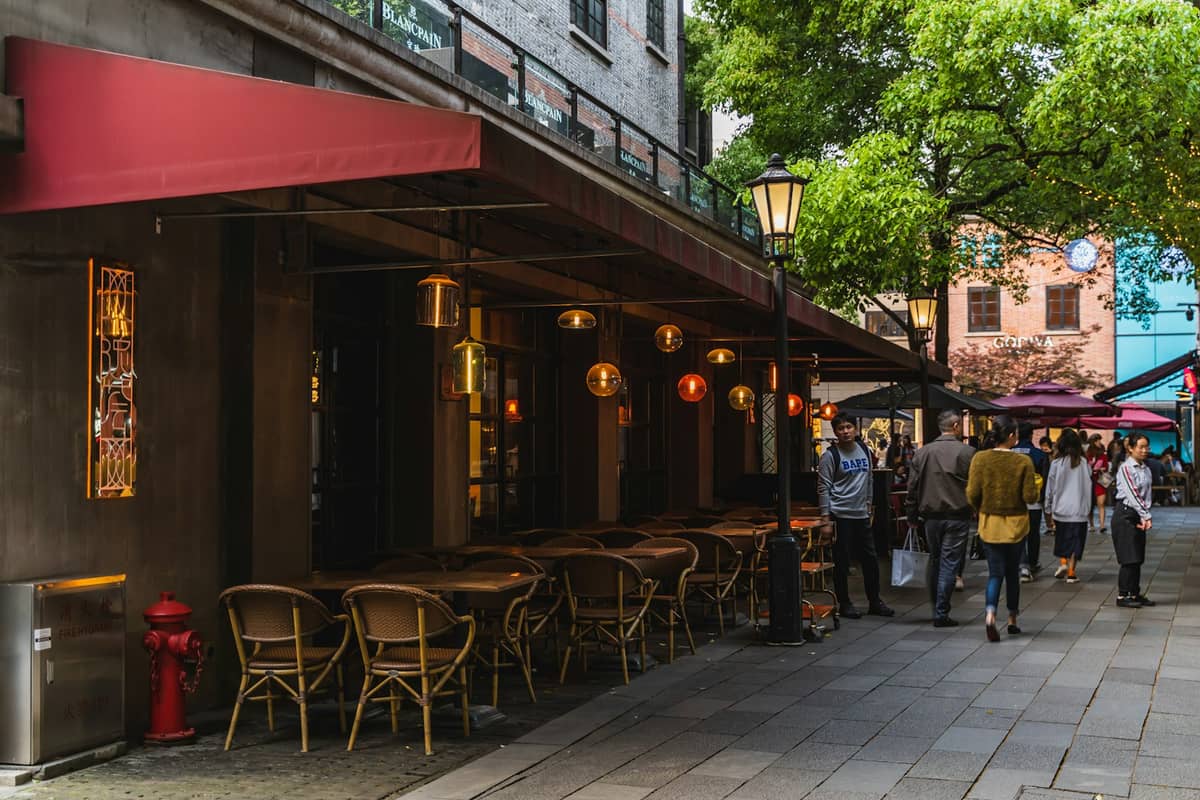
After dark the area shifts register entirely. The restaurants fill up, the bars on the upper floors of the shikumen houses turn on their ambient lighting, and the crowds that remain are there by choice rather than obligation. The stone-paved lanes stay lit and feel completely safe. Weekend nights, particularly Friday and Saturday from around 9pm onward, bring significant noise from the bars, which is worth factoring in if you are staying nearby.
Huaihai Road has a different rhythm. It functions as a genuine daily-use street for Shanghai residents, not just a tourist destination. In the mornings, commuters move briskly past the same luxury storefronts that attract window-shoppers in the afternoon. On weekend afternoons, particularly in spring and autumn, the pavement fills with young couples, families, and groups of teenagers treating the street as a social space rather than a transit route. The tree cover on parts of the road, combined with the mix of Art Deco and mid-century facades, gives it a different visual texture from the more exposed commercial boulevards elsewhere in the city. Huaihai Road rewards a slow, observational walk rather than a purposeful shop.
💡 Local tip
Visit the North Block of Xintiandi on a weekday morning before 9am if you want to photograph the shikumen facades without crowds. The light is best from the east, and the lanes are genuinely quiet at that hour.
What to See & Do
The shikumen lane houses of Xintiandi are the primary draw, and they justify the visit even if you find the surrounding retail polish a little too smooth. The North Block in particular preserves the original alleyway grid and several facade details that survived the development process: stone door frames, carved lintels, the narrow two-story structures that defined working-class and middle-class housing in early 20th-century Shanghai. Walking through here with some knowledge of what these buildings originally were adds depth to what might otherwise feel like an upscale shopping mall with atmospheric packaging. A short walk brings you to Xintiandi's historic blocks, which are free to enter and walk through.
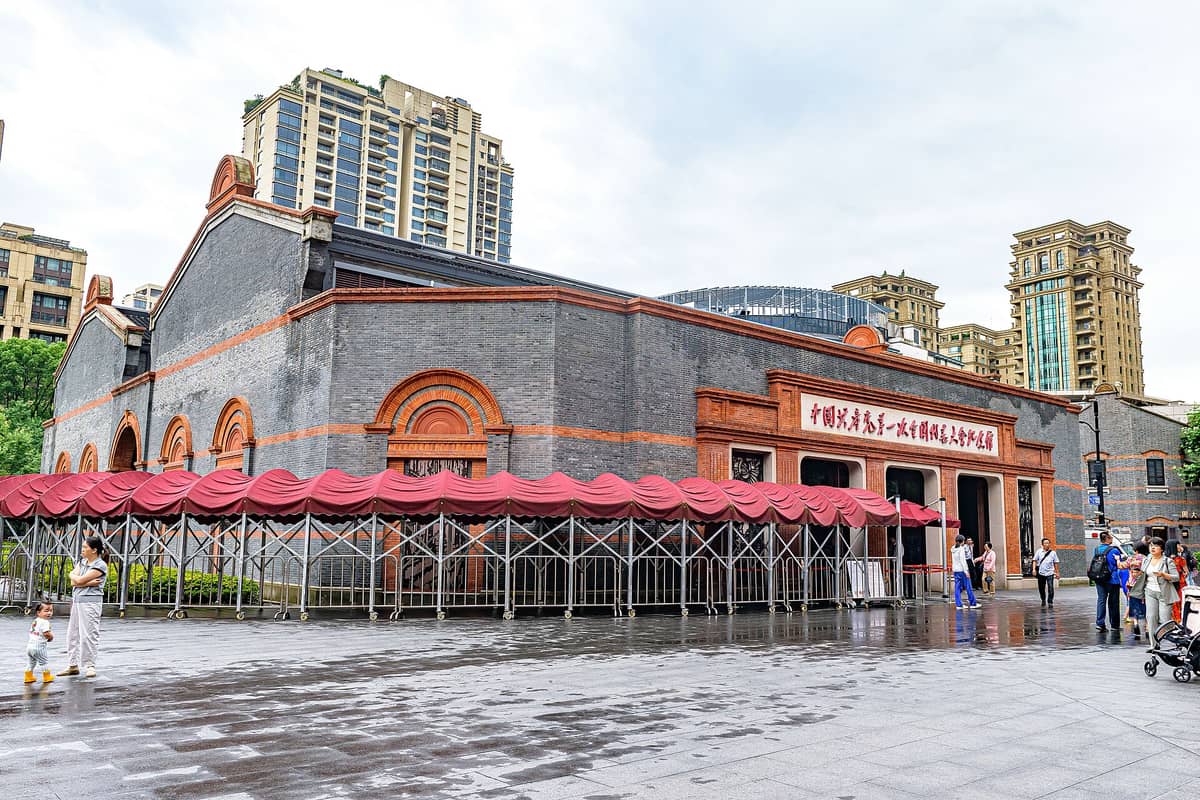
The Memorial of the First National Congress of the CPC sits on the edge of the Xintiandi development, on Xingye Road. This is where the Chinese Communist Party held its founding congress in July 1921, in a shikumen house that has been preserved and turned into a museum. It is a significant historical site regardless of your views on the politics, and the museum does a reasonable job of contextualizing early 20th-century Shanghai. Entry is free but requires ID registration.
A short walk south from Xintiandi, Sinan Mansions on Sinan Road offers a quieter version of the same restored-heritage-meets-upscale-hospitality concept. The block of 1920s European-style villas has been converted into hotels, restaurants, and event spaces, and it attracts far fewer day-trippers than Xintiandi while offering arguably more architecturally interesting buildings.
Further south, Fuxing Park provides a genuine green respite. Laid out in French formal garden style in 1909, it is one of the few parks in central Shanghai that still attracts mostly local residents rather than tourists. On weekend mornings you can watch groups practicing tai chi, couples walking dogs, and retirees playing cards under the plane trees. It borders the edge of the Former French Concession and makes a natural end point for a Xintiandi walk.
Xintiandi North Block: shikumen architecture, pedestrian lanes, free to enter
Memorial of the First National Congress of the CPC: key historical site on Xingye Road, free with ID
Sinan Mansions: restored 1920s villas, boutique hotels, quieter crowds
Fuxing Park: formal garden, local daily life, free entry
Huaihai Road window-shopping: Art Deco and mid-century building facades, luxury flagships, street-level urban energy
Eating & Drinking
The food and drink scene here is genuinely strong but prices run higher than most other parts of Shanghai. Xintiandi in particular has positioned itself as a destination for experience dining, and the rents in the shikumen blocks filter out all but the most commercially robust operators. That said, the quality ceiling is high, and on any given evening you can eat very well in cuisine ranging from Shanghainese to Italian to Japanese, often in beautifully restored interiors.
For local flavors, the area is a reasonable place to try proper Shanghainese cooking in a comfortable setting. Look for restaurants serving hong shao rou (red-braised pork), smoked fish, and lion's head meatballs. If you want to understand the city's dumplings tradition more broadly, the soup dumplings guide covers options across the city, including the neighborhoods surrounding this area.
The bars in Xintiandi's North Block range from large rooftop venues to small speakeasy-style spaces tucked into the upper floors of the lane houses. The rooftop options in particular get busy on weekend evenings from about 9pm and can be noisy until late. Along Huaihai Road, the mall food halls in IAPM and K11 offer a more affordable and eclectic range of options, useful for lunch or if you are traveling with people who cannot agree on a cuisine.
Coffee culture is well represented: several specialty coffee shops operate in and around the North Block, and the streets between Xintiandi and Fuxing Park have accumulated a cluster of independent cafes over the past decade. These tend to be quieter than the flagship venues inside the development, and some occupy lane house ground floors with courtyard seating in good weather.
ℹ️ Good to know
Budget travelers should know that the restaurants inside Xintiandi's pedestrian blocks are noticeably more expensive than comparable food a few streets away. Lunch mains in the Xintiandi core typically start at ¥120-180 per person; the same quality of food is available for ¥40-60 in the surrounding streets heading toward Fuxing Road.
Getting There & Around
The area is well served by two metro stations: Site of the First CPC National Congress · South Huangpi Road Station (Huangpi Nan Lu) drops you directly at the edge of Xintiandi on Lines 1 and 14, while South Shaanxi Road Station (Shaanxi Nan Lu) places you at the western end of the most interesting part of Huaihai Road on Lines 1, 10, and 12. Both stations are on Line 1, making this corridor easy to access from People's Square and Jing'an to the north, or from Xujiahui to the south. Line 10 also serves South Shaanxi Road Station, adding connections from Yuyuan Garden and the Old Town area.
From the Bund and Nanjing Road area, the most direct metro route is Line 2 to People's Square, then Line 1 south two stops to South Huangpi Road. The journey takes about 15-20 minutes depending on connections. Alternatively, it is a walkable 35-40 minutes from the Bund along routes that pass through the southern edge of the old concession grid, though the direct walking routes are not especially scenic. For a more interesting approach on foot, consult the best self-guided walks in Shanghai for a route that threads through the architecture between the Bund corridor and Xintiandi.
Within the neighborhood, walking is the only practical option for exploring Xintiandi itself; the pedestrian lanes are car-free by design. The wider area between Xintiandi and Fuxing Park, and down toward Sinan Mansions, is pleasant on foot and compact enough that most of the key points are within a 15-minute walk of each other. Taxis and Didi are easy to flag or book for onward journeys, particularly along Huaihai Road.
⚠️ What to skip
Avoid arriving by taxi or Didi directly to the Xintiandi pedestrian block on weekend evenings: the surrounding streets see significant congestion from around 7pm and you may spend longer in the car than expected. The South Huangpi Road metro exit is a 3-minute walk from the North Block entrance and is consistently faster on busy nights.
Where to Stay
This is one of the better-located areas in Shanghai for visitors who prioritize walkability and want to be close to the French Concession without committing to staying inside it. The where to stay in Shanghai guide covers the broader accommodation picture across all neighborhoods, but within this area the strongest case is for mid-range to luxury travelers who want to walk to restaurants and bars in the evening without relying on metro or taxis.
Several international hotel brands have properties on or immediately adjacent to Huaihai Road, with the blocks between South Huangpi Road and South Shaanxi Road offering the most central positions. Boutique options also exist in the Sinan Mansions development and in the converted lane house buildings on streets running south from Fuxing Road. These tend to book out quickly on weekends and around public holidays.
Budget accommodation is scarce in this specific area. Hostels and budget hotels cluster further north toward People's Square or west into Jing'an. If cost is a primary concern, staying a few metro stops away and visiting Xintiandi and Huaihai Road on a day or evening excursion makes more sense than paying a premium for proximity.
One practical consideration for couples or honeymoon travelers: this area consistently ranks among Shanghai's most atmospheric evening destinations, with the lit lane houses and the restaurant density creating a genuinely pleasant atmosphere after dark. The Shanghai for couples guide covers the broader romantic itinerary options, but Xintiandi and the surrounding streets make a natural base for that type of trip.
Honest Assessment: Is This Neighborhood For You?
Xintiandi is one of Shanghai's most visited areas for good reason: the architecture is genuinely attractive, the food and drink options are wide-ranging, and the pedestrian environment is comfortable. But it is also one of the more commercially polished neighborhoods in the city, and visitors looking for unmediated street life, cheap eats, or a sense of the ordinary rhythms of Shanghai will find it thin here. The shikumen are restored rather than lived-in, and the lane houses now contain the same international brands and concepts you could find in a dozen other cities.
Huaihai Road has more authentic urban energy, and the architecture along the tree-lined sections between South Shaanxi Road and South Huangpi Road gives it a character that Nanjing Road does not have. For shopping, the mix of domestic and international brands makes it a more interesting street to walk than most. For context on how shopping here fits into the broader city picture, the Shanghai shopping guide is worth reading before committing significant time to the area.
Safety is not a concern here beyond standard urban common sense. The area is well-lit, heavily trafficked, and has a significant police presence around the major intersections and the memorial site. Pickpocketing in crowded weekend lanes is the main practical risk, as it would be in any dense urban entertainment district.
TL;DR
Xintiandi's restored shikumen lane houses are the most architecturally distinctive part of the area and worth a morning visit, especially before the day crowds arrive.
Huaihai Road is one of Shanghai's best streets for a slow urban walk, combining genuine retail variety with interesting mid-century and Art Deco architecture.
Food and drink quality is high but prices are above the Shanghai average; budget travelers should eat on the surrounding streets rather than inside the Xintiandi development itself.
Transit access is excellent via Line 1 (South Huangpi Road and South Shaanxi Road stations), making this easy to combine with a Bund visit or a French Concession afternoon.
Best suited to: couples, first-time visitors to Shanghai, architecture enthusiasts, and anyone who wants a comfortable, walkable base with good evening dining options. Less suited to: budget travelers or those seeking unfiltered local street life.
Three days is enough to cover Shanghai's essential contrasts: colonial waterfront, modern skyscrapers, art deco lanes, and some of the best urban food in China. This itinerary is built around the metro, organized by geography to minimize backtracking, and clear about what's worth your limited time.
Shanghai has one of the most diverse museum scenes in Asia, spanning 5,000 years of Chinese civilization, cutting-edge contemporary art, and world-class science. This guide covers the best museums in Shanghai by category, with practical tips on what to expect at each.
Shanghai rewards photographers at every turn, from the world-famous Bund skyline to laneway cafés draped in plane tree shade. This guide covers the 20 best photo spots in Shanghai, with specific advice on timing, angles, and what makes each location worth the trip.
Shanghai rewards walkers more than almost any other megacity in Asia. From the colonial grandeur of the Bund promenade to the plane-tree canopy of the French Concession and the regenerated industrial banks of Suzhou Creek, these self-guided routes are free, fully walkable, and rich with architectural and cultural detail. This guide gives you the routes, the logistics, and the practical detail to make the most of them.
Shanghai's temples are active places of worship with centuries of history behind them, not museum pieces. This guide covers the best Buddhist, Taoist, and Confucian temples in the city, from a golden shrine flanked by luxury malls to a 1,700-year-old complex with Shanghai's oldest surviving pagoda.
Shanghai is a city you can visit year-round, but when you go shapes everything from what you wear to how much you pay. This guide breaks down every season, the crowds, the climate quirks, and the festivals so you can plan with confidence.
Shanghai has one of the world's most dramatic skylines, and the city delivers it from every angle: glass-floored observation decks above the clouds, riverside promenades facing twin horizons, and rooftop bars with unobstructed Bund vistas. This guide covers the best spots to see it all, whether you're chasing the perfect photo at dusk or looking for the highest point in China.
Shanghai sits at the heart of one of China's best high-speed rail networks, putting ancient canal towns, mountain lakes, and imperial gardens within easy reach. This guide covers the top day trips from Shanghai with real costs, transport logistics, and a clear view of what's worth the journey.
Shanghai is one of Asia's most spectacular cities, and a surprising amount of it costs nothing to experience. This guide covers the best free attractions, from iconic waterfronts and heritage walks to museums with free-entry days and parks that locals actually use.
Shanghai has one of the world's most extensive metro systems, official taxi tariffs, a record-breaking Maglev train, and two major international airports. This guide breaks down every transport option with real fares, journey times, and what actually works best for travelers.
Shanghai rewards the curious traveller who looks beyond the Bund and Yu Garden. From a 1930s slaughterhouse turned art labyrinth to a basement full of Cold War propaganda posters, these are the places locals treasure and guidebooks overlook.
Shanghai sits at the top tier of Asia's luxury city-break destinations, with world-class hotels lining the Bund, a Michelin-starred restaurant scene that rivals Paris and Tokyo, and a shopping landscape anchored by flagship boutiques and heritage malls. This guide cuts through the noise to tell you exactly where to stay, eat, and spend your time, and when to go to get the most out of it.
Shanghai contains one of the world's most layered architectural landscapes: 52 colonial-era buildings on the Bund, one of the largest surviving Art Deco collections outside New York, and a Lujiazui skyline that rewrote the rulebook on supertall towers. This guide breaks it all down by era, district, and visiting logic.
Chinese New Year transforms Shanghai into a city of red lanterns, temple fairs, and reunion dinners, but it also brings closures, surging prices, and the world's largest annual human migration. This guide covers everything visitors need to know before arriving during Spring Festival.
Shanghai has quietly become one of Asia's most compelling contemporary art cities, with a scene distributed across state museums, private foundations, converted industrial spaces, and laneway galleries. This guide covers the essential venues across the city, from the West Bund riverfront to Suzhou Creek and the Bund.
Shanghai's food streets and night markets range from centuries-old snack courts near the City God Temple to massive outdoor markets running until 2am on weekends. This guide breaks down every major venue by location, hours, transport links, and what to actually order — so you spend less time searching and more time eating.
Shanghai delivers romance at every budget, from candlelit Bund rooftops and Huangpu River night cruises to slow afternoons in the French Concession. This guide breaks down the best couple experiences with real pricing, seasonal tips, and a clear view of what's worth your time.
Shanghai's hairy crab season runs from late September to early December, with distinct peak windows for female and male crabs. This guide covers the best restaurants, realistic price ranges, authenticity warnings, and practical booking tips to make the most of one of China's most celebrated annual eating events.
Autumn is widely considered the best season to visit Shanghai, but the three months play out very differently. This guide breaks down weather, crowds, seasonal food, key events, and practical logistics for September, October, and November so you can plan the right trip at the right time.
Spring is one of the most rewarding times to visit Shanghai, but each month feels different. This guide breaks down the weather, crowds, cherry blossom timing, and practical tips for March, April, and May so you can plan with confidence.
Shanghai at night is a different city entirely. The Bund glows across the river, French Concession bars fill up past midnight, and underground clubs don't peak until 2am. This guide breaks down where to go, when to arrive, what to pay, and what to skip.
Shanghai noodles are not one dish but an entire culinary category spanning delicate scallion oil noodles, rich braised pork belly noodles, and luxurious seasonal crab roe noodles. This guide breaks down every style worth knowing, with realistic price ranges, seasonal notes, and practical ordering tips for first-timers and returning visitors alike.
Shanghai has a reputation as a global financial powerhouse, but day-to-day costs are far more manageable than most visitors expect. From ¥3 metro rides to free museum admissions and ¥15 noodle bowls, this guide breaks down exactly how to explore one of the world's great cities without burning through your money.
Shanghai is one of Asia's safest major cities for tourists, but petty theft, overcharging, and a handful of persistent scams do catch visitors off guard. This guide breaks down exactly what to watch for, how to get around safely, and what to do if something goes wrong.
Shanghai is one of Asia's great shopping cities, with options ranging from luxury flagship stores and slick megamalls to fabric markets where tailors cut custom suits for a fraction of Western prices. This guide breaks down the best areas, what to expect, and how to avoid the traps.
Xiaolongbao are Shanghai's most iconic bite — thin-skinned, broth-filled, and deceptively tricky to eat without burning yourself. This guide covers where to find the best versions across the city, what to order by season, how much to pay, and the rookie mistakes that will ruin your first basket.
Shanghai is a city of 24.8 million people, 20 metro lines, and a learning curve that catches most first-timers off guard. This guide cuts through the noise with practical, specific advice on getting around, choosing the right season, understanding the neighborhoods, and avoiding the mistakes that waste your time and money.
Four ancient water towns sit within day-trip distance of Shanghai, each with a different character, price point, and crowd level. This guide cuts through the confusion with specific transport details, current ticket prices, and a ranking to help you choose the right one for your trip.
Shanghai rewards family travel more than most cities its size. From the immersive lands of Shanghai Disneyland to the dinosaur halls of the Natural History Museum, this guide covers the best activities for kids of all ages, when to visit, how to get around with children, and what to skip.
Shanghai is one of the most layered cities on earth, where Art Deco waterfront architecture stands opposite a forest of supertall skyscrapers, and century-old tea houses sit a short metro ride from world-class contemporary art museums. This guide covers the best things to do in Shanghai, organized by theme and neighborhood, with a clear view of what's worth your time and what to skip.
Shanghai cuisine is one of China's most distinct regional food traditions, built around sweetness, umami, and precision technique. This guide covers the dishes you should not leave without trying, where to find them, what to pay, and how to eat like someone who actually lives here.
Choosing where to stay in Shanghai shapes your entire trip. This guide breaks down the city's key neighborhoods by location, metro access, price range, and who each area suits best, so you can book with confidence.