Memorial of the First CPC National Congress: Where Modern China Began
On a quiet lane in Xintiandi, a preserved shikumen townhouse marks the spot where 13 delegates convened in July 1921 to found the Chinese Communist Party. Today the site and its adjoining modern exhibition hall form one of Shanghai's most historically significant free attractions.
Quick Facts
- Location
- No. 76 Xingye Road (former site) & No. 374 South Huangpi Road (memorial hall), Huangpu District, Shanghai
- Getting There
- Metro Line 10/13: Site of the First CPC National Congress · Xintiandi Station; Metro Line 1/14: Site of the First CPC National Congress · South Huangpi Road Station — both under 5 min walk
- Time Needed
- 1.5 to 2.5 hours for both buildings
- Cost
- Free (passport/ID required; advance reservation recommended; daily visitor quota applies)
- Best for
- History enthusiasts, architecture lovers, travellers seeking context on modern China
- Official website
- www.zgyd1921.com/en/about-us.html
What This Place Actually Is
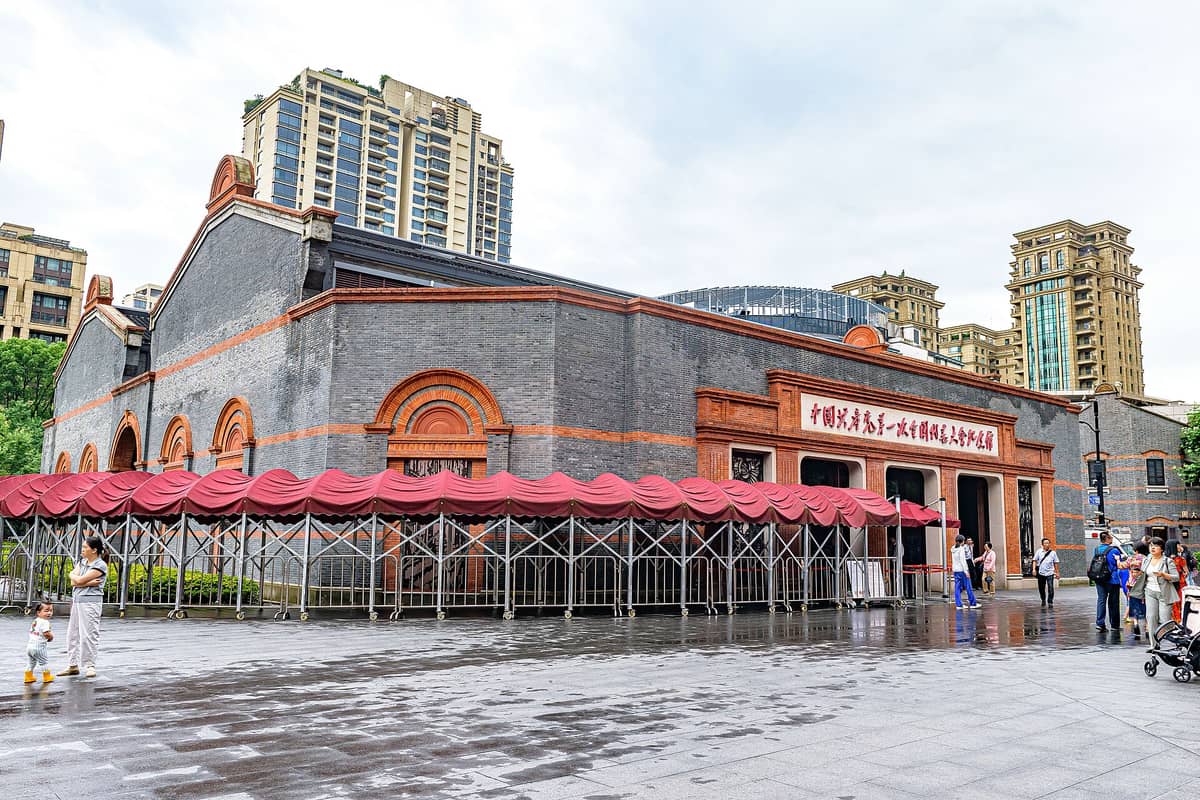
The Memorial Hall of the First National Congress of the Communist Party of China occupies two distinct structures in close proximity on Xingye Road and South Huangpi Road in Huangpu District. The first is the original 1920 shikumen building at No. 76 Xingye Road, where delegates met in secret in July 1921. The second is a purpose-built modern exhibition hall at No. 374 South Huangpi Road, which opened ahead of the Party’s centenary. Together they create a layered experience: the intimacy of the original room preserved behind glass, and the scale of a contemporary museum that contextualises why this gathering mattered.
Visitors expecting a dusty party shrine will be surprised. The new hall is architecturally ambitious, with generous ceiling heights, well-lit display cases, multilingual panels, and a curatorial approach that places the 1921 congress within the broader sweep of Republican-era Shanghai and global political history. For travellers trying to understand how the country they are moving through came to be, this is one of the clearest starting points in the city.
💡 Local tip
Admission is free but a daily visitor quota applies. Bring your passport — real-name registration is required and walk-in entry is not always guaranteed during peak periods, especially around national holidays and the July 1 anniversary of the Party's founding. Check the official website for the current reservation process before visiting.
The Original Building: Shikumen Architecture and a Secret Meeting
The building at No. 76 Xingye Road is a shikumen (stone-gate) townhouse, a hybrid residential form unique to early 20th-century Shanghai that blended European terraced-house layouts with Chinese courtyard proportions. Built in late 1920, the structure is low, dark-brick, and compact, typical of the lane-house neighbourhoods that once defined the city's former French Concession. Walking through the stone gate into the narrow entrance passage gives an immediate physical sense of secrecy: this was a residential street where a small group could gather without drawing attention.
The meeting room itself has been restored to approximate its 1921 appearance, with a long wooden table, chairs, teacups, and windows that let in only moderate natural light. There are no dramatic theatrical effects. The restraint is the point. Thirteen delegates representing 53 Party members across China sat here and drafted a founding programme over several days. The congress was interrupted by a police agent on the final day and the last session was relocated to a boat on South Lake in Jiaxing, Zhejiang Province.
The surrounding Xintiandi blocks give useful visual context: the rest of the original lane network has been converted into the upscale retail and dining precinct known as Xintiandi, where the same shikumen facades now house boutiques and restaurants. The contrast between the preserved meeting site and the commercialised surroundings is itself a kind of exhibit, and worth sitting with for a moment before moving to the exhibition hall.
The shikumen form appears throughout the neighbourhood and across the former French Concession more broadly. If the architecture interests you, the Shanghai architecture guide covers the full range of building types concentrated in this part of the city.
Tickets & tours
Hand-picked options from our booking partner. Prices are indicative; availability and final rates are confirmed when you complete your booking.
Shanghai city and Zhujiajiao water town private tour with lunch
From 371 €Instant confirmationFree cancellationShanghai private tour with iconic landmarks of the old and new city
From 284 €Instant confirmationFree cancellationShangai Yuyuan Garden entrance tickets
From 9 €Instant confirmationFree cancellation
The New Exhibition Hall: Scale, Chronology, and Craft
Cross South Huangpi Road and the experience shifts register entirely. The 2021 exhibition hall at No. 374 is a large, climate-controlled space of about 3,700 square metres with a permanent collection arranged chronologically. It covers the social and intellectual conditions in late Qing and Republican China that made the 1921 congress possible, the lives of individual delegates, the early years of Party organisation, and the decades leading to 1949. There are original documents, photographs, period newspapers, replica installations, and multimedia displays.
Allow at least 75 minutes here if you intend to read the panels carefully. The English translations are thorough, if occasionally formal in phrasing. Photography is permitted in most areas without flash. The hall is busiest mid-morning on weekdays and throughout the day on weekends; the atmosphere is noticeably more reflective in the early afternoon on quieter days, when school groups and tour parties have often moved on.
ℹ️ Good to know
The exhibition hall and the former site building are separate structures on opposite sides of South Huangpi Road. Factor in a few minutes to walk between them. Many visitors begin at the modern hall for historical context, then cross to the original building — that order tends to make the restored room feel more resonant.
When to Visit and How It Changes by Time of Day
Opening hours are 09:00 to 17:00, with last admission around 16:30. The site is closed on Mondays, except when Monday falls on a public holiday. Arriving at 09:00 gives you the calmest conditions: the original building in particular feels genuinely still in the first hour, before group tours arrive and the room becomes crowded around the narrow viewing barriers. By 10:30 on weekends it can feel congested.
The exterior lane at Xingye Road photographs best in morning light, when the brick facade catches direct sun from the east and the narrow alley is relatively empty. Afternoon light is flat on the south-facing gate. If photography is a priority, morning is the clear preference. The surrounding Xintiandi area is open around the clock, so arriving early means you can combine the memorial with a quieter walk through the lanes before the restaurants open for lunch.
The best time to visit Shanghai in terms of weather is broadly April to May and October to November. Both periods are comfortable for the short walks between buildings and the surrounding Xintiandi lanes. Summer visits (June to August) are feasible but hot and humid; the air-conditioned exhibition hall becomes a practical relief as much as a cultural draw.
Getting There and Practical Logistics
The site is straightforward to reach by metro. Metro Lines 10 and 13 stop at Site of the First CPC National Congress · Xintiandi Station, which puts you within a short walk of the Xingye Road entrance. Metro Lines 1 and 14 stop at Site of the First CPC National Congress · South Huangpi Road Station, which is closer to the exhibition hall entrance. Both walks take under five minutes and are flat and well-signed. Taxis and ride-hailing apps (Didi) can drop off on South Huangpi Road.
Passport or national ID is required for entry registration. If you have not reserved in advance and the daily quota has been reached, entry will be refused. During the weeks around 1 July (the anniversary of the Party's founding) and Golden Week (early October), demand spikes significantly and advance booking is strongly recommended. On ordinary weekday mornings outside those windows, walk-ins have generally been accommodated, though the official process varies.
Accessibility information for the site is limited in publicly available sources. The surrounding area is flat and paved, making it manageable for most mobility needs, but visitors requiring specific assistance should contact the memorial directly before their visit to confirm arrangements.
The Surrounding Area: Xintiandi and the Former French Concession
The memorial sits at the edge of Xintiandi, the pedestrian precinct developed in the early 2000s from the same shikumen lane fabric as the congress building itself. The contrast is stark and not uninteresting: restored stone-gate facades now front wine bars, coffee shops, and international restaurants, with the preserved political site sitting among them. Whether you find this juxtaposition discordant or genuinely thought-provoking depends on your expectations.
Walking south or west from the memorial takes you deeper into the Former French Concession, one of Shanghai's most architecturally layered neighbourhoods. The streets shift from brick lanes to plane-tree canopies within a few blocks, and the density of prewar residential architecture is high. It is one of the better walking areas in central Shanghai, and combining the memorial with a self-guided wander through the surrounding streets uses a morning well.
Sinan Mansions, a preserved cluster of Republican-era villas converted into boutique hotels and cultural spaces, is a short walk south. Fuxing Park is also within easy reach and worth a detour, especially on weekend mornings when locals gather for tai chi, ballroom dancing, and card games.
Who This Attraction Suits and Who It Does Not
The Memorial of the First CPC National Congress rewards visitors who arrive with some prior reading on Republican China, the political conditions of the 1920s, or the early history of the Chinese Communist Party. The exhibition hall provides context, but it works best as reinforcement rather than introduction. If you have no interest in political history and are visiting Shanghai primarily for food, design, or skyline experiences, this is unlikely to feel compelling enough to justify the time.
Travellers on a tight schedule who have already visited the Shanghai History Museum or one of the city's other major historical collections may find the thematic overlap significant. That said, the specific focus here, the physical space where a particular event occurred, offers something no general history museum can replicate. For those who care about the question of origins, there is genuine weight to standing in a room this small and thinking about what followed from it.
Insider Tips
- Visit the exhibition hall first, then cross to the original building. The chronological displays provide a frame that makes the restored meeting room feel significantly more affecting than it would on a cold visit.
- The lane outside No. 76 Xingye Road is narrow and becomes difficult to photograph without people in frame once tour groups arrive, usually from around 10:00 onward. If you want a clear shot of the stone gate, arrive at opening time.
- Closed Mondays (except when Monday is a public holiday): many visitors discover this after arriving. If your schedule is tight, lock in a Tuesday through Sunday morning visit and book in advance through the official website.
- The area immediately around Xintiandi has some of Shanghai's better cafe options for a post-visit coffee. Prices are elevated compared with the rest of the city, but the outdoor seating in the lane sections is pleasant in mild weather.
- If you are visiting in the week leading up to or following 1 July, expect significantly higher crowds, additional security procedures, and potentially stricter entry management. The site takes on a different atmosphere during this period, with organised political visits common.
Who Is Memorial of the First CPC National Congress For?
- Travellers interested in 20th-century Chinese political history
- Architecture enthusiasts studying shikumen residential forms
- First-time visitors to Shanghai wanting foundational context for modern China
- Visitors combining a cultural morning with a walk through the Former French Concession
- Budget-conscious travellers: free entry with real substance
Nearby Attractions
Other things to see while in Xintiandi & Huaihai:
- Huaihai Road
Once the grand Avenue Joffre of the French Concession, Huaihai Middle Road stretches roughly 5.5 kilometres through central Shanghai as a layered mix of international brands, indie cafes, plane-tree canopy, and century-old lane houses. Free to walk, endlessly browsable, and genuinely different at 10am versus 9pm.
- Xintiandi
Xintiandi is a pedestrian district in Huangpu built from restored 1920s shikumen (stone-gate) townhouses, now home to international restaurants, boutiques, bars, and the site of the First National Congress of the Chinese Communist Party. Entry to the lanes is free. The experience ranges from quiet morning coffee to a lively after-dark bar scene.