Xintiandi, Shanghai: The Shikumen District That Reinvented Itself
Xintiandi is a pedestrian district in Huangpu built from restored 1920s shikumen (stone-gate) townhouses, now home to international restaurants, boutiques, bars, and the site of the First National Congress of the Chinese Communist Party. Entry to the lanes is free. The experience ranges from quiet morning coffee to a lively after-dark bar scene.
Quick Facts
- Location
- Lane 181, Taicang Road, Huangpu District, Shanghai
- Getting There
- Metro Line 10 or Line 13 – Xintiandi Station (Exit 1 or 6)
- Time Needed
- 1.5 to 3 hours for a full walk, dining, and one museum stop
- Cost
- Free to enter the lanes; restaurants and bars priced at premium Shanghai rates
- Best for
- Architecture lovers, evening dining, couples, first-time visitors to Shanghai
- Official website
- www.xintiandi.com/en/project/xintiandi-shanghai
What Xintiandi Actually Is
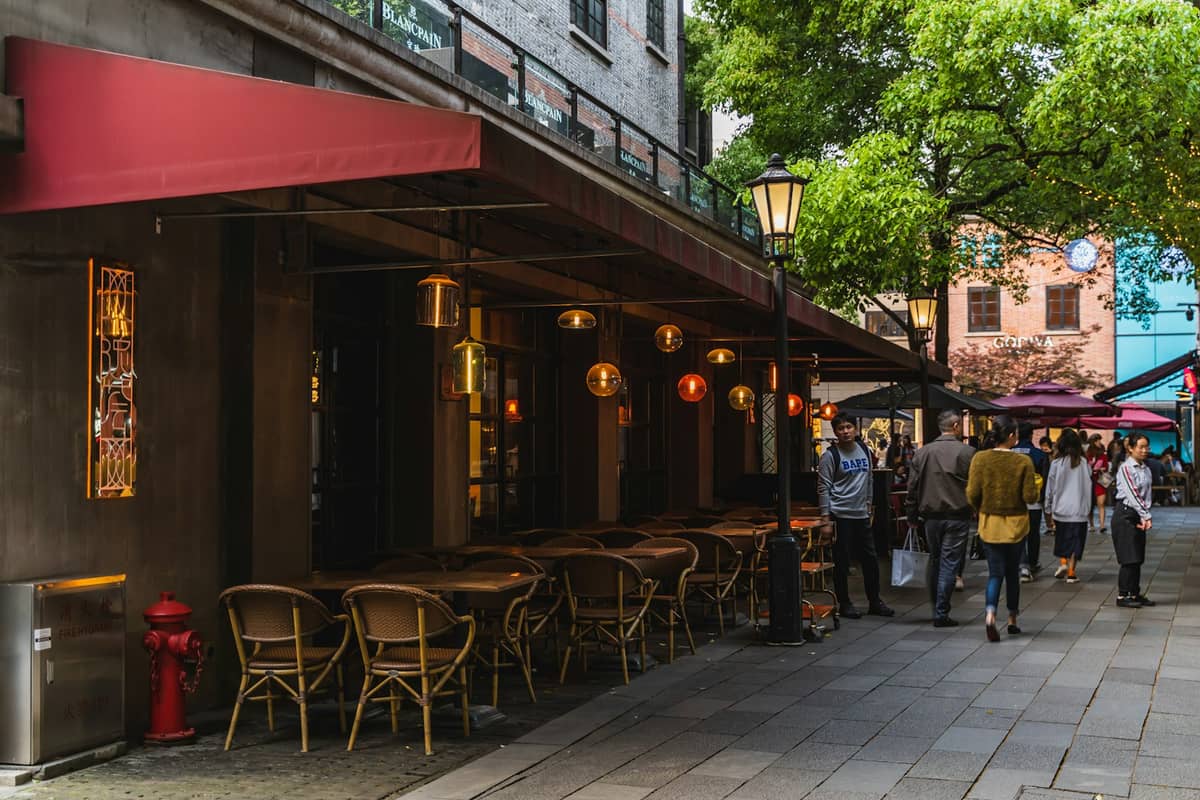
Shanghai Xintiandi (上海新天地) is a pedestrianized heritage district in Huangpu, built on the bones of a shikumen neighborhood that once housed ordinary Shanghainese families. Shikumen, meaning 'stone-gate house', is a residential style unique to Shanghai: terraced grey brick structures arranged along narrow stone lanes, with tall gate frames and internal courtyards that blend southern Chinese and Western terraced-house forms. The typology emerged in the late 19th century and defined how most urban Shanghai residents lived through the first half of the 20th century.
The redevelopment completed in the early 2000s was controversial. Hundreds of families were relocated, and the original building fabric was essentially gutted and rebuilt to modern structural standards behind preserved facades. What you walk through today is not a living historical neighborhood in the way that pockets of the Former French Concession still are. The lanes are clean, the stones are even, and the crowds on weekend evenings are thick. That said, the architectural detail at eye level is genuinely impressive: carved lintels, heavy timber gate frames, rough-textured exterior brick, and interior courtyards that slow the pace down even on busy afternoons.
ℹ️ Good to know
Xintiandi divides into a North Block (Taicang Road side, heavier on restaurants and the CPC museum) and a South Block (more retail and the indoor Xintiandi Style mall). The open-air North Block is where most visitors spend the majority of their time.
For historical context on why shikumen architecture matters in Shanghai's urban story, the Shanghai architecture guide covers the full timeline from treaty-port construction to contemporary towers.
The Site of the First National Congress of the CPC
Within the North Block sits one of the more historically significant addresses in modern Chinese history. The building at 76 Xingye Road was where the First National Congress of the Chinese Communist Party was held in July 1921, before the delegates relocated to a boat on Nanhu Lake in Jiaxing after being discovered by police. The building has been preserved and converted into a museum.
The Memorial of the First National Congress of the CPC is formally a separate attraction but is located directly within the Xintiandi footprint. Entry is free but timed reservations are often required. The exhibits are detailed, with English labeling, and the reconstructed meeting room gives a concrete sense of the scale and secrecy of that founding moment. Allow 30 to 45 minutes if you plan to go inside.
Tickets & tours
Hand-picked options from our booking partner. Prices are indicative; availability and final rates are confirmed when you complete your booking.
Shanghai city and Zhujiajiao water town private tour with lunch
From 371 €Instant confirmationFree cancellationShanghai private tour with iconic landmarks of the old and new city
From 284 €Instant confirmationFree cancellationShangai Yuyuan Garden entrance tickets
From 9 €Instant confirmationFree cancellation
How the Experience Changes Through the Day
Morning is the most underrated time to visit Xintiandi. Before 10:00, the lanes are quiet enough that you can actually hear your footsteps on the stone paving. The light comes in low and sideways between the brick facades, making the texture of the old walls far more visible than in the flat midday glare. A few cafes open early. The air at this hour carries a faint smell of damp stone, which disappears entirely once foot traffic and food preparation kick in.
By midday the district fills with office workers from surrounding Huangpu, tourists with guided groups, and shoppers moving between the open-air North Block and the air-conditioned South Block. The lanes can feel crowded but not overwhelmingly so on weekdays. Weekends between noon and 15:00 are the busiest window, particularly around the more photogenic lane junctions and in front of the CPC Congress building, where visitors line up for photos.
Evening is when Xintiandi shifts character most noticeably. The restaurant and bar crowd takes over after 18:00, with outdoor seating spilling into the lanes at warmer times of year. The stone-gate buildings are lit softly from below, which gives the grey brick an amber warmth that reads very differently from the daytime palette. If you are here for the architecture and the calm, come in the morning. If you are here for dinner and a drink in a setting that earns its atmosphere, evening works well.
💡 Local tip
Photography tip: The junction between North Block lanes around Lane 181 catches the best structural light on clear mornings between 08:00 and 10:00. At dusk, the warm uplighting on the brick facades creates very different shots. Midday delivers the flattest, harshest light.
Getting There and Getting Around
Metro Line 10 and Line 13 both serve Xintiandi Station, with Exit 1 or 6 bringing you directly into the district's northern edge. The walk from the exit to the first set of shikumen lanes takes under two minutes. Coming from The Bund or People's Square, Line 10 is the most direct option. From Jing'an Temple, Line 13 runs without transfer.
Xintiandi sits on the northern edge of the Xuhui administrative border, close to the Former French Concession. The two areas connect naturally on foot: from the South Block, a 10 to 15 minute walk south along Madang Road or Ruijin Er Road reaches the quieter residential streets of the Concession. Combining the two into one afternoon is a logical and satisfying route.
The lanes themselves are flat and broad enough for wheelchairs and strollers. There are no steps between the main pedestrian sections of the North Block. The South Block mall has elevators throughout. The ground surfaces are traditional stone paving: not rough, but not the smoothest surface for rolling luggage. Dress for the weather, since both blocks are predominantly open-air and there is limited shelter from rain.
Eating and Drinking at Xintiandi
Xintiandi's food and drink scene is extensive and consistently priced at the premium end of Shanghai's market. You will find everything from Cantonese dim sum to Japanese omakase to upscale Shanghainese cuisine to European brasserie formats. Several well-regarded international restaurant groups have flagship or early Shanghai locations here. Outdoor terrace seating, particularly in the North Block, fills quickly on Friday and Saturday evenings, so reservations for dinner are practical if you have a specific venue in mind.
This is not a neighborhood for budget eating. A coffee at one of the specialty cafes runs from ¥35 to ¥65. A meal for two at a mid-range restaurant in the district typically costs ¥300 to ¥600, more at higher-end venues. If you want to eat well but not at Xintiandi prices, the surrounding streets of Huangpu have more local options within a short walk. The district rewards you with setting and service. It charges accordingly.
For a broader picture of where to eat around the neighborhood, the what to eat in Shanghai guide covers the city's essential dishes and where to find them across different price levels.
Honest Assessment: Is It Worth Your Time?
Xintiandi gets a mixed reputation among experienced Shanghai travelers, and that reaction is understandable. If you arrive expecting a preserved historical neighborhood, you will notice immediately that the patina is largely reconstructed. The shikumen aesthetic is real, but the context is entirely commercial. There are no residents hanging laundry, no local corner stores, no everyday Shanghai life visible through the gates.
What Xintiandi does deliver is a high-quality pedestrian environment built around a genuinely distinctive architectural style, with serious food options and a good evening atmosphere. For first-time visitors to Shanghai who want to see what shikumen architecture looks like without walking through less tourist-ready neighborhoods, it is a reasonable orientation point. The CPC Congress Museum adds real historical substance. And as a dinner-then-drinks destination, the setting is hard to fault.
Travelers who want to see shikumen in a less curated form should consider walking the lanes around Tianzifang in the Former French Concession, where the commercial overlay is lighter and the feel closer to a neighborhood that still functions as one.
⚠️ What to skip
Who should skip: Travelers on a tight budget will find Xintiandi frustrating, as almost every lane-facing business is priced for expense-account visitors. Travelers who prioritize authenticity over presentation may prefer the French Concession streets to the south. On rainy days, the open-air North Block loses much of its appeal.
Seasonal Considerations
Spring (April to May) and autumn (October to November) are the most comfortable seasons for walking Xintiandi's outdoor lanes. Temperatures sit in the 15 to 22°C range, humidity is lower than summer, and the light is pleasant. Summer visits between June and August involve heat above 30°C and high humidity; the air-conditioned South Block becomes more appealing and the outdoor lanes feel less comfortable by midday. Shanghai's plum rain season in June to early July can bring consecutive days of drizzle, which turns the stone lanes slick and reduces visibility for photography.
For a full breakdown of seasonal conditions across Shanghai, the best time to visit Shanghai guide covers weather patterns, crowds, and key seasonal events.
Insider Tips
- The North Block lanes are openly accessible at all hours, even when shops are closed. An early morning walk between 07:30 and 09:00 on a weekday gives you nearly empty lanes with good photographic light and none of the weekend crowds.
- For the Memorial of the First National Congress, check whether timed real-name entry reservations are required before you arrive. Walk-in entry is not always guaranteed on busy weekends or public holidays, and reservations are made via the venue's official WeChat account and WeChat mini-program.
- The South Block connects via an underground passage to Xintiandi Style mall, which provides useful shelter on wet days and has additional food court options at lower prices than the lane-facing restaurants.
- Xintiandi sits at the edge of a walkable cluster: Sinan Mansions is about 10 minutes east on foot, and the Former French Concession tree-lined streets begin just south of the South Block. Building either into a wider afternoon loop avoids doubling back on the Metro.
- Outdoor lane-side seating at bars and restaurants on warm Friday evenings fills before 19:30. If you want a specific terrace table, arrive early or reserve. The inside of most venues has less atmosphere than the open-air sections.
Who Is Xintiandi For?
- First-time visitors to Shanghai who want an accessible, walkable introduction to shikumen architecture
- Couples looking for a dinner and evening drinks setting with genuine architectural backdrop
- History travelers combining a visit with the Memorial of the First National Congress
- Architecture enthusiasts interested in the shikumen typology and its 20th-century context
- Visitors who want high-quality international dining in a pleasant outdoor setting
Nearby Attractions
Other things to see while in Xintiandi & Huaihai:
- Huaihai Road
Once the grand Avenue Joffre of the French Concession, Huaihai Middle Road stretches roughly 5.5 kilometres through central Shanghai as a layered mix of international brands, indie cafes, plane-tree canopy, and century-old lane houses. Free to walk, endlessly browsable, and genuinely different at 10am versus 9pm.
- Memorial of the First CPC National Congress
On a quiet lane in Xintiandi, a preserved shikumen townhouse marks the spot where 13 delegates convened in July 1921 to found the Chinese Communist Party. Today the site and its adjoining modern exhibition hall form one of Shanghai's most historically significant free attractions.