Sinan Mansions: Shanghai's Finest Preserved Villa District
Sinan Mansions is a restored early 20th-century garden villa compound in the heart of the Former French Concession. Free to enter and with its outdoor streets accessible at all hours, it combines architectural heritage, leafy pedestrian streets, and a curated mix of cafes, galleries, and boutiques within one of Shanghai's most atmospheric historic neighborhoods.
Quick Facts
- Location
- No. 523 Fuxing Middle Road, Huangpu District, Shanghai (also accessed via Sinan Road)
- Getting There
- Metro Line 10 or 13 to Site of the First CPC National Congress · Xintiandi Station (Exit 5), then approx. 10–15-min walk; or Line 1 to South Shaanxi Road Station with a slightly longer walk
- Time Needed
- 1 to 2 hours for a relaxed walk; longer if visiting nearby former residences or stopping to eat
- Cost
- Free entry to the outdoor compound; some exhibitions and special events may require separate tickets, while nearby historic residences currently offer free entry with ID registration.
- Best for
- Architecture lovers, history enthusiasts, photography, slow-travel exploration, cafe culture
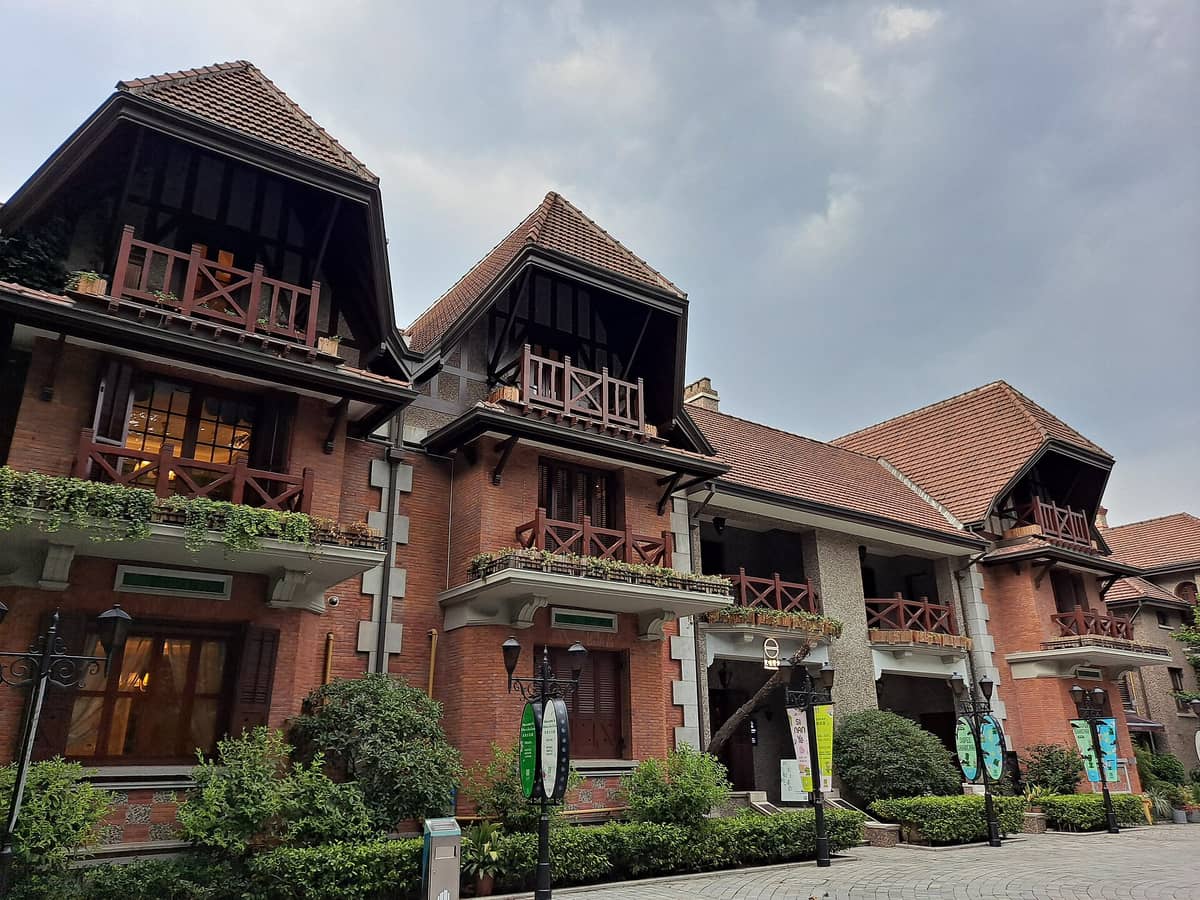
What Sinan Mansions Actually Is
Sinan Mansions is a preserved cluster of early 20th-century European-style garden villas that once served as private residences during Shanghai's concession era. Today the compound functions as an open urban district: pedestrian streets loop through restored two- and three-story villas in a mix of French Renaissance, Tudor, and Spanish Colonial styles, with plane trees arching overhead and low perimeter walls that give the entire area a residential scale rarely found this close to central Shanghai.
The Chinese name, 思南公馆 (Sīnán Gōngguǎn), translates roughly as 'Sinan Residence' and reflects the compound's origins as a deliberate preservation project rather than an organic neighborhood. In the 2000s, the Shanghai municipal government undertook a large-scale restoration of dozens of historic villas in this block, converting them into a mixed-use heritage district while retaining the low-rise street character. The result is something between an outdoor architecture museum and a working commercial street, with the outdoor lanes freely accessible day and night.
ℹ️ Good to know
The outdoor compound and streets are open 24 hours year-round with no ticket required. Individual restaurants, shops, hotels, and galleries inside the villas operate their own hours, typically daytime through evening. The on-site Sinan Time Zone gallery, for example, opens Tuesday to Friday 13:00–19:00 and weekends 11:00–19:00, with free entry.
The Architecture: What You're Actually Looking At
The villas at Sinan Mansions were built primarily in the 1920s and 1930s when the surrounding area formed part of the French Concession, an extraterritorial zone administered by France from 1849 until 1943. Unlike the neoclassical grandeur of the Bund's banking facades, the architecture here is domestic in scale: steeply pitched roofs, shuttered windows, wraparound porches, iron balcony railings, and gardens squeezed between the buildings. Walking the main pedestrian spine of Sinan Road, the visual rhythm alternates between cream-colored render and warm brick, with occasional bursts of dark timber framing.
For travelers interested in the broader story of Shanghai's architectural layers, the Shanghai architecture guide provides useful context on how the concession-era building typologies relate to the city's other surviving historic districts.
Several of the compound's villas carry genuine historical weight beyond their aesthetic appeal. The neighborhood sits adjacent to the former residence of Sun Yat-sen and a house associated with Zhou Enlai, both of which can be visited separately and currently offer free entry for specific interiors with ID registration. Sinan Mansions itself is often described as an 'outdoor museum' of Shanghai's residential past, though the renovations are thorough enough that the surfaces feel fresh rather than weathered. That polish is either a virtue or a limitation depending on what you're looking for.
Tickets & tours
Hand-picked options from our booking partner. Prices are indicative; availability and final rates are confirmed when you complete your booking.
Shanghai city and Zhujiajiao water town private tour with lunch
From 371 €Instant confirmationFree cancellationShanghai private tour with iconic landmarks of the old and new city
From 284 €Instant confirmationFree cancellationShangai Yuyuan Garden entrance tickets
From 9 €Instant confirmationFree cancellation
How the Atmosphere Changes Through the Day
Early mornings, before 9:00, the compound is nearly deserted. The plane tree canopy filters low light onto the empty streets, and the only sounds are birdsong and the occasional delivery vehicle. This is the best window for photography without people in frame, and the quality of morning light on the villa facades is notably different from the flat midday conditions. The smells at this hour are of damp pavement and garden soil, occasionally cut by coffee from a cafe setting up inside one of the ground-floor villas.
By mid-morning, weekday crowds build gradually: mostly local professionals on lunch breaks, hotel guests from the on-site boutique properties, and some tourists. Weekend afternoons bring significantly more foot traffic, particularly along the cafe-lined sections where tables spill onto the pedestrian lanes. The compound never gets as congested as nearby Xintiandi, which sits about ten minutes' walk to the north, partly because Sinan Mansions has less retail density and its layout across several blocks naturally disperses visitors.
Evening has its own character. Warm lighting inside the villa windows and string lights along some of the exterior corridors give the streets a low-key atmosphere suited to a slow post-dinner walk. The restaurants and bars within the compound draw a local crowd in the evenings, and the noise level rises noticeably after 20:00 near the dining venues, while the quieter villa lanes remain calm. On public holidays and during spring and autumn weekends, small outdoor events and pop-up markets have occasionally been hosted on the central lawn areas, though these are not regular fixtures.
Navigating the Compound
Sinan Mansions is spread across several city blocks rather than enclosed within a single gate, so the entry experience is gradual: you simply walk in from Fuxing Middle Road, Sinan Road, or adjacent lanes. There is no formal reception area, no map distributed at an entrance, and no guided tour infrastructure built into the site itself. Orientation comes from wandering, which suits the place well.
The main pedestrian zone along Sinan Road forms the commercial core, with restaurants, cafes, and boutiques occupying the villa ground floors. Side lanes reveal quieter villas that have been converted into boutique hotels or corporate offices; some of these are accessible to look at from the street but not to enter without a booking or appointment. The gardens between buildings are mostly open and offer good views of the villa proportions from a short distance.
💡 Local tip
Street numbers in this area can be confusing. The compound is commonly referenced as starting around No. 51–61 Sinan Road and also at No. 523 Fuxing Middle Road. Both are valid access points. If you are coming from the metro, walking south from Site of the First CPC National Congress · Xintiandi Station along Sinan Road puts you at the heart of the compound within about ten minutes.
The surrounding Former French Concession streets are worth exploring beyond the immediate compound. The Wukang Road heritage corridor and Fuxing Park are both within comfortable walking distance and extend the architectural and green-space experience without requiring additional transport.
Historical Context: Why This Block Matters
The Former French Concession produced a distinct residential typology in Shanghai: private villas with enclosed gardens, set back from the street behind gates and low walls, built for foreign residents and wealthy Chinese families who sought European-style domesticity in a dense Chinese city. Sinan Mansions represents one of the more intact clusters of this type to survive the urban redevelopment pressures of the late 20th century. Many comparable blocks in Xuhui and Huangpu were demolished or altered beyond recognition.
The proximity to historically significant addresses adds another layer. The Former Residence of Sun Yat-sen, located nearby on Xiangshan Road, and a residence associated with Zhou Enlai on Sinan Road itself, place the compound within a stretch of the city that shaped early 20th-century Chinese political history. Sinan Mansions as a preservation project reflects the city's ongoing effort to balance heritage conservation with commercial viability, a tension that is visible in the gleaming restorations but also in the fact that the area remains genuinely livable and used rather than purely performative.
Visitors wanting to connect this area to Shanghai's broader historical narrative can combine it with the Memorial of the First CPC National Congress at Xintiandi, a ten-minute walk north, or with the Xintiandi heritage blocks that occupy a similar restored-concession-era format.
Photography and Practical Considerations
Sinan Mansions is among the more photogenic streets in central Shanghai, with consistent architectural character and tree cover that softens harsh midday light. The plane trees are most dramatic in late autumn when the leaves turn gold before dropping, and in early spring when fresh green growth contrasts against the cream render. Summer provides dense canopy shade but also heavy humidity that can create haze and flat light.
Photography is unrestricted in the public outdoor areas. Interior shooting within individual galleries or restaurants depends on their own policies. The narrow pedestrian lanes create natural framing for architectural shots, but the limited width also means a wide-angle lens will capture more of the buildings than a standard focal length. Early morning and the hour before sunset produce the most useful light quality for facade detail.
For a broader strategy on where to point a camera across the city, the best photo spots in Shanghai guide covers locations across multiple neighborhoods and time conditions.
⚠️ What to skip
Wheelchair and pushchair accessibility across the compound is generally workable on paved streets, but specific barrier-free details for individual venues are not well documented in available public sources. Visitors with specific mobility requirements should contact individual venues directly before visiting, as some historic villa interiors involve stairs with no documented lift access.
Honest Assessment: Who This Is and Is Not For
Sinan Mansions rewards visitors who find satisfaction in walking through well-preserved streets, reading architectural detail, and sitting in a cafe without a particular agenda. It is not a spectacle. There are no panoramic views, no single landmark moment, and no curated museum experience unless you seek out specific former residences separately. The value is cumulative and atmospheric rather than concentrated.
Travelers expecting a traditional Chinese cultural experience will not find it here. The aesthetic is European, the cuisine in many of the restaurants skews international, and the crowd on weekends can be as much about the cafe scene as the heritage. If your priority is authentically Chinese urban texture, the nearby lanes of the Former French Concession offer more unmediated street life. If you appreciate thoughtful preservation and want a calm counterpoint to the intensity of areas like Nanjing Road or the Bund, Sinan Mansions delivers reliably.
Visitors with limited time who want to see more of the concession district can combine Sinan Mansions with a broader Former French Concession walk that takes in Fuxing Park, Wukang Road, and Huaihai Road in a single half-day loop.
Insider Tips
- Visit on a weekday morning before 9:00 if photography is your priority. The combination of empty streets and directional early light on the villa facades is significantly better than any other time slot, and you will have the place largely to yourself.
- The on-site Sinan Time Zone gallery (Tues–Fri 13:00–19:00, weekends 11:00–19:00) offers free entry and provides a quiet interior space with rotating art and design exhibitions worth checking if you want more than street-level architecture.
- The former residence associated with Zhou Enlai sits directly within the Sinan Road stretch of the compound at No. 73. It is easy to walk past without realizing its significance. Look for the gate and signage along the eastern side of Sinan Road.
- Autumn, from mid-October through November, is the best season for this specific location. The French plane trees (Platanus x acerifolia) that line Sinan Road and Fuxing Road drop golden leaves across the pavement, and the temperatures are mild enough to sit outside at one of the cafe terraces without discomfort.
- If you are arriving from the metro, Line 10 to Xintiandi Station is marginally more straightforward than Line 1 to South Shaanxi Road for reaching the heart of the compound, but both involve a short walk through pleasant streets.
Who Is Sinan Mansions For?
- Architecture and heritage travelers who want to understand how concession-era Shanghai actually lived, rather than just its commercial facades
- Photographers seeking tree-lined villa streets with consistent architectural character and manageable crowd levels
- Couples looking for a relaxed half-day neighborhood walk with good cafe and restaurant options built into the route
- Visitors wanting a low-key complement to higher-intensity attractions like the Bund or Nanjing Road
- History-focused travelers combining the site with nearby former residences of Sun Yat-sen and Zhou Enlai for a connected itinerary
Nearby Attractions
Other things to see while in Former French Concession:
- Fuxing Park
Fuxing Park is a historic French-style public garden at the heart of the former French Concession, offering free entry and a rare window into everyday Shanghai life. From early-morning tai chi practitioners to evening ballroom dancers, the park runs on its own unhurried rhythm — and it anchors one of the city's most rewarding walking neighborhoods.
- Tianzifang
Tianzifang is a warren of converted shikumen alleyways in the Former French Concession, packed with independent studios, cafes, and craft shops. Free to enter and accessible from Dapuqiao Station, it rewards early visitors and confounds those who arrive expecting quiet authenticity on a weekend afternoon.
- Wukang Road
Wukang Road is a 1.17-kilometre historic street in Shanghai's Xuhui District, lined with 37 officially protected buildings from the early twentieth century. Free to walk at any hour, Wukang Road is a 1.17-kilometre historic street in Shanghai's Xuhui District, lined with 37 officially protected buildings from the early twentieth century. Free to walk at any hour, it is one of the clearest surviving examples of the Former French Concession's residential architecture and slow-paced street life.