Wukang Road: Shanghai's Most Photographed Historic Street
Wukang Road is a 1.17-kilometre historic street in Shanghai's Xuhui District, lined with 37 officially protected buildings from the early twentieth century. Free to walk at any hour, Wukang Road is a 1.17-kilometre historic street in Shanghai's Xuhui District, lined with 37 officially protected buildings from the early twentieth century. Free to walk at any hour, it is one of the clearest surviving examples of the Former French Concession's residential architecture and slow-paced street life.
Quick Facts
- Location
- Wukang Road, Xuhui District, Shanghai 200031 (Former French Concession)
- Getting There
- Metro Line 10 or Line 11 to Jiaotong University Station, then a short walk north
- Time Needed
- 1 to 2 hours for a relaxed walk; add 30–60 minutes per cafe or building stop
- Cost
- Free — Wukang Road is a public street open 24 hours year-round
- Best for
- Architecture lovers, photographers, slow-travel walkers, Shanghai history enthusiasts
What Wukang Road Actually Is
Wukang Road is not a museum, a park, or a ticketed attraction. It is a working city street in Shanghai's Xuhui District, roughly 1.18 kilometres long, that happens to contain 37 officially protected historic buildings along its single gently curving route. Laid out in 1907 during the French Concession period under its original name Ferguson Road, it survived the twentieth century largely intact, which is remarkable in a city that has demolished and rebuilt entire districts within a generation.
The street runs in a slight arc through one of Shanghai's most residential corners of the Former French Concession. Its character comes from the combination of mature plane trees forming a canopy overhead, early Republican-era villas set behind low walls, and a ground floor layer of small independent cafes, florists, and slow-fashion boutiques that have gradually replaced older shopfronts. Walking it feels less like sightseeing and more like stepping into someone else's neighbourhood at a calmer speed than the rest of the city allows.
For broader context on the neighbourhood that surrounds it, the guide to the Former French Concession covers the wider area's history and walkable highlights.
The Architecture: What You Are Actually Looking At
The 37 protected buildings along Wukang Road span several architectural styles that arrived in Shanghai between the 1910s and 1940s. French Norman, Spanish Mission, Art Deco, and the distinctly Shanghai hybrid called Shikumen-influenced Garden Villa all appear within a few hundred metres of each other. Most were originally built as private residences for wealthy Chinese families, foreign merchants, and senior Concession administrators. A smaller number were purpose-built apartment blocks for the professional middle class.
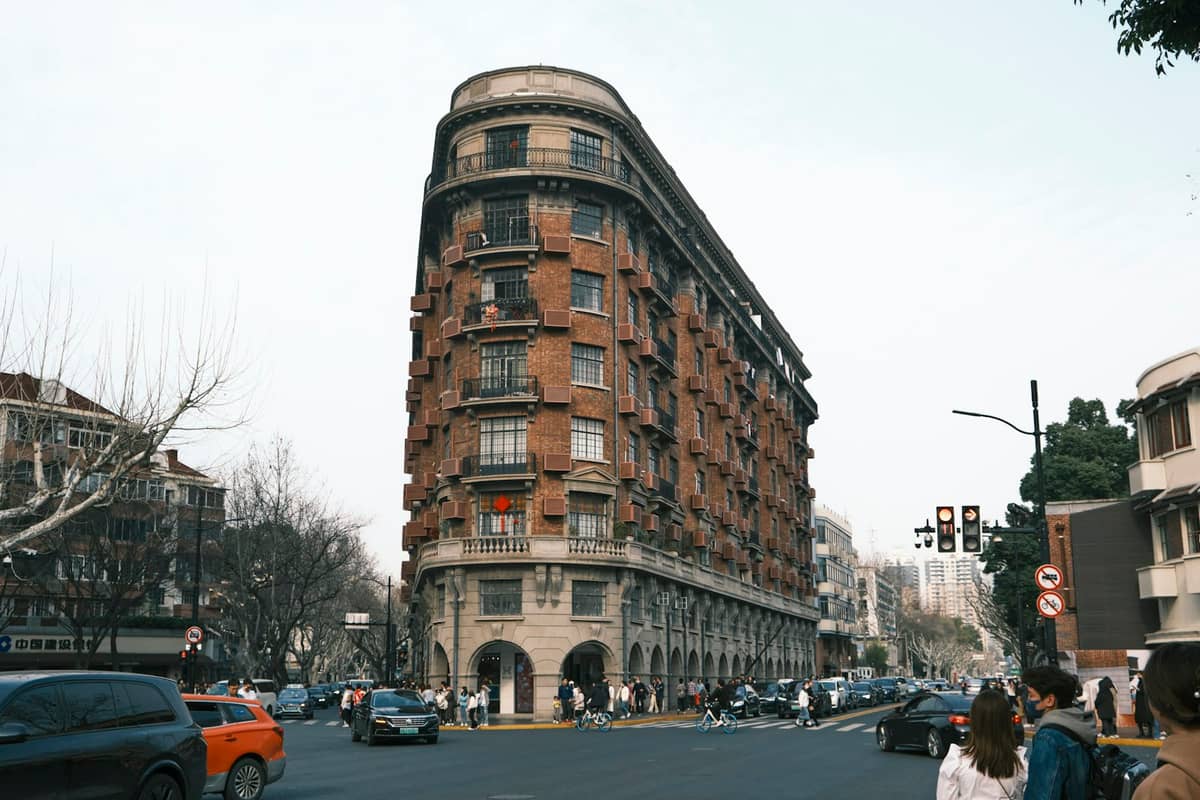
The most photographed structure on the street is the Normandy Apartments, a 1924 building designed by Hungarian architect László Hudec that stands at the junction where Wukang Road meets Huaihai Middle Road. Its curved facade and terracotta cladding are immediately recognisable. Hudec was responsible for several of Shanghai's defining interwar buildings, and this is one of his most accessible — you can walk right up to the base. The building remains in residential use, so the lobby is not open to visitors.
Further south, villas with ornamental ironwork gates, tiled roof ridges, and half-timbered upper storeys sit close to the pavement. Many are still occupied and in active use by institutions or private residents. The protected status means facades cannot be altered, which is why the visual continuity of the street holds even where ground-floor commercial tenants have changed. Look up at the rooflines rather than at the shop signage and the architectural logic becomes much clearer.
💡 Local tip
Bring a camera with a moderate wide-angle lens rather than a phone zoom. The street is narrow, the buildings are close, and the best details — carved lintels, ironwork balconies, terracotta tile patterns — are at close range, not at distance.
Tickets & tours
Hand-picked options from our booking partner. Prices are indicative; availability and final rates are confirmed when you complete your booking.
Shanghai city and Zhujiajiao water town private tour with lunch
From 371 €Instant confirmationFree cancellationShanghai private tour with iconic landmarks of the old and new city
From 284 €Instant confirmationFree cancellationShangai Yuyuan Garden entrance tickets
From 9 €Instant confirmationFree cancellation
How the Street Changes Through the Day
Early morning, roughly 7 to 9 AM, is when Wukang Road belongs to its residents. Older locals do tai chi in the small patches of open space near the side streets. A few cafes open early and you can smell fresh coffee from the pavement. The light is soft and directional through the plane tree canopy, which is the best condition for photographing the building facades without harsh shadows or blown-out skies. Foot traffic is light enough that you can stand in the middle of a side alley and compose a shot without anyone walking into frame.
From around 10 AM onward, weekend visitor numbers build steadily. By noon on a Saturday or Sunday, particularly around the Normandy Apartments intersection, the pavement is crowded with people taking photographs. This is not necessarily a problem for walking, but it does change the character. The street feels more performative, less lived-in. Weekday mornings between Tuesday and Thursday are noticeably quieter.
Late afternoon from 4 PM onward brings a second quieter window before the dinner hour. The westward light hits the building facades at a low angle and the plane trees cast long shadows across the road. Cafe tables fill with people finishing work. This is the most comfortable time to sit outside, particularly in spring and autumn when temperatures are moderate.
At night, Wukang Road dims considerably compared to the brighter commercial streets nearby. The street lighting is low-key, the residential villas are mostly dark, and the active venues are limited to a handful of bars and restaurants near the northern end. It is pleasant for a quiet evening walk but there is little architectural detail visible after dark.
Walking the Route: A Practical Sequence
The most logical approach is to start at the northern end near the Normandy Apartments at the Huaihai Middle Road junction and walk south. This puts the most iconic building behind you as you continue, which means you have already oriented yourself before the street narrows and quietens. The walk from north to south end takes around 20 minutes at a slow pace without stopping.
About halfway along, several notable side streets branch off. Taian Road to the west has a cluster of small galleries and coffee roasters in a short stretch. Xingguo Road to the east adds another block of protected buildings if you want to extend the walk slightly. Neither detour requires more than 15 additional minutes.
The southern end of Wukang Road connects toward Fuxing West Road and beyond that toward Xujiahui, which gives you several options for continuing onward. If you are combining Wukang Road with a broader French Concession walk, the most natural pairing is to head east along Fuxing Road toward Sinan Mansions or north toward Huaihai Road.
Wukang Road fits naturally into a half-day French Concession loop. The best self-guided walks in Shanghai guide outlines how to connect it with Fuxing Park, Xintiandi, and the surrounding lanes.
ℹ️ Good to know
The pavement along Wukang Road is uneven in places, particularly near the older building frontages where tree roots have lifted sections of tile. Comfortable flat shoes are practical. Visitors using wheelchairs or pushchairs should expect some rough surface patches; there is no verified step-free guarantee along the full length.
Photography: Getting Past the Standard Shot
The Normandy Apartments and the plane tree canopy mid-street are the two images that appear in almost every article about Wukang Road. Both are worth photographing, but there are less-replicated angles if you slow down. The iron gates on individual villas, some with intricate floral patterns from the 1930s, are rarely shown in close detail. The contrast between old tiled rooflines and the modern apartment blocks visible at the ends of the cross streets is a more honest portrait of Shanghai's layered cityscape.
In autumn, usually October into November, the plane trees turn yellow and drop leaves onto the road surface. This is the most photogenic seasonal state for the street. In summer, the canopy is dense and green and provides genuine shade, but the light is harder to work with. Winter strips the trees back and exposes the building facades more clearly, which is better for architectural documentation but less atmospheric for general photography.
For the wider context of where Wukang Road fits among Shanghai's most photogenic locations, see the guide to the best photo spots in Shanghai.
Honest Assessment: Is It Worth Your Time?
Wukang Road is one of the few places in central Shanghai where early twentieth-century residential architecture survives at street scale rather than as an isolated preserved building surrounded by redevelopment. That is its genuine value. It is not spectacular in the way that the Bund or the Pudong skyline is spectacular. Nothing will make your jaw drop. What it offers instead is texture and continuity: a sense of what the city looked like when it was one of Asia's most cosmopolitan addresses.
The street has become very well known and on peak weekend mornings it can feel crowded for what is essentially a narrow residential road. If you are arriving expecting a quiet neighbourhood discovery, that expectation needs adjusting. But the crowds thin considerably if you walk further south past the first few buildings, and the side streets off Wukang Road are almost always uncrowded even when the main road is busy.
Visitors with no interest in architecture or urban history will find the appeal limited. There is nothing to do here in the conventional tourist sense beyond walking, looking, and sitting in a cafe. Families with young children may find the lack of activity or open space a constraint. The nearby Fuxing Park, a few minutes' walk away, offers open grounds that pair well as a complement.
If architecture is a central interest, the broader Shanghai architecture guide places Wukang Road within the full picture of the city's built heritage across different eras and districts.
Getting There and Practical Notes
The most straightforward metro route is Line 10 or Line 11 to Jiaotong University Station. From the station exits, Wukang Road is a short walk north, passing through characteristic French Concession side streets as you approach. The walk from the station to the southern end of Wukang Road takes around 8 to 12 minutes depending on which exit you use.
Taxis and ride-hailing via Didi Chuxing can drop you directly at the northern end near the Normandy Apartments junction with Huaihai Middle Road, which is the most convenient drop-off point for starting a south-facing walk. Traffic in this area can be slow during weekend afternoons, so the metro is often faster.
Wukang Road is a public street with no entrance, no ticket, and no closing time. The street is open 24 hours year-round. Individual businesses along the street set their own hours; most cafes open from around 9 or 10 AM and some bars stay open until midnight or later. There is no official visitor centre that keeps verified regular hours — any tourist information point along the road should be treated as supplementary rather than a primary information source.
⚠️ What to skip
Shanghai's summer months (June through August) bring high heat and humidity. Wukang Road has no indoor shelter beyond the cafes and shops. If you visit in summer, an early morning start before 9 AM makes the walk significantly more comfortable. The plane tree canopy provides shade mid-street but does not cover the full pavement width.
For advice on timing a Shanghai visit around weather, seasonal events, and crowd patterns, the best time to visit Shanghai guide covers month-by-month conditions in practical detail.
Insider Tips
- Walk the cross streets, not just the main road. Taian Road, Yongjia Road, and the lanes connecting toward Fuxing West Road have buildings of similar vintage with almost none of the foot traffic. The architectural quality is comparable and the experience is more like actual neighbourhood exploration.
- The Normandy Apartments look best from the small triangular island where Wukang Road meets Huaihai Middle Road and Fuxing West Road. Cross to the traffic island and look back toward the building from a slight distance — this is the angle that shows the full curve of the facade. Standing directly beneath it compresses the perspective.
- Weekday mornings between Tuesday and Thursday see the lowest visitor numbers. If your schedule allows flexibility, this is when the street most closely resembles its residential character rather than a photography destination.
- Several of the cafes on Wukang Road have upper-floor seating with windows that face the plane tree canopy. Sitting at that level gives you a different perspective on the street and is worth the price of a coffee, particularly in autumn when the leaves are turning.
- The protected building plaques are mounted at eye level near the entrance gates of many of the villas. They carry construction dates, original use information, and the protection category in Chinese with some English. Reading them adds significant context to what would otherwise be an attractive but opaque facade.
Who Is Wukang Road For?
- Architecture enthusiasts interested in interwar Shanghai and the Former French Concession period
- Photographers looking for early-morning street scenes with architectural texture and natural canopy light
- Slow-travel visitors who want to experience a Shanghai neighbourhood at walking pace rather than through scheduled attractions
- Couples looking for a relaxed afternoon walk followed by coffee or a meal in an atmospheric street setting
- Repeat visitors to Shanghai who have covered the major landmarks and want something with more residential character
Nearby Attractions
Other things to see while in Former French Concession:
- Fuxing Park
Fuxing Park is a historic French-style public garden at the heart of the former French Concession, offering free entry and a rare window into everyday Shanghai life. From early-morning tai chi practitioners to evening ballroom dancers, the park runs on its own unhurried rhythm — and it anchors one of the city's most rewarding walking neighborhoods.
- Sinan Mansions
Sinan Mansions is a restored early 20th-century garden villa compound in the heart of the Former French Concession. Free to enter and with its outdoor streets accessible at all hours, it combines architectural heritage, leafy pedestrian streets, and a curated mix of cafes, galleries, and boutiques within one of Shanghai's most atmospheric historic neighborhoods.
- Tianzifang
Tianzifang is a warren of converted shikumen alleyways in the Former French Concession, packed with independent studios, cafes, and craft shops. Free to enter and accessible from Dapuqiao Station, it rewards early visitors and confounds those who arrive expecting quiet authenticity on a weekend afternoon.