Shamian Island is a 0.30 km² sandbank in Guangzhou's Liwan District, set apart from the surrounding city by narrow channels and a completely different architectural character. Once a European and American concession zone in the 19th and early 20th centuries, it remains a quiet enclave of banyan-lined avenues, European-style buildings, and riverside promenades that feels genuinely unlike anywhere else in the city.
Shamian Island sits in the Pearl River in Liwan District, a compact sandbank where French and British colonial-era buildings line shaded avenues barely a five-minute walk across. It is the most architecturally distinct neighborhood in Guangzhou, a place where the pace slows considerably and the scale stays human, even as one of China's largest cities hums just across the narrow channels that define its borders.
Orientation
Shamian Island occupies roughly 0.30 square kilometers in the southwestern corner of Liwan District, sitting in the Pearl River like a leaf dropped into a stream. Its stated boundaries are Liu'ersan Road to the east, the Zhujiang Tunnel to the west, the Bai'etan section of the Pearl River to the south, and the Shaji Chong channel to the north. In practical terms, the island is so compact that a brisk walk from one end to the other takes under fifteen minutes.
The island connects to the surrounding city via bridges, and its position places it within easy reach of several other neighborhoods worth knowing. Liwan DistrictThe island connects to the surrounding city via bridges, and its position places it within easy reach of several other neighborhoods worth knowing. Shamian stretches north and east, home to the traditional shopping corridor of Shangxiajiu and the older commercial lanes of Xiguan. The Pearl River wraps around the southern edge, with Haizhu District visible across the water. Shamian is often treated as a standalone destination, but it makes more sense as part of a wider day that takes in the Liwan waterfront, the Huangsha seafood market nearby, and the colonial-to-contemporary contrast of the riverfront.
The internal layout of the island is straightforward: a central east-west avenue runs the length of the island and forms its architectural spine, flanked by parallel residential and institutional streets. The southern edge faces the Pearl River directly and offers open views. The northern edge borders the Shaji Chong channel, which separates the island from the main urban fabric of Liwan.
Character and Atmosphere
Shamian Island operates on a different clock from the rest of Guangzhou. In the early morning, before the day-trip crowds arrive, the avenues under the old banyan trees are almost entirely given over to local residents: retirees doing slow tai chi in the small parks, families pushing strollers, and older couples sitting on benches in the filtered morning light. The sound is birdsong, distant river traffic, and occasionally the scrape of someone pulling open a café shutter.
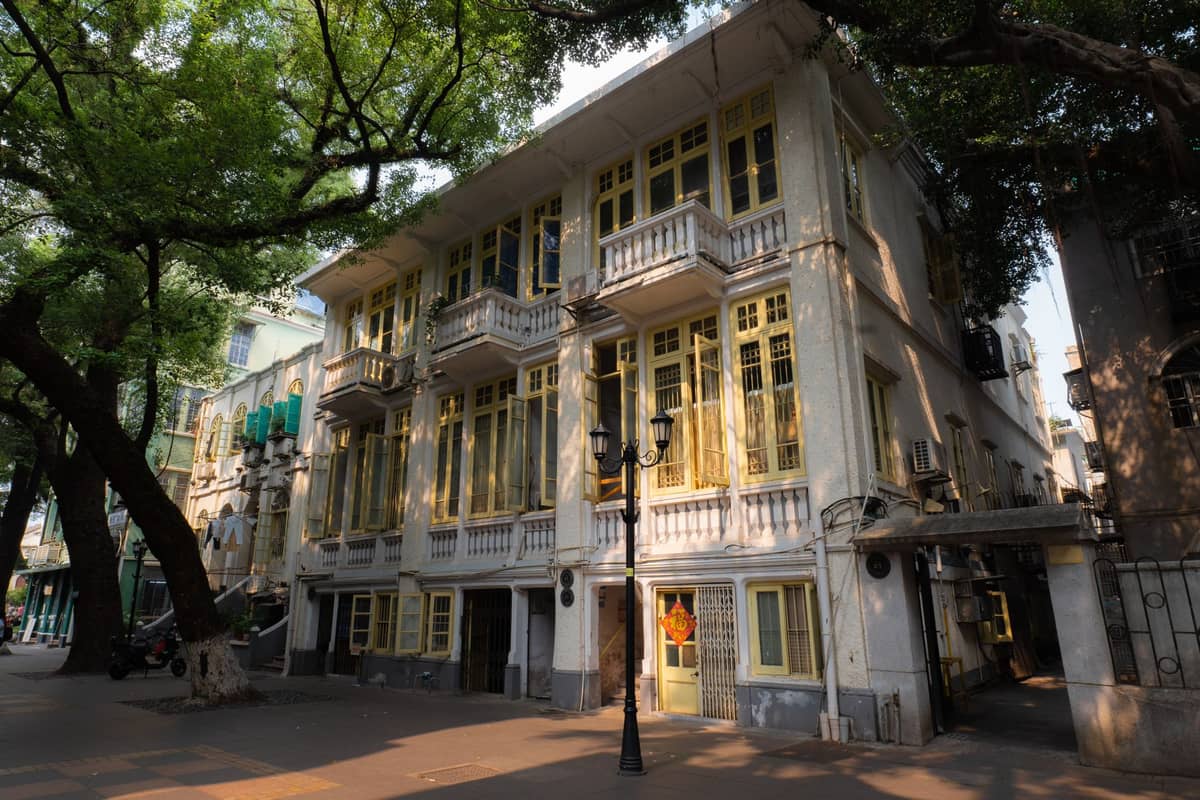
By midmorning, the character shifts. Tour groups and individual visitors come to photograph the European-style facades: pale yellow, cream, and terracotta buildings with arched colonnades, ornate ironwork balconies, and weathered stone columns. The buildings are well-maintained but not over-restored, which means they still show their age in ways that feel authentic rather than stage-managed. The White Swan Hotel on the southern waterfront and the old Shamian Hotel are the most recognizable landmarks, though the entire island functions as an open-air architectural catalog.
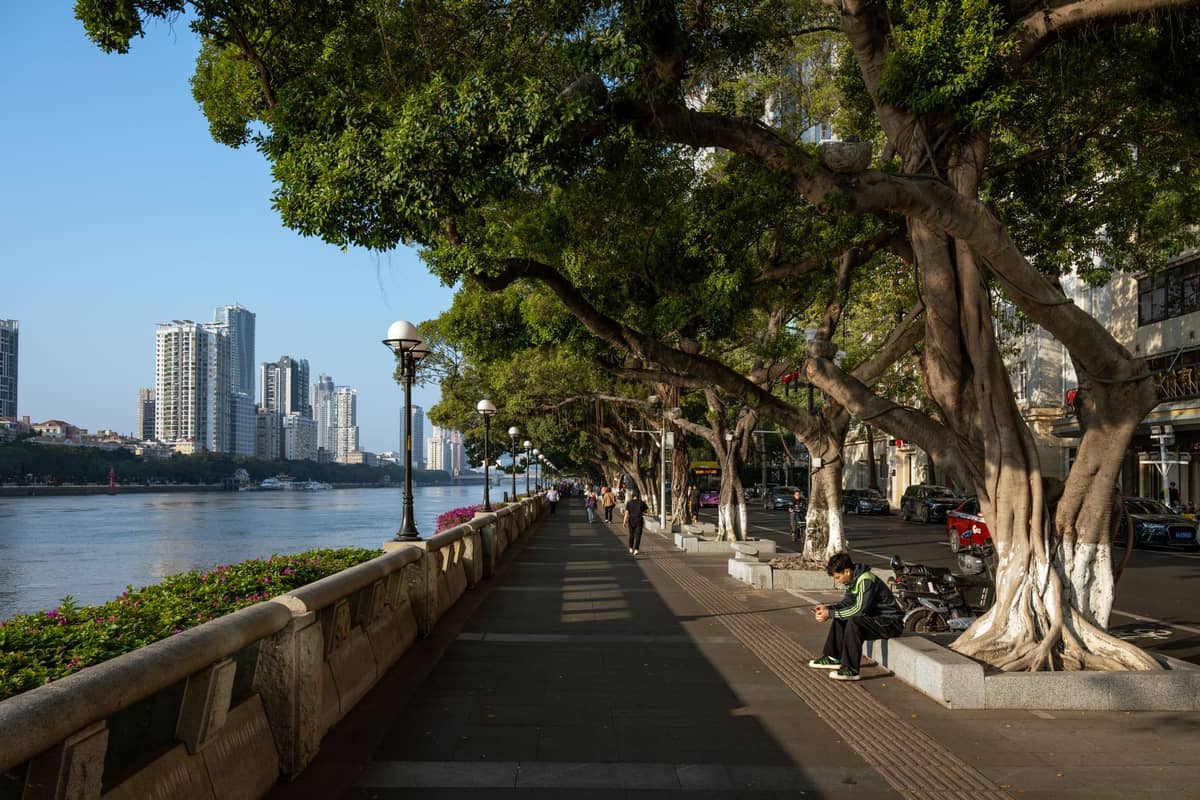
Afternoons bring strong humidity in summer and pleasant warmth in autumn, and the banyan canopy along the main avenue provides real shade. The light in late afternoon turns amber and falls at low angles across the facades, which is when the architecture looks its best. By evening, the tour groups thin out and the island settles back into something quieter. Cafés and small bars along the waterfront side fill up gradually, and the riverside promenade draws couples and joggers. It is never truly lively after dark in the way that Tianhe or Beijing Road are, but it has a composed evening atmosphere that many visitors find preferable.
ℹ️ Good to know
Shamian Island is free to enter at all hours. There are no gates or admission fees, and the area is accessible day and night. The island is small enough that you can walk its entire perimeter in around 30 minutes at a relaxed pace.
History and Context
The island's current character is a direct product of 19th-century treaty port politics. Following the Second Opium War and the Treaty of Tientsin in 1858, Shamian was officially designated as a foreign concession zone, divided between the British and French. The channel to the north was deepened and the island was built up with the administrative buildings, banks, churches, consulates, and residences that foreign merchants and officials required. For decades, the island functioned as a self-contained foreign city within Guangzhou, governed separately and physically separated from the surrounding Chinese city.
After the concession era ended in the 20th century, the buildings were repurposed rather than demolished. The result is an unusually intact collection of colonial-era architecture by Chinese urban standards. Walking the central avenue, you pass buildings that once housed the British consulate, French institutions, foreign trading houses, and private residences, now serving as hotels, cafés, government offices, and apartments.
The island's history intersects with Guangzhou's broader colonial and revolutionary past. The Peasant Movement Training Institute and other sites of early 20th-century political significance are located in the wider city, and understanding Shamian requires placing it within that context: it was the enclave that the surrounding city resented, and several historical incidents of anti-foreign sentiment played out at or near its bridges.
What to See and Do
The primary activity on Shamian Island is walking and looking. This is not a neighborhood built around ticketed attractions or indoor venues. The value is in the street-level architectural experience: following the central avenue from east to west, ducking down the narrower side streets, and ending up at the southern riverside promenade with views across the Pearl River.
The Shamian Island riverfront along the southern edge is the most pleasant stretch for an unhurried walk. The embankment faces directly onto the Pearl River, and on clear days you can see south toward Haizhu District. Benches and low walls line the promenade, making it a practical place to sit and watch river traffic. Early morning and early evening are the best times, when the light is softer and the crowds are thinner.
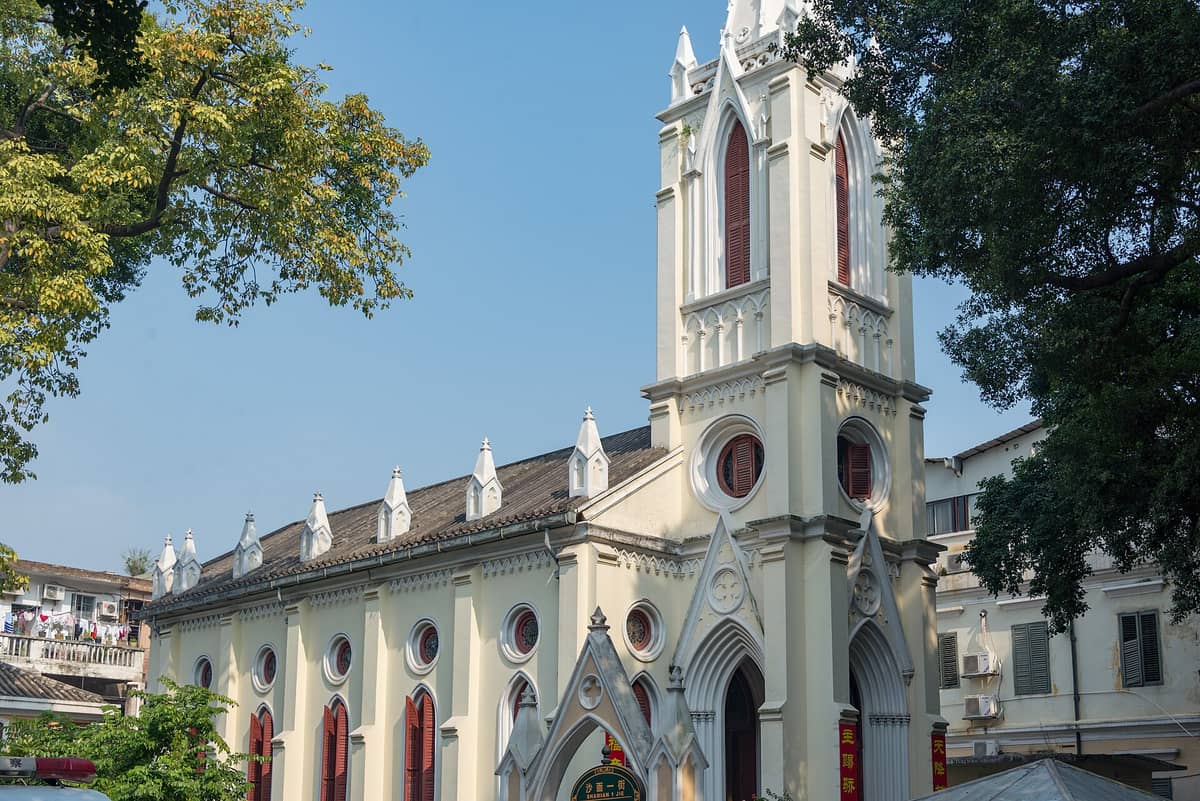
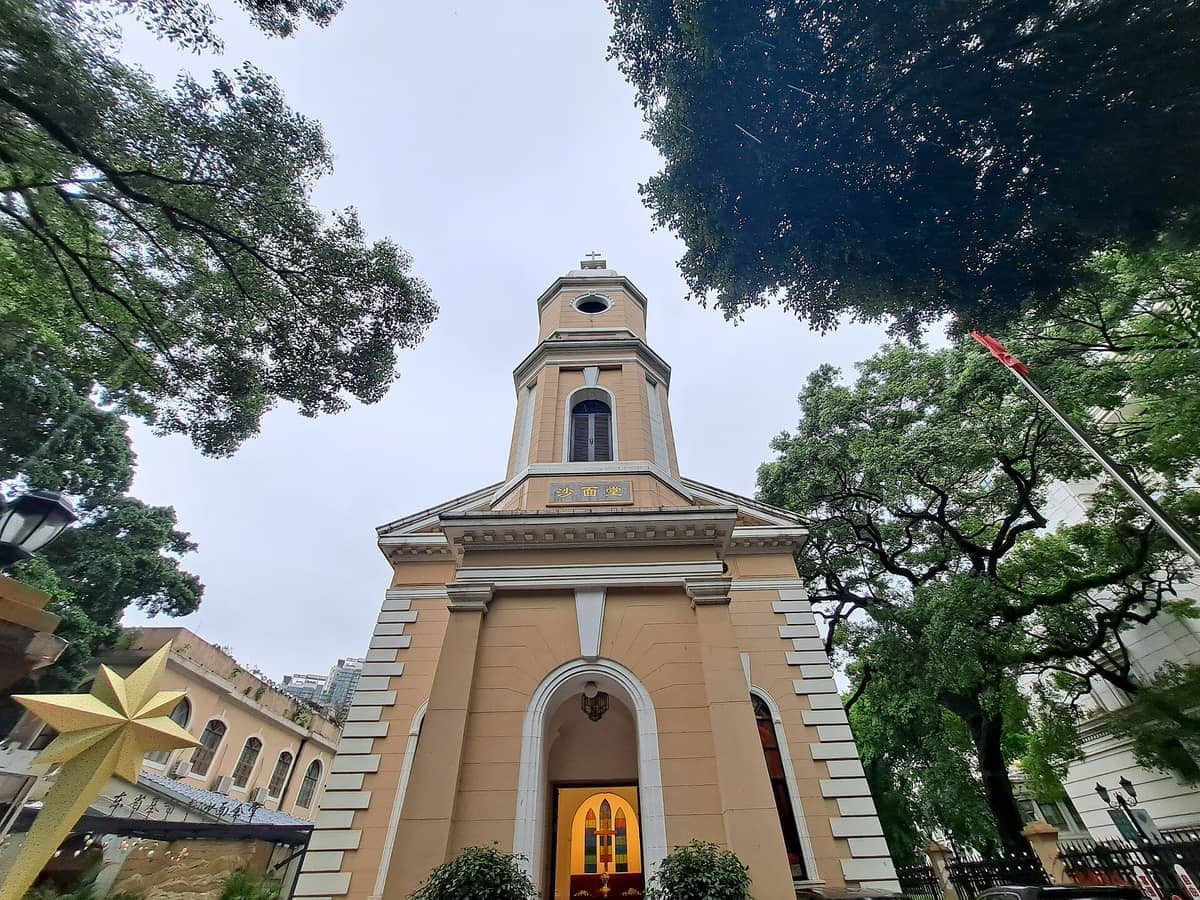
Both churches on the island are worth a look: the Shamian Christian Church (also called Our Savior's Church) is the better-known of the two, a brick Protestant church with a modest tower that dates from the concession era. It still holds services and is not purely a tourist landmark. The Catholic chapel is smaller and less prominently situated but equally atmospheric. Neither requires a ticket, though you should dress respectfully and avoid services if you are there purely to photograph.
Walk the full length of the central avenue (Shamian Dajie) from east to west to see the main concentration of colonial-era facades
Follow the southern embankment for Pearl River views and to reach the western end of the island
Look for the small decorative statues and sculptures placed along some of the side streets, a civic art project that adds some character to the quieter lanes
Cross the northern channel bridge and walk five minutes into Liwan for contrast: the shift from European-scale order to dense Cantonese urban fabric is immediate and worth experiencing
💡 Local tip
The island photographs best on overcast days, when the diffuse light prevents harsh shadows on the building facades and the colors of the plasterwork come through more clearly. Direct midday sun in summer creates strong shadows and pushes the heat to uncomfortable levels.
Eating and Drinking
The food scene on Shamian is small and oriented toward visitors, which means prices are slightly higher than in the surrounding Liwan neighborhoods and the options are more limited. The island has cafés, a handful of Western-leaning restaurants, and some Cantonese options, but it is not a dining destination in its own right. Most of the cafés are clustered along the main avenue and the southern riverfront.
Coffee culture is reasonably well represented here. Independent cafés occupy some of the colonial-era ground-floor spaces, and it is genuinely pleasant to sit with a drink under the archways while the avenue traffic passes. For serious eating, the better strategy is to cross into Liwan and look toward the surrounding street food lanes and traditional Cantonese teahouses. Prices drop noticeably within a few minutes' walk of the island.
The Huangsha Seafood Market is located close to Huangsha metro station, a short walk east of the island, and is one of the best places in the city to eat fresh seafood at market prices. This makes a natural complement to a morning on Shamian: spend the morning on the island, then walk east for a midday seafood lunch. The Shangxiajiu Pedestrian Street is also within easy walking distance to the northeast and has a wider range of snack food and traditional Cantonese options.
For a broader introduction to Cantonese food, including dim sum customs specific to Guangzhou, see the dim sum guide for Guangzhou. Dim sum on the island itself is limited, but options open up quickly once you cross into Liwan.
Getting There and Around
The most convenient metro station for Shamian Island is Huangsha, served by both Line 1 and Line 6 on the Guangzhou Metro. From Huangsha station, the walk to the eastern entrance of the island takes around 10 to 15 minutes on foot, heading southwest along the riverfront direction. The Cultural Park station on Line 6 is another option and can be slightly closer depending on which part of the island you are targeting.
Bus access is available via nearby stops serving the area, including routes that connect the island with central Guangzhou and Liwan District. Bus travel in Guangzhou can be slower due to traffic, but it provides more direct surface-level navigation for travelers who want to see the city from street level.
Once on the island, everything is on foot. The island is too small and too densely built for cycling to add much value, and private vehicles are limited. For broader navigation across the city, including how to combine Shamian with other neighborhoods, the guide to getting around Guangzhou covers metro lines, bus networks, and ride-hailing in detail.
💡 Local tip
If you are arriving from central Guangzhou, Line 1 from Gongyuanqian (near Beijing Road and Yuexiu) to Huangsha is a direct, quick connection. If you are arriving from central Guangzhou, Line 1 from Gongyuanqian (near Beijing Road and Yuexiu) to Huangsha is a direct connection. The journey is quick and puts you within easy walking distance of the island.
Where to Stay
Accommodation on Shamian Island itself is limited but notable. The White Swan Hotel, a large landmark property on the southern waterfront, is the most prominent option and offers direct Pearl River views. The Shamian Hotel provides a more modestly priced alternative with the same advantage of being on the island itself. Staying on Shamian means waking up before the day visitors arrive, which is genuinely the best time to experience the place.
For travelers who want broader Guangzhou access at lower prices, staying in Liwan District more generally or near Huangsha metro station keeps Shamian within easy reach while giving better transport connections to the rest of the city. The complete guide to where to stay in Guangzhou covers all major areas and price ranges with specific guidance on which neighborhoods suit which types of traveler.
Shamian is a reasonable base for travelers whose primary interest is Guangzhou's colonial history, Lingnan architecture, and the western Pearl River waterfront. It is less practical for travelers focused on Tianhe's modern commercial districts or the exhibition venues of Haizhu, which are on the opposite side of the city center and require more transit time.
Practical Assessment: Is Shamian Worth Your Time?
Shamian Island is one of the more unusual places in Guangzhou, but it is worth being direct about what it is and is not. It is a small, well-preserved architectural enclave that works best as a half-day visit or a quiet morning before moving on to more active parts of the city. It does not have a dense program of ticketed attractions, and visitors who arrive expecting a full day of activities may find themselves running out of things to do after two or three hours.
The crowds on weekends and holidays can be considerable. The central avenue in particular fills with people taking photos, and some of the intimacy that makes the island appealing at quieter times gets lost when the benches and promenade are busy. Weekday mornings are significantly calmer and allow for a more genuine experience of the place.
In the context of a longer Guangzhou trip, Shamian pairs well with a walk through Liwan's older commercial streets, a visit to the Chen Clan Ancestral Hall to the north, and a meal at the Huangsha seafood market. Combined, these form a coherent day in the western part of the city that covers colonial history, Cantonese folk architecture, traditional commerce, and riverfront life. The Guangzhou walking tours guide includes suggested routes that can help connect these areas.
⚠️ What to skip
Summer heat on Shamian can be intense, especially between June and August. The banyan canopy provides some shade, but the southern riverfront promenade is fully exposed. Bring water, visit in the early morning, and plan to move to an air-conditioned space by midday if you are visiting during the hottest months.
TL;DR
Shamian Island is the most architecturally distinctive neighborhood in Guangzhou: a 0.30 km² colonial-era enclave of European-style buildings, banyan-lined avenues, and riverfront promenades in Liwan District.
Best visited on a weekday morning, when the island is quiet and the light on the facades is at its best; weekend crowds can be heavy.
Ideal for travelers interested in Guangzhou's colonial history, architectural contrast, and a slower pace, and best combined with Liwan's wider street food and heritage sites nearby.
Transit access via Huangsha metro station (Lines 1 and 6) makes it easy to reach from across the city; the island itself is entirely walkable.
Not suited to travelers seeking a packed itinerary of ticketed attractions; plan for two to three hours and then continue to neighboring Liwan or the Huangsha seafood market.
Three days is the ideal amount of time to experience Guangzhou's full range: ancient temples and colonial backstreets, futuristic skylines and river cruises, and one of the world's great food cities. This day-by-day itinerary covers the essential attractions without turning the trip into a rushed checklist.
Guangzhou's humid subtropical climate means the difference between a comfortable trip and a sweaty, storm-interrupted one often comes down to timing. This guide breaks down every season, flags the Canton Fair impact on prices, and tells you which months are genuinely worth prioritizing.
Guangzhou rewards those who look up, climb high, and linger by the river after dark. This guide covers the city's best viewpoints, from the 488-meter observation deck of Canton Tower to the forested summit of Moxing Ridge, plus hilltop temples, riverside promenades, and terraced gardens with sweeping city panoramas.
The Canton Fair is the world's largest trade fair, held twice a year in Guangzhou, China. This guide covers registration, badge requirements, phase schedules, venue logistics, and practical tips for first-time foreign buyers.
Guangzhou sits at the center of one of the most destination-rich regions in China. Whether you want ancient watchtowers, serious Cantonese food, or a Hong Kong skyline, the best day trips from Guangzhou are faster and cheaper to reach than most travelers expect. This guide ranks your options by practicality, not just scenery.
Guangzhou is the undisputed home of dim sum, where yum cha is less a meal and more a daily ritual. This guide covers the best restaurants across the city, the dishes worth ordering, the timing tricks locals rely on, and the common mistakes first-timers make.
Guangzhou rewards budget travelers generously. From ancient temples and colonial island walks to world-class museums and urban wetlands, these 20 free attractions cover the city's history, culture, and nature without spending a yuan on entry.
Guangzhou is a sprawling city of nearly 19 million people across 7,434 km², but its transport network is one of the most efficient in China. This guide covers the metro system, taxis, ride-hailing, airport connections, and everything else you need to move around the city confidently.
Guangzhou's built environment spans two thousand years of history, from climate-adapted Lingnan courtyards to some of the boldest contemporary structures in Asia. This guide walks you through the key styles, the best places to see them, and how to plan a serious architectural itinerary across the city.
Baiyun Mountain is Guangzhou's best-known hiking destination, with marked trails, a cable car to the summit area, and panoramic views over the Pearl River Delta. This guide covers every trail option, gate access, transport logistics, and the best times to go.
Cantonese opera is one of southern China's most distinctive art forms, and Guangzhou is the best city in the world to experience it. This guide covers the top venues, the essential museum visit, seasonal advice, and practical tips for first-timers and returning visitors alike.
Chimelong Tourist Resort in Guangzhou's Panyu District is one of China's largest theme park complexes, but each park inside it runs on its own schedule, pricing, and vibe. This guide breaks down every option so you can pick the right park and plan your day without wasted time.
Chinese New Year in Guangzhou is not a single night of fireworks. It is a rolling season of flower fairs, lantern exhibitions, temple activities, and district-level events that stretches from late January through early March. This guide covers what happens, when, where, and how to navigate it without getting caught out.
Guangzhou is southern China's Cantonese capital: a city of 18.7 million people, 2,200 years of history, and some of the best food in the country. This guide covers everything a first-time visitor needs, from arrival logistics and district breakdowns to the best time to visit and frank guidance on what the city actually delivers.
Guangzhou Baiyun International Airport (CAN) is southern China's primary aviation hub, serving a city of nearly 19 million people. This guide covers everything from booking flights and understanding the airport layout to getting into the city quickly and affordably.
Autumn is the most comfortable season to visit Guangzhou, with cooler temperatures, low rainfall, and clear skies from October through December. This guide breaks down the weather month by month, what to do, what to watch out for, and how to get the most from a fall visit to Guangdong's capital.
Guangzhou punches well above its weight as a luxury destination. This guide breaks down the best 5-star hotels by district, the fine dining worth your money, and the high-end cultural experiences that separate a premium Guangzhou trip from a basic one.
Guangzhou has one of the richest museum scenes in southern China, spanning 2,000 years of trade, art, and revolutionary history. This guide covers the best museums across every category, from ancient archaeology to Cantonese opera, with practical tips on booking, admission, and where to go first.
Guangzhou nightlife spans rooftop lounges with skyline views, a dedicated riverside bar strip, speakeasy cocktail bars, live music venues, and Pearl River night cruises. This guide breaks down where to go, what to spend, and when to go out across the city's main after-dark districts.
Guangzhou is one of China's most rewarding cities for budget travelers. From 2 CNY metro rides to free museums and 10 CNY street food, this guide breaks down exactly where your money goes and how to stretch it further across every category of spend.
The Pearl River (Zhujiang) is Guangzhou's geographic and cultural backbone, stretching through the city's historic core and modern skyline. This guide covers night cruises, waterfront walks, pier logistics, and the best spots along the riverbank for first-timers and returning visitors alike.
Guangzhou has been a trading city for over 2,000 years, and that commercial DNA runs through everything from its flagship luxury malls in Tianhe to its chaotic wholesale garment markets near the train station. This guide breaks down every major shopping zone by what you actually buy there, how much to budget, and when to go.
Guangzhou has been a city of traders, pilgrims, and believers for over two thousand years, and its temples reflect every strand of that history. This guide covers the finest Buddhist, Taoist, Islamic, and colonial Christian sites in the city, from ancient pagodas in Yuexiu to a spectacular Mazu complex on the Pearl River Delta.
The journey from Guangzhou to Hong Kong takes as little as 47 minutes by high-speed train or up to 4 hours by road.. This guide breaks down every realistic option, including which ferry routes actually exist, what each costs, and when to book in advance.
Guangzhou's best neighborhoods are surprisingly walkable once you know which districts to target. This guide breaks down the top self-guided walking routes, what each area offers, how to connect them by metro, and the practical details that make a walking day actually work.
Guangzhou is the wholesale capital of southern China, with over 1,000 specialized markets covering everything from clothing and electronics to toys and fabrics. This guide cuts through the noise with district-by-district breakdowns, real pricing expectations, payment logistics, and the timing intel that separates experienced buyers from first-timers.
Guangzhou is a genuinely underrated family destination, with world-class theme parks, interactive museums, free parks, and riverfront evenings that work for all ages. This guide covers the best activities for kids, honest pricing, seasonal advice, and how to structure your visit without burning out.
Guangzhou rarely tops bucket lists, but that's exactly what makes it interesting. This guide cuts through the business-city stereotype to show what the city actually offers travelers: world-class Cantonese food, genuine history, serious shopping, and a pace of life that Beijing and Shanghai simply don't have.
Guangzhou rewards visitors with one of China's richest mixes of history, food culture, river life, and modern architecture. This guide covers the top things to do in Guangzhou across every district, with practical assessments, practical logistics, and seasonal advice.
Guangzhou is the birthplace of Cantonese cuisine, a cooking tradition built on freshness, precision, and restraint. This guide covers the essential dishes, where to eat them, what to pay, and how to eat like a local from sunrise to sunset.
Guangzhou has several distinct hotel zones, and choosing the wrong one can cost you hours of commuting per day. This guide breaks down the five main areas by trip type, with practical assessments of who each zone actually suits.