Chen Clan Ancestral Hall: Guangzhou's Most Ornate Qing Dynasty Compound
Built between 1888 and 1893 as a center for education and ancestor worship, Chen Clan Ancestral Hall is the most elaborately decorated traditional compound in Guangzhou. Its nineteen linked halls are covered in stone carvings, wood reliefs, iron castings, ceramic friezes, and stucco moldings that represent the full range of Cantonese folk craft at its peak.
Quick Facts
- Location
- No. 34, Enlongli, Zhongshan 7th Road, Liwan District, Guangzhou
- Getting There
- Chenjiaci Station, Metro Line 1 (Exit D leads directly to the compound and adjacent square)
- Time Needed
- 1.5 to 2.5 hours for a thorough visit; allow extra time for the folk art museum inside
- Cost
- CNY 10 per adult (reduced categories reported for eligible visitors)
- Best for
- Architecture enthusiasts, Cantonese cultural history, photography, and anyone interested in traditional decorative arts
What the Chen Clan Ancestral Hall Actually Is
The Chen Clan Ancestral Hall, known in Chinese as 陈家祠 (Chénjiā Cí) and sometimes called the Chen Clan Academy, is a large ceremonial and educational compound built in the late Qing dynasty between approximately 1888 and 1893. It was commissioned collectively by Chen-surnamed families from across Guangdong Province as a shared place for ancestor veneration and as a preparatory academy for clan members sitting the imperial civil service examinations in Guangzhou.
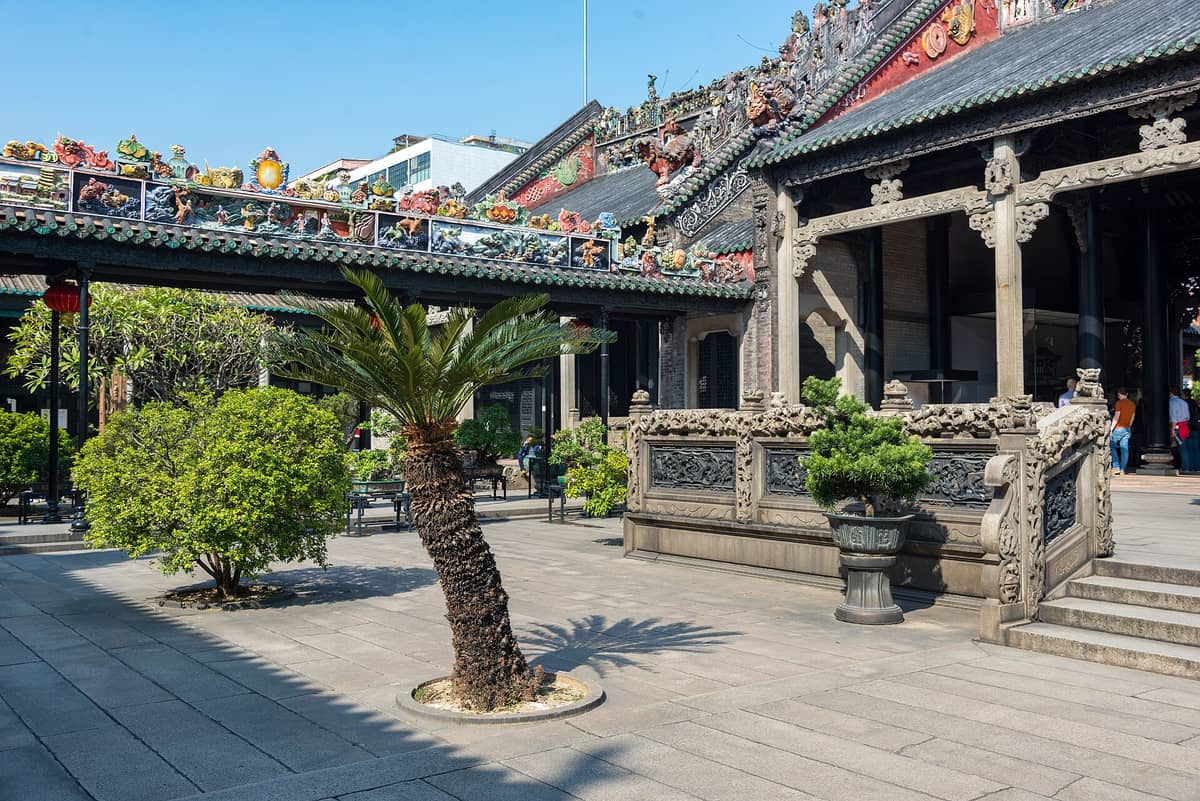
The compound occupies roughly 15,000 square meters and contains nineteen interconnected halls, six courtyards, and nine main structures arranged on a symmetrical north-south axis. What sets it apart from other ancestral halls in the Pearl River Delta is the sheer quantity and quality of its decorative work. Every surface, from roof ridge to threshold, carries carved or molded imagery: folk tales, historical scenes, auspicious symbols, and botanical motifs rendered in six different craft traditions simultaneously.
Today the compound functions as the Guangdong Folk Art Museum, though it is universally known by its historical name. The folk art collection displayed inside is substantial and well-curated, but for most visitors the building itself is the main exhibit.
⚠️ What to skip
Opening hours are reported inconsistently across sources: some list 8:30 AM–5:30 PM daily, others report 9:00 AM–5:30 PM with Tuesday closures (except public holidays). Verify current hours before visiting, especially on Tuesdays or public holidays.
The Six Decorative Crafts: What You Are Actually Looking At
Most visitors arrive expecting a handsome old building and leave slightly stunned. The complexity of the decorative program is genuinely unusual, even by Chinese temple standards. The compound is cited by architectural historians as the most complete surviving example of six traditional Cantonese craft forms applied simultaneously to a single structure: stone carving, wood carving, brick carving, iron casting, ceramic ridgework (known as shiwan pottery), and lime-plaster stucco molding (called gray sculpture or hui su).
The rooflines are where most visitors stop and stare first. The ceramic ridge decorations are built up in vivid polychrome layers from Shiwan kilns in Foshan, depicting operatic battle scenes, dragon boats, and mythological tableaux in figures roughly the size of a child's toy soldier. Some ridges run ten meters or more, packed with dozens of individual figures. From ground level the detail is harder to read, so bring binoculars or use a telephoto lens to pull the scenes into focus.
The iron screen panels near the main hall entrance are less photographed but arguably more impressive up close. Cast in Foshan during the original construction, they combine geometric lattice patterns with naturalistic vine and bird imagery in a way that no modern reproduction quite replicates. The texture and patina of the original iron is worth touching if you can reach it.
Moving Through the Compound: A Practical Walkthrough
The main entrance faces south onto Zhongshan 7th Road. After buying tickets (a valid passport or ID is required at the window), you pass through a screening courtyard before the full facade of the central gate hall comes into view. Pause here rather than walking straight through. The entrance facade concentrates some of the densest decorative work in the entire compound, and most visitors simply walk past it.
The compound reads best if you move systematically from the central axis outward rather than drifting. The three-bay central hall contains the main ancestral shrine space and gives the clearest sense of the building's scale and atmosphere. Side corridors lead to smaller halls and the folk art museum galleries, which display embroidery, ivory carving, shadow puppetry, and ceramic work from across Guangdong. The galleries are air-conditioned and worth the detour, particularly in summer.
The interior courtyards receive natural light but also trap heat and humidity in summer. The best detailing in the courtyards is in the wooden screens and railings of the upper-level corridors, where carved panels depict scenes from classical literature. Look for the grain of the wood and the layering of the relief carving rather than trying to read every narrative scene. The craftsmanship communicates better as texture than as story.
💡 Local tip
The northeast corner of the compound receives less foot traffic and contains some of the finer wood-carving panels. Most visitors follow the central axis and exit without exploring the peripheral corridors.
How the Experience Changes by Time of Day
Morning visits before 10:00 AM are consistently quieter. The low-angle light at that hour catches the relief surfaces well, deepening the shadows in the carved panels and making the stone and brick detailing read more clearly. Tour groups tend to arrive from 10:00 AM onward, and by midday the central courtyard can become genuinely crowded. The noise level rises sharply with group tours, which tend to move quickly through the main halls.
Midday in summer is uncomfortable in the open courtyards: the stone paving radiates heat, and the compound offers limited shade outside the gallery buildings. If you visit between June and September, the late afternoon slot, arriving around 3:30 PM and staying until closing, is more bearable thermally and often quieter than midday. The quality of the light on the ceramic ridges in the late afternoon is also notably good for photography.
In the cooler months of October through December and again in February through April, the compound is comfortable at almost any hour. Weekday mornings during these months are the closest the site gets to genuinely uncrowded.
Historical and Cultural Context
The hall was funded through collective contributions from Chen-surnamed clans across all 72 counties of Guangdong Province, a fact that explains both its exceptional scale and its extraordinarily lavish decoration. Clan prestige was publicly visible in the quality of the building, and individual donors could commission specific carved panels depicting their family's stories or auspicious symbols. This competitive patronage model produced a building that reads almost like a compendium of late Qing folk art rather than a single coherent design. It sits in Liwan District, an area of Guangzhou historically associated with traditional Cantonese commerce and urban culture, which gives it a neighborhood context that still feels relatively low-rise and unhurried compared to the city center.
After the imperial examination system was abolished in 1905, the hall lost its original academic function and passed through various uses, including a period as a school and as a revolutionary headquarters during the Republican era. It was designated a national key cultural relic protection unit and converted into the Guangdong Folk Art Museum in 1959. The building has undergone restoration work over the decades, and some sections show fresher stonework than others, which is worth keeping in mind when assessing what you are looking at.
If the decorative arts of this period interest you more broadly, the Guangdong Museum in Zhujiang New Town holds a significant collection of Cantonese crafts and regional artifacts in a more conventional museum format. The two visits complement each other well.
Photography, Practicalities, and Who Should Skip This
Photography is permitted throughout the compound and no tripod restrictions are prominently enforced for casual visitors. The most productive approach is to shoot the roof ridges with a telephoto or zoom lens, capture the carved wooden panels in diffuse morning light, and use the courtyard geometry for architectural composition shots in the early hours. The compound is large enough that even moderately crowded conditions allow you to find clean frames if you are patient.
The admission price of CNY 10 makes this one of the better-value heritage sites in Guangzhou. Getting there is straightforward: Metro Line 1 runs directly to Chenjiaci Station, and the compound is a short walk from the exit. The broader Shangxiajiu pedestrian street is nearby, making it easy to combine a morning at the ancestral hall with an afternoon in Liwan's historic commercial core.
Wheelchair access to the main courtyards is possible in principle given the ground-level layout of much of the compound, but no detailed official accessibility statement was available at the time of writing. The upper-corridor areas involve steps, and some thresholds between halls have raised sills that are typical of traditional Chinese architecture.
Visitors who find Chinese decorative arts repetitive or who prefer minimalist architecture may find the sensory density of the compound exhausting rather than rewarding. The site is also less engaging for young children unless they are drawn to the ceramic figurines on the rooflines or the folk art galleries. Families with older children interested in history or crafts will find more to hold attention here. For a broader picture of what Guangzhou offers in this genre, the Guangzhou architecture guide places the ancestral hall in context alongside the city's other surviving traditional and colonial-era buildings.
ℹ️ Good to know
A valid passport or national ID is required to purchase tickets at the gate. Foreigners should carry their passport rather than relying on a phone photo of it.
Getting There and Combining with the Surrounding Area
Chenjiaci Station on Metro Line 1 is the most direct approach. Exit D deposits you within easy walking distance of the entrance on Zhongshan 7th Road. Bus routes 17, 88, 104, 107, 109, 128, and several others also serve the area, though the metro is faster and removes any navigational uncertainty.
Liwan District rewards a half-day or full-day approach rather than a single-stop visit. After the ancestral hall, the Liwan Lake Park is walkable and offers a slower-paced contrast, with traditional garden design and tea culture. The Hualin Jade Street area is also in this neighborhood for those interested in Guangzhou's trading heritage. The district as a whole has a lower-density, older-city feel that differs noticeably from Tianhe or Zhujiang New Town, and that atmosphere is part of what makes the ancestral hall visit work as a full experience rather than just a monument tick.
Insider Tips
- Bring a pair of compact binoculars or use your phone camera's optical zoom to read the ceramic roof ridge figures from ground level. The narrative detail is invisible to the naked eye at that distance and represents some of the finest work in the compound.
- The folk art museum galleries inside are air-conditioned and often uncrowded even when the courtyard is busy. They are worth a full 30 to 40 minutes independently of the building's exterior, particularly the embroidery and ivory carving sections.
- If you want the compound largely to yourself, arrive when it opens on a weekday morning in autumn or winter. By 10:00 AM on weekends, tour group volume makes quiet contemplation of the carvings difficult.
- The northeast and northwest corner halls receive the fewest visitors and contain detailed wooden screen panels that are comparable in quality to anything on the central axis. Most people exit without seeing them.
- The ceramic ridge figures were made in Foshan's Shiwan kilns and are an example of a craft tradition that still operates today. A day trip to Foshan to see the kilns and the Zumiao ancestral hall there makes for a logical follow-on if the Chen Clan Hall leaves you wanting more of this tradition.
Who Is Chen Clan Ancestral Hall For?
- Architecture and decorative arts enthusiasts who want a sustained close-up encounter with late Qing craftsmanship
- Photographers looking for layered architectural detail, strong geometry, and vivid ceramic color on the rooflines
- Travelers building a Cantonese cultural itinerary who want historical context beyond temples and modern landmarks
- First-time visitors to Guangzhou who want a single site that efficiently encapsulates traditional Pearl River Delta visual culture
- Slow travelers who are happy to spend two hours on a single compound rather than ticking off a list of sites
Nearby Attractions
Other things to see while in Liwan (Xiguan):
- Bruce Lee Ancestral Home
Tucked inside the restored Yongqing Fang heritage block in Liwan District, the Bruce Lee Ancestral Home is a small but quietly affecting tribute to one of the most influential figures in 20th-century popular culture. Free to enter and open most days, it rewards visitors who come with context and curiosity rather than expecting a grand museum experience.
- Cantonese Opera Art Museum
Housed in a sprawling classical Lingnan garden complex on Enning Road in Liwan District, the Cantonese Opera Art Museum is the most authoritative dedicated space for understanding yueju, the opera tradition that defines Guangdong's cultural identity. Free to enter and open most evenings on Fridays and Saturdays, it rewards visitors with theatrical costumes, intricate stage props, historic instruments, and architecture that is itself a performance.
- Hualin Jade Street
Hualin Jade Street (华林玉器街) in Liwan District is where Guangzhou's jade trade has concentrated for centuries. Stretching roughly 500 metres through the old city, it packs in more than 80% of the city's jade merchants — from rough stone dealers to finished jewellery boutiques — all free to browse.
- Huangsha Seafood Market
Huangsha Aquatic Product Trading Market is Guangzhou's most serious seafood destination, a wholesale-turned-retail floor in Liwan District where tanks overflow with live fish, crabs, and shellfish. Converted from an old freight terminal in 1994, it has fed both professional chefs and curious travelers for decades.