Huangsha Seafood Market: Guangzhou's Freshest Fish Floor
Huangsha Aquatic Product Trading Market is Guangzhou's most serious seafood destination, a wholesale-turned-retail floor in Liwan District where tanks overflow with live fish, crabs, and shellfish. Converted from an old freight terminal in 1994, it has fed both professional chefs and curious travelers for decades.
Quick Facts
- Location
- Liwan District, Guangzhou (near Huangsha Station)
- Getting There
- Huangsha Station, Line 1 & Line 6
- Time Needed
- 1–2 hours
- Cost
- Free entry; spending depends on purchases
- Best for
- Food lovers, Cantonese cuisine research, early-morning market culture
What Huangsha Seafood Market Actually Is
Officially registered as the Huangsha Aquatic Product Trading Market (黄沙水产交易市场), this is Guangzhou's largest seafood trading floor. It is not a tourist night market with neon signs and skewers. It is a working wholesale and retail market, the kind of place where restaurant buyers from across the Pearl River Delta arrive before sunrise to source live seafood for the day's menu. That professional seriousness is precisely what makes it worth visiting.
The market opened in July 1994, converted from the old Huangsha Freight Terminal on the Pearl River's north bank. For more than three decades it operated at its original Liwan address near Conggui Road. In September 2025, the operation relocated to a newer, purpose-built facility called the Huangsha Aquatic Products Center (黄沙水产中心), at No. 188 Shaluo Longwan Street, Dongsha Subdistrict, Liwan District. If you are planning a visit, confirm which site is currently active before you go, as the transition may affect vendor distribution and operating hours at each location.
⚠️ What to skip
The market relocated to a new facility in September 2025. Verify the current operating address before visiting, as some older navigation apps and listings may still point to the original Conggui Road site.
What You Will Find Inside
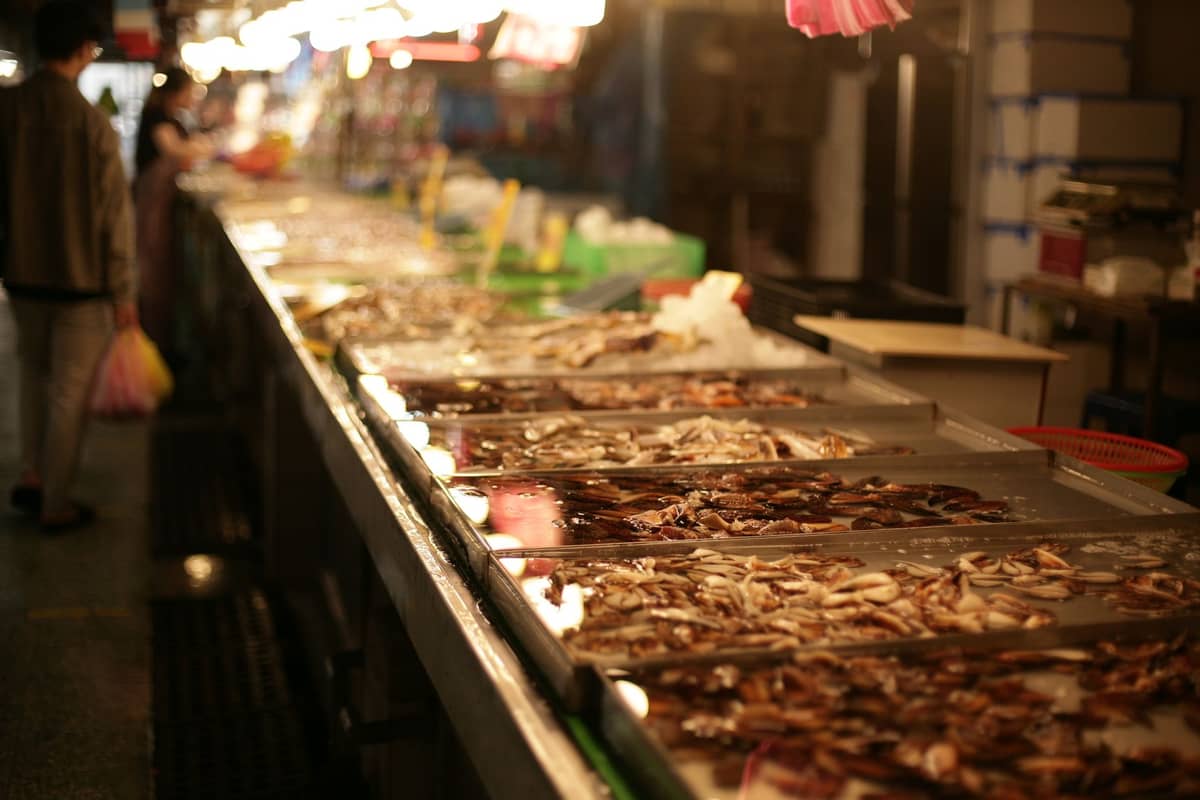
Walking into the market, the first thing that hits you is not the smell but the sound: aerators bubbling in hundreds of stacked tanks, vendors calling out prices in Cantonese, and the occasional crash of a crate being repositioned. The smell comes a moment later, clean and briny rather than rotting, which is a reliable sign that turnover is fast and the stock is genuinely fresh.
The range of species on offer reflects Guangdong's position at the meeting point of South China Sea fishing grounds and Pearl River aquaculture. Expect live grouper, mud crab, mantis shrimp, razor clams, sea cucumber, geoduck, various flatfish, tilapia, grass carp, and seasonal catches that shift month to month. High-value items like live abalone, lobster, and imported king crab occupy the more prominent stalls toward the main aisles. Budget-friendly options, whole fish sold by the catty, sit deeper in the market.
Beyond raw product, the market has sections selling dried and preserved seafood: salted fish, dried shrimp, scallop powder, and fermented shrimp paste. These are the pantry ingredients of Cantonese cooking, and the prices here are consistently lower than in supermarkets or retail specialty shops.
If the dried goods interest you, the dedicated retail strip on Yide Road in Yuexiu District is also worth comparing, but Huangsha tends to have a wider live selection and a more wholesale-oriented pricing structure.
How the Market Changes by Time of Day
Early morning, roughly from 5:00 to 9:00, is when the market runs at full capacity. Wholesale buyers move quickly, prices shift with negotiation, and the energy is almost frantic. Vendors restock tanks, delivery vehicles unload at the edges of the floor, and the whole place smells of the Pearl River at low tide. This is the best time to understand how the city's food supply actually works.
Mid-morning through early afternoon is when retail customers, including home cooks and curious visitors, take over. The pace slows, vendors have more time to explain what is in their tanks, and you can point at something unfamiliar without feeling like you are obstructing commerce. This window is generally better for first-time visitors who want to browse without pressure.
Some sources report that parts of the market operate into the late evening, while others list closing around midnight. In practice, activity appears to thin significantly in the late evening, though tank maintenance and restocking may continue. If you are arriving after 22:00 expecting a full market experience, you risk finding a largely quiet floor.
💡 Local tip
Visit between 7:00 and 10:00 for the best combination of full stock, active vendors, and authentic wholesale atmosphere. Weekdays are less crowded than weekends.
The Cantonese Food Context
To understand why Huangsha matters, you need to understand how central fresh seafood is to Cantonese cuisine. Cantonese cooking philosophy prizes the natural flavor of the ingredient above the complexity of the sauce. A live fish steamed with ginger, scallion, and light soy sauce is a showpiece dish precisely because it requires nothing to hide behind. The fish must be impeccably fresh, meaning still alive minutes before cooking.
This is why wholesale markets like Huangsha are not peripheral to Guangzhou's food culture; they are foundational. The same philosophy drives the city's celebrated dim sum tradition and its broader culinary identity. For a deeper look at what that translates to on the plate, the Guangzhou food guide covers the key dishes and where to find them across the city.
Several seafood restaurants operate near the market, and some vendors can arrange to have your purchase cooked at a nearby eatery, a well-established Guangzhou practice known locally as zichan zishao (自带自烧). The restaurant charges a cooking fee based on the weight and preparation method. This is a perfectly normal arrangement and one of the more memorable ways to eat in Guangzhou, as long as you are comfortable selecting live seafood and communicating your preferences, ideally with some Cantonese or Mandarin, or with a phone translation app.
Getting There and Practical Logistics
The original market site was a short walk from Huangsha Station on Metro Line 1 and Line 6. Exit F is commonly cited for the older Conggui Road address; GDToday references Exit D for the market area. Given the 2025 relocation, check current navigation apps using the name 黄沙水产中心 (Huangsha Aquatic Products Center) or the new address at No. 188 Shaluo Longwan Street to confirm the correct exit at the new site.
Liwan District places you in one of Guangzhou's older, more architecturally layered neighborhoods. The area around Huangsha and Shamian Island contains colonial-era buildings, traditional shophouse streets, and significant Pearl River frontage. If you are in the area, the historic Shamian Island riverfront is a short distance away and makes a natural pairing with a morning market visit, offering quiet tree-lined streets in contrast to the market's intensity.
Entry to the market is free. You pay only for what you buy. Prices are typically listed by jin (斤), the Chinese unit equivalent to 500 grams. Vendors expect some negotiation on larger purchases, but prices on individual items in the retail hours are usually closer to fixed. Bring cash; while mobile payment via WeChat Pay or Alipay is increasingly accepted, smaller stalls may still prefer cash for small transactions.
ℹ️ Good to know
The market floor can be wet and slippery at all hours. Wear closed-toe shoes with grip. Sandals or smooth-soled footwear are genuinely uncomfortable and potentially unsafe around water drainage channels.
Photography and Who Should Reconsider Visiting
The market offers strong documentary photography conditions in the early morning: low natural light filtered through industrial skylights, vivid colors from tanks and catch, and faces concentrated on work rather than the camera. Ask permission before photographing vendors directly. Most people are focused on their work and will not object to environmental shots, but pointing a camera at someone's face without acknowledgment is considered rude.
Be honest with yourself about whether this environment suits you. If live seafood in tanks, including animals being prepared for sale, is distressing to watch, this market will not be a comfortable experience. The process is matter-of-fact and unsentimental, as you would expect from a working food market. This is not a food hall with artistic plating; it is the raw supply chain. Travelers who prefer their food experiences more curated would do better exploring Guangzhou's restaurant scene directly.
For those who want market atmosphere without the wholesale intensity, the retail food streets around Shangxiajiu Pedestrian Street in Liwan offer a more accessible introduction to local eating culture.
Combining with the Surrounding Liwan Area
Huangsha and the surrounding Liwan waterfront sit in one of Guangzhou's most historically layered districts. Within walking distance or a short metro ride, you can reach the Chen Clan Ancestral Hall, one of the finest examples of southern Chinese decorative architecture, and the historic commercial lanes around Liwan Lake Park. A morning at the market followed by an afternoon exploring Liwan's architectural heritage makes for a full and coherent day in this part of the city.
For a broader overview of how Liwan fits into Guangzhou's geography and what else the district contains, the Liwan District guide provides useful orientation.
Insider Tips
- Use the Chinese name 黄沙水产中心 when searching navigation apps after the 2025 relocation. English listings have not caught up with the new address at No. 188 Shaluo Longwan Street.
- If you plan to do the buy-and-cook arrangement at a nearby restaurant, agree on the cooking fee per dish before handing over your seafood. A typical cooking charge is negotiated by weight and preparation method.
- Bring a lightweight insulated bag if you are purchasing to take home. The market has no dedicated cold packaging service for retail buyers, and seafood degrades quickly in Guangzhou's heat.
- Weekday mornings between Tuesday and Thursday tend to see lower foot traffic than weekends, which means vendors have more time to show you unfamiliar species and explain how to cook them.
- The dried seafood section near the back of the market is significantly cheaper than the retail prices on Yide Road. Stock up on dried shrimp, dried scallop (conpoy), and salted fish if you have cooking plans.
Who Is Huangsha Seafood Market For?
- Food travelers who want to understand Cantonese cuisine from the ingredient level up
- Home cooks or professionals sourcing fresh or dried seafood at wholesale-adjacent prices
- Early risers interested in the operational reality of how a major Chinese city feeds itself
- Photographers looking for unposed, documentary-style market scenes
- Travelers pairing a Liwan food morning with an afternoon of the district's heritage architecture
Nearby Attractions
Other things to see while in Liwan (Xiguan):
- Bruce Lee Ancestral Home
Tucked inside the restored Yongqing Fang heritage block in Liwan District, the Bruce Lee Ancestral Home is a small but quietly affecting tribute to one of the most influential figures in 20th-century popular culture. Free to enter and open most days, it rewards visitors who come with context and curiosity rather than expecting a grand museum experience.
- Cantonese Opera Art Museum
Housed in a sprawling classical Lingnan garden complex on Enning Road in Liwan District, the Cantonese Opera Art Museum is the most authoritative dedicated space for understanding yueju, the opera tradition that defines Guangdong's cultural identity. Free to enter and open most evenings on Fridays and Saturdays, it rewards visitors with theatrical costumes, intricate stage props, historic instruments, and architecture that is itself a performance.
- Chen Clan Ancestral Hall
Built between 1888 and 1893 as a center for education and ancestor worship, Chen Clan Ancestral Hall is the most elaborately decorated traditional compound in Guangzhou. Its nineteen linked halls are covered in stone carvings, wood reliefs, iron castings, ceramic friezes, and stucco moldings that represent the full range of Cantonese folk craft at its peak.
- Hualin Jade Street
Hualin Jade Street (华林玉器街) in Liwan District is where Guangzhou's jade trade has concentrated for centuries. Stretching roughly 500 metres through the old city, it packs in more than 80% of the city's jade merchants — from rough stone dealers to finished jewellery boutiques — all free to browse.