Bruce Lee Ancestral Home: A Martial Arts Legend Rooted in Liwan
Tucked inside the restored Yongqing Fang heritage block in Liwan District, the Bruce Lee Ancestral Home is a small but quietly affecting tribute to one of the most influential figures in 20th-century popular culture. Free to enter and open most days, it rewards visitors who come with context and curiosity rather than expecting a grand museum experience.
Quick Facts
- Location
- No. 13, Yongqingyi Lane, Enning Road, Liwan District, Guangzhou
- Getting There
- Huangsha Station, Metro Line 1 or Line 6, then walk to Yongqing Fang
- Time Needed
- 30–60 minutes for the home; 1.5–2 hours if you explore Yongqing Fang
- Cost
- Free admission
- Best for
- Film history enthusiasts, Cantonese culture lovers, heritage walkers
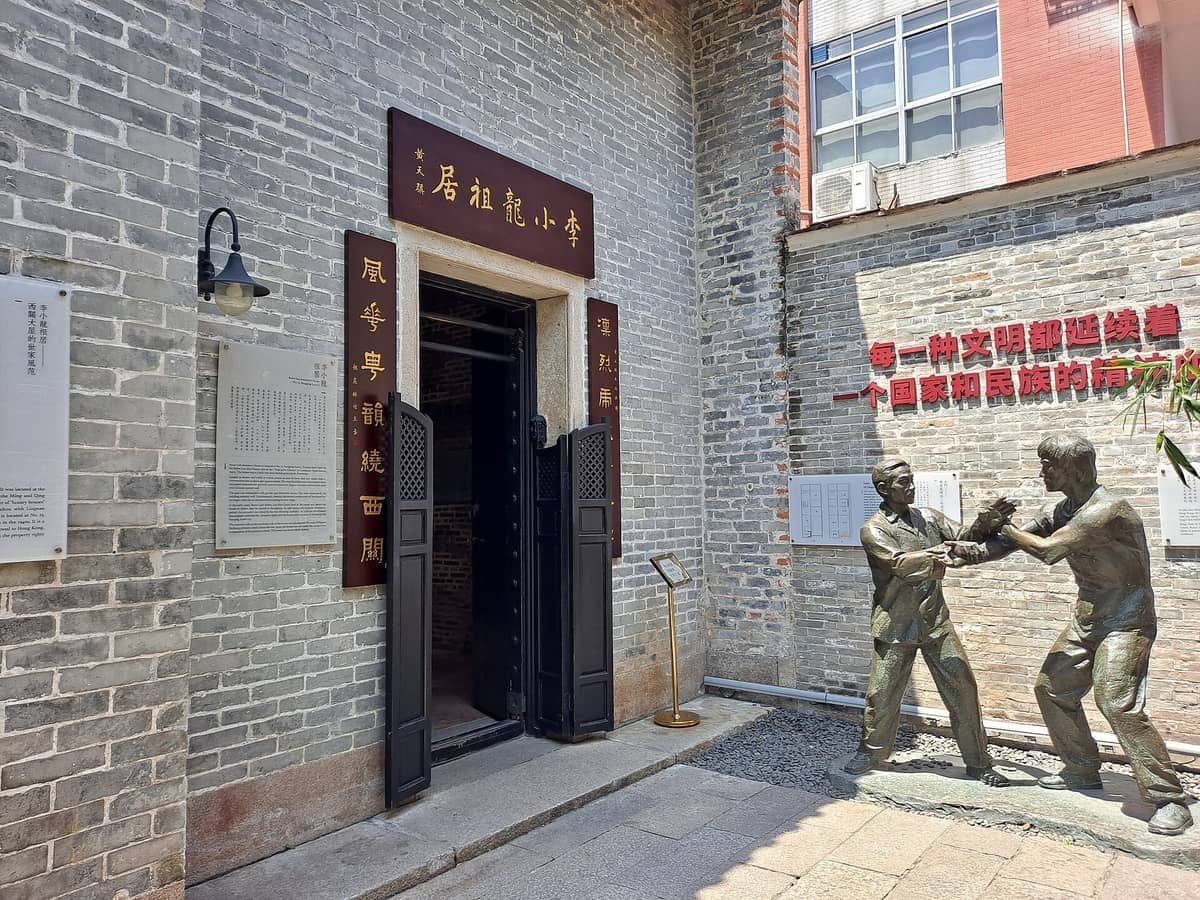
What Is the Bruce Lee Ancestral Home?
The Bruce Lee Ancestral Home, known in Chinese as 李小龙祖居, sits at No. 13, Yongqing Lane 1, on Enning Road in Liwan District. It is not a birthplace, and that distinction matters. Bruce Lee was born in San Francisco in 1940. This property in Guangzhou is the family home that his father, the Cantonese opera singer and actor Lee Hoi-chuen, purchased in 1947. It represents the Lee family's ancestral roots in the old Xiguan quarter of the city, and it connects one of Hong Kong and Hollywood's most iconic figures to a specific, walkable block of southern Chinese urban history.
The home is small by any standard. Visitors expecting a full biographical museum will find the scale modest. What the site does well is place Bruce Lee within a Cantonese context that is rarely foregrounded in the global narrative about him. Inside, you will find period photographs, family memorabilia, and displays about his father's career in opera and film, as well as exhibits tracing Bruce Lee's own trajectory from Hong Kong child actor to global martial arts icon.
ℹ️ Good to know
Opening hours: Tuesday to Sunday, 9:00 AM to 5:00 PM. Closed on Mondays. Admission is free. No reservation appears to be required.
The Setting: Yongqing Fang and the Xiguan Neighbourhood
The ancestral home does not stand in isolation. It sits within Yongqing Fang, a restored heritage block that has become one of the most photographed streetscapes in Guangzhou. The area is characterised by Xiguan-style architecture: narrow lanes flanked by two-storey residential buildings with carved wooden screens, coloured glass transoms, and granite thresholds worn smooth by foot traffic over generations. These are the hallmarks of the old western city quarter, where merchant families and opera troupes once shared the same dense urban fabric.
Liwan District earned its reputation as Guangzhou's cultural heartland precisely because of streets like this one. The neighbourhood has historically been the centre of Cantonese opera, traditional crafts, and the antique trade. Walking from Huangsha Station to Yongqing Fang, you pass remnants of that older city: medicine shops, incense traders, and the faded signage of businesses that predate the Pearl River waterfront's current skyline. For a broader sense of Liwan's personality, the Shangxiajiu Pedestrian Street is a short walk northeast and gives a complementary, more commercial angle on the same district.
Yongqing Fang itself was renovated in recent years, and the renovation is evident. The lane feels curated, with craft coffee shops, design boutiques, and casual eateries occupying the ground floors of restored shophouses. On weekend afternoons, crowds gather here for the atmosphere as much as for any single attraction. The Bruce Lee home sits toward the quieter end of the lane, and the contrast between the relaxed cafe-going foot traffic outside and the more reflective mood inside the heritage site is noticeable.
Inside the Home: What You Actually See
The residence is structured around a traditional Xiguan layout: compact rooms arranged around a narrow light well, with original wooden furniture and fittings preserved or restored throughout. The ground floor introduces the Lee family's background in Cantonese opera and the specific social world of the Xiguan merchant class. Lee Hoi-chuen was a well-known performer in the Cantonese opera circuit, and that career took the family between Guangzhou, Hong Kong, and eventually the United States, which is where Bruce Lee was born.
Upper-floor displays shift focus to Bruce Lee's own career: his training under Ip Man, his time in Seattle and San Francisco, and his emergence as a film star in Hong Kong before his American breakthrough. The photographs are the strongest element. There are images of Lee Hoi-chuen performing on stage, early family portraits, and production stills that span Bruce Lee's trajectory from child actor in Hong Kong films to the set of Enter the Dragon. Captions are in both Chinese and English, which makes the exhibits accessible to international visitors.
The displays are not extensive by the standards of a dedicated museum. The home covers perhaps 200 square metres across two floors. What it offers is not exhaustive documentation but a sense of physical place, of the specific architectural environment that shaped a family's identity across generations. For visitors who have any prior knowledge of Bruce Lee's biography, the site will add texture to that knowledge. For visitors who arrive with no background, the story can feel incomplete.
💡 Local tip
Read a short biography of Bruce Lee before visiting. The displays assume some familiarity, and knowing the basic arc of his life — Cantonese opera family, Hong Kong childhood, American education, martial arts philosophy, Hollywood films — will make the exhibits significantly more rewarding.
How the Experience Changes by Time of Day
Yongqing Fang is at its most atmospheric in the early morning, when the lane is nearly empty and the light falls obliquely on the carved wooden facades. The Bruce Lee home opens at 9:00 AM, and arriving close to opening time gives you the rooms to yourself, which suits the reflective tone of the space considerably better than sharing it with a crowded group. The smell of incense from a nearby temple drifts through the lane at this hour, and the stone underfoot is still cool. It is the closest the experience gets to what this neighbourhood might have felt like in the 1940s when Lee Hoi-chuen's family lived here.
By midday on weekends, Yongqing Fang fills with visitors primarily interested in the cafes and boutiques. The Bruce Lee home remains relatively uncrowded compared to the lane itself, but the ambient noise level rises noticeably. Weekend afternoons bring tour groups, and the interior can feel cramped when more than fifteen people are inside at once. Weekday mornings are reliably quieter. The site closes at 5:00 PM and is shut on Mondays.
Getting There and Practical Notes
The most straightforward route is the Guangzhou Metro. Take Line 1 or Line 6 to Huangsha Station and use Exit B. From there, Yongqing Fang is a short walk south along Enning Road. The walk itself is interesting: Enning Road retains much of its pre-renovation streetscape, with pharmacy signage in traditional script and the occasional Lingnan-style carved stone threshold. Buses No. 2 and No. 3 also stop at Enning Lu Station if you prefer surface transport.
There is no dedicated parking near Yongqing Fang, and the lanes are too narrow for vehicles. Ride-hailing apps including DiDi drop off on Enning Road itself. If you are combining this visit with other Liwan sites, Yongqing Fang as a neighbourhood destination is worth half a day in its own right, especially if you are also interested in the traditional architecture along the surrounding lanes.
Accessibility information for the site is not currently documented in available sources. The traditional Xiguan layout typically involves narrow doorways, raised thresholds, and stairways without handrails. Visitors with mobility requirements should contact the site in advance or expect potential limitations.
⚠️ What to skip
The site is closed every Monday. If your Guangzhou itinerary is limited to a Monday, plan the Chen Clan Ancestral Hall or another Liwan attraction instead and save this for a different day.
Cultural Significance: Why This Site Matters Beyond the Name
Bruce Lee is among the most globally recognised figures from the Cantonese-speaking world, yet his connection to Guangzhou is largely unknown outside of China. Most international accounts of his life anchor him in Hong Kong or the United States. The ancestral home in Liwan is a corrective to that partial picture. It situates him within a specific Cantonese cultural tradition — the opera families of the Pearl River Delta, the Xiguan merchant quarter, the migratory circuits between Guangzhou, Hong Kong, and the Chinese diaspora in North America — that directly shaped who he became. His martial arts philosophy, his physicality, his performance style: all of these have roots in a cultural lineage that this house represents in concrete form. For more context on Cantonese cultural heritage in Liwan, the Chen Clan Ancestral Hall and the Cantonese Opera Art Museum offer complementary depth.
It is also worth noting that Liwan District as a whole is one of the best-preserved examples of old Guangzhou urban life. The district's historical character — narrow lanes, Xiguan residential architecture, the legacy of the southern Silk Road trade — is documented in detail across several nearby heritage sites. The Liwan District page covers the broader neighbourhood context if you want to plan a full day around the area.
Who Should Reconsider This Visit
If you have very limited time in Guangzhou and are primarily interested in large-scale heritage experiences, this site may not rank highly enough to displace other priorities. The home is compact, the exhibits are modest in scope, and the surrounding Yongqing Fang area, while photogenic, is primarily a leisure and dining destination rather than a deep cultural immersion. Visitors who find small house museums unsatisfying, or who need extensive multilingual interpretation to engage with historical material, may leave feeling the visit was brief to a fault.
For visitors who are specifically interested in Bruce Lee, Cantonese heritage, or the social history of pre-war Guangzhou, the site earns its time. Its free admission removes any cost-versus-value calculation, and the walk through the surrounding lanes adds genuine texture even if the interior exhibits are not exhaustive.
Insider Tips
- Arrive within the first thirty minutes of opening on a weekday for the quietest experience. The rooms are small and the atmosphere shifts significantly when more than a dozen visitors are inside at once.
- Look at the light well in the centre of the house carefully. The proportions and natural lighting system are a defining feature of Xiguan residential architecture and tell you as much about how people lived here as any exhibit panel.
- The surrounding lanes immediately off Yongqing Fang — particularly the smaller residential alleys to the south — see far fewer visitors than the main strip and give a less curated sense of what the neighbourhood actually looks like when the renovation fades.
- If you read Chinese, the Chinese-language panels inside contain more biographical detail than the English translations. Ask a Mandarin or Cantonese speaker in your group to read ahead if possible.
- Combine the visit with the Cantonese Opera Art Museum, which is nearby and similarly free. The two sites together create a coherent picture of the cultural world Bruce Lee's father inhabited as a professional opera performer.
Who Is Bruce Lee Ancestral Home For?
- Film history and martial arts enthusiasts who want to understand Bruce Lee's cultural roots
- Architecture and heritage walkers interested in Xiguan residential design
- Visitors building a half-day itinerary around Liwan's old-city lanes
- Travellers interested in the Chinese diaspora experience and its Cantonese origins
- Anyone looking for a free, unhurried cultural stop that rewards prior knowledge
Nearby Attractions
Other things to see while in Liwan (Xiguan):
- Cantonese Opera Art Museum
Housed in a sprawling classical Lingnan garden complex on Enning Road in Liwan District, the Cantonese Opera Art Museum is the most authoritative dedicated space for understanding yueju, the opera tradition that defines Guangdong's cultural identity. Free to enter and open most evenings on Fridays and Saturdays, it rewards visitors with theatrical costumes, intricate stage props, historic instruments, and architecture that is itself a performance.
- Chen Clan Ancestral Hall
Built between 1888 and 1893 as a center for education and ancestor worship, Chen Clan Ancestral Hall is the most elaborately decorated traditional compound in Guangzhou. Its nineteen linked halls are covered in stone carvings, wood reliefs, iron castings, ceramic friezes, and stucco moldings that represent the full range of Cantonese folk craft at its peak.
- Hualin Jade Street
Hualin Jade Street (华林玉器街) in Liwan District is where Guangzhou's jade trade has concentrated for centuries. Stretching roughly 500 metres through the old city, it packs in more than 80% of the city's jade merchants — from rough stone dealers to finished jewellery boutiques — all free to browse.
- Huangsha Seafood Market
Huangsha Aquatic Product Trading Market is Guangzhou's most serious seafood destination, a wholesale-turned-retail floor in Liwan District where tanks overflow with live fish, crabs, and shellfish. Converted from an old freight terminal in 1994, it has fed both professional chefs and curious travelers for decades.