Hualin Jade Street: Guangzhou's Jade Trading Heart in Liwan
Hualin Jade Street (华林玉器街) in Liwan District is where Guangzhou's jade trade has concentrated for centuries. Stretching roughly 500 metres through the old city, it packs in more than 80% of the city's jade merchants — from rough stone dealers to finished jewellery boutiques — all free to browse.
Quick Facts
- Location
- Hualin New Street area, Liwan District, Guangzhou (near Kangwang Middle Road)
- Getting There
- Metro Line 8 — Hualinsi Station; or Metro Line 1 — Changshou Lu Station
- Time Needed
- 1–2 hours for casual browsing; half a day if you plan to negotiate and buy
- Cost
- Free to enter and browse; prices for jade vary enormously by quality
- Best for
- Jade and gemstone buyers, Cantonese culture enthusiasts, serious collectors
What Is Hualin Jade Street?
Hualin Jade Street — officially known as 华林玉器街, sometimes rendered as Hualinsi Jade Street or Hualin Jadeware Street in English — is the undisputed centre of Guangzhou's jade and gemstone trade. Running for roughly 500 metres through the historic core of Liwan District, the street and its surrounding lanes hold the greatest concentration of jade merchants in the city, reportedly accounting for more than 80% of Guangzhou's jade wholesale and retail business.
This is not a curated tourist attraction with a ticket booth and an audio guide. It is a working commercial street where buyers from across China and Southeast Asia come to source goods. That professional energy is exactly what makes it interesting. Vendors display raw stones alongside polished bangles, and the air carries the faint mineral smell of freshly cut rock and the occasional waft of incense from nearby Hualin Buddhist Temple.
ℹ️ Good to know
There is no admission fee. The street is publicly accessible and open to browsers, though the concentration of wholesale activity means most serious vendors expect engaged buyers rather than passive tourists.
A Market With Qing Dynasty Roots
The market's origins trace to the early Qing Dynasty, when Liwan — then known as Xiguan (the Western Quarter) — was the commercial heartland of Guangzhou. Xiguan was where wealthy merchant families built their ornate residences, and the surrounding lanes became specialised trading zones for silks, antiques, dried goods, and precious stones. Jade, long associated with virtue, longevity, and status in Chinese culture, found a natural home here.
The street's proximity to Hualin Buddhist Temple, one of Guangzhou's oldest religious sites, was no coincidence. Religious pilgrims passing through to the temple provided an early customer base, and the exchange of auspicious objects — jade pendants, carved figurines, prayer beads — was a natural fit for the neighbourhood. Over generations, the jade trade deepened until the street became a dedicated market, and by the 20th century it had taken its current form as a dense corridor of specialist shops.
Liwan District as a whole carries this layered history across many of its lanes. If you want to understand the neighbourhood better before or after visiting Hualin Jade Street, the Shangxiajiu Pedestrian Street and Chen Clan Ancestral Hall are both within the same cultural orbit and show the same Xiguan merchant heritage from different angles.
What You Actually See: Walking the Street
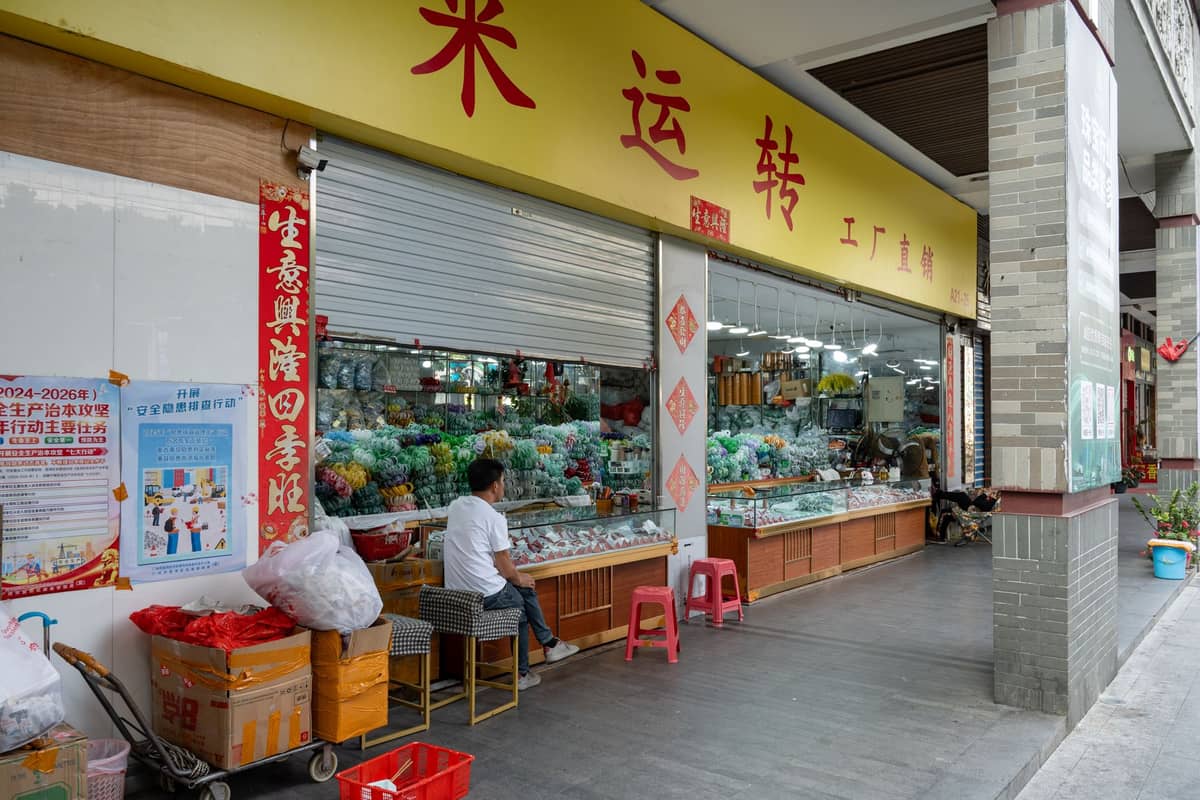
Step off the Metro at Hualinsi Station and you'll be on the street within two minutes. The transition from the modern metro environment to the market is abrupt: the pavement narrows, the storefronts multiply, and the visual noise rises immediately. Glass display cases line both sides of the street, filled with bangles in every shade of green, white, lavender, and yellow. Some shops specialise in raw material — rough boulders of jadeite or nephrite sitting on wooden pallets, their cut surfaces catching the fluorescent light. Others deal strictly in finished jewellery.
The market has two tiers of trade operating simultaneously. At street level, retail shops sell finished goods at relatively accessible prices to walk-in customers. In the buildings set slightly back from the main thoroughfare, and in the multi-storey jade malls that anchor parts of the street, wholesale transactions happen on a larger scale. It is worth going up a floor or two in one of these buildings. The density of merchandise increases, the vendors are more focused, and you get a clearer picture of how large the professional trade actually is.
Apart from jade, the street carries a secondary trade in related gemstones: amber, turquoise, agate, pearl, and various decorative stones from Yunnan and Myanmar. Some vendors specialise in carved figurines of Buddhist iconography. The mix makes the street useful even if jade is not your primary interest.
How the Market Changes Through the Day
The best window for a genuine experience is mid-morning, roughly 9:30 to 11:30. This is when professional buyers are active, the stalls are fully stocked, and the light is good enough to assess stone colour without needing an ultraviolet lamp. Vendors are alert and willing to talk through their inventory, especially if you approach with some knowledge or genuine curiosity.
By early afternoon, the street thins out. Some of the smaller retailers close for a lunch break between roughly noon and 2:00 PM, a common pattern in older Guangzhou commercial streets. This lull is less rewarding for shopping but gives you a chance to walk the full length of the market without the foot traffic.
Weekend mornings bring noticeably larger crowds, including domestic tourists and day-trippers from elsewhere in the Pearl River Delta. If you are there to buy seriously and negotiate without distraction, a weekday morning is preferable. Conversely, the weekend energy — with more vendors pulling out their best pieces and more price competition — can work in a buyer's favour.
💡 Local tip
Weekday mornings between 9:30 and 11:30 offer the best combination of fully stocked stalls, active professional trade, and manageable crowd levels. Avoid late afternoons on weekdays, when many retail shops start winding down.
Buying Jade: What to Know Before You Spend
Jade is one of the most complex gemstone markets in the world, and Hualin Jade Street is no place for impulsive purchases of high-value pieces unless you know what you are doing. There are two distinct materials sold under the umbrella term 'jade': jadeite (翡翠, feicui), which is harder, denser, and generally more valuable, originating primarily from Myanmar; and nephrite (软玉, ruanyu), a softer stone with a longer history in Chinese culture. Most of the premium trade on this street involves jadeite.
Quality grading in jadeite follows colour saturation, translucency (known as 'water' in the trade), texture, and the absence of inclusions or cracks. Imperial green jadeite with high translucency commands the highest prices and can run to figures that would surprise casual visitors. For everyday decorative pieces, bangles, and small pendants in mid-grade material, prices are far more accessible and represent reasonable value given the concentration of supply.
Bring a UV flashlight or a jeweller's loupe if you are a serious buyer — they are standard tools for checking whether stone has been chemically treated or polymer-filled to improve its apparent quality. Reputable vendors will not object to you examining merchandise. Be cautious of pieces priced far below market expectations for their apparent quality; treatment of jade is widespread in lower market segments.
⚠️ What to skip
Bargaining is standard practice on this street, but do not assume a large discount indicates a find. Inflated initial prices followed by theatrical negotiation is a common retail technique. Research benchmark prices before you arrive.
Getting There, Navigating Around, and Practical Notes
The cleanest approach is Metro Line 8 to Hualinsi Station, or Metro Line 1 to Changshou Lu Station, both of which are within walking distance of the market. Both routes are straightforward.
The street itself runs through a dense urban area with uneven paving in places, narrow stretches, and significant foot traffic during peak hours. Wheelchair accessibility is not guaranteed, and the buildings housing the indoor jade malls typically have steps at their entrances. Bring comfortable shoes for extended browsing.
Hualin Jade Street sits within easy reach of several other Liwan landmarks. The Liwan Lake Park is a short distance to the northwest, offering a good decompression point after the commercial intensity of the market. The area around Kangwang Middle Road also connects naturally toward Yongqingfang, Guangzhou's Yongqingfang cultural district, where the neighbourhood's older lane architecture has been preserved and activated with cafes, studios, and small restaurants.
If you are making a full day of Liwan's historic districts, pair Hualin Jade Street with the nearby Huaisheng Mosque and then walk across to Shangxiajiu for lunch — the neighbourhood rewards unhurried exploration on foot. For broader context on how this area fits into Guangzhou's old commercial districts, the Guangzhou walking tour guide covers several routes through Liwan.
Who Will Enjoy This — and Who Might Not
Visitors with a genuine interest in jade, gemstones, or Chinese jewellery culture will find Hualin Jade Street difficult to rival anywhere in southern China. The scale and variety of material available in one concentrated stretch is exceptional, and the presence of professional wholesale trade means you are seeing the real market, not a sanitised tourist version of it.
Travellers with no interest in shopping or gemstones will find the cultural and historical texture thin once the initial novelty of the sheer quantity of jade on display has worn off. The street lacks the architectural drama of Liwan's best-preserved lane areas, and the commercial focus means there is little to stop and look at beyond the merchandise itself. If you are not in buying mode, an hour is genuinely enough.
Parents with young children should be aware that the indoor malls have dense, fragile display cases and narrow aisles, which can be stressful with a stroller or an energetic toddler. The street is manageable, but the indoor shopping buildings are not designed for family browsing.
Insider Tips
- The indoor jade malls set back from the main street — particularly those along the Hualin New Street section — carry a wider range of wholesale-grade material than the street-front retail shops. Go upstairs in at least one building to see the full scope of the trade.
- If you want to learn about jade quality without any sales pressure, spend time watching professional buyers examine merchandise before approaching a vendor yourself. Their assessment technique — angling the stone toward the light source, checking translucency with a flashlight — is visible and instructive.
- Vendors who speak Cantonese and Mandarin are the norm; English is rare. A translation app on your phone is genuinely useful here, both for reading product labels and for negotiating prices, which are often written down on paper rather than spoken aloud.
- The area directly around Hualinsi Buddhist Temple, a few minutes' walk from the market's northern end, is quieter and gives you context for the neighbourhood's pre-commercial history. The temple itself (华林寺) is one of Guangzhou's oldest Buddhist sites and is worth a short visit before or after the market.
- For photography, the raw stone displays near the market's southern entrance photograph well in morning light. The polished goods under fluorescent store lighting are harder to capture accurately — the real colour and translucency of quality jade is almost always better in natural light than in any indoor photo.
Who Is Hualin Jade Street For?
- Jade collectors and serious gemstone buyers looking for wholesale-adjacent pricing and real variety
- Travellers interested in Cantonese commercial history and the culture of the old Xiguan merchant quarter
- Shoppers wanting to buy jade gifts or jewellery at competitive prices with a wide selection
- Architecture and urban explorers using the market as a starting point for a deeper walk through Liwan's historic lanes
- Anyone curious about how a centuries-old specialist trade actually operates at scale in a modern Chinese city
Nearby Attractions
Other things to see while in Liwan (Xiguan):
- Bruce Lee Ancestral Home
Tucked inside the restored Yongqing Fang heritage block in Liwan District, the Bruce Lee Ancestral Home is a small but quietly affecting tribute to one of the most influential figures in 20th-century popular culture. Free to enter and open most days, it rewards visitors who come with context and curiosity rather than expecting a grand museum experience.
- Cantonese Opera Art Museum
Housed in a sprawling classical Lingnan garden complex on Enning Road in Liwan District, the Cantonese Opera Art Museum is the most authoritative dedicated space for understanding yueju, the opera tradition that defines Guangdong's cultural identity. Free to enter and open most evenings on Fridays and Saturdays, it rewards visitors with theatrical costumes, intricate stage props, historic instruments, and architecture that is itself a performance.
- Chen Clan Ancestral Hall
Built between 1888 and 1893 as a center for education and ancestor worship, Chen Clan Ancestral Hall is the most elaborately decorated traditional compound in Guangzhou. Its nineteen linked halls are covered in stone carvings, wood reliefs, iron castings, ceramic friezes, and stucco moldings that represent the full range of Cantonese folk craft at its peak.
- Huangsha Seafood Market
Huangsha Aquatic Product Trading Market is Guangzhou's most serious seafood destination, a wholesale-turned-retail floor in Liwan District where tanks overflow with live fish, crabs, and shellfish. Converted from an old freight terminal in 1994, it has fed both professional chefs and curious travelers for decades.