Cantonese Opera Art Museum: Where a Living Art Form Gets Its Due
Housed in a sprawling classical Lingnan garden complex on Enning Road in Liwan District, the Cantonese Opera Art Museum is the most authoritative dedicated space for understanding yueju, the opera tradition that defines Guangdong's cultural identity. Free to enter and open most evenings on Fridays and Saturdays, it rewards visitors with theatrical costumes, intricate stage props, historic instruments, and architecture that is itself a performance.
Quick Facts
- Location
- No. 127 Enning Road, Liwan District, Guangzhou
- Getting There
- Huangsha Metro Station (Lines 1 & 6, Exit B), then about 800 meters (10 minutes) via Yongqingfang arcade street
- Time Needed
- 1.5 to 3 hours depending on interest level
- Cost
- Free; advance reservation required via WeChat official account '粤剧艺术博物馆'
- Best for
- Culture lovers, architecture fans, photographers, families, and curious first-timers
What the Cantonese Opera Art Museum Actually Is
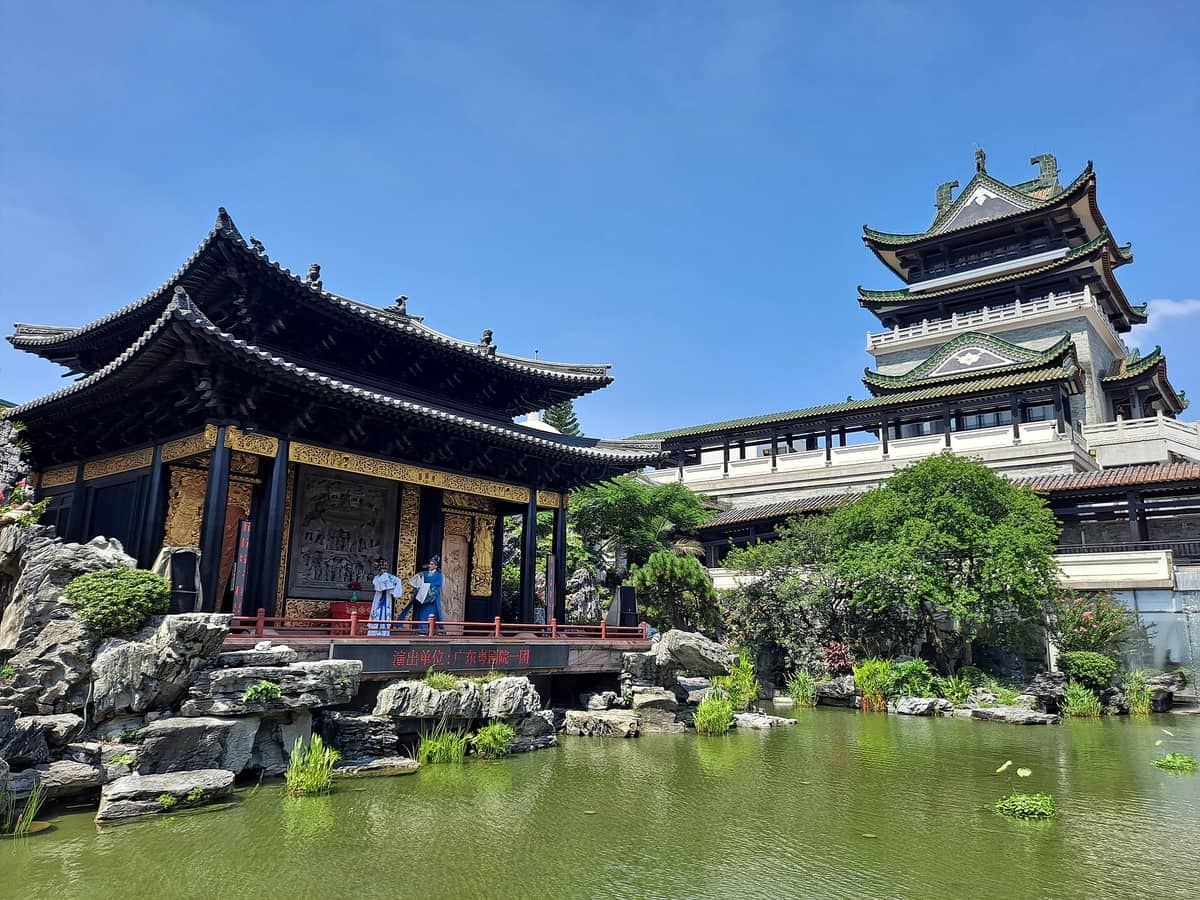
The Cantonese Opera Art Museum (粤剧艺术博物馆) opened in 2016 at No. 127 Enning Road in Liwan District, making it one of Guangzhou's newer major cultural institutions, but it feels anything but new. The complex covers a total land area of 17,200 square meters with a building area of 21,700 square meters, arranged as a classical Lingnan-style garden with covered walkways, ornamental ponds, carved stone bridges, and layered rooflines decorated in the glazed tilework distinctive to southern Chinese architecture.
Cantonese opera, known in Chinese as yueju (粤剧), is one of the major regional opera forms in China and the dominant theatrical tradition of Guangdong Province and Hong Kong. It blends music, poetry, martial arts, acrobatics, and elaborate costuming into staged narratives that have evolved over roughly 400 years. In 2009, UNESCO added Cantonese opera to its Representative List of the Intangible Cultural Heritage of Humanity, and this museum exists partly to anchor that recognition with a permanent physical home.
If you want to understand why Guangzhou's cultural identity is so distinct from the rest of China, Cantonese opera is one of the clearest entry points. For context on the broader cultural landscape of the city, the Guangzhou Cantonese opera guide covers where to catch live performances and what to look for when you attend.
ℹ️ Good to know
Advance reservation is required and is done through the museum's official WeChat account (粤剧艺术博物馆). If you don't have WeChat set up before arrival, sort this out the night before, as walk-in access without a booking is not guaranteed.
The Architecture: A Garden That Performs Alongside the Exhibits
Most museums in China compete with their own contents. Here, the building is part of the exhibit. The Cantonese Opera Art Museum was designed in the Lingnan garden tradition, which draws on classical Chinese garden principles but adapts them to the humid subtropical environment of Guangdong Province: shaded corridors, water features that cool the air, layered planting that provides color year-round, and decorative details executed in painted ceramics, carved woodwork, and polished granite.
The interior courtyards are connected by arched bridges over lotus ponds, and many of the pavilion eaves carry figurative ceramic friezes depicting operatic scenes. Even visitors with no prior interest in Cantonese opera tend to slow down here and look up. The craftsmanship is not decorative filler — it is a deliberate extension of the opera tradition itself, since the same artisans' guilds that supplied scenery and props for yueju performances historically also worked on temple and garden ornamentation across Guangdong.
The museum sits in Liwan District, which remains the most architecturally coherent of Guangzhou's older urban areas. Nearby streets like Enning Road and the surrounding neighborhood preserve an unusual density of pre-modern shophouse facades and lane culture. Pairing the museum with a walk along Yongqingfang — a restored Qing and Republican-era lane complex just minutes away — gives you a full picture of what this part of Guangzhou looked like before rapid development reshaped most of the city.
Inside: What the Permanent Collection Covers
The permanent galleries move through the full ecosystem of Cantonese opera: the history of the art form from its origins in Guangdong and its spread through overseas Chinese communities across Southeast Asia, North America, and Australia; the instruments used in the opera orchestra (dominated by the gaohu, a two-stringed spike fiddle, alongside percussion and wind instruments); the costume tradition, which involves heavily embroidered silk robes with coded color schemes indicating character type and social rank; and the makeup conventions, where face painting serves the same function as a playbill, telling audiences who a character is before a single word is spoken.
The costume display cases are particularly worth time. Cantonese opera costuming is technically distinct from Beijing opera: the embroidery motifs, the cut of sleeves, and the weight of the headdresses all differ. Full sets of the most elaborate costumes can take hundreds of hours to produce and weigh several kilograms. Seeing them under museum lighting, close up, makes clear why the tradition requires specialist artisans entirely separate from the performers themselves.
The temporary exhibition hall has its own hours: 9:00 to 17:30, compared to the main museum which stays open until 21:00 on Fridays and Saturdays. Temporary shows often focus on specific aspects of the tradition, visiting troupes, or contemporary interpretations of yueju aesthetics. Check the WeChat account for current programming before your visit, as shows rotate and some are genuinely excellent.
💡 Local tip
The museum is open until 21:00 on Friday and Saturday evenings. A visit around 6:30 to 7:00 pm is noticeably quieter than mid-afternoon, the garden lighting shifts to a warmer tone, and the reflection of the pavilion rooflines in the ponds is worth the wait.
How the Experience Changes by Time of Day
Late morning on weekdays sees a mix of school groups and older local visitors, many of whom grew up with Cantonese opera as a household sound and engage with the exhibits differently from international tourists. Listening to the audio guides playing near the instrument cases, or watching an elderly visitor study a costume in the glass case with the recognition of someone who saw it worn on stage, adds a layer to the visit that no guidebook can manufacture.
Weekend afternoons bring larger crowds and more families with children. The outdoor garden areas can feel congested at peak times on Saturdays, particularly around the central pond and the photogenic bridge structures. If you visit on a weekend, arrive at opening (9:00) or after 17:00 when day-trip crowds thin out.
Evening visits have a quieter, more contemplative feel. The gallery rooms are less crowded, the outdoor corridors empty out, and the combination of warm interior light through latticed windows and the cooler air of the garden creates an atmosphere that the daytime visit doesn't quite replicate. For photographers, the golden hour before dusk and the hour after are the most productive windows.
Practical Walkthrough: Getting There and Moving Around
The most straightforward transit option is Huangsha Station, served by Metro Lines 1 and 6, Exit B. From the station exit, walk about 800 meters (10 minutes) via Yongqingfang arcade street. The route passes some of Liwan's most intact shophouse streetscapes, so allow extra time if street-level architecture holds your attention.
Liwan District rewards unhurried exploration. If you're already in the area for Shangxiajiu Pedestrian Street, the museum is reachable on foot in under 15 minutes. The getting around Guangzhou guide has full metro map details and advice on day-trip logistics from different starting points across the city.
The museum complex spans multiple linked buildings across a large footprint. A rough internal circuit covers the main entrance hall, three or four primary gallery wings, the garden courtyard, the temporary exhibition space, and several secondary pavilions. There is no strict prescribed route, which suits exploratory visitors but can frustrate those who want a linear narrative. The bilingual signage in English and Chinese is reasonably consistent throughout the permanent galleries, though some secondary pavilion labels are Chinese only.
⚠️ What to skip
The museum is closed on Mondays, except when Monday falls on a public holiday. Plan accordingly, particularly during Golden Week periods when the holiday schedule shifts.
What to Expect if You Know Nothing About Cantonese Opera
The museum does not require prior knowledge and makes no assumptions about the visitor's familiarity with yueju. The introductory hall provides enough historical and contextual grounding to make the subsequent exhibits legible. English-language information is present throughout the permanent galleries, and the visual and material nature of most exhibits — costumes, instruments, props, architectural models — means that even visitors who cannot read Chinese will find the content accessible.
That said, a small amount of preparation deepens the experience significantly. Before visiting, watching even 10 minutes of a Cantonese opera excerpt online gives you an auditory reference for the instruments on display and a visual reference for how the costumes move during performance. It converts abstract objects behind glass into equipment with a function you have seen in action.
Visitors who find opera generally uninteresting should not dismiss this museum as inaccessible. The garden architecture alone justifies the visit, and the costume and prop collections function as craft and textile history independent of any theatrical context. The museum is not a venue where you sit and watch performances. It is a physical record of a complete cultural world.
Who This Museum Is Not For
Visitors expecting interactive displays, audio-visual spectacle, or the kind of technology-driven museum experience common in newer institutions in Shanghai or Beijing may find the format relatively traditional. The emphasis is on authentic objects, scholarly presentation, and architectural atmosphere rather than gamified learning or large-format projections. Children under around 8 years old may disengage quickly in the gallery wings, though the garden spaces give them room to move.
Travelers on a very tight schedule who are trying to cover major landmarks in a single day should be honest about priorities. This museum takes a minimum of 90 minutes to do justice to and benefits from a slower pace. If your Guangzhou day only has room for one stop in Liwan, the choice between this and a street-level neighborhood walk depends entirely on your interest in material culture versus urban texture.
Insider Tips
- Reserve your slot on the WeChat official account (粤剧艺术博物馆) the evening before your visit. Same-morning bookings sometimes work on quiet weekdays, but weekend slots can fill by Thursday.
- The rooftop ceramic friezes along the main entrance pavilion are best photographed from the central garden courtyard, roughly 15 to 20 meters back, in the mid-morning light before shadows from neighboring wings fall across the facade.
- Ask at the front desk whether any live demonstration events are scheduled during your visit. The museum occasionally hosts short performance sessions in the garden pavilion space, which are free with entry and give context that no exhibit case can replicate.
- The museum's internal garden is one of the few places in Liwan where you can sit on a stone bench beside a lotus pond in relative quiet on a weekday morning. It works as a rest stop in the middle of a longer Liwan walking day.
- Combine your visit with the surrounding Enning Road streetscape before or after. The block between the museum and Yongqingfang concentrates a high density of Cantonese shophouse architecture, craft workshops, and small food stalls that put the opera tradition in its living neighborhood context.
Who Is Cantonese Opera Art Museum For?
- First-time visitors to Guangzhou who want cultural depth beyond temples and markets
- Architecture and design-focused travelers interested in classical Lingnan garden construction
- Travelers with an interest in textile, costume, or craft history
- Families with older children (roughly 9 and up) curious about Chinese performing arts
- Anyone building a Liwan District walking day who wants an anchor attraction
Nearby Attractions
Other things to see while in Liwan (Xiguan):
- Bruce Lee Ancestral Home
Tucked inside the restored Yongqing Fang heritage block in Liwan District, the Bruce Lee Ancestral Home is a small but quietly affecting tribute to one of the most influential figures in 20th-century popular culture. Free to enter and open most days, it rewards visitors who come with context and curiosity rather than expecting a grand museum experience.
- Chen Clan Ancestral Hall
Built between 1888 and 1893 as a center for education and ancestor worship, Chen Clan Ancestral Hall is the most elaborately decorated traditional compound in Guangzhou. Its nineteen linked halls are covered in stone carvings, wood reliefs, iron castings, ceramic friezes, and stucco moldings that represent the full range of Cantonese folk craft at its peak.
- Hualin Jade Street
Hualin Jade Street (华林玉器街) in Liwan District is where Guangzhou's jade trade has concentrated for centuries. Stretching roughly 500 metres through the old city, it packs in more than 80% of the city's jade merchants — from rough stone dealers to finished jewellery boutiques — all free to browse.
- Huangsha Seafood Market
Huangsha Aquatic Product Trading Market is Guangzhou's most serious seafood destination, a wholesale-turned-retail floor in Liwan District where tanks overflow with live fish, crabs, and shellfish. Converted from an old freight terminal in 1994, it has fed both professional chefs and curious travelers for decades.