Yongqingfang (永庆坊): Guangzhou's Living Lingnan Alleyway District
Yongqingfang is a carefully restored century-old alleyway quarter in Liwan District, where traditional Lingnan architecture sits alongside independent cafes, craft studios, and Cantonese street food. Entry is free, the streets are walkable, and the atmosphere shifts dramatically between a quiet morning and a packed weekend evening.
Quick Facts
- Location
- Enning Road, Liwan District, Guangzhou
- Getting There
- Huangsha Station (Lines 1 & 6); or Changshou Road Station
- Time Needed
- 1.5 to 3 hours
- Cost
- Free to enter (individual shops and venues charge separately)
- Best for
- Architecture lovers, food explorers, photography, cultural history
What Is Yongqingfang?
Yongqingfang (永庆坊) is a restored historic alleyway district on Enning Road in Liwan District, one of Guangzhou's oldest urban cores. The project was officially launched in 2016, but the lane network itself dates back to the early twentieth century, when Guangzhou was rebuilding its commercial quarters under the influence of both Cantonese tradition and Western architectural ideas brought through colonial trade routes.
The project is often described as an urban renewal success story: instead of demolishing the old qilou (arcade house) rows and narrow alleys, Liwan District authorities worked to stabilize the original structures and adapt them for modern use. The result is a district where the bones of old Guangzhou remain visible in the carved wooden window frames, the worn granite paving stones, and the green-tiled roofline overhangs, while the ground floors have been repurposed into cafes, design studios, craft shops, and small galleries.
ℹ️ Good to know
The public outdoor area of Yongqingfang is accessible throughout the day. Individual venues inside typically open from around 10:00 and many stay open until 21:00 or 23:00, with the evening crowd being notably livelier than the morning. Verify individual venue hours on arrival, as they vary.
The Architecture: What You're Actually Looking At
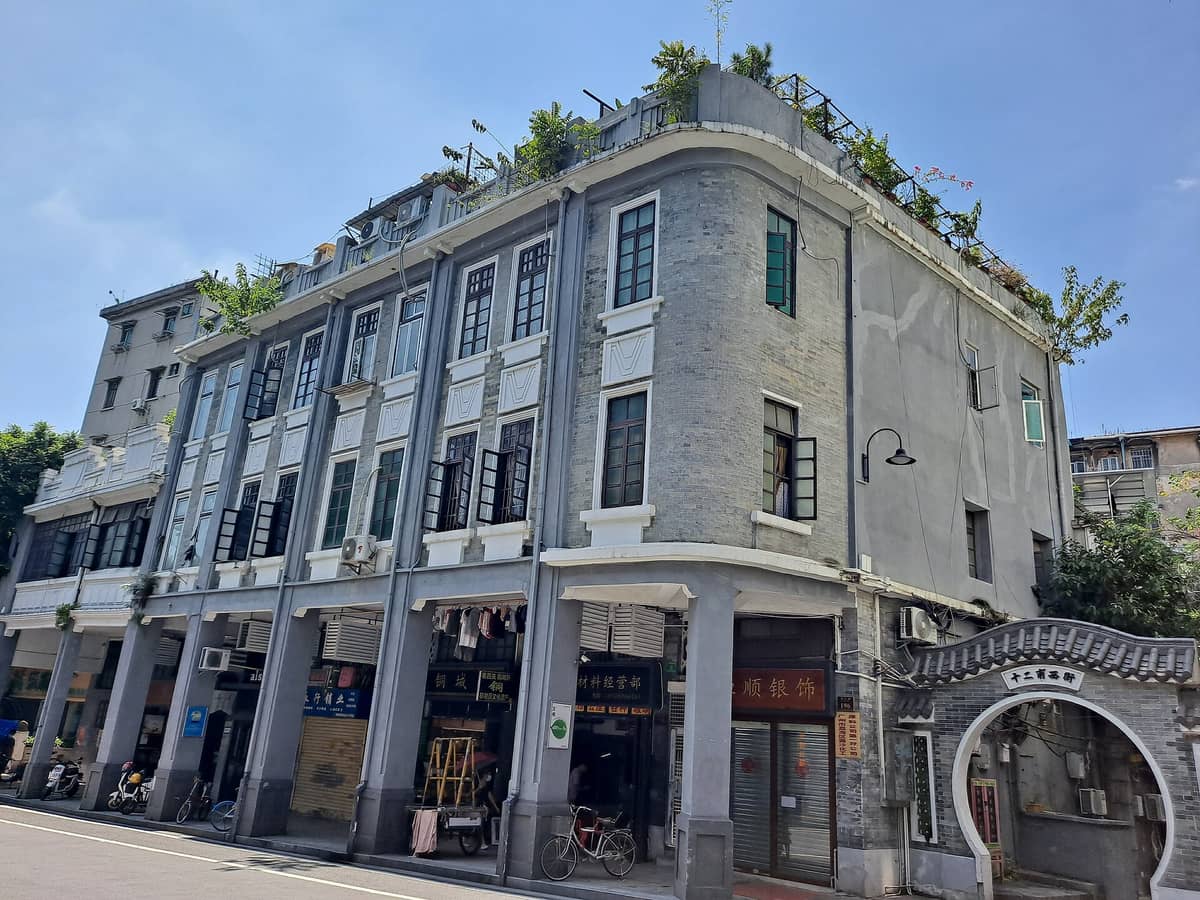
The defining architectural feature of Yongqingfang is the qilou, the covered arcade building that became the signature streetscape of southern Chinese cities in the early twentieth century. Ground-floor colonnades create a shaded walkway for pedestrians, a practical response to Guangzhou's summer rain and heat, while upper floors overhang the street with iron railings and shuttered windows. The style blends Cantonese craftsmanship with European Baroque and Neoclassical detailing, reflecting the trading culture of a city shaped by outside influence.
In the deeper lanes behind the main Enning Road frontage, the scale shifts. The alleys narrow to two or three meters, the buildings drop to two storeys, and the sense of enclosure becomes much stronger. Light enters at steep angles in the morning and vanishes quickly in the afternoon. This internal network of lanes is where Yongqingfang is most visually interesting and where most visitors spend the majority of their time. If you want a broader sense of what Guangzhou's historic architecture looks like at a city scale, the Guangzhou architecture guide puts Yongqingfang in context alongside other key sites.
One detail worth noting: the restoration has been thorough in some areas and somewhat cosmetic in others. Near the main entrance on Enning Road, the facades are immaculate, the signage is coordinated, and the overall impression is curated. Move deeper into the secondary lanes and the texture becomes rougher, more authentic, with patched plasterwork, aged roof tiles, and the occasional building still in residential use. Both zones are worth exploring, but they offer different experiences.
How the Experience Changes Through the Day
Yongqingfang in the morning, between 9:00 and 11:00, is genuinely quiet. Shopkeepers are setting up, the smell of coffee from the small roasters drifts into the lane, and the light falls at a low angle across the carved wooden screens. This is the best time for photography and for actually reading the interpretive plaques that explain the history of specific buildings. The stone paving is damp from overnight humidity in the wetter months, and the sound of the city outside barely penetrates the inner lanes.
By early afternoon on weekdays, foot traffic picks up moderately. Groups from nearby offices come for lunch, and a steady flow of domestic tourists moves through the main lane. Weekend afternoons are a different matter entirely: the central alleys can become congested, the queue for popular food stalls stretches back several units, and the overhead speakers from some venues compete for attention. If your priority is architecture or quiet exploration, weekday mornings are the obvious choice. If you want to experience the place as a social space with the full energy of a popular Guangzhou destination, weekend evenings from around 18:00 onward deliver that.
💡 Local tip
Photography is easiest on weekday mornings before 11:00. The narrow lanes mean that by midday the harsh overhead light creates deep shadows that flatten the architectural detail. Overcast days are ideal for even exposure across the alley widths.
Food and Shops: What to Expect Inside
The food options at Yongqingfang skew heavily toward Cantonese snacks, desserts, and cafe-style drinks. Egg waffles, tangyuan, sweeter dim sum items, and a range of milk teas are available from multiple vendors. This is street-snacking territory rather than a sit-down meal destination, though a handful of small restaurants operate inside the complex. For a more substantial introduction to Cantonese food in the surrounding area, the Shangxiajiu Pedestrian Street is a short walk away and has a wider range of proper restaurant options.
The retail mix leans toward independent creative businesses: small bookshops, hand-printed textile studios, ceramic workshops, vintage clothing, and locally designed lifestyle goods. A few national chains have moved in near the main entrance, which dilutes the independent character slightly, but the majority of the interior retail is still genuinely small-scale. Prices are moderate to slightly elevated compared with the surrounding streets, reflecting the curated setting rather than the local residential market.
There is also a Bruce Lee connection worth knowing. Enning Road is associated with Bruce Lee's family, and a small ancestral home connected to the Lee family is part of the broader Yongqingfang cultural zone. Signage in the area references this, and visitors interested in that specific history can follow the marked route.
Practical Walkthrough: Getting There and Around
The clearest approach is from Huangsha Metro Station on Lines 1 and 6. From the station, walk northeast along the river-facing streets for roughly ten minutes until you reach Enning Road. The main entrance to Yongqingfang is signed clearly at No. 99 Enning Road. Alternatively, Changshou Road Station provides access from the north side of the district, which is useful if you are combining the visit with Shangxiajiu or the wider Liwan historic area.
The district itself covers a large area, and the alley network can feel maze-like on a first visit. There is no strict one-way circuit: most visitors enter from Enning Road, walk the main spine, branch into side lanes as the mood takes them, and exit back onto Enning Road or through a secondary gate onto a parallel street. Allow at least 90 minutes if you want to cover the full interior network without rushing. A half-day works well if you combine it with the nearby Liwan Lake Park or a walk along the older commercial lanes of the surrounding Liwan neighborhood.
The lane surfaces are largely paved stone and generally flat, which makes them manageable for most visitors. However, no formal accessibility audit has been published for the site, and the narrower internal alleys do not accommodate wheelchairs easily. Some sections have minor raised thresholds at shop entrances. Comfortable, closed-toe shoes are preferable to sandals, particularly after rain when the stone can be slippery.
⚠️ What to skip
The area around Yongqingfang gets extremely crowded on public holidays and during the Chinese New Year period. If you are visiting during a national holiday, plan for significantly higher foot traffic and potential queues at popular food stalls.
Practical Assessment: Who Will Enjoy This and Who Won't
Yongqingfang is a well-executed example of adaptive heritage reuse, and for visitors interested in how Chinese cities are managing the tension between preservation and modernization, it is genuinely interesting. The architecture is the strongest reason to come. If you are primarily interested in deep historical authenticity without commercial overlay, you may find it slightly polished for your taste, particularly near the main entrance. The Chen Clan Ancestral Hall nearby offers a less commercial, more purely historical experience of Lingnan craft and architecture.
Visitors who dislike crowds, noise, or heavily curated heritage zones may find weekend afternoons frustrating. The place is popular with Chinese domestic tourists and younger Guangzhou residents treating it as a social outing, so the atmosphere on busy days is closer to a lively outdoor mall with historic aesthetics than a contemplative cultural site. That is not a criticism, just an accurate description of what the experience is on peak hours.
For a first-time visitor to Guangzhou trying to understand the city's layered history, Yongqingfang pairs naturally with a broader Guangzhou walking tour through Liwan. The alleyway district is one piece of a larger historic neighborhood that rewards slow exploration on foot.
Weather and Seasonal Considerations
Guangzhou's climate is humid subtropical, which means summer visits, roughly June through August, involve serious heat and humidity in the enclosed alleys. The stone-paved lanes absorb heat and there is limited shade in the wider sections. Autumn, from October through November, is the most comfortable season, with lower humidity and stable temperatures. Spring visits from March to May can be pleasant but expect frequent rain. For a broader picture of seasonal timing, the best time to visit Guangzhou guide covers the tradeoffs in detail.
Rain transforms the lanes significantly. The granite paving becomes reflective and the covered qilou arcades along the main spine stay mostly dry, so light rain is not a dealbreaker. Heavy rain in summer, particularly typhoon-season downpours, can make the narrower internal alleys uncomfortable and the uneven stone surfaces slippery. A small umbrella is worth carrying from April through September.
Insider Tips
- Enter from the Enning Road main gate but exit via one of the secondary side gates to walk a different set of lanes on the way out. The alleys immediately east and west of the main spine are quieter and often more photogenic.
- The Bruce Lee family ancestral home reference on Enning Road draws its own small crowd midday. If that is something you want to see clearly, arrive before 10:30.
- Several of the cafes inside the complex have upper-floor seating with window views directly over the alley below. These seats fill fast on weekends but are easy to claim on weekday mornings and give a different visual perspective on the roofline architecture.
- The food vendors closest to the main entrance have the longest queues and are often the most generically priced. Walk deeper into the secondary lanes and you will find smaller stalls with shorter waits and sometimes more locally specific offerings.
- If you are visiting during Golden Week or Spring Festival, check whether the Liwan District government has scheduled any specific programming or performance events at Yongqingfang. The open plaza areas inside the complex occasionally host Cantonese opera performances or craft markets during holiday periods.
Who Is Yongqingfang For?
- Architecture and urban design enthusiasts interested in Republican-era Lingnan building styles
- Photographers looking for textured, human-scale streetscapes with strong morning light angles
- Food explorers after Cantonese snacks and specialty drinks in a walkable outdoor setting
- Travelers combining a half-day Liwan heritage walk with other nearby historic sites
- Visitors wanting a free, low-commitment introduction to old Guangzhou without buying tickets
Nearby Attractions
Other things to see while in Liwan (Xiguan):
- Bruce Lee Ancestral Home
Tucked inside the restored Yongqing Fang heritage block in Liwan District, the Bruce Lee Ancestral Home is a small but quietly affecting tribute to one of the most influential figures in 20th-century popular culture. Free to enter and open most days, it rewards visitors who come with context and curiosity rather than expecting a grand museum experience.
- Cantonese Opera Art Museum
Housed in a sprawling classical Lingnan garden complex on Enning Road in Liwan District, the Cantonese Opera Art Museum is the most authoritative dedicated space for understanding yueju, the opera tradition that defines Guangdong's cultural identity. Free to enter and open most evenings on Fridays and Saturdays, it rewards visitors with theatrical costumes, intricate stage props, historic instruments, and architecture that is itself a performance.
- Chen Clan Ancestral Hall
Built between 1888 and 1893 as a center for education and ancestor worship, Chen Clan Ancestral Hall is the most elaborately decorated traditional compound in Guangzhou. Its nineteen linked halls are covered in stone carvings, wood reliefs, iron castings, ceramic friezes, and stucco moldings that represent the full range of Cantonese folk craft at its peak.
- Hualin Jade Street
Hualin Jade Street (华林玉器街) in Liwan District is where Guangzhou's jade trade has concentrated for centuries. Stretching roughly 500 metres through the old city, it packs in more than 80% of the city's jade merchants — from rough stone dealers to finished jewellery boutiques — all free to browse.