Shangxiajiu Pedestrian Street: Shangxiajiu Pedestrian Street: Guangzhou's Historic Commercial Strip
Shangxiajiu Pedestrian Street (上下九步行街) is Guangzhou's most historically layered commercial corridor, stretching roughly 1,237 metres through the heart of Liwan District. Free to enter and open all day, it combines Republican-era Lingnan shophouse architecture with street food stalls, traditional crafts, and the full sensory weight of old Cantonese urban life.
Quick Facts
- Location
- Liwan District, Guangzhou (No. 59–60 Xiajiu Road)
- Getting There
- Huangsha Station (Line 1 or 6), Exit B; about 10 minutes' walk
- Time Needed
- 1.5–3 hours for a thorough walk including food stops
- Cost
- Free entry; individual shops and food stalls vary
- Best for
- Architecture, Cantonese street food, local shopping, cultural context
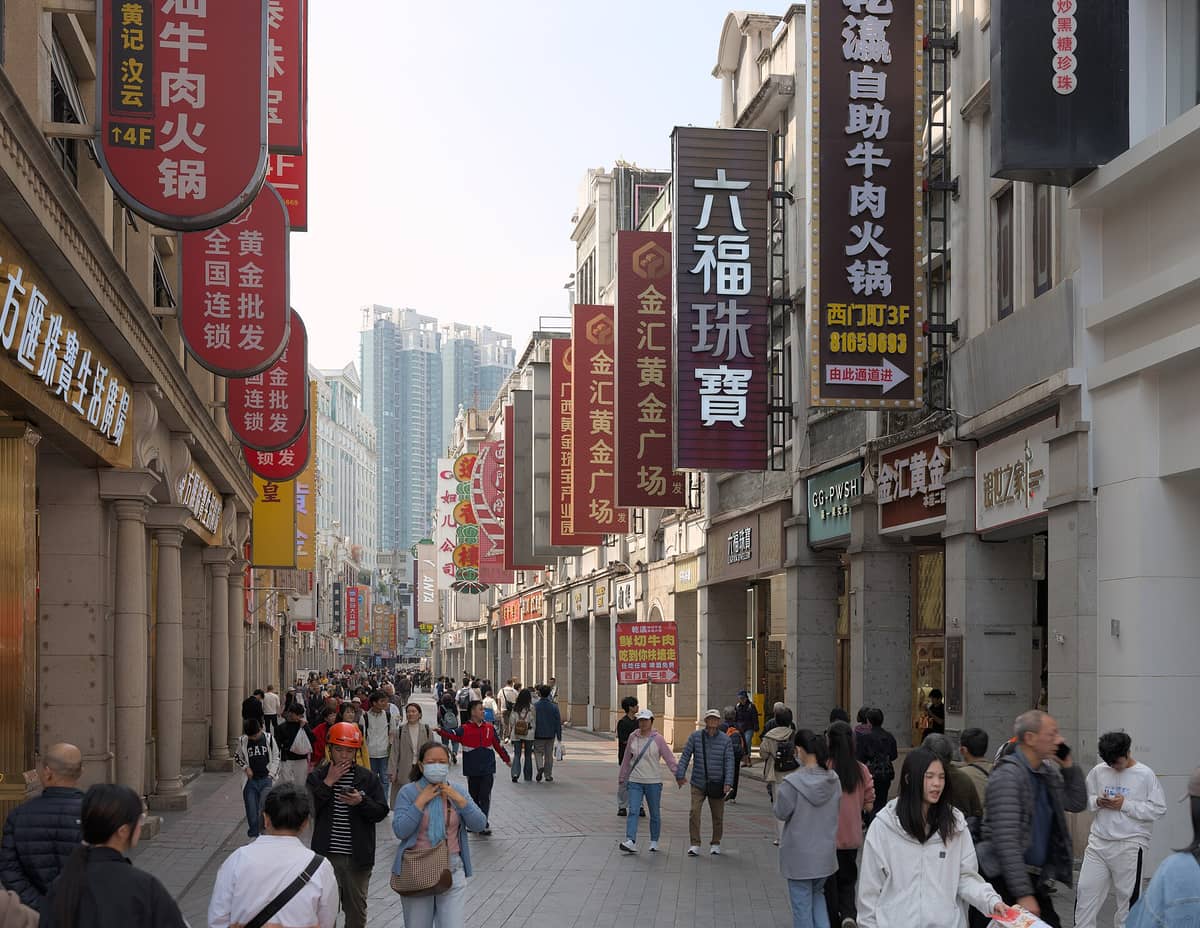
What Shangxiajiu Actually Is
Shangxiajiu Pedestrian Street, written in Chinese as 上下九步行街, is a roughly 1,237-metre commercial corridor in Liwan District that opened in its current pedestrianised form in September 1995. It is widely regarded as one of Guangzhou's first business streets and sits in what was historically the commercial and cultural heartland of the city before modern Tianhe rose to prominence.
The street runs through the Xiguan area of Liwan, a neighbourhood whose name is often rendered as 'west pass' and which carries centuries of Cantonese merchant history. Walking the full length takes you past more than 200 shops, dozens of food stalls, and a near-continuous row of covered arcade colonnades that have sheltered pedestrians from Guangzhou's heavy summer rain and glaring sun for the better part of a century.
For context on how this area fits into the wider city, the Liwan District guide gives a useful overview of the neighbourhood's distinct character relative to more modern parts of Guangzhou.
The Architecture: Lingnan Arcade Shophouses
The defining visual feature of Shangxiajiu is its qilou architecture, the colonnaded shophouse style that evolved in south China and Southeast Asia during the late Qing dynasty and the Republican period (roughly 1910s to 1940s). Each building follows the same basic logic: a covered ground-floor arcade for pedestrians, with residential or storage floors rising above the shops behind ornate facade treatments that blend Cantonese, European Baroque, and occasionally Art Deco detailing.
Stand at the northern end of the street in the morning, when the light comes in at a low angle, and the effect is striking. The colonnades create a rhythmic tunnel of shadow and column that draws the eye south. Look upward and you will see balustrades, arched window surrounds, and ceramic tile inlays that date to an era when Cantonese merchants competed partly through architectural display. Most facades have been restored to varying degrees of fidelity, and a few buildings retain original tilework.
If Lingnan architecture interests you beyond a single street, the broader Guangzhou architecture guide covers the city's full range of styles from ancient to contemporary.
💡 Local tip
For the clearest photographs of the qilou facades without crowds obstructing the ground floor colonnade, arrive early on a weekday morning. The overhead arcade creates natural diffused light that softens harsh shadows even in mid-morning.. The overhead arcade creates natural diffused light that eliminates harsh shadows even in mid-morning.
How the Street Changes Through the Day
Shangxiajiu runs all day and much of the night, but the experience shifts meaningfully depending on when you arrive. Mornings before 10 am are the quietest window. Shopkeepers are setting up, delivery crates are being moved through side alleys, and the food stalls near the southern end are frying their first batches of taro fritters and glutinous rice rolls. The smell of frying oil and dried osmanthus from nearby tea shops is strongest at this hour.
By midday the street is operating at full capacity. Schoolchildren on outings, office workers on lunch breaks, and tourists from across China fill the arcade colonnade to capacity on weekends. This is the noisiest period: loudspeakers outside clothing shops, the percussion of kitchen woks from the restaurant frontages, and the general density of a street designed for far fewer visitors than it now receives. Navigation becomes genuinely slow.
Evenings from around 6 pm to 10 pm represent the sweet spot for most visitors. The heat drops (outside of June to August, when it stays warm), the lighting shifts to the warm glow of shop lanterns and neon signs, and the street food choices reach their widest selection. This is when local families are most present, and the street takes on a different register from the afternoon tourist peak.
⚠️ What to skip
Weekends and public holidays can make the central section genuinely difficult to move through. If you are arriving on a weekend, plan for the morning window or the late evening. Avoid the 1–4 pm block entirely if you dislike dense crowds.
What to Eat and Where to Look
The food dimension of Shangxiajiu is arguably its strongest reason to visit. This is not a curated food market with uniform stalls — it is a working commercial street where decades-old Cantonese snack shops operate alongside newer bubble tea chains, traditional herbal jelly (guilinggao) counters, and bakeries selling wife cakes (laopobing) and egg tarts. The mix is unfiltered, and the quality at the older establishments is consistently high.
Look for the queueing locals, not the largest signage. The best snack stops are rarely the most visually prominent. Specific things to try on the street include: freshly pressed sugarcane juice, available from small machines at multiple points; stewed beef offal noodles from the older restaurants on Xiajiu Road itself; and sesame paste dessert soups (zhima hu), which are a Cantonese staple and sold at specialist dessert shops along the route.
For a structured approach to eating in the broader Liwan area, the Guangzhou dim sum guide covers the neighbourhood's longest-established teahouses, some of which are within a few minutes' walk of Shangxiajiu.
Shopping: What's Worth Your Time
The shopping at Shangxiajiu covers a wide range, from clothing and accessories aimed at younger Cantonese shoppers to traditional medicine shops, jade vendors, and stalls selling Cantonese opera accessories. The street is not a luxury retail destination; it is genuinely commercial, with prices that reflect local rather than tourist margins at most of the older shops.
Traditional goods worth seeking out include: Xiguan-style embroidered goods, herbal tea blends sold loose by weight at the pharmacy-style shops, and ceramic teaware. The jade and jewellery section near the northern entry is adjacent to the Hualin Jade Street market area, which extends the shopping options considerably if you want to go deeper.
The adjacent Hualin Jade Street is a natural extension of a Shangxiajiu visit and is less than five minutes' walk away — worth including if your visit focuses on traditional crafts and markets.
Getting There and Practical Notes
The most direct metro approach is Huangsha Station on Line 1 or Line 6, from which the street is approximately a 10-minute walk. Both routes are straightforward and well-signposted at street level.
The street is flat and fully paved, making it accessible for pushchairs and wheelchairs at the surface level. The side alleys branching off the main corridor vary considerably in surface quality. Entry is free. There is no ticketing, no gate, and no organised entry point — you simply walk in from either end or from any of the connecting side streets.
Guangzhou's summers (June to August) bring serious heat and humidity to Shangxiajiu. The colonnade provides partial shade, but the crowding compounds the heat. If you visit in summer, the early morning window is not just recommended for photography — it is genuinely more comfortable. Bring water. Autumn (October to November) offers the best balance of comfortable temperatures and manageable crowds outside of major public holidays.
ℹ️ Good to know
Shangxiajiu is free to enter and has no single official website. Shangxiajiu is free to enter and is generally listed as open all day, with individual shops typically trading from mid-morning to late evening. Confirm specific restaurant hours locally, as they vary.
Practical Assessment: Who Will Enjoy This and Who Won't
Shangxiajiu delivers something that newer parts of Guangzhou do not: genuine continuity with how this city has traded, eaten, and moved through public space for generations. The architecture is real, the food culture is real, and the commercial energy is unmistakably local. For visitors interested in what Guangzhou looked and felt like before the skyscrapers, this street provides a coherent and accessible window.
That said, anyone expecting a quiet or particularly scenic experience on a weekend afternoon will be disappointed. The street is a working commercial corridor, not a heritage precinct. Signage is in Chinese, crowds are dense at peak hours, and the mix of traditional and mass-market shops is not carefully curated. If your priority is calm atmosphere or photogenic emptiness, visit early on a weekday morning and move on before 11 am.
Shangxiajiu pairs well with a broader walk through Liwan, which includes the nearby Yongqingfang creative district and the traditional architecture of the Xiguan area. Together they make a half-day or full-day walk that covers different layers of the same neighbourhood.
Insider Tips
- The side alleys (fang) branching off the main pedestrian corridor The side alleys (fang) branching off the main pedestrian corridor contain quieter streets that most visitors skip entirely.. Turn into any unmarked alley heading east or west and you will quickly reach quieter streets that most visitors skip entirely.
- A number of the herbal tea shops on the street sell guilinggao (tortoise jelly) in portions for a few yuan. It is an acquired taste, but it is a genuinely Cantonese experience and the older shops have been at it for decades.
- The northern end of the street near the Hualin Temple area The northern end of the street near the Hualin Temple area is often less crowded than the central and southern sections. If you want the architecture without the peak-hour compression, start from the north and work south.. If you want the architecture without the peak-hour compression, start from the north and work south.
- Payment at most stalls and smaller shops is via WeChat Pay or Alipay. Payment at many stalls and smaller shops is via WeChat Pay or Alipay. Have a payment method set up before you arrive. Have a payment method set up before you arrive.
- Weekday mornings in October and November are statistically the easiest time to move through the street comfortably. The post-Golden Week period sees crowds thin while temperatures remain comfortable.
Who Is Shangxiajiu Pedestrian Street For?
- Travellers interested in Lingnan architecture and Republican-era Cantonese streetscapes
- Food-focused visitors wanting to sample a wide range of traditional Cantonese snacks in one corridor
- Shoppers looking for traditional goods, herbal products, and jade at local prices
- First-time visitors to Guangzhou wanting an orientation in the older, pre-modern city
- Photographers working in the morning light before peak crowds arrive
Nearby Attractions
Other things to see while in Liwan (Xiguan):
- Bruce Lee Ancestral Home
Tucked inside the restored Yongqing Fang heritage block in Liwan District, the Bruce Lee Ancestral Home is a small but quietly affecting tribute to one of the most influential figures in 20th-century popular culture. Free to enter and open most days, it rewards visitors who come with context and curiosity rather than expecting a grand museum experience.
- Cantonese Opera Art Museum
Housed in a sprawling classical Lingnan garden complex on Enning Road in Liwan District, the Cantonese Opera Art Museum is the most authoritative dedicated space for understanding yueju, the opera tradition that defines Guangdong's cultural identity. Free to enter and open most evenings on Fridays and Saturdays, it rewards visitors with theatrical costumes, intricate stage props, historic instruments, and architecture that is itself a performance.
- Chen Clan Ancestral Hall
Built between 1888 and 1893 as a center for education and ancestor worship, Chen Clan Ancestral Hall is the most elaborately decorated traditional compound in Guangzhou. Its nineteen linked halls are covered in stone carvings, wood reliefs, iron castings, ceramic friezes, and stucco moldings that represent the full range of Cantonese folk craft at its peak.
- Hualin Jade Street
Hualin Jade Street (华林玉器街) in Liwan District is where Guangzhou's jade trade has concentrated for centuries. Stretching roughly 500 metres through the old city, it packs in more than 80% of the city's jade merchants — from rough stone dealers to finished jewellery boutiques — all free to browse.