Shamian Island Riverfront: Guangzhou's Colonial Promenade
Shamian Island is a 0.30-square-kilometre sandbank in the Pearl River where European consular buildings, shaded boulevards, and a quiet riverside promenade survive largely intact. Entry is free, and the atmosphere is unlike anywhere else in Guangzhou.
Quick Facts
- Location
- Shamian Island, Liwan District, Guangzhou, Guangdong, China
- Getting There
- Huangsha Station, Metro Line 1 or Line 6 — walk across the bridge to the island
- Time Needed
- 1.5 to 3 hours for a relaxed walk with stops
- Cost
- Free — no entrance ticket required for public outdoor areas
- Best for
- Architecture lovers, morning walkers, photography, and a break from Guangzhou's city pace
What Shamian Island Actually Is
Shamian Island (沙面岛) is a narrow sandbank in the Pearl River, reached by small bridges from the surrounding streets. It covers just 0.30 square kilometres, which means the entire island can be walked end to end in under twenty minutes at a casual pace. That compact size is part of what makes it feel so distinct: the moment you step off the overpass from Huangsha Station, the surrounding city recedes almost immediately.
The island was designated a foreign concession in the 19th century and used as a base for foreign trade, diplomacy, and residence for roughly a century. The consulates and trading houses are long gone, but the buildings themselves remain in remarkable condition: Baroque facades, arcaded ground floors, shuttered upper windows, and plane trees that now form a continuous canopy over the main boulevard. Guangzhou has restored and protected most of the colonial-era streetscape, and the island is recognized as a historic area.
ℹ️ Good to know
The outdoor public areas of Shamian Island are open 24 hours, every day. There is no entrance gate, no ticket booth, and no admission charge. Individual buildings such as cafes, churches, and interior venues keep their own separate hours.
The Riverfront Walk: What You See and Feel
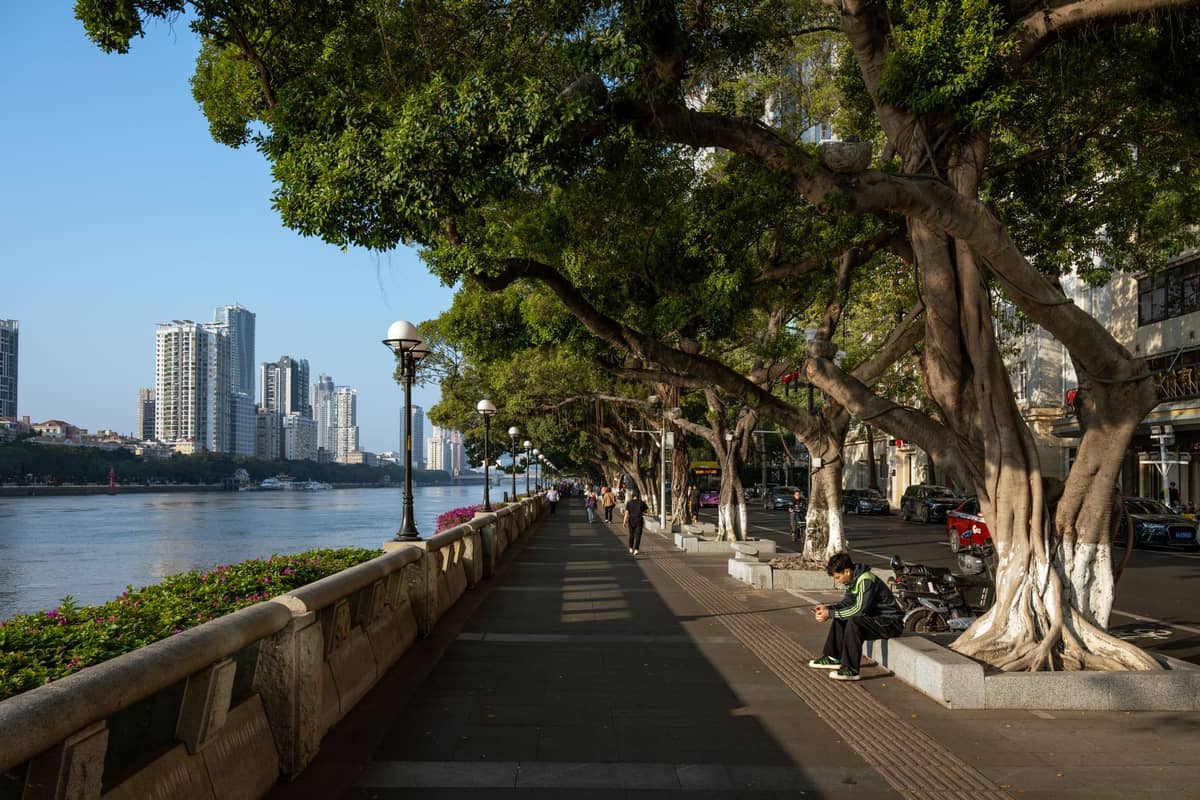
The southern edge of the island faces the Pearl River directly, and this is where the atmosphere earns its reputation. The promenade is broad, shaded by old trees, and lined with European-style buildings on one side and open river views on the other. Cargo barges move slowly past, and on clear days you can see the Guangzhou skyline to the east, with the Canton Tower in the distance.
In the morning, the riverfront belongs to residents: retirees doing tai chi on the wide pavement, couples walking small dogs, a few people reading on the low stone walls overlooking the water. The air carries a faint river smell, and the sounds are unexpectedly quiet given the city immediately outside. This is often the best time to be here. The light is soft and directional, the crowds are light, and the island has an unperformed quality that disappears once tour groups arrive mid-morning.
By mid-afternoon the dynamic shifts. Photographers set up tripods along the promenade, tour groups pause at the bronze statues scattered across the island, and the cafes along the north-facing streets fill up. The island never becomes truly crowded by Guangzhou standards, but the early solitude is gone. If your priority is photography or a reflective walk, aim for before 9:00 or after 17:00.
💡 Local tip
For the best light on the south-facing facades, visit in the morning. The afternoon sun hits the north side of the island more directly, which suits the interior boulevard trees. Golden hour before sunset produces strong warm light across the river.
Architecture and Historical Context
The buildings on Shamian range from restrained neoclassical to full Baroque, and the consistency of scale and material is what makes the streetscape work. Most are two or three storeys, faced in cream or ochre plaster, with arched colonnades at ground level that originally allowed residents to walk in shade. Several bear brass plaques identifying their original occupants: the former British Consulate, the Astor House Hotel, various trading company offices.
The island's colonial history is inseparable from the broader history of Guangzhou as China's primary port for foreign trade over several centuries. Guangzhou (then widely known in the West as Canton) was the entry point for the 19th-century trade in opium, silk, and porcelain that eventually triggered the Opium Wars. The concession on Shamian was one direct consequence of those conflicts. For more on how that trading history shaped the city's architecture and identity, the Guangzhou architecture guide covers the full picture across multiple districts.
Two religious buildings survive in active use. Our Lady of Lourdes Chapel, a compact Catholic church in the former French concession zone, continues to hold services. The Shamian Christian Church, a Protestant building in the former British zone, is also still functioning. Neither requires advance booking to view from outside, and both are worth a pause for their stonework and their contrast with the surrounding civic buildings.
Getting There and Moving Around the Island
The most direct approach is Metro Line 1 or Line 6 to Huangsha Station. Follow the signs for Shamian Island (沙面岛) and cross the pedestrian bridge over the canal. The walk from the station exit to the island takes only a few minutes. Head toward the southern exit options and look for the bridge over the narrow waterway.
Taxis and DiDi can drop you at the canal-side streets bordering the island. If you are combining Shamian with nearby areas, the island sits close to Liwan District's older commercial quarters. Shangxiajiu Pedestrian Street is a 15-minute walk or a short taxi ride northeast, making it a natural pairing for a half-day itinerary in western Guangzhou.
The island itself has no vehicles in its pedestrianised core. The entire area is flat and walkable. People with mobility limitations should find the main promenade and central boulevard accessible without difficulty, though some narrower side lanes have uneven paving.
Photography Notes
Shamian is one of the more photogenic locations in Guangzhou, but it rewards specific approaches. The plane tree canopy along the central east-west boulevard creates strong dappled light from mid-morning onward. The south-facing riverside promenade gets direct morning light and becomes harsh by early afternoon. The narrow lanes between buildings in the interior of the island are shadowed for most of the day and work best on overcast days when the light is even.
The bronze statues placed at intervals across the island — depicting figures in early 20th-century dress — have become standard subjects, but they are most interesting when used as foreground elements with the building facades behind them rather than photographed in isolation. Wedding photography shoots are common on weekends, which can occasionally block access to specific angles for ten to twenty minutes at a time.
💡 Local tip
Overcast days in Guangzhou, common in spring, actually suit Shamian's streets well. Without harsh shadows, the building textures and the tree-lined lanes photograph more evenly. Bring a jacket in winter — the riverfront gets a noticeable wind off the Pearl River even when the air feels warm inland.
Seasonal Considerations and When to Visit
Shamian works in any season, but the quality of the visit varies. October through December is the most comfortable period: the humidity drops sharply after September, the plane trees are still in full leaf, and the light in autumn has a clarity that summer cannot match. If your Guangzhou trip falls in this window, autumn in Guangzhou is consistently the most pleasant time to explore the city's outdoor spaces.
Summer (June through August) is hot and humid, and the riverfront has limited shade on its southern edge. Mornings remain manageable, but the midday heat between 11:00 and 15:00 is genuinely uncomfortable for a slow walk. The island does not close, but visitors who are heat-sensitive should plan around the middle of the day. Spring (March to May) brings frequent rain. The island remains open and is still walkable in light rain, but wet paving on some of the older surfaces can be slippery.
Chinese public holidays, particularly Golden Week in early October and Chinese New Year in January or February, bring larger visitor numbers across Guangzhou. Shamian is less affected than more commercially concentrated attractions, but weekend crowds during these windows are noticeably higher than on ordinary weekdays.
Practical Assessment: Is It Worth Your Time?
Shamian Island is free, takes no more than two hours at a thorough pace, and offers a genuinely different visual and atmospheric experience compared to the rest of Guangzhou. It is not spectacular in the way that the Canton Tower or a major museum is spectacular. Nothing happens here. There are no performances, no major exhibitions, and the buildings are viewable only from the outside for the most part. The value is in the quality of the walking experience and the historical layering, not in a defined payoff.
Visitors who come expecting an immersive historical experience with interior access may find the island underwhelming. It functions best as part of a broader day in western Guangzhou rather than as a sole destination. Pair it with Chen Clan Ancestral Hall for a half-day that covers both colonial and traditional Cantonese architectural history, or combine it with a meal on Shangxiajiu Pedestrian Street nearby.
Travelers who find the colonial history of China uncomfortable or politically charged may want to do some reading before visiting. The island does not prominently interpret its own history in the way a museum would — there are plaques, but no overarching narrative. For deeper context, the Nanyue King Mausoleum Museum and Guangzhou's historical museum network provide a more structured understanding of the city's layered past.
Insider Tips
- The narrow canal on the north side of the island is crossed by several small bridges. Walking the canal-side path rather than the main boulevard gives you a quieter perspective and better views of the buildings from across the water.
- The cafe scene on Shamian is quiet but reliable. Several independent cafes occupy ground-floor arcaded spaces in former trading houses. These are not tourist-oriented in pricing or atmosphere — locals use them too, which is a reasonable indicator of quality.
- Wedding photo shoots happen almost every weekend, particularly on Saturday mornings. If you want the promenade to yourself for photography, early weekday mornings are significantly cleaner. Arriving before 8:00 on a weekday means you will likely share the island only with residents doing morning exercise.
- The plane trees along the central boulevard are old enough that their roots have raised sections of the paving in places. Comfortable walking shoes are practical — sandals or heels on the uneven interior lanes are a minor but real inconvenience.
- Shamian is a fully functional residential neighbourhood, not a theme park. Some buildings are private apartments. Keep noise levels appropriate and avoid photographing into residential windows.
Who Is Shamian Island Riverfront For?
- Architecture and history travelers who want to see Guangzhou's treaty-port past preserved at street scale
- Photographers looking for European-style facades, tree-lined lanes, and riverside light in a Chinese city
- Morning walkers who want a calm start to a day before the city picks up pace
- Travelers combining a half-day in western Guangzhou with nearby Liwan District attractions
- First-time visitors to Guangzhou who want to understand the breadth of the city's history beyond its modern skyline
Nearby Attractions
Other things to see while in Shamian Island:
- Our Lady of Lourdes Chapel
Built by French missionaries in 1890, Our Lady of Lourdes Chapel stands as one of Guangzhou's most striking pieces of colonial religious architecture. Set on the shaded avenues of Shamian Island, the chapel is free to enter, still holds daily services, and rewards visitors who arrive early with genuine calm and beautiful light.
- Shamian Christian Church
Shamian Christian Church is one of the most architecturally distinctive colonial-era buildings on Shamian Island, a former foreign concession in Guangzhou's Liwan District. Built in the 1860s, the church offers free entry and holds Sunday worship at 9:30am, making it a rare living landmark rather than a preserved relic.