Our Lady of Lourdes Chapel: Shamian Island's Quiet Gothic Landmark
Built by French missionaries in 1890, Our Lady of Lourdes Chapel stands as one of Guangzhou's most striking pieces of colonial religious architecture. Set on the shaded avenues of Shamian Island, the chapel is free to enter, still holds daily services, and rewards visitors who arrive early with genuine calm and beautiful light.
Quick Facts
- Location
- 14 Shamian Dajie, Shamian Island, Liwan District, Guangzhou
- Getting There
- Metro Line 1, Huangsha Station; multiple bus routes including 102, 103, 105, 106, 110, 114
- Time Needed
- 20–40 minutes for the chapel; allow 1–2 hours to explore all of Shamian Island
- Cost
- Free admission
- Best for
- Architecture lovers, photography, quiet reflection, colonial history
What Is This Place, and Why Does It Matter?
Our Lady of Lourdes Chapel, known in Chinese as 沙面露德圣母堂 and in French as Chapelle Notre-Dame de Lourdes, is a Catholic chapel built in 1890 by French missionaries on Shamian Island in Guangzhou's Liwan District. It is one of the clearest surviving examples of European religious architecture in a city that was, for much of the 19th and early 20th centuries, one of the primary points of contact between China and the Western world.
Shamian Island was established as a foreign concession in 1859, divided administratively between France and Britain. The French sector occupied the eastern third of the island, and it was within this zone that the chapel was constructed. Today it remains an active place of worship, not a museum piece, which gives it a quality that polished heritage sites often lack: you are not visiting a reconstruction but a building that has continued its original function for more than 130 years.
ℹ️ Good to know
Daily worship is held at 7:00 A.M. If you are not attending a service, the chapel is generally open to respectful visitors from around 06:00 to 17:00 (to 17:30 on Sundays). Verify hours locally before visiting, as religious sites can adjust schedules around liturgical events and public holidays.
The Architecture: What You Actually See
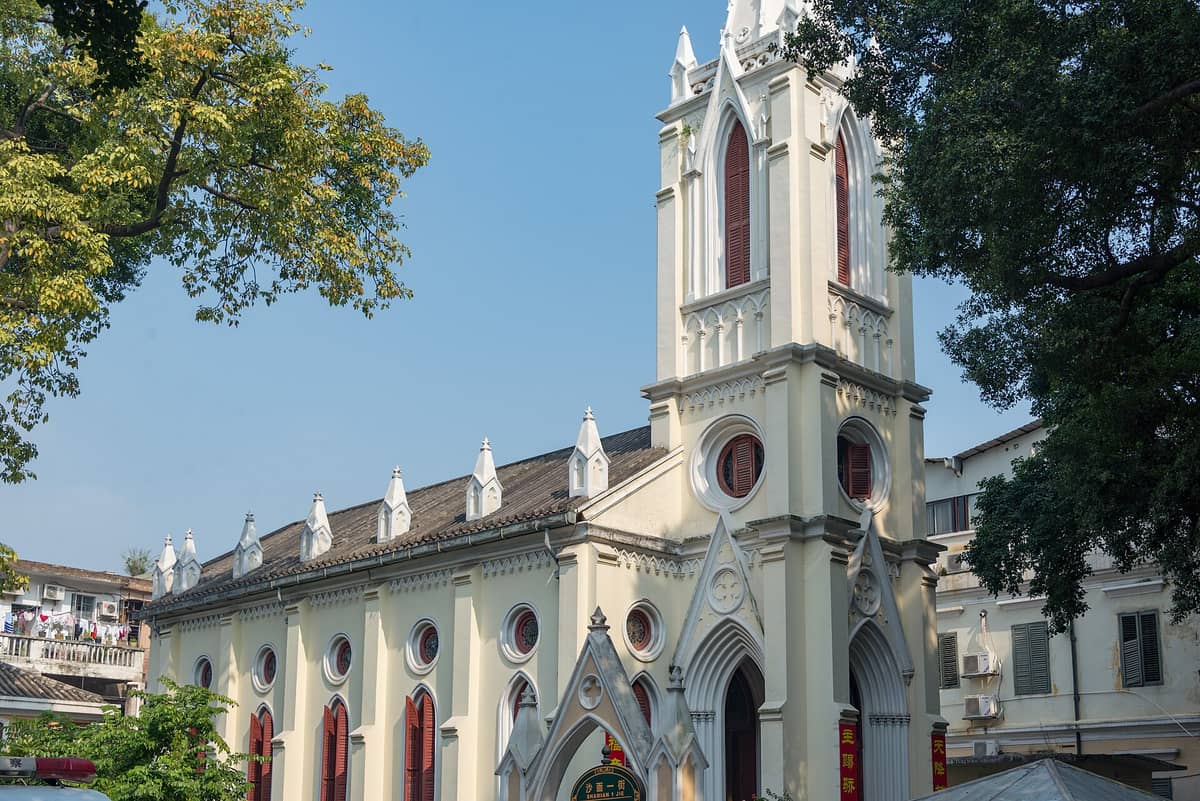
The chapel is a compact late-19th-century Gothic structure in the French missionary tradition. Its facade features a pointed central arch, a modest rose window, and pale rendered walls that catch the morning light in a way that feels out of place with the subtropical surroundings, which is precisely the point. The missionaries who built it were trying to reproduce something familiar from home, and the result is an architectural outlier in a city of Cantonese shophouses and modern high-rises.
The building is not on the scale of the Sacred Heart Cathedral in Yuexiu District, which is a full neo-Gothic cathedral with tall twin spires. Our Lady of Lourdes is intimate by comparison, more like a small French village church than a grand urban cathedral. That intimacy is what makes it work as an experience. You can take in the entire facade from across a narrow tree-lined street, and the proportions are human-scaled enough that the building feels accessible rather than imposing.
The surrounding streetscape of Shamian Island reinforces the effect. Broad-canopied banyan and rain trees line the pavements, and many of the adjacent buildings date from the same concession-era period. Walking from Shamian Island's riverfront promenade toward the chapel, you pass consulate buildings, old villas, and the Shamian Christian Church on the opposite end of the island, which makes it easy to frame a short architectural walk that takes in the full range of the island's heritage buildings in a single loop.
How the Visit Changes by Time of Day
Early morning is the most rewarding time to visit. Before 8:00 A.M. the island has a different character: older residents do slow exercises under the trees, vendors set up fruit stalls near the entrances, and the light is soft and directional. The chapel facade faces a direction that picks up warm morning light well, and the lack of crowds means you can photograph it cleanly. The daily 7:00 A.M. service is also underway at this hour. If you stand quietly near the entrance, you can often hear the congregation inside, which adds a layer of experience that no amount of reading about the building's history can provide.
By mid-morning, tour groups and weekend strollers begin to arrive on the island. The chapel becomes part of a broader photo circuit, and the pavement in front fills with people taking pictures. The experience is not unpleasant, but it is different. Midday in summer should be avoided if possible: Guangzhou's humid subtropical climate makes the hours between 11:00 and 14:00 uncomfortable from June through August, and the stone pavement around the chapel holds heat. Late afternoon, particularly in the cooler months of October through December and February through April, offers good soft light and noticeably thinner crowds than the middle of the day.
💡 Local tip
Photography tip: Position yourself on the far side of the street and use the banyan tree canopy to frame the chapel's upper facade. The filtered light through the leaves softens harsh midday shadows. A wide-angle lens or a phone in standard mode captures the full building without distortion from close range.
Historical Context: The Concession Era on Shamian Island
To understand why a Gothic Catholic chapel exists on a small sandbar in the Pearl River, you need to understand Shamian's specific history. The island was created as a foreign enclave following the Second Opium War, carved out as a controlled zone where European merchants and diplomats could operate under their own legal frameworks. Roman Catholic missionary activity was a standard part of French colonial expansion across Asia. and Roman Catholic missionary activity was a standard part of French colonial expansion across Asia.
The chapel was built in 1890, roughly three decades after the concession was formally established, suggesting the French community had become stable enough to invest in permanent religious infrastructure. It was dedicated to Our Lady of Lourdes, referencing the Marian apparition site in southern France that had become a major pilgrimage destination after the 1858 visions of Bernadette Soubirous. Naming a missionary chapel after Lourdes in 1892 was a deliberate cultural signal: it tied the overseas community to a new and devotionally powerful location in French Catholic identity.
The chapel survived the turbulent decades of the 20th century, including the Japanese occupation of Guangzhou during World War II and the social and religious disruptions of the Cultural Revolution. That it continues to function as an active parish today reflects both the resilience of Guangzhou's Catholic community and the broader rehabilitation of religious practice in China since the early 1980s.. For deeper context on the island's architectural legacy, the Guangzhou architecture guide covers the concession-era building stock in more detail.
Practical Walkthrough: Getting Here and Moving Around
Shamian Island is straightforward to reach. From Huangsha Station on Metro Line 1, the walk to the island takes roughly 10 minutes on foot. The station exit closest to the island is well signposted, and the route crosses a short bridge over a narrow channel of the Pearl River. If you are traveling by bus, a large number of routes stop near the island's entrances, including lines 102, 103, 105, 106, 110, 114, 123, 125, 125A, 176, 181, 188, 208, 209, 217, 219, 226, 236, and 238.
The chapel sits at 14 Shamian Dajie, which is the main east-west avenue running along the center of the island. From the northern bridge entrance, walk straight ahead along the main avenue and you will pass the chapel within a few minutes. The island is small enough that getting lost is not a realistic concern: it measures roughly 900 meters from east to west, and the main roads form a simple grid.
Shamian Island pairs naturally with a walk along its southern riverside promenade, where you can look across the Pearl River toward Haizhu District. It also connects logically to Shangxiajiu Pedestrian Street and Yongqingfang, both of which are within walking distance or a short bus ride to the northeast, in Liwan District's older commercial core.
⚠️ What to skip
Accessibility note: Step-free access to the chapel interior has not been confirmed by official sources. The island's pavements are generally flat and walkable, but specific accessibility features inside the chapel building are unverified. Visitors with mobility requirements should contact the parish in advance.
Practical Assessment: Who Will Love This, and Who Might Not
Our Lady of Lourdes Chapel is a small building. If you are primarily motivated by architectural grandeur or interior decoration, it will not match expectations set by Guangzhou's larger religious sites. The Sacred Heart Cathedral in Yuexiu, built a few decades later, is a more dramatic Gothic structure with a larger nave, more elaborate stonework, and a stronger claim to architectural ambition. The Lourdes Chapel is something different: a building valued more for its context, its intimacy, and its continued function than for any single extraordinary feature.
Travelers who appreciate the texture of a place, who want to understand what it meant for a small French Catholic community to build a piece of home in 19th-century Guangzhou, will find the chapel genuinely moving. Visitors looking for a quick landmark to photograph and move on will be satisfied in 10 minutes. Either approach is legitimate, but knowing which one applies to you helps set expectations before you arrive.
For those with a broader interest in Guangzhou's religious architecture and history, the Guangzhou temples and religious sites guide provides context on how the city's diverse religious landscape fits together, from Buddhist and Taoist temples in Yuexiu to the mosques of Liwan and the Catholic and Protestant buildings of Shamian.
Insider Tips
- Arrive before 8:00 A.M. on a weekday to have the chapel facade almost entirely to yourself. Weekend mornings bring significantly more foot traffic by 9:00 A.M., especially on sunny days when Shamian Island is a popular destination for family walks and pre-wedding photo shoots.
- The 7:00 A.M. daily mass is open to Catholics attending worship. If you are not attending a service, position yourself quietly outside and listen: the sound of the congregation carries through the doors and adds a dimension to the visit that purely visual observation cannot replicate.
- Look at the trees on Shamian Dajie as carefully as the chapel itself. Several of the old rain trees and banyans on the island are heritage specimens with trunks several meters in circumference. The relationship between the building and the tree canopy is part of what makes the visual composition work.
- If you visit in autumn or winter (October through February), the cooler and drier weather makes it much easier to walk the full perimeter of the island before or after visiting the chapel. The combination of a morning service visit, a walk along the southern riverfront, and a stop at one of the island's cafes can fill a relaxed half-day without feeling rushed.
- The chapel is not lit dramatically at night, and Shamian Island quiets down significantly after dark. Daytime visits are strongly preferable. If you do pass through the island in the evening, the building is visible but the experience is far less rewarding than in morning or late-afternoon light.
Who Is Our Lady of Lourdes Chapel For?
- Architecture and heritage travelers interested in colonial-era religious buildings
- Photographers seeking well-composed European Gothic facades in a tropical setting
- Visitors on a Shamian Island walking tour who want to understand the island's full historical character
- Catholics or practicing Christians who want to attend an active parish service in Guangzhou
- Travelers looking for a quiet, low-cost counterpoint to Guangzhou's more crowded modern attractions
Nearby Attractions
Other things to see while in Shamian Island:
- Shamian Christian Church
Shamian Christian Church is one of the most architecturally distinctive colonial-era buildings on Shamian Island, a former foreign concession in Guangzhou's Liwan District. Built in the 1860s, the church offers free entry and holds Sunday worship at 9:30am, making it a rare living landmark rather than a preserved relic.
- Shamian Island Riverfront
Shamian Island is a 0.30-square-kilometre sandbank in the Pearl River where European consular buildings, shaded boulevards, and a quiet riverside promenade survive largely intact. Entry is free, and the atmosphere is unlike anywhere else in Guangzhou.