Shamian Christian Church: Colonial Faith on Guangzhou's Concession Island
Shamian Christian Church is one of the most architecturally distinctive colonial-era buildings on Shamian Island, a former foreign concession in Guangzhou's Liwan District. Built in the 1860s, the church offers free entry and holds Sunday worship at 9:30am, making it a rare living landmark rather than a preserved relic.
Quick Facts
- Location
- No. 58 Shamian Nanjie (South Street), Liwan District, Guangzhou
- Getting There
- Metro Line 1, Huangsha Station; also accessible from Huangsha Matou, Liu'Ersan Lu, and Cultural Park bus stops
- Time Needed
- 20–40 minutes for the church; pair with a 1–2 hour walk around Shamian Island
- Cost
- Free entry; Sunday worship open to visitors at 9:30am
- Best for
- History lovers, architecture enthusiasts, quiet morning walks, photography
What Is Shamian Christian Church?
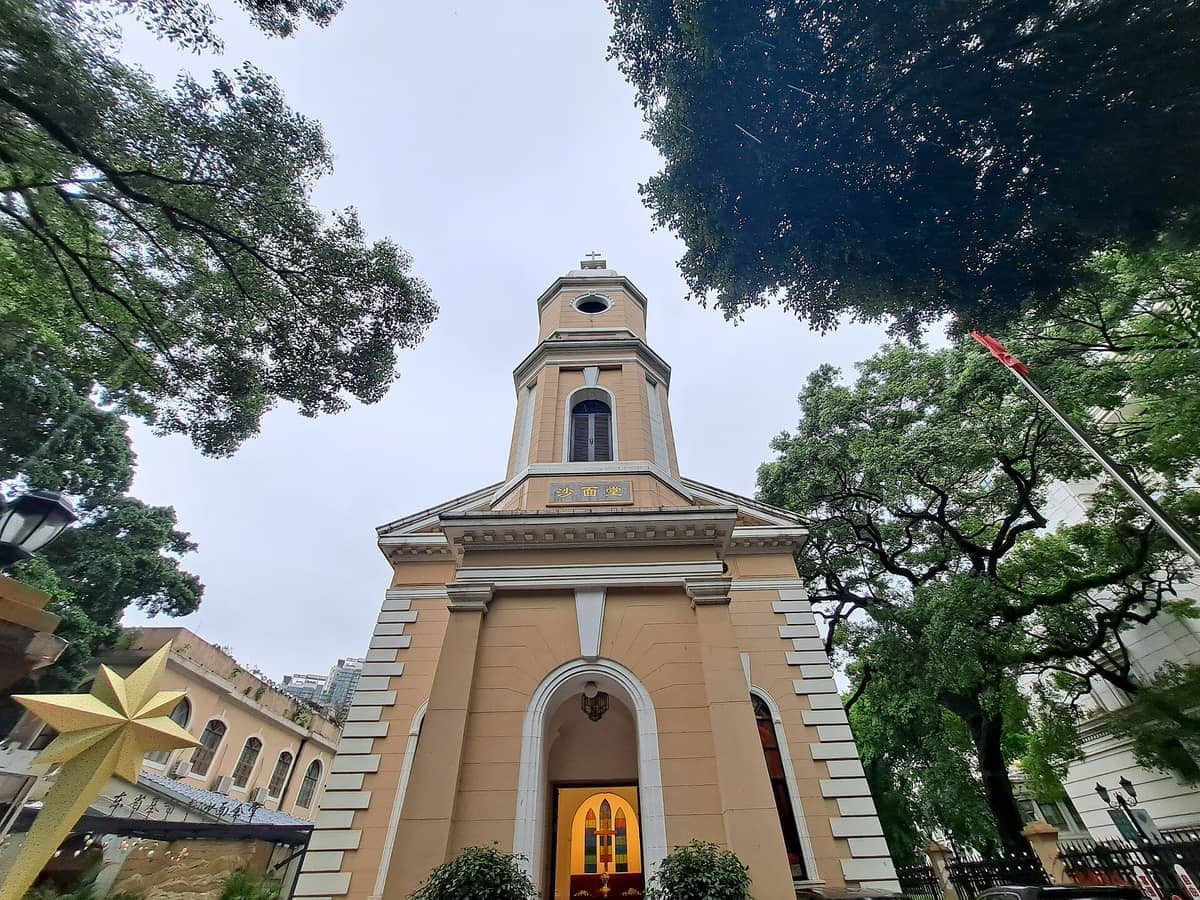
Shamian Christian Church, known in Chinese as 基督教沙面会堂 (also listed as Christ Church Shamian and 沙面基督教堂), is a colonial-era Protestant church located on the southern edge of Shamian Island in Guangzhou's Liwan District. Built in the 1860s during the period when Shamian served as a foreign concession shared between British and French interests, the church is one of the few buildings on the island still used for its original purpose.
Unlike many colonial buildings in China that have been converted into cafés, hotels, or government offices, this church remains an active place of Christian worship. Sunday services at 9:30am draw a modest local congregation, and the building itself is free to approach and photograph at any time. It is a small structure by European cathedral standards, but within the compact landscape of Shamian Island it carries genuine weight.
ℹ️ Good to know
The church holds Sunday worship at 9:30am. If you visit on a weekday, you can view and photograph the exterior freely, but the interior may not be accessible. Confirm current opening arrangements locally, as hours for non-Sunday visits are not formally published.
The Architecture: Gothic Revival on a Subtropical Island
The building reflects the Gothic Revival style that British missionaries and colonial administrators favored throughout their overseas postings in the 19th century. The façade features pointed arch windows, a modest bell tower, and rendered masonry in a pale finish that contrasts sharply with the dense tropical greenery of Shamian's banyan-lined avenues. On overcast mornings, the grey-white stone reads almost silver.
The church is not a grand structure. It was built for a concession population, not a metropolitan congregation, and its scale reflects that. The proportions are intimate rather than imposing, which in some ways makes it more approachable than larger colonial churches. The detailing around the window arches and entry portal shows craftsmanship that is worth looking at slowly rather than quickly.
For visitors interested in how colonial-era architecture shaped Guangzhou's built environment, the church fits into a broader Guangzhou architecture guide that spans from the Shamian concession buildings to the modernist towers of Zhujiang New Town.
Historical Context: The Shamian Concession and Its Religious Life
Shamian Island was ceded to foreign powers following the Second Opium War, with British and French sections formally established in the early 1860s. The island, a sandbar in the Pearl River, was developed into a self-contained colonial enclave with consulates, banks, trading houses, a hospital, a cricket ground, and churches. The Shamian Christian Church was established to serve the Protestant British community, with construction dated to 1864 or 1865 depending on the source.
The concession era ended after the founding of the People's Republic in 1949, but the island's physical fabric was largely preserved rather than demolished. Since the 1980s, Shamian has been designated a protected historical zone. The church survived intact and was eventually returned to Christian use, making it one of the few working Protestant churches in Guangzhou with a directly traceable lineage to the colonial period.
Shamian Island itself is worth exploring beyond the church. The Shamian Island riverfront offers a walkable stretch of colonial-era buildings, riverside benches, and old trees with root systems that have slowly reclaimed sections of pavement over decades.
How the Visit Changes by Time of Day
Early mornings on Shamian Island are genuinely quiet. Before 9am, the only sounds are birdsong from the banyan trees, the occasional bicycle, and the distant river traffic from the Pearl River to the south. This is the best time to photograph the church exterior without pedestrians cutting through the frame. The soft light on the pale masonry is particularly good in the hour after sunrise.
By mid-morning on weekdays, tour groups begin to move through Shamian, and the outdoor seating at cafés nearby fills up. The church exterior remains accessible but becomes a backdrop for more general foot traffic. On Sunday mornings, the dynamic is different: the 9:30am service brings a small, steady stream of local worshippers, and visitors who attend respectfully are generally welcome. Cantonese is the primary language used in the service.
Afternoon light hits the church from the west, which can create harsh contrast in photographs but also produces strong shadows that emphasize the arched stonework. Late afternoon in autumn or winter, when Guangzhou's humidity drops and the light softens, is arguably the most photogenic window. Summer afternoons should be avoided unless you enjoy heat and crowds in equal measure.
💡 Local tip
Photography tip: Position yourself on the south side of the building in the morning for the best light on the façade. The surrounding trees provide natural framing but can create deep shadows at midday — plan accordingly.
Getting There and Practical Logistics
The most straightforward route is Metro Line 1 to Huangsha Station. From the station, Shamian Island is a short walk south across a pedestrian bridge. The church sits on Shamian Nanjie (South Street) near the southern edge of the island, so from the metro entrance you are looking at roughly 10 minutes on foot. Bus options include stops at Huangsha Matou, Liu'Ersan Lu, Cultural Park, and Nanfang Dasha.
The island is compact and entirely walkable. There is no need for taxis or ride-hailing once you arrive. The streets are flat, shaded by mature trees, and largely free of motor traffic, which makes navigation easy. Note that Shamian's address numbering can be inconsistent across maps and signs: the church is listed as both No. 58 and No. 60 Shamian Nanjie in different sources. Use the intersection with Shamian Dajie as a landmark and look for the church tower.
For a more complete picture of how to move around Guangzhou efficiently, the getting around Guangzhou guide covers metro lines, bus networks, and ride-hailing options in detail.
Pairing the Church With the Rest of Shamian Island
The church should not be treated as a standalone stop. Shamian Island is small enough to walk entirely in under an hour, and the surrounding streets contain some of Guangzhou's best-preserved colonial residential and commercial architecture. The island also has a French Catholic chapel nearby, the Our Lady of Lourdes Chapel, making it possible to visit two distinct colonial-era Christian buildings in a single morning.
The Our Lady of Lourdes Chapel on the French side of the old concession boundary offers an interesting counterpoint: Catholic versus Protestant colonial architecture, French versus British institutional aesthetics, all within a few hundred metres of each other.
After the island, the natural next stop is the broader Liwan area. The historic Shangxiajiu Pedestrian Street is within easy walking or cycling distance, and brings a completely different texture: crowded, commercial, and loud in contrast to Shamian's preserved calm.
Who Should Temper Their Expectations
Visitors expecting a grand Gothic cathedral will find the Shamian Christian Church modest by comparison. It is a colonial outpost church, built for a small expatriate congregation, and its interior is not ornate. If you are primarily interested in spectacular religious architecture, Guangzhou's Sacred Heart Cathedral in Yuexiu offers far more dramatic scale and decorative ambition.
The church is also not accessible in the conventional tourist sense for most of the week. Without a confirmed Sunday service visit or a specific arrangement with the congregation, weekday visitors are limited to the exterior. For those who are interested in architectural observation and the layered history of Shamian Island, that exterior is still worth the time. For visitors with very limited time in Guangzhou who need to prioritise, it is honest to say the church works best as part of an island walk rather than as a primary destination in its own right.
⚠️ What to skip
If you plan to attend Sunday worship, dress conservatively and arrive a few minutes before 9:30am. The service is conducted in Cantonese. Visitors are generally welcome but should behave as guests in a place of active religious practice, not as tourists at a sightseeing stop.
Insider Tips
- Arrive before 8:30am on any day to have the church and surrounding streets almost entirely to yourself. Shamian empties out overnight and tour groups rarely arrive before mid-morning.
- The Sunday service at 9:30am is one of the few ways to see the interior. It is an active Christian congregation, not a museum service, so attend only if you are genuinely interested in participating or observing respectfully.
- The address discrepancy (listed as both No. 58 and No. 60 Shamian Nanjie) can cause confusion with map apps. Search for '基督教沙面会堂' in Chinese mapping apps like Amap (高德地图) for the most precise pin.
- Combine the visit with a walk along the Pearl River side of the island in the late afternoon. The light on the river and the old colonial buildings together is the most atmospheric part of any Shamian visit.
- October to December is the best season for Shamian generally: lower humidity, comfortable temperatures, and clear skies that make the pale colonial stonework read cleanly in photographs.
Who Is Shamian Christian Church For?
- History and colonial architecture enthusiasts who want depth beyond a quick photo stop
- Photographers looking for early-morning quiet and strong European-style architectural subjects in a subtropical setting
- Christian travellers interested in attending a historic Sunday service in Guangzhou
- First-time visitors to Guangzhou who want to understand the city's 19th-century foreign concession history in a walkable, well-preserved setting
- Slow travellers who prefer combining a single cultural site with a longer neighbourhood walk rather than ticking off a checklist of major attractions
Nearby Attractions
Other things to see while in Shamian Island:
- Our Lady of Lourdes Chapel
Built by French missionaries in 1890, Our Lady of Lourdes Chapel stands as one of Guangzhou's most striking pieces of colonial religious architecture. Set on the shaded avenues of Shamian Island, the chapel is free to enter, still holds daily services, and rewards visitors who arrive early with genuine calm and beautiful light.
- Shamian Island Riverfront
Shamian Island is a 0.30-square-kilometre sandbank in the Pearl River where European consular buildings, shaded boulevards, and a quiet riverside promenade survive largely intact. Entry is free, and the atmosphere is unlike anywhere else in Guangzhou.