Yide Road Dried Seafood Street: Guangzhou's Wholesale Seafood Quarter
Yide Road is Guangzhou's historic dried seafood and New Year goods street, stretching about 1 kilometer through Yuexiu District. With around 200 shops and five large indoor wholesale markets selling over 1,600 varieties of dried seafood, it offers a raw, unfiltered look at how Cantonese kitchens are stocked. Entry is free, and the experience is as much about the sensory overload as it is about shopping.
Quick Facts
- Location
- Yide Road, Yuexiu District, Guangzhou, Guangdong Province, China
- Getting There
- Yide Lu Station (Metro Line 6), Exit A
- Time Needed
- 1 to 2 hours for a thorough walk-through
- Cost
- Free to enter; individual purchases vary by vendor
- Best for
- Food lovers, photographers, shoppers stocking up on Cantonese pantry staples
What Yide Road Actually Is
Yide Road (一德路) is not a tourist attraction in the conventional sense. It is a working wholesale street, roughly 1 kilometer long, that has been supplying Guangzhou's restaurants, household kitchens, and Lunar New Year tables with dried seafood and preserved goods for the better part of a century. The street traces its current commercial character back to the Republican era, and the density of trade here has never really let up.
The numbers give you a sense of the scale: around 200 shops line the road and spill into five large indoor wholesale markets, together offering more than 1,600 varieties of dried seafood. Dried abalone, scallops, sea cucumbers, fish maw, shrimp, squid, cuttlefish, oysters, and dozens of fungi and preserved meats compete for shelf space. What looks like chaos from the street entrance is, on closer inspection, a highly organized supply chain that feeds much of Guangdong.
💡 Local tip
Most shops open around 8:00 AM to 9:30 AM and close by 5:30 PM to 6:00 PM, though hours vary by shop and season. Arrive before 10:00 AM on a weekday to see the wholesale trade at full pace without weekend crowds.
The Sensory Reality of the Street
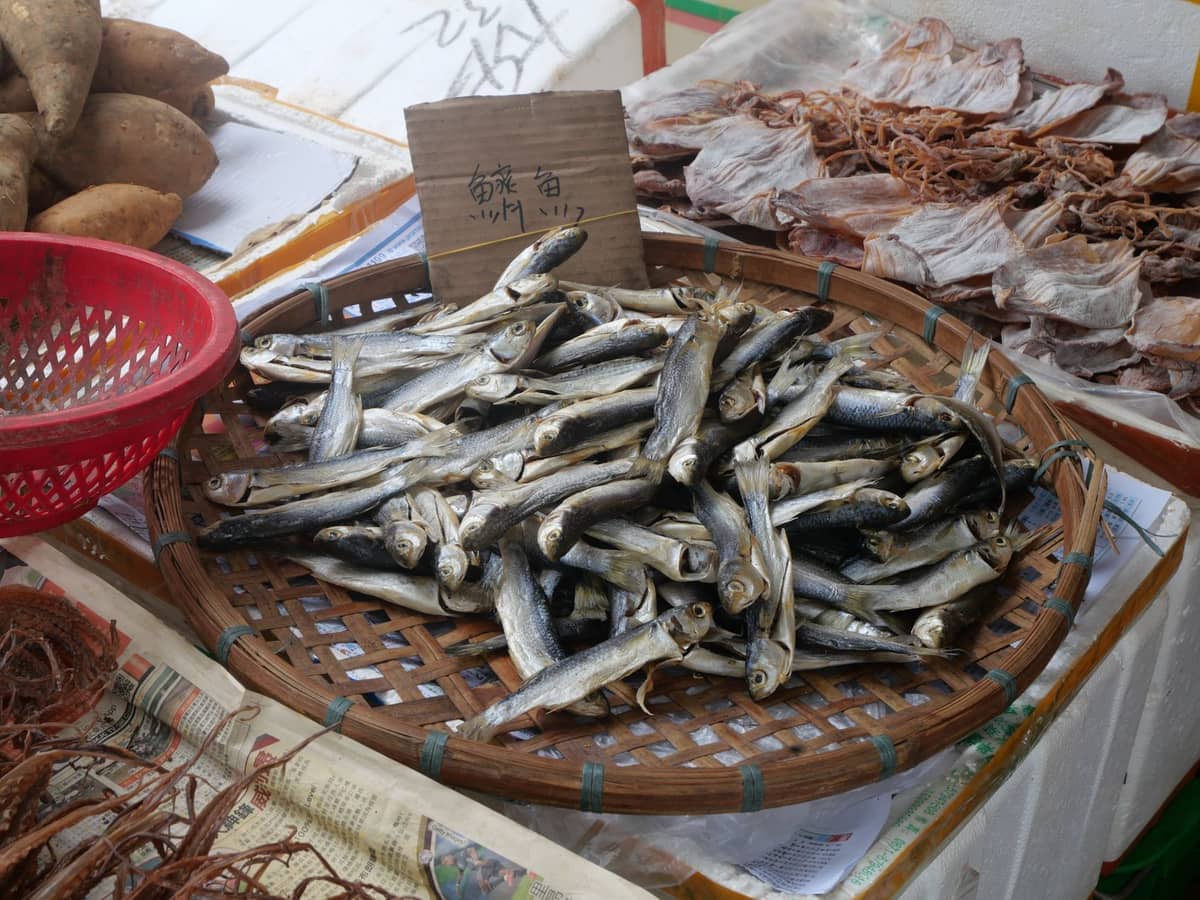
The smell arrives before you reach the first stall. Dried seafood has a concentrated, oceanic intensity that becomes familiar within minutes but never fully disappears. At street level, sacks of dried shrimp and wooden crates of sea cucumber sit stacked on the pavement outside shops, their surfaces dusty with salt crystals. Overhead, strings of dried fish and squid hang across doorways, swaying slightly in the morning air. Underfoot, the pavement is slightly tacky near the busier wholesale market entrances.
The indoor wholesale markets are worth entering. They tend to be louder and more functional than the street-facing shops: fluorescent lighting, hand trolleys stacked with bulk orders, and vendors calling prices across narrow aisles. The smell intensifies sharply once you pass through the main entrance. It takes a few minutes to navigate your bearings, but the layout becomes readable once you notice that individual product categories tend to cluster together.
Photographically, the morning light before 10:00 AM gives the best results for street-level shots, when the low sun catches the hanging fish and the sidewalk displays without the flat midday glare. The indoor markets are a different matter: bring a camera that handles mixed artificial light well, or use your phone's night mode.
How the Street Changes Through the Day
Early mornings, roughly 8:00 AM to 10:00 AM, belong to wholesale buyers: restaurant owners, catering suppliers, and market traders who arrive with specific lists and move fast. The energy is purposeful rather than leisurely. Vendors are focused on their regulars and are less inclined toward extended conversation with casual browsers, which is worth knowing if you plan to ask detailed questions about products.
By mid-morning the retail traffic picks up: local households, out-of-town visitors, and tourists drawn by curiosity. This is also when the street becomes easier to navigate at your own pace, because the urgent wholesale rush has subsided. In the lead-up to Chinese New Year, the atmosphere shifts entirely. Yide Road is known locally as one of Guangzhou's key New Year goods streets, and the weeks before the holiday see the sidewalks so densely packed with shoppers and produce that moving at anything faster than a slow shuffle becomes unrealistic.
If you are planning to visit during the Lunar New Year period, read more about timing and crowds in the Guangzhou Chinese New Year guide before you go.
Historical and Cultural Context
Guangzhou's position as a trading port for more than two millennia made dried and preserved seafood a practical necessity long before refrigeration existed. Drying, salting, and fermenting seafood extended the shelf life of coastal catches and allowed inland communities throughout Guangdong and beyond to access protein-rich ingredients. The Cantonese culinary tradition built entire categories of dishes around these preserved ingredients, from abalone-braised pork to dried scallop congee and fish maw soups.
Yide Road consolidated this trade during the Republican era, and the street has remained commercially active through subsequent decades when many of Guangzhou's older trading streets were redeveloped or lost their original function. The fact that it still operates at wholesale scale, rather than having been converted into a heritage retail zone, gives it an authenticity that more curated food streets cannot replicate.
To understand how dried seafood ingredients fit into the broader Cantonese cooking tradition, the Guangzhou food guide covers the key dishes and where to try them across the city.
Practical Walkthrough: Getting There and Getting Around
Getting to Yide Road is straightforward. Take Guangzhou Metro Line 6 to Yide Lu Station and use Exit A to surface directly onto the street. The walk from the exit to the main concentration of seafood shops is short, and the street's character becomes obvious within the first 50 meters.
The street itself runs approximately 1 kilometer, and a single pass without stopping takes about 15 minutes. Realistically, if you are looking at products, stepping into a few indoor markets, and comparing prices, allow at least 90 minutes. The indoor wholesale markets are accessed through ground-floor entrances marked with signs; most are open to the public, though some larger wholesale floors may be busier and less oriented toward individual retail buyers.
No admission fee applies to the street or its markets. Prices for individual products vary significantly by grade and quantity. Premium dried abalone and high-grade sea cucumber command prices comparable to specialty food shops anywhere in Asia, while common items like dried shrimp, squid, and mixed mushrooms are sold at bulk rates that make them excellent value compared to supermarket alternatives.
ℹ️ Good to know
Yide Road sits within Yuexiu District, close to several of Guangzhou's most significant historical sites. It pairs well with a morning visit to the nearby Nanyue King Mausoleum Museum or a walk through Shamian Island.
Yuexiu District as a whole rewards a longer visit. For context on what else the area offers, see the overview of Yuexiu District.
What to Buy and What to Watch For
For visitors buying to take home, dried scallops (conpoy), dried shrimp, dried mushrooms, and smaller packs of mixed dried seafood travel reasonably well in sealed packaging and are commonly permitted in luggage for most destinations, though you should verify your destination country's customs rules before purchasing. High-moisture items like certain preserved fish are less suitable for long-haul travel.
Grade matters enormously on this street. Dried abalone, for instance, spans an enormous price range depending on origin, drying method, and size count per catty. Vendors generally know their product well and can explain the differences if you show genuine interest. Basic Mandarin or Cantonese phrases help; many vendors have limited English. A translation app is useful for reading product labels.
⚠️ What to skip
Do not assume that a lower-priced product is the same quality as a higher-priced one from the next stall. Grade variations in dried seafood are significant and affect both flavor and culinary use. If you are buying a substantial quantity, ask the vendor to explain the grade before committing.
Practical Assessment: Who This Is For and Who Should Skip It
Yide Road works best for visitors who are genuinely curious about Cantonese food culture, who cook or plan to cook with these ingredients, or who want to see how a working wholesale trade street actually operates in a major Chinese city. It also works for photographers looking for textures, patterns, and authentic commercial life rather than staged heritage scenes.
It is not the right stop for visitors who are sensitive to strong smells, who need wide-clearance accessible pathways, or who are looking for a polished, air-conditioned retail experience. The street can become genuinely difficult to navigate in the weeks before Chinese New Year due to crowd density. On rainy days, the outdoor displays make sections of pavement slippery and some shop entrances narrow considerably to shelter goods from the weather.
If you are building a broader itinerary around Guangzhou's market streets, the Shangxiajiu Pedestrian Street nearby in Liwan offers a more polished mix of traditional storefronts and food vendors that complements the raw wholesale character of Yide Road.
Insider Tips
- Weekday mornings between 9:00 AM and 11:00 AM offer the best balance of full stock, active trade, and manageable crowd levels. Weekends draw significantly more casual visitors.
- The indoor wholesale markets, accessed through doorways set back from the street, often have better prices and wider variety than the street-facing shops, but require more navigational patience. Look for markets with large Chinese signage above their ground-floor entrances.
- Bring a reusable bag. Vendors will package purchases in plastic, but if you are buying multiple small items from different stalls, consolidating into one bag makes the walk back more manageable.
- Some vendors near the street's eastern end stock a wider range of preserved meats and Chinese New Year goods including candy, dried fruit, and festive items, making that section worth exploring even if dried seafood is not your focus.
- If you are visiting Yuexiu District for a half-day, pair Yide Road with the Nanyue King Mausoleum Museum a short walk to the north. The contrast between a 2,000-year-old royal tomb and a century-old wholesale street captures something essential about how Guangzhou layers its history.
Who Is Yide Road Dried Seafood Street For?
- Food enthusiasts who want to understand the raw ingredients behind Cantonese cuisine
- Shoppers sourcing authentic dried seafood at wholesale-adjacent prices
- Photographers drawn to working commercial streets with strong visual texture
- Travelers building a full-day Yuexiu District itinerary around Guangzhou's historical core
- Visitors preparing for Chinese New Year celebrations who want traditional festive goods
Nearby Attractions
Other things to see while in Yuexiu:
- Beijing Road Pedestrian Street
Beijing Road Pedestrian Street runs through the historic heart of Yuexiu District, layering modern retail over more than a thousand years of commercial history. Entry is free, the metro drops you right at the door, and the glass-covered archaeological ruins embedded in the pavement are an unexpected highlight worth stopping for.
- Canton Orchid Garden
Tucked inside Yuexiu District, the Canton Orchid Garden is a compact but carefully curated public garden dedicated entirely to orchid cultivation. At RMB 8 entry, it offers a rare pocket of calm in central Guangzhou, best appreciated in the cooler months when the flowers are at their peak.
- Ersha Island
Ersha Island sits in the Pearl River between Guangzhou Bridge and Haiyin Bridge, covering 1.26 square kilometers of parks, cultural venues, and tree-lined promenades. Free to enter and open around the clock, it offers a rare change of pace from the city's commercial core.
- Five Rams Statue
Carved from over 130 pieces of granite and completed in the late 1950s, the Five Rams Statue stands as one of Guangzhou's most recognizable landmarks. Located inside Yuexiu Park, it is free to visit and open daily, and is often best experienced in the early morning when the park is quiet and the light is soft.