Canton Orchid Garden: Guangzhou's Quiet Floral Retreat in Yuexiu
Tucked inside Yuexiu District, the Canton Orchid Garden is a compact but carefully curated public garden dedicated entirely to orchid cultivation. At RMB 8 entry, it offers a rare pocket of calm in central Guangzhou, best appreciated in the cooler months when the flowers are at their peak.
Quick Facts
- Location
- No. 901 Jiefang North Road, Yuexiu District, Guangzhou
- Getting There
- Guangzhou Metro Line 2, Yuexiu Park Station (Exit B2 or C), short walk
- Time Needed
- 45 minutes to 1.5 hours
- Cost
- RMB 8 per person (verify on arrival; cash may be required)
- Best for
- Orchid enthusiasts, photography, quiet morning walks, garden lovers
What Is the Canton Orchid Garden?
The Canton Orchid Garden (广州兰圃, also rendered as Guangzhou Orchid Garden) is a specialist botanical garden in the heart of Yuexiu District. Covering approximately 3.99 hectares, it is one of the few public gardens in China dedicated to the cultivation and display of orchids. The entrance fee is RMB 8, which makes it genuinely accessible rather than symbolic.
The garden sits on Jiefang North Road, a central artery running through Yuexiu District, placing it within easy reach of several of Guangzhou's most significant historical sites. It shares the same general neighborhood as Yuexiu Park and the Nanyue King Mausoleum, making it a natural addition to a half-day cultural itinerary in this part of the city.
ℹ️ Good to know
Opening hours are 08:00–18:00 daily, but the garden has historically adjusted these for special orchid exhibitions. During one recorded 2024 event, visiting windows were restricted to 9:30–12:00 and 14:00–17:00. Check locally before planning a visit during spring festival seasons.
The Garden Experience: What You Actually See
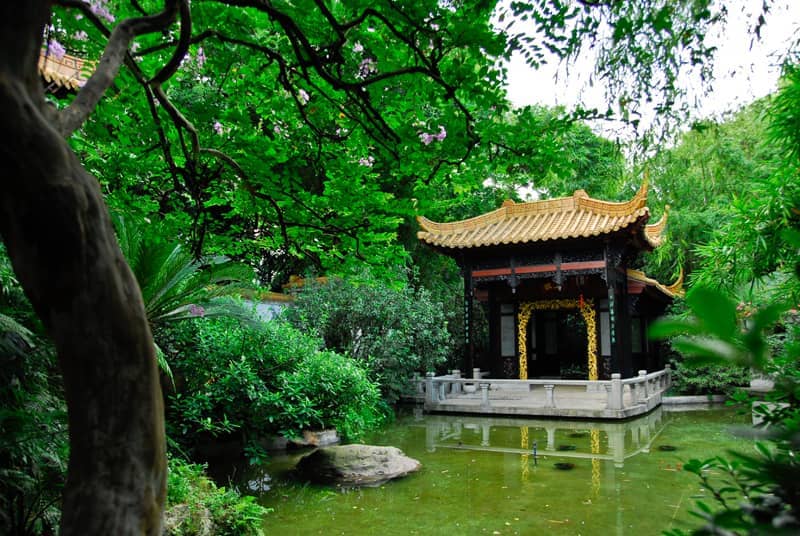
The Canton Orchid Garden is compact enough to walk fully in under an hour, but it rewards slower movement. The layout combines covered display pavilions housing potted orchid specimens with open-air paths shaded by bamboo and subtropical trees. The air carries a faint, green dampness common to enclosed garden spaces in Guangzhou's humid climate, occasionally sharpened by the scent of flowering specimens in the display houses.
The orchid collection itself spans a wide variety of species, with particular emphasis on cymbidiums (lan hua), which hold deep cultural significance in Chinese literati tradition. These are plants associated with moral refinement and scholarly virtue, a symbolism that dates back to Confucian writings. Display labels are primarily in Chinese, so visitors without reading ability will appreciate the visual quality of the specimens without the full botanical context.
Beyond the orchids, the garden contains decorative rockeries, small ponds with koi, and pavilion seating areas where older residents of the surrounding neighborhood often gather for morning tea and conversation. This social layer is part of what makes the space feel genuinely used rather than merely preserved.
How the Atmosphere Changes Through the Day
Early mornings between 08:00 and 09:30 are consistently the best time to visit. The light is softer, the temperature in Guangzhou's warmer months is still tolerable, and the visitor numbers are low enough that you can move through the display areas at your own pace. Local residents use this slot for quiet exercise and sitting, giving the garden an unhurried, neighborhood feel that disappears once tourist groups begin arriving mid-morning.
By late morning, especially on weekends, the narrow paved paths between display beds can feel congested. Photography becomes harder as other visitors crowd popular specimen areas. If you're primarily here to photograph orchids, arrive within the first hour of opening. Midday in summer should be avoided for comfort reasons alone: Guangzhou's humidity between June and August is punishing, and the garden's partial shade provides only limited relief.
Late afternoon visits, roughly 16:00 onwards, offer a second quieter window. The angle of light through the canopy improves for photography, and the day's heat begins to break from September onward. The garden closes at 18:00, so there is no twilight viewing.
💡 Local tip
The best flowering period for most orchid species on display is late autumn through early spring, roughly November to March. Visiting in this window maximizes what you'll see in bloom. Summer visits still offer green scenery and a peaceful walk, but fewer orchids will be flowering.
Cultural and Historical Context
The garden was established in 1962, a period when Guangzhou was developing its public green infrastructure. Its focus on orchids was deliberate: the orchid (lan) is one of the Four Gentlemen in Chinese art and culture, alongside plum blossom, bamboo, and chrysanthemum. Each represents a moral quality, and the orchid is associated with integrity and refinement under adversity. For a garden planted in an era of considerable social upheaval, the choice of subject carries weight that extends beyond horticulture.
Canton was the historic name for Guangzhou used by Western traders and diplomats, and its continued use in the garden's English name reflects the city's long engagement with international commerce and cultural exchange. Visitors interested in that broader history will find deeper context at the Guangdong Museum or at the nearby Nanyue King Mausoleum Museum, both of which document Guangzhou's deep historical roots.
Getting There and Practical Logistics
The most straightforward route is Guangzhou Metro Line 2 to Yuexiu Park Station. Use Exit B2 or Exit C, then walk a short distance along Jiefang North Road to No. 901. The walk is flat and takes roughly five minutes. Taxis and ride-hailing via DiDi are also viable options if you're coming from further afield or carrying luggage.
The garden is located close to Yuexiu Park, which is directly accessible from the same metro station. Combining both in a single morning is practical and efficient: Yuexiu Park is considerably larger and takes 1.5 to 2 hours on its own, so visit the Orchid Garden first while energy is high, then walk across to Yuexiu Park for the rest of the morning.
At least one visitor review has noted that the entrance payment was cash only at time of visit. This is not confirmed by official sources, but it is worth carrying small-denomination RMB notes as a precaution. Mobile payment via WeChat Pay or Alipay is standard across most of Guangzhou's public spaces, but specialty gardens can lag behind. Arrive with both options available.
⚠️ What to skip
During special orchid exhibitions, entry procedures and visiting windows may be restricted to specific time slots and may require advance booking. This has been documented for spring events. Confirm current arrangements if visiting in March, April, or May.
Photography Tips and What to Bring
The display pavilions have controlled but often low light. A phone with a decent portrait or macro mode will work well for individual blooms, but the interiors can be challenging without some form of image stabilization. Natural light on the outdoor paths is far more forgiving, particularly in the hour after opening.
Wear comfortable walking shoes with some grip. Stone paths in shaded areas stay damp and can be slippery after rain. A light waterproof layer is sensible from April through September given Guangzhou's unpredictable afternoon downpours. The garden is small enough that an umbrella is manageable throughout.
If you want to extend your day in this part of Guangzhou, the Five Rams Statue is a short walk away inside Yuexiu Park, and the Zhenhai Tower with its Guangzhou Museum sits on the hill inside the same park. Together, these three sites make a coherent half-day loop in Yuexiu.
Who Should Probably Skip This
Travelers on tight itineraries with only one or two days in Guangzhou will find the Canton Orchid Garden hard to justify over larger, more varied sites. It does one thing well, and that thing is orchids. If botanical gardens don't engage you, the RMB 8 and 45 minutes are better spent elsewhere.
Families with young children looking for interactive or high-energy experiences will likely find the garden too quiet and static. For family-oriented options in Guangzhou, our guide to Guangzhou with kids offers better-suited alternatives. Similarly, visitors primarily interested in Guangzhou's architectural heritage or food culture should prioritize other parts of the city first.
Insider Tips
- Visit within the first hour of opening on a weekday for the quietest experience. By 10:00 on weekends, the narrow paths between display beds see noticeably more foot traffic.
- The garden hosts special orchid exhibitions in spring, typically around March to May. These draw larger crowds but also showcase the collection at its most elaborate. Check for event notices at the gate or through Guangzhou International tourism channels before arrival.
- Carry small denomination RMB cash as a backup. Mobile payment is standard across Guangzhou, but payment systems at smaller public gardens can be inconsistent.
- The koi ponds near the interior pavilions are among the more photogenic spots in the garden and are often overlooked in favor of the orchid displays. They photograph well in the softer morning light.
- Combine with Yuexiu Park next door for a full morning. The Orchid Garden takes under an hour; Yuexiu Park can absorb another two. Both are accessible from the same metro exit, making the combination efficient and cost-effective.
Who Is Canton Orchid Garden For?
- Orchid enthusiasts and botanical garden visitors
- Photographers looking for macro and floral subjects in natural light
- Travelers wanting a quiet, low-cost break from the pace of central Guangzhou
- Those building a half-day Yuexiu history and nature itinerary
- Visitors traveling in autumn or winter when the garden is at its most photogenic and the weather is cooperative
Nearby Attractions
Other things to see while in Yuexiu:
- Beijing Road Pedestrian Street
Beijing Road Pedestrian Street runs through the historic heart of Yuexiu District, layering modern retail over more than a thousand years of commercial history. Entry is free, the metro drops you right at the door, and the glass-covered archaeological ruins embedded in the pavement are an unexpected highlight worth stopping for.
- Ersha Island
Ersha Island sits in the Pearl River between Guangzhou Bridge and Haiyin Bridge, covering 1.26 square kilometers of parks, cultural venues, and tree-lined promenades. Free to enter and open around the clock, it offers a rare change of pace from the city's commercial core.
- Five Rams Statue
Carved from over 130 pieces of granite and completed in the late 1950s, the Five Rams Statue stands as one of Guangzhou's most recognizable landmarks. Located inside Yuexiu Park, it is free to visit and open daily, and is often best experienced in the early morning when the park is quiet and the light is soft.
- Guangzhou Martyrs' Memorial Garden
Guangzhou Martyrs' Memorial Garden is a free public park and memorial cemetery in Yuexiu District, built to honor those killed in the Guangzhou Uprising of December 1927. It combines significant revolutionary history with shaded walkways, lotus ponds, and calm open spaces that feel worlds away from the surrounding city traffic.