Guangdong Museum: Guangdong's History, Art, and Natural World Under One Roof
The Guangdong Museum is Guangzhou's flagship public museum, housed in a striking contemporary building in Zhujiang New Town. Admission is free, but advance booking is required. Expect broad collections covering Guangdong's natural history, fine arts, and deep trading heritage.
Quick Facts
- Location
- No. 2 Zhujiang East Road, Zhujiang New Town, Tianhe District, Guangzhou
- Getting There
- Metro Line 3 – Zhujiang New Town Station (Exit B1); APM Line – Guangzhou Opera House Station (Exit B)
- Time Needed
- 2–3 hours
- Cost
- Free admission; advance real-name reservation required; ID required at entry
- Best for
- History lovers, art and ceramics enthusiasts, rainy-day culture seekers, families with older children
- Official website
- www.gdmuseum.org.cn/en
What the Guangdong Museum Actually Is
The Guangdong Museum (广东省博物馆) is the provincial museum of Guangdong, and by scope, it is one of the most substantial museums in southern China. Opened to the public on October 1, 1959, the institution has grown considerably over the decades. The current building in Zhujiang New Town opened in the 2010s and spans around 77,000 square meters at its Zhujiang New Town building. It houses permanent collections covering Guangdong's natural history, historical artifacts, fine arts, ceramics, and the province's long maritime trade legacy. Temporary exhibitions rotate regularly and tend to draw from both domestic and international lending institutions.
Admission is free, but free does not mean walk-up. The museum operates a real-name reservation system: you must book a time-slotted ticket online or collect one from the ticket office starting at 8:50 a.m. and you will need to show a valid ID at the entrance. This is standard practice for major free museums across China, not a quirk of this institution.
💡 Local tip
Book your free ticket online before you arrive. Tickets are distributed daily from the ticket office from 8:50 a.m. Bring your passport or China ID — the ticket is tied to your name.
The Building Itself: Architecture Worth Noting
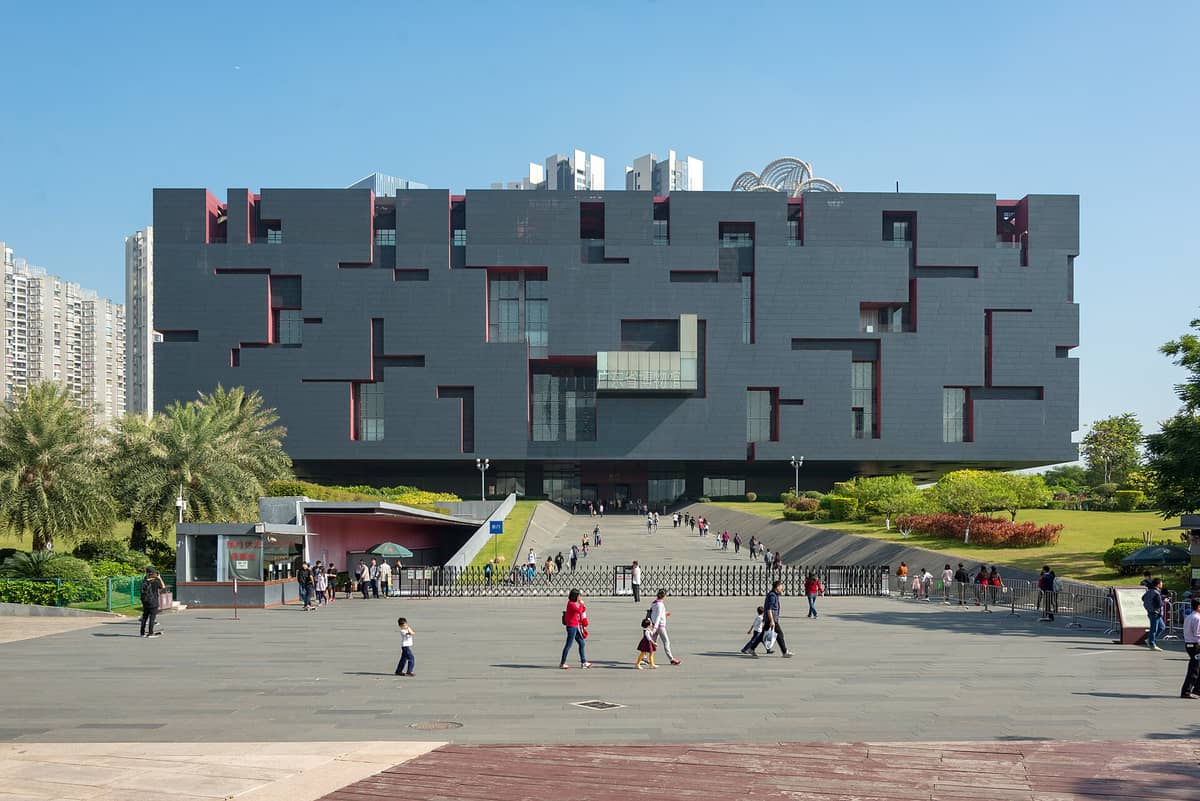
The Guangdong Museum's current home is architecturally ambitious. The building, designed by Rocco Design Architects, takes the form of a carved lacquer box, a reference to one of Guangdong's most celebrated traditional crafts. The exterior is a latticed, perforated shell that wraps around the structure, creating shadow patterns that shift with the sun across the day. From the plaza outside, it reads as a solid mass that somehow appears both dense and permeable at the same time.
It sits on the eastern bank of the Pearl River in Zhujiang New Town, directly across from the Guangzhou Opera House and within sight of Canton Tower to the south. The surrounding plaza connects these civic landmarks and is a major pedestrian space.
The broader Zhujiang New Town precinct is Guangzhou's most architecturally coherent modern district. If you are interested in the city's contemporary built environment, the Guangzhou architecture guide maps out the key buildings worth seeing in the area.
The Collections: What You Will Actually See
The permanent collection is organized across several major themes. The natural history galleries cover the geology, ecology, and wildlife of Guangdong province, including fossil specimens and displays on the Pearl River delta's ecological history. The exhibits are well-labeled, and some sections have bilingual English signage, though coverage varies by gallery.
The history and culture galleries are the museum's strongest material. Guangdong was at the center of China's maritime trade for centuries, and the collections reflect that: porcelain export wares, trade goods, maps, and objects from the Canton System era when Guangzhou (then called Canton in English) was the only port officially open to Western merchants. For anyone trying to understand why Guangzhou feels different from northern Chinese cities, these galleries provide real context.
The art collection includes traditional Chinese painting and calligraphy with particular depth in the Lingnan painting school, a distinctly Guangdong artistic tradition that blends Chinese and Western techniques. The ceramics holdings are genuinely strong, covering both local kilns and export porcelain produced for international markets.
Temporary exhibitions occupy a significant portion of the floor space and change every few months. These can range from blockbuster loans from major Chinese institutions to traveling international shows. Check the museum's official website before your visit, since a compelling temporary show can meaningfully change how you allocate your time inside.
Visiting by Time of Day: What Changes and When
The museum opens at 9:00 a.m. Tuesday through Sunday, with last entry at 4:00 p.m. and closing at 5:00 p.m. The building is closed on Mondays, except when a national holiday falls on that day. The first hour after opening is reliably the quietest. Natural light in the atrium is at its most interesting in the morning, filtering through the latticed exterior. The permanent galleries feel calm at this hour, and you can move through the ceramics rooms without navigating around school groups.
By mid-morning, especially on weekends, visitor numbers increase noticeably. The areas near temporary exhibition entrances and the ground-floor lobby can become congested. If you plan to visit a popular temporary show, arriving at opening is genuinely useful rather than just a guidebook cliché.
ℹ️ Good to know
The museum is a reliable rain-day option. Guangzhou's rainy season runs roughly April through September, with the heaviest downpours in late spring and summer. On a wet afternoon, expect slightly higher visitor numbers than usual as people redirect plans. The building's interior is fully air-conditioned, which is welcome on humid summer days.
Late afternoon visits (after 3:00 p.m.) are quieter again, but remember that last entry is at 4:00 p.m. Arriving at 3:30 p.m. leaves genuine time only if you are targeting one or two specific galleries rather than the full collection.
Getting There and Getting In
The most straightforward metro route is Line 3 to Zhujiang New Town Station, using Exit B1, followed by a short walk east toward the riverside plaza. The APM Line stops at Guangzhou Opera House Station, Exit B, which deposits you directly at the plaza shared by the museum and the opera house. Line 5 to Liede Station, Exit D, is another option, but the walk is somewhat longer and less direct.
Bus routes 40, 293, 669, 886, and 407 serve stops near the museum, depending on which gate you use. Ride-hailing via DiDi is straightforward in this part of the city, and dropping off on Zhujiang East Road puts you steps from the entrance.
Zhujiang New Town is also home to the Guangzhou Opera House and the Canton Tower, which is a short walk south along the Pearl River. Combining the museum with an evening visit to the tower is a practical way to use your day, since the tower is most photogenic after dark.
Practical Notes Before You Go
Opening hours are Tuesday to Sunday, 9:00 a.m. to 5:00 p.m. with last entry at 4:00 p.m. The museum is closed Mondays except national holidays. These hours are subject to change, so verify on the official website at gdmuseum.org.cn before your visit.
Photography is generally permitted in the permanent galleries without flash, but individual rooms or temporary exhibitions may have specific restrictions that are posted at entry points. Large bags may need to be checked at the cloakroom near the entrance. The museum has cafeteria-style food service on-site, though the surrounding Zhujiang New Town plaza has considerably better dining options a short walk away.
Detailed accessibility information was not confirmed in official sources at the time of writing. The building is modern and designed to contemporary standards, but visitors with specific mobility or accessibility requirements should contact the museum directly before visiting.
⚠️ What to skip
Be honest about your expectations: the Guangdong Museum is a serious, collection-driven institution. Signage quality varies, and not all galleries have strong English labeling. Visitors who rely entirely on English will get more out of the natural history and art galleries than from the more text-heavy historical sections. An audio guide or research beforehand makes a real difference.
Who Should Skip This and Who Should Not
Visitors on a very short itinerary who are primarily interested in street-level Guangzhou, food markets, and neighborhood atmosphere may find the museum competes poorly with alternatives. The city's living culture, from the tea houses of Liwan to the ceramic-roofed temples of Yuexiu, is often more immediately engaging than a formal institution.
That said, for anyone trying to understand the deeper context behind what they are seeing across the city, starting or ending with the Guangdong Museum pays dividends. The trade history galleries in particular reframe places like Shamian Island and Huangpu Ancient Port with considerably more depth.
Children under ten are likely to find the pacing slow, though the natural history section with geological specimens and wildlife displays holds attention reasonably well. Teenagers and adults with genuine curiosity will find the visit rewarding, particularly if they budget the full two to three hours rather than rushing through.
Insider Tips
- The APM Line (the ¥2 automated rail connector (APM) inside Zhujiang New Town) is underused by visitors. Board it at any station in the district and exit at Guangzhou Opera House Station for a near-doorstep drop-off at the museum with zero wait.
- The lacquer-box exterior casts interesting geometric shadows on the plaza in the late morning. If you photograph the building, the eastern facade in mid-morning light gives the most texture. By early afternoon the light flattens considerably.
- The permanent ceramics collection includes export porcelain made specifically for European markets in the 17th and 18th centuries. Look for pieces decorated with Western coats of arms or scenes painted to order for foreign buyers — they are small windows into how global Guangdong's trade economy really was.
- Check the temporary exhibition calendar before you visit rather than after you arrive. Some shows draw queues inside that can add 20–30 minutes of wait time even with a reserved entry slot. Knowing in advance lets you allocate your time accordingly.
- The museum plaza connects directly to the riverfront promenade. After your visit, walking south along the Pearl River toward Canton Tower takes about 15 minutes on foot and is one of the better ways to see Zhujiang New Town at eye level.
Who Is Guangdong Museum For?
- Travelers who want historical and cultural context for what they are seeing across Guangzhou and Guangdong province
- Art and ceramics enthusiasts interested in Lingnan painting traditions and export porcelain
- Rainy-day or hot-afternoon escapes in a fully air-conditioned, free-entry building
- Architecture watchers drawn to contemporary civic design in Zhujiang New Town
- Families with older children or teenagers with an interest in natural history or regional history
Nearby Attractions
Other things to see while in Zhujiang New Town:
- Canton Tower
At 600 metres, Canton Tower is the defining feature of Guangzhou's modern skyline. From its observation decks and sky walk, it offers sweeping views over the Pearl River and Zhujiang New Town. This guide covers everything you need to plan a visit, from ticket tiers to the best hour to arrive.
- Guangzhou Opera House
Opened in May 2010 and designed by the late Zaha Hadid, the Guangzhou Opera House is one of the most architecturally significant buildings in southern China. Set along the Pearl River in Zhujiang New Town, its fluid twin-boulder forms are as striking from the outside as the interiors are from within.