Huangpu Ancient Port: Guangzhou's Maritime Silk Road Gateway
Huangpu Ancient Port (黄埔古港) in Haizhu District is where Guangzhou's centuries-long role as a global trading hub left its clearest mark. This free, open-access historic site in Shiji Village preserves the atmosphere of a historic port settlement, from ancestral halls to riverside stone quays.
Quick Facts
- Location
- Shiji Village, Bazhou Street, Xingang East Road, Haizhu District, Guangzhou
- Getting There
- Metro Line 4 or Line 8 to Wanshengwei Station (Exit B), then Bus 229 or Tourist Bus Line 3 to Pazhou Shiji Village / Huang Bu Gu Gang
- Time Needed
- 1.5 to 2.5 hours
- Cost
- Free admission, open all day year-round
- Best for
- History enthusiasts, slow walkers, photography, escaping the city crowds
What Is Huangpu Ancient Port?
Huangpu Ancient Port, known in Chinese as 黄埔古港, sits inside Shiji Village on the southern banks of the Pearl River in Haizhu District. It is one of the few places in Guangzhou where you can stand beside water and genuinely feel the weight of maritime history beneath your feet rather than in a glass display case. The port traces its origins to the Northern Song Dynasty (960–1127), when this stretch of river was already handling foreign cargo. By the Qing period it had become one of China's designated foreign-trade ports, with the Huangpu Registration Office established in 1686 after Guangdong Customs was set up in 1685.
This is not a reconstructed theme park or a museum with turnstiles. The site is an open historic district where lanes between old clan houses, a riverside promenade, memorial archways, and a small dedicated museum occupy the same village footprint that once processed silk, porcelain, and tea bound for Europe. Entry is free. There are no timed slots, no audio guide rentals, and no souvenir queues. That absence of commercial pressure is both the site's quiet appeal and its main limitation for visitors who want their history narrated for them.
💡 Local tip
Arrive before 9am on a weekday to have the riverside lanes almost entirely to yourself. By mid-morning on weekends, tour groups from local schools and community organizations move through in clusters.
A Port That Shaped Global Trade
Understanding why Huangpu Ancient Port matters requires a short rewind. For most of the Qing Dynasty, Canton (the older English name for Guangzhou) was the only Chinese port legally permitted to conduct trade with the West. Foreign merchants arriving by sea would anchor offshore and transfer goods via smaller vessels upriver. Huangpu was the closest permitted anchorage point to the city for large ocean-going ships. The goods unloaded here, silk bolts, crates of blue-and-white porcelain, chests of Wuyi tea, formed the supply chain for European drawing rooms and parlors across the 18th century.
The village that grew around this trade bears the imprint of that wealth. Clan ancestral halls, carved stone memorial archways, and older residential lanes survived the 20th century in reasonably intact condition here, in contrast to much of central Guangzhou. For a deeper read on the city's trading past, the Canton Fair Complex continues that commercial tradition a few kilometers to the north, while the Pearl River guide gives the broader waterway context that connects all of these historic sites.
Walking the Site: What You Will Actually See
The core of Huangpu Ancient Port is compact enough to cover on foot without a map, though picking one up at the small on-site exhibition hall helps you identify the named archways and halls correctly. The main entrance leads into a renovated lane flanked by low whitewashed walls and dark timber eaves. Stone-paved paths run between the buildings, and the textures underfoot shift from polished reconstruction to genuinely worn original slabs as you move deeper into the village.
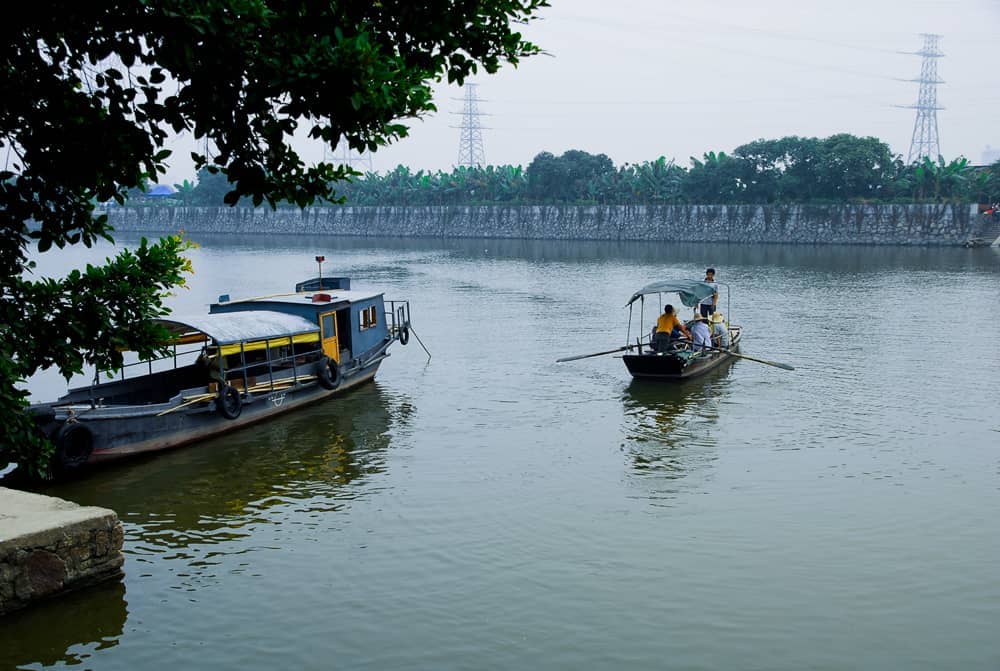
The riverside area offers the clearest view of what this place once was. Stone steps descend toward the Pearl River, and on a clear morning the light on the water is flat and grey-silver before it turns golden around 8am. The far bank is industrial and unglamorous, which is honest: this was always a working port, not a scenic retreat. A row of commemorative markers and stone inscriptions lines the quayside, describing the nationalities of trading vessels that once anchored here.
Inside the exhibition hall (a small dedicated building within the site), photographs, maps, and a modest collection of trade artifacts document the port's peak period from the late 17th to early 19th century. Labels are predominantly in Chinese, with some English translations provided. The exhibits are informative rather than spectacular, giving dates and trade volumes rather than reconstructed scenes. Budget 20 to 30 minutes here if you read slowly or want to photograph the panels.
If you want to compare Guangzhou's historic architectural heritage after your visit, the Chen Clan Ancestral Hall in Liwan District offers a more elaborate and better-labeled example of Lingnan clan architecture, while Nanyue King Mausoleum Museum pushes Guangzhou's documented history several centuries earlier.
How the Experience Changes Through the Day
Early morning, roughly 7am to 9am, is the most atmospheric time to visit. Local residents walk through the lanes as part of their daily routine, older men sit outside on low stools, and the smell of cooking from nearby households drifts through. The stone paths are still cool underfoot. This is when the site feels least like an attraction and most like the village it still partially is.
By late morning the character shifts. Guided groups arrive and the lanes narrow with people. Snack vendors near the entrance do steady business. The site is not so popular that it becomes genuinely congested, but the quiet is gone. Afternoon light is harsh in summer and flat in winter, making photography less rewarding between 11am and 3pm.
Late afternoon, from about 4pm, is the second-best window. Tour groups tend to leave, the light turns amber across the river, and the memorial archways catch the low sun well from the west side. The site stays open after dark but there is minimal lighting in the deeper lanes, so exploring after sunset is not practical.
⚠️ What to skip
Summer visits (June through August) mean intense heat and high humidity. The site has no shaded indoor rest areas apart from the small exhibition hall. Carry water and plan a short visit or arrive very early.
Getting There and Getting Around the Area
Take Guangzhou Metro Line 4 or Line 8 to Wanshengwei Station and use Exit B. From there, Bus 229 or Tourist Bus Line 3 will take you to the stop serving Pazhou Shiji Village, also signposted as Huang Bu Gu Gang. The bus ride adds roughly 10 to 15 minutes to your journey. Nearby bus stops include Pazhou Shiji Cun Zong Zhan and Huangpu Cun, which appear on local bus maps and apps.
The surrounding Haizhu District is also home to the Pazhou area, where the Canton Fair Complex hosts its large trade fairs twice yearly. If your visit coincides with Canton Fair season, expect higher traffic and accommodation prices across this part of the city. The Canton Fair visitor guide covers how to navigate that period.
The site itself is entirely walkable once you arrive. There are no internal transport links, golf carts, or guided shuttles. Footwear matters: the older stone lanes are uneven, and some areas near the riverbank have steps without handrails. Visitors with significant mobility limitations will find the main entrance area and the exhibition hall accessible, but deeper parts of the village are not step-free.
Photography and Practical Details
The site photographs well under soft morning or late-afternoon light. The memorial archways frame cleanly against open sky when approached from the south. The riverside steps and quay offer compositional depth with the river as background. Interior hall spaces are dim, so a wide-aperture lens or a phone with strong low-light capability will produce better results than a standard kit lens.
There are no restrictions on photography for personal use in the outdoor areas. Inside the exhibition hall, follow any posted notices, as individual exhibits may carry restrictions. Drone photography is subject to China's general urban drone regulations and should be arranged only with proper permits obtained in advance.
For context on how this site fits into a wider itinerary, the Guangzhou walking tours guide includes routes that connect Haizhu historic sites with the Pearl River waterfront. The Guangzhou on a budget guide lists Huangpu Ancient Port among the city's most substantial free experiences.
Who This Site Is and Is Not For
Huangpu Ancient Port rewards visitors who arrive with at least a basic interest in trade history, Lingnan architecture, or the broader story of Guangzhou's relationship with the outside world. It also works well as a slow, low-stimulus walk for anyone who wants to spend an hour away from the city's commercial energy.
It is not the right choice for visitors expecting a polished heritage experience with English-language interpretation throughout, hands-on exhibits, or air-conditioned facilities. Children under about 10 may find the lane-walking monotonous unless they have a specific interest in history. Visitors with only one day in Guangzhou and a long list of major sights should probably prioritize elsewhere, since the site requires a dedicated trip that is not easily combined with the main tourist corridor.
ℹ️ Good to know
The site is free and open all day, every day of the year. There is no booking required and no ticket to collect. Simply arrive, walk in, and explore at your own pace.
Insider Tips
- The small exhibition hall inside the site is easy to miss because it doesn't advertise itself loudly from the main lane. Look for the building with Qing-era trade maps mounted on the exterior wall and go inside before you continue to the riverfront.
- The stone memorial archways photograph best from the south side in morning light. Walking around to the back of each archway gives you a cleaner shot with fewer visitor signs and modern additions in frame.
- Combine this visit with the Pazhou Pagoda, which is a short distance away in the same area of Haizhu, to make the most of the journey out from central Guangzhou.
- There are small food stalls and local eateries near the village entrance that serve Cantonese snacks at prices aimed at residents rather than tourists. Eating here before or after your walk costs a fraction of what you'd pay near major tourist sites.
- If you are visiting during October or November, the autumn light on the Pearl River here is noticeably softer and warmer than in summer, making this one of the more rewarding photography windows of the year for riverside shots.
Who Is Huangpu Ancient Port For?
- History and trade route enthusiasts who want to connect Guangzhou's past to the global story of the Maritime Silk Road
- Photographers looking for atmospheric Lingnan village lanes, riverside stone quays, and carved archways away from tourist crowds
- Slow travelers who want to spend a quiet morning in a place that still partly functions as a real village
- Budget travelers seeking a meaningful and free half-day experience in Haizhu District
- Visitors already heading to the Pazhou or Canton Fair area who want to add historical depth to that part of the city
Nearby Attractions
Other things to see while in Haizhu:
- Canton Fair Complex (Pazhou)
The Canton Fair Complex on Pazhou Island is the home of China's most important trade fair, which has been held since 1957. Even outside fair season, the sheer scale of this architectural landmark makes it one of Guangzhou's most distinctive destinations. Here is what visiting actually looks like.
- Guangzhou Museum of Art
The Guangzhou Museum of Art (广州艺术博物院) is Guangdong's premier public art institution, offering free admission to rotating and permanent collections spanning classical Chinese painting, Lingnan art, and contemporary works. Relocated to a striking new venue in Liwan, it rewards both serious art lovers and casual visitors with enough depth to fill two to three hours.
- Haizhu Wetland Park
Guangzhou Haizhu National Wetland Park is one of the largest urban wetlands in China, covering roughly 1,100 hectares of canals, fruit orchards, and reed beds in Haizhu District. Recognized as a Ramsar site in 2022 and listed on the IUCN Green List, it offers a genuine break from the city without leaving it.
- Pazhou Pagoda
Rising above the rooftops of Pazhou Village in Haizhu District, Pazhou Pagoda is one of Guangzhou's oldest standing structures, built between 1597 and 1600 during the Ming dynasty. It served as a navigational landmark for ships entering the Pearl River, and today it remains a quiet, largely overlooked counterpoint to the glass towers of the nearby Canton Fair complex.