Canton Fair Complex (Pazhou): Inside the World's Largest Exhibition Center
The Canton Fair Complex on Pazhou Island is the home of China's most important trade fair, which has been held since 1957. Even outside fair season, the sheer scale of this architectural landmark makes it one of Guangzhou's most distinctive destinations. Here is what visiting actually looks like.
Quick Facts
- Location
- No. 382 Yuejiang Zhong Road, Haizhu District, Guangzhou — on Pazhou Island
- Getting There
- Pazhou Station (Line 8) for Area B and C; Xingangdong Station (Line 8) for Area A
- Time Needed
- 1–2 hours for the exterior and island walk; full day if attending a fair event
- Cost
- No general public admission fee; Canton Fair entry is by registration and invitation for trade participants
- Best for
- Trade professionals, architecture enthusiasts, urban explorers, and anyone wanting to understand Guangzhou's role in global commerce
- Official website
- www.cantonfair.org.cn/en-US
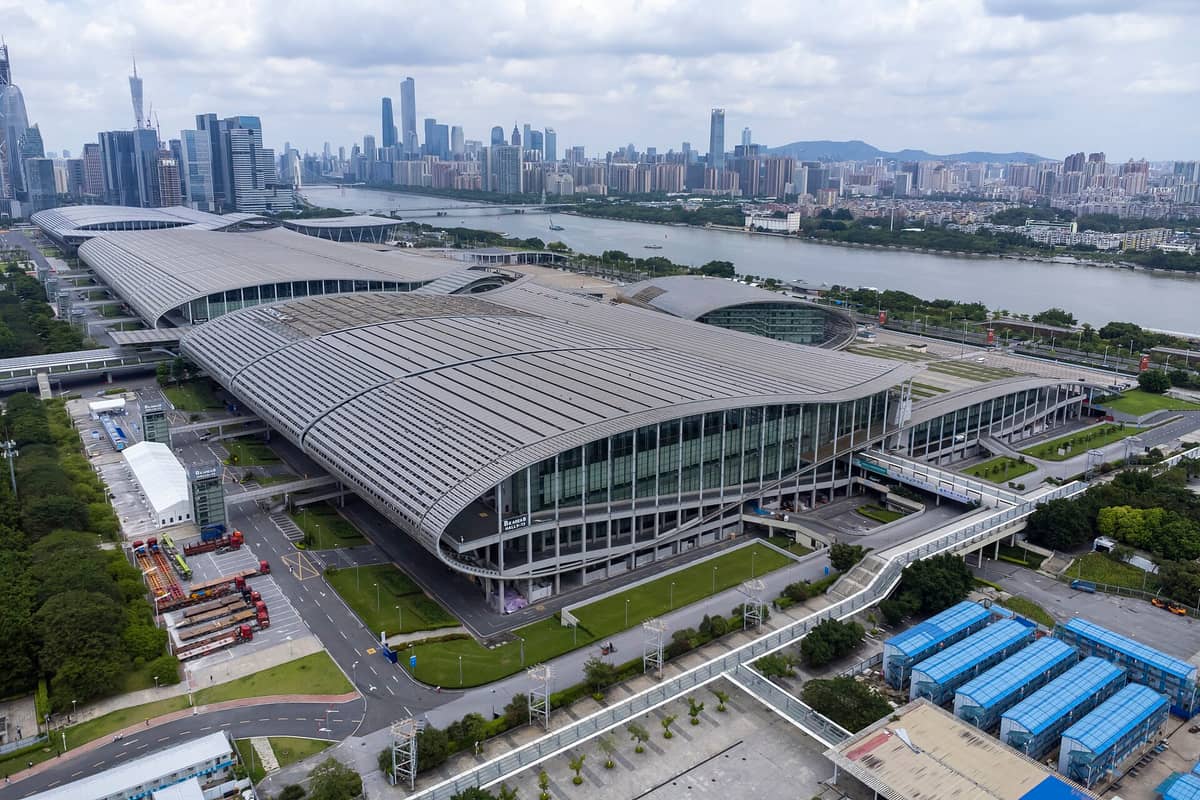
What the Canton Fair Complex Actually Is
The Canton Fair Complex, officially the China Import and Export Fair Complex (中国进出口商品交易会展馆), is one of the largest modernized exhibition centers in the world. Located on Pazhou Island in Haizhu District, the complex spans a large footprint of interconnected halls, sky bridges, and outdoor plazas.
The complex serves primarily as the home of the Canton Fair (China Import and Export Fair), which has been held since 1957, making it one of the longest-running trade fairs in China. The fair now runs twice a year, typically in April and October, and draws hundreds of thousands of international buyers and exhibitors across its three phases. Outside of those windows, the facility hosts a rotating calendar of industry-specific expos covering everything from automotive parts to beauty products to electronics.
ℹ️ Good to know
The Canton Fair is not open to the general public. Attendance requires prior registration as a buyer or exhibitor. If you are visiting Guangzhou as a leisure traveler, you can still walk the Pazhou Island area and appreciate the complex from the exterior, but plan your visit around whether a fair or expo is in session — it significantly changes the energy of the entire island.
The Architecture and Scale
The complex is divided into three main areas: Area A, Area B, and Area C. Area A, the original and most iconic section, faces the Pearl River. Area B and Area C are connected via covered walkways and expand the complex considerably to the south and east.
The architecture is unapologetically utilitarian at its core — this is a facility engineered for logistics, crowd flow, and the movement of goods — but it achieves a kind of grandeur through repetition and scale. The rooflines of Area A in particular have a wave-like rhythm that reads as deliberate from a distance. For anyone interested in large-scale civic and commercial architecture in China, the complex rewards attention.
The surrounding Pazhou Island has developed considerably around the complex, with hotels, restaurants, and a riverside promenade that runs along the Pearl River. The island sits directly south of the main Haizhu riverfront, and the views back across the water toward Canton Tower are genuinely worth seeking out. For more context on the river geography, the Guangzhou Pearl River guide explains how the Pearl River corridor connects Pazhou to the broader city.
How the Experience Changes by Season and Time of Day
During the Canton Fair's April and October sessions, Pazhou Island transforms entirely. The metro stations become some of the busiest in the city, queues form well before the gates open in the morning, and the surrounding streets fill with the characteristic sound of rolling suitcases and the polyglot mix of negotiations in Cantonese, Mandarin, Arabic, English, and a dozen other languages. Hotel rates in Haizhu and across the city spike sharply during these weeks. The atmosphere is genuinely singular — it is one of the few places in the world where global wholesale trade happens in person at this density.
Outside of fair season, the complex operates on a quieter rhythm tied to whatever industry expo or event is currently scheduled. Some months have back-to-back events; others are relatively calm. During quieter periods, the exterior plazas are walkable and the surrounding island is considerably more relaxed. Early mornings on the riverfront side of the complex, before the heat of the day sets in, offer a different view of the building against the river and the Guangzhou skyline to the north.
Weather is a real factor here. The fair's April session falls during Guangzhou's wetter spring period, when afternoon downpours are common. The October session catches the tail end of typhoon season but typically benefits from drier, more comfortable weather. If you are attending as a trade buyer, the October dates generally offer more pleasant outdoor conditions for the walks between areas. Bring comfortable, flat-soled shoes regardless — the distances between halls are not trivial.
💡 Local tip
If you are visiting Guangzhou during fair season for leisure, not trade, book accommodation as early as possible and expect elevated prices across the city. Even hotels far from Pazhou see occupancy spikes. For timing your leisure trip to avoid the crowds and expense, check the Canton Fair's official schedule at cantonfair.org.cn.
History: Sixty-Plus Years of Uninterrupted Trade
The Canton Fair's origins in 1957 connect directly to Guangzhou's long history as a major trading port. The city has been a trading center for well over a thousand years, and the fair was established in the early years of the People's Republic to support foreign trade at a time when China had limited diplomatic relationships with much of the world. Guangzhou, with its deep-water access and established merchant culture, was the natural home.
The complex itself on Pazhou Island is a later development — earlier editions of the fair were held at other Guangzhou venues, including the Liuhua Complex further north. The Pazhou site was developed to accommodate the fair's massive growth in the reform era, as China's manufacturing export economy expanded through the 1980s and 1990s. By the time the current complex reached its current scale, it had become not just a trade venue but an emblem of Guangzhou's role as the engine room of Chinese manufacturing exports.
That longer commercial history of Guangzhou is legible in the older parts of the city too. The wholesale district culture around Yide Road and the ancient port at Huangpu Ancient Port both reflect centuries of the same mercantile instinct that the Canton Fair now expresses at global scale.
Getting There and Getting Around the Complex
The Guangzhou Metro Line 8 provides direct access to the complex. Xingangdong Station is the closer stop for Area A, while Pazhou Station is convenient for Areas B and C. During the Canton Fair, shuttle buses also run between areas, and the complex operates its own internal transport connections. Outside of fair season, the walk between areas along the riverfront road is manageable and actually pleasant in mild weather.
Taxis and ride-hailing via DiDi can drop you directly at the main entrance, but during the fair's peak arrival times in the morning, road congestion around the island is severe enough that the metro is the faster and more predictable option. The metro also connects directly to Guangzhou South Railway Station and other main interchange points, making it straightforward to combine a visit here with other parts of the city.
For a broader overview of how to move around the city efficiently, the getting around Guangzhou guide covers metro lines, bus networks, and ride-hailing in more detail.
⚠️ What to skip
Do not assume you can simply walk in and explore the exhibition halls. During the Canton Fair, access requires a valid buyer or exhibitor badge. Security checks at the entrances are thorough. If you arrive without registration credentials during an active fair, you will not be admitted past the outer plaza.
Visiting the Surrounding Pazhou Island Area
Even if you have no trade business at the complex, Pazhou Island rewards a visit for its waterfront setting. The Pearl River-facing side of the island has a pedestrian riverside area with clear sightlines to Canton Tower to the northwest and the Guangzhou skyline to the north. The best light for photography is in the late afternoon, when the sun drops toward the west and catches both the complex's facade and the tower across the water.
The island's restaurant and hotel cluster, which developed in parallel with the complex, is dense with Cantonese restaurants and a scattering of international options. Lunch near Pazhou during a fair event can feel chaotic, with every seat taken by noon. Off-season, it is considerably more relaxed. The nearby Pazhou Pagoda is a historically significant site on the island worth combining with a visit, particularly if you are interested in seeing older Guangzhou alongside the modern exhibition infrastructure.
Haizhu District as a whole is underappreciated by leisure travelers who tend to gravitate toward Yuexiu or Tianhe. Pazhou is on the eastern edge of Haizhu, and the district extends westward along the river toward areas with a more residential, everyday character. If you have more time, the district makes for an interesting contrast between Guangzhou's industrial-scale commercial identity and its quieter neighborhood life.
Who This Attraction Is For — and Who Should Skip It
The Canton Fair Complex is among the most important commercial sites in the world by the volume of trade it processes. If that context interests you — whether for professional reasons, historical curiosity, or an interest in how global supply chains physically manifest — the complex is a genuinely remarkable place to experience in person, particularly during a live fair session.
For travelers with no trade interest and limited time in Guangzhou, the complex is a lower priority than the city's cultural, culinary, and historical sites. The exhibition halls themselves are not designed for general visitors, and the experience outside of an active fair is essentially an architectural walk. Those travelers would be better served by the Chen Clan Ancestral Hall or exploring the full range of things to do in Guangzhou before committing a half-day to Pazhou.
Children will find little to engage with here. The complex is built for adults moving quickly between booths, not for leisure exploration. Families with young children should plan their Haizhu time elsewhere.
Insider Tips
- The Canton Fair runs in three phases across roughly two weeks per session, with different product categories in each phase. Check the official schedule at cantonfair.org.cn before booking travel — attending the phase that aligns with your industry is essential, since many exhibitors are only present for their designated phase.
- If you are attending as a buyer, register online well in advance. On-site registration during the fair is possible but involves longer queues, and badge processing on peak first-day mornings can add an hour to your entry time.
- The Pazhou riverside walkway between Area A's northern face and the Pearl River is accessible to the public regardless of whether a fair is in session. It offers some of the clearest views of Canton Tower from the south bank and is largely uncrowded on weekday mornings outside fair season.
- Accommodation on Pazhou Island itself, including the Shangri-La Guangzhou, is the most convenient base during the fair but sells out months in advance for popular phases. If you cannot secure island accommodation, any hotel within walking distance of a Line 8 metro station gives reliable access without the street-level congestion.
- The complex's food court and surrounding restaurants are overwhelmed at peak lunch hours during the fair. Eat before 11:30 or after 13:30 to avoid the worst of it, or bring food in, as outside food is generally permitted in common areas.
Who Is Canton Fair Complex (Pazhou) For?
- International trade buyers and sourcing professionals attending the Canton Fair
- Business travelers wanting to understand Guangzhou's role in global manufacturing
- Architecture and urban planning enthusiasts interested in large-scale exhibition infrastructure
- Travelers visiting Guangzhou during fair season who want to understand what drives the city's hospitality economy
- Anyone curious about the Pazhou Island waterfront and its Pearl River views
Nearby Attractions
Other things to see while in Haizhu:
- Guangzhou Museum of Art
The Guangzhou Museum of Art (广州艺术博物院) is Guangdong's premier public art institution, offering free admission to rotating and permanent collections spanning classical Chinese painting, Lingnan art, and contemporary works. Relocated to a striking new venue in Liwan, it rewards both serious art lovers and casual visitors with enough depth to fill two to three hours.
- Haizhu Wetland Park
Guangzhou Haizhu National Wetland Park is one of the largest urban wetlands in China, covering roughly 1,100 hectares of canals, fruit orchards, and reed beds in Haizhu District. Recognized as a Ramsar site in 2022 and listed on the IUCN Green List, it offers a genuine break from the city without leaving it.
- Huangpu Ancient Port
Huangpu Ancient Port (黄埔古港) in Haizhu District is where Guangzhou's centuries-long role as a global trading hub left its clearest mark. This free, open-access historic site in Shiji Village preserves the atmosphere of a historic port settlement, from ancestral halls to riverside stone quays.
- Pazhou Pagoda
Rising above the rooftops of Pazhou Village in Haizhu District, Pazhou Pagoda is one of Guangzhou's oldest standing structures, built between 1597 and 1600 during the Ming dynasty. It served as a navigational landmark for ships entering the Pearl River, and today it remains a quiet, largely overlooked counterpoint to the glass towers of the nearby Canton Fair complex.