Guangzhou Opera House: Inside Zaha Hadid's River-Stone Icon
Opened in May 2010 and designed by the late Zaha Hadid, the Guangzhou Opera House is one of the most architecturally significant buildings in southern China. Set along the Pearl River in Zhujiang New Town, its fluid twin-boulder forms are as striking from the outside as the interiors are from within.
Quick Facts
- Location
- Huajiu Road, Zhujiang New Town, Tianhe District, Guangzhou
- Getting There
- Metro Line 3 or Line 5 to Zhujiang New Town Station, Exit B1 (approx. 100 m south)
- Time Needed
- 1–2 hours for the exterior and public areas; allow a full evening for a performance
- Cost
- Free to visit exterior; public interior tours available Sat, Sun, and national holidays 9:30–16:30 (advance booking required for groups of fewer than 10); performance ticket prices vary by event
- Best for
- Architecture enthusiasts, performing arts visitors, evening walkers along the Pearl River
- Official website
- en.gzdjy.org
What the Guangzhou Opera House Actually Is
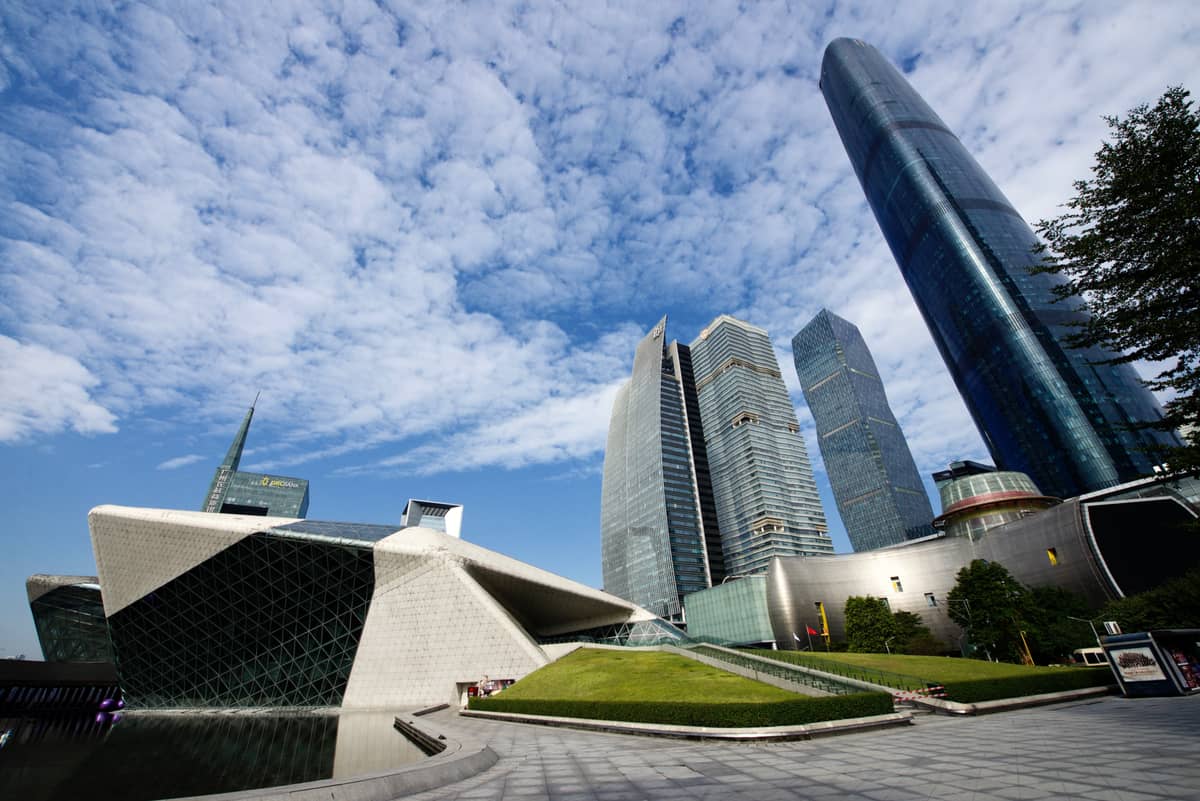
The Guangzhou Opera House (广州大剧院) is a world-class performing arts venue that opened on 9 May 2010 in the Zhujiang New Town district of Tianhe. Designed by the Iraqi-British architect Zaha Hadid, the building is composed of two asymmetrical, boulder-like forms that appear to have been deposited on the Pearl River bank by some geological force rather than constructed by human hands. The larger volume houses the Grand Theater, seating approximately 1,800 people; the smaller contains a multi-function hall.
Hadid described the concept as inspired by the way rivers shape stones over millennia, and the metaphor is legible in every curved surface. The building is clad in granite and glass panels cut at acute angles, creating a skin that shifts from grey to pale gold depending on the light. It is not a decoration added to Zhujiang New Town's skyline; it is a load-bearing argument for what civic architecture can do.
ℹ️ Good to know
Public interior visits are only available on Saturdays, Sundays, and national holidays between 9:30 and 16:30. Groups of fewer than 10 people should book one day in advance. Weekdays are reserved for group bookings of at least 10 people.
The Architecture: What to Look For
Walking toward the building from Zhujiang New Town Metro Station, you pass through a broad public plaza that gives the two main forms space to breathe. From the northeast approach, the larger auditorium appears almost monolithic; from the west, the angular cuts of the granite panels become visible, and the building feels more like a fractured landscape than a box. This is deliberate. Hadid's team used parametric design tools to generate thousands of individually sized cladding panels, each fitted precisely to the compound-curved shell structure underneath.
The interior of the Grand Theater foyer continues the logic: curved ramps replace staircases, and the ceiling sweeps down to meet the floor with no obvious seam. The acoustic shell inside the main hall is a warm amber wood that contrasts sharply with the raw-concrete exterior impression. Balconies cantilever without visible supports. If you attend a performance, arrive 30 minutes early specifically to sit in the foyer and watch the space fill with people.
The building sits within a cluster of landmark structures that define Guangzhou's 21st-century civic ambitions. The Guangdong Museum is directly adjacent, and the Canton Tower is visible to the southwest across the river. Taken together, this axis of new construction represents one of the most concentrated displays of signature architecture in China outside of Beijing and Shanghai.
How the Experience Changes by Time of Day
Arriving in the morning on a weekend, the plaza is quiet and the light is flat. This is actually the best time to photograph the building's texture: the low-angle sun catches the beveled panel edges and creates long shadows that emphasize the geometry. The granite surface, which looks uniformly grey in overcast conditions, reveals fine veining and color variation in direct sunlight.
By mid-afternoon on weekends, small crowds of architecture students, tourists, and families appear. The interior foyer is open for public visits and the scale of the space becomes more legible when there are people to provide reference. The staff at the entry desks speak Mandarin; English signage is present but limited, so having a translation app ready is useful.
The evening transformation is the most dramatic. From around 7:00 pm onward, the building's exterior lighting system activates, casting warm uplight across the stone panels while the glazed sections glow amber from the interior. The Pearl River walkway to the south fills with local residents out for an evening stroll, and the reflection of the lit building in the river is one of the better photography compositions in the city. Performance nights add another layer: formally dressed concertgoers arriving by taxi, the foyer visible through the glass at full occupancy, the muffled sound of an orchestra tuning.
💡 Local tip
For the best exterior photography, visit on a clear evening between 7:30 and 9:00 pm when both the building's lighting and the ambient sky light are active. The western facade reflecting in any standing water after rain produces particularly striking results.
Attending a Performance: What to Know
The Guangzhou Opera House programs a genuine international calendar: international orchestras, ballet companies, opera productions, and Chinese classical music alongside spoken word and contemporary dance. The programming is not aimed primarily at tourists, which is actually a recommendation. You are more likely to be surrounded by Guangzhou residents who use this venue regularly than by a guided tour group.
Ticket prices vary substantially by event and seat category. Purchasing directly through the official website (gzdjy.org) is the most reliable method; third-party ticketing platforms are also widely used in China and often have Chinese-language interfaces. It is worth checking the schedule several weeks in advance if a specific production is a priority, as international touring shows sell out quickly.
Dress code is smart-casual at minimum for evening performances. The air conditioning inside is aggressive, as is common in Guangzhou public buildings during summer, so a light layer is advisable regardless of the outdoor temperature. Late entry is generally not permitted once a performance has begun.
Getting There and Getting Around the Area
The most direct route is Metro Line 3 or Line 5 to Zhujiang New Town Station, Exit B1. From the exit, the opera house is approximately 100 meters south, visible immediately. The walk takes under two minutes.
Zhujiang New Town is covered in detail in the Zhujiang New Town neighborhood guide, which includes the broader layout of the civic plaza, riverside walking routes, and dining options in the surrounding towers. The area is walkable and well-lit at night, making it a natural extension of a Pearl River evening walk.
For context on how the opera house fits into Guangzhou's architectural story more broadly, the Guangzhou architecture guide covers the full range from historic colonial structures in Shamian to the Zhujiang New Town cluster.
Practical Assessment: Who This Is and Isn't For
If architecture holds no interest for you and you are not attending a performance, the Guangzhou Opera House is a 20-minute exterior stop, not a destination. The surrounding plaza is pleasant but not experiential on its own. Travelers focused on Cantonese cultural heritage, food, or historic neighborhoods will find more immediate reward elsewhere.
Visitors interested specifically in Cantonese performing arts traditions may find the Cantonese Opera Art Museum in Liwan District more directly relevant, as it focuses on the historical and craft dimensions of the regional art form rather than contemporary international programming.
For architecture enthusiasts, design students, and anyone with a genuine interest in how parametric construction was applied at civic scale, this building rewards close attention. The interior, when accessible, is one of the most spatially coherent examples of non-rectilinear public architecture in Asia.
⚠️ What to skip
Interior access on weekdays is restricted to pre-booked groups of at least 10 people. Solo travelers and small groups should plan visits for weekends or national holidays only, and confirm hours in advance as schedules can change around performances and special events.
Practical Notes: Weather, Accessibility, and Photography
Guangzhou's rainy season runs roughly from April to September, with the heaviest rainfall concentrated in late spring and summer. The open plaza around the opera house has limited shelter, so rain gear is worth carrying between June and August. That said, light rain actually improves the texture photography: wet granite panels become more reflective and the angular geometry reads more clearly.
No verified official accessibility details were available at the time of writing. The building's exterior plaza is level and paved. Given the curved interior geometry and the building's design priorities, visitors with specific mobility requirements should contact the venue directly via gzdjy.org before visiting.
Photography of the exterior is unrestricted. Interior photography policies vary by event; check with staff on arrival. For context on viewpoints across Zhujiang New Town more broadly, the best views in Guangzhou guide includes the Pearl River waterfront angle that captures both the opera house and the Canton Tower in a single frame.
Insider Tips
- The northwest corner of the adjacent Guangdong Museum plaza gives you an elevated angle on the opera house's roofline that most visitors miss. From street level the building reads as two boulders; from slightly above, the full compound curve of the larger form becomes visible.
- Check the opera house's WeChat official account (search 广州大剧院) for last-minute ticket availability and schedule updates. Some productions add shows or release returned tickets within 48 hours of the performance.
- The pedestrian walkway running south of the building along the Pearl River is best after 8:00 pm on clear nights, when the building's exterior lighting is fully active and the river traffic has thinned. This stretch is much quieter than the Haizhu riverfront further west.
- The foyer's curved ramp system connects multiple levels without stairs. If you are visiting for the architecture rather than a performance, ask at the box office whether the upper foyer levels are open on that day, as the view back down the main atrium is substantially more revealing than the ground-floor entry perspective.
- Weekday mornings are the only time the exterior plaza is genuinely empty. If clean architectural photography without people in frame is the goal, arriving before 9:00 am on a Tuesday or Wednesday is the practical solution.
Who Is Guangzhou Opera House For?
- Architecture and design enthusiasts wanting close-up access to a Zaha Hadid public building
- Performing arts visitors seeking international-caliber opera, ballet, and orchestral programming
- Photographers targeting Guangzhou's nighttime skyline and Pearl River reflections
- Travelers combining a Zhujiang New Town cultural walk with the nearby Guangdong Museum
- Evening walkers looking for a landmark anchor point along the Pearl River waterfront
Nearby Attractions
Other things to see while in Zhujiang New Town:
- Canton Tower
At 600 metres, Canton Tower is the defining feature of Guangzhou's modern skyline. From its observation decks and sky walk, it offers sweeping views over the Pearl River and Zhujiang New Town. This guide covers everything you need to plan a visit, from ticket tiers to the best hour to arrive.
- Guangdong Museum
The Guangdong Museum is Guangzhou's flagship public museum, housed in a striking contemporary building in Zhujiang New Town. Admission is free, but advance booking is required. Expect broad collections covering Guangdong's natural history, fine arts, and deep trading heritage.